Schedule paper and packaging conversion around reel widths and approved jobs
For production managers, planners and plant leaders · Compare approaches
TL;DR — what you’ll learn
- Combining converting jobs on a jumbo parent reel solely to minimize side-trim waste often pairs an urgent dispatch order with a speculative stock order—or worse, releases a lane whose customer artwork revision is still unapproved.
- Gate every slitting and converting schedule on four hard constraints before calculating trim efficiency: identical substrate grade/grammage (GSM), active customer-approved specification and artwork revision, compatible run length (linear metres), and customer delivery due date.
- Account for every millimetre and kilogram of the parent jumbo reel across slit daughter rolls, reusable butt/side reels above the minimum restock width, and baled edge-trim waste.
- In an illustrative 1,600 mm × 10,000 m (1,280.0 kg at 80 GSM) bleached kraft parent reel schedule (REEL-BK80-2026-309), rejecting a 99.38% width-utilisation pattern (10 mm trim) that includes an unapproved artwork revision (JOB-C, Art-Rev2 pending) in favor of an approved-only pattern (1,540 mm slit width, 60 mm trim = 3.75% waste) prevents 256.0 kg (Rs 28,672.00) of obsolete printed scrap and delivers both due orders on time.

Illustrative manufacturing inspection room and machine shop floor; not a client facility.
In paper, film, foil, and flexible-packaging converting plants, planners schedule slitter-rewinders, rotogravure/flexo presses, and sheeting lines by cutting narrow customer lanes out of wide parent jumbo reels. Because edge trim is a visible material loss, trim-optimisation spreadsheets frequently pair any combination of open orders whose widths sum close to the parent reel width. When that width pairing ignores specification and artwork approval status, substrate lot compatibility, or order due dates, the plant achieves low edge trim at the cost of printing an entire lane onto an obsolete artwork revision or delaying an urgent shipment while setting up a low-priority filler lane.
Three ways pure trim-minimisation breaks packaging conversion schedules
Standard ERP finite-capacity scheduling engines—such as Microsoft Dynamics 365 finite capacity planning—allocate work-centre time slots, while engineering change systems—such as Microsoft Dynamics 365 engineering change management—control active product revisions. In converting operations, those two decisions intersect directly on the slitter or press arbor:
- Unapproved or superseded artwork enters a shared multi-lane run: When a planner needs a
320 mmfiller lane to fill out a1,600 mmjumbo reel alongside two approved jobs, pulling in a repeat order whose customer has requested a nutritional-panel or barcode revision (Artwork_Status = Pending_Customer_Proof) turns20.00%of the entire jumbo reel into non-dispatchable scrap. - Mismatched linear run lengths create orphan butt reels or over-makes: All lanes mounted together on a slitter-rewinder must run the same linear length (
metres) between knife changes. Pairing a10,000 murgent order with a4,000 mfiller order either forces an extra mid-reel knife setup (45 minutesof line downtime) or over-produces6,000 mof unrequested stock on the filler lane. - Unreconciled reel mass hides core damage and side-trim losses: Parent reels are purchased by weight (
kg) at a nominal grammage (g/m²orGSM), converted by linear length (m) and width (mm), and sold by roll count or linear metres. Without reconciling parent reel mass against daughter-roll weights, reusable side-reel remnants, and baled trim using traced roll IDs—as supported by GS1 Global Traceability Standard transformation linkage—reels lose lot traceability and inventory balances drift.
Four-gate scheduling model for reel slitting and conversion
To balance trim efficiency against specification compliance and on-time delivery, the converting schedule must evaluate candidate orders through four sequential gates before releasing a slitting pattern to the floor:
- Gate 1 — Hard specification and artwork eligibility: Only jobs with
Specification_State = ReleasedandArtwork_Revision = Customer_Approved_Activemay enter the candidate pool. Any job under engineering change hold (ECN_Hold) or awaiting proof sign-off is excluded from trim pairing, regardless of how well its width fits. - Gate 2 — Substrate grade, caliper, and surface-treatment match: Candidate lanes must share the exact approved parent substrate code (for example,
80 GSM MG Bleached Kraft, Corona Treated ≥ 38 dynes/cm, with applicable food-contact or industrial barrier certification verified in the quality release record). - Gate 3 — Linear run-length and knife-change alignment: Group eligible lanes into uniform linear-metre pulls (such as
10,000 mper parent reel) so knife resets occur at natural parent-reel or splice boundaries. - Gate 4 — Total cost and delivery evaluation of slit patterns: Compare candidate knife patterns across:
- Minimum required edge trim (
≥ 10 mmtotal—5 mmper side—for clean web edge guiding, an illustrative machine parameter subject to slitter OEM specification). - Reusable side-reel threshold (for example, any unprinted side cut
≥ 250 mmwide is rewound as a labelled remnant reel into stock; cutsbelow 250 mmare chopped into pneumatic trim waste). - Total run economics:
Net_Trim_Cost + Knife_Setup_Cost + Late_Delivery_Risk + Unapproved_Scrap_Exposure.
- Minimum required edge trim (
Filter candidate packaging jobs by approved artwork before optimising reel trim
Follow the workflow below, or open its complete text version.
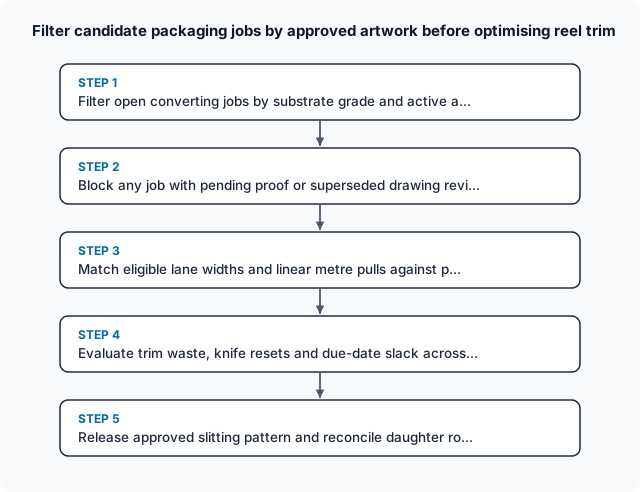
Read the complete workflow as text
- Filter open converting jobs by substrate grade and active a... → Block any job with pending proof or superseded drawing revi...
- Block any job with pending proof or superseded drawing revi... → Match eligible lane widths and linear metre pulls against p...
- Match eligible lane widths and linear metre pulls against p... → Evaluate trim waste, knife resets and due-date slack across...
- Evaluate trim waste, knife resets and due-date slack across... → Release approved slitting pattern and reconcile daughter ro...
Worked example: 1,600 mm bleached kraft parent reel (REEL-BK80-2026-309)
Consider an illustrative scheduling decision at an industrial paper and laminated-packaging converter running Slitter-Printer Line SLP-02. All dimensions, weights, grammages, and rupee values below are synthetic operational data created to verify converting schedule arithmetic.
Parent jumbo reel and cost parameters
- Parent Reel ID:
REEL-BK80-2026-309(80 GSMMG Bleached Kraft, widthW_parent = 1,600 mm = 1.600 m, lengthL = 10,000 m). - Parent reel area and mass:
1.600 m × 10,000 m = 16,000 m²; at80 g/m²(0.080 kg/m²), net paper mass =16,000 × 0.080 = 1,280.0 kg. - Substrate cost and trim salvage value: Purchased substrate cost =
Rs 92.00/kg(Rs 1,17,760.00for1,280.0 kg); pneumatic baled paper trim recovery value =Rs 14.00/kg(net cost of trim waste =Rs 92.00 − Rs 14.00 = Rs 78.00/kg).Converted printed roll value (substrate + ink/varnish + machine conversion) =Rs 112.00/kg.
Open order candidates for 80 GSM MG Bleached Kraft (10,000 m pull)
JOB-A(Priority Due Day 1, CustomerCust-104): Requires2 lanes × 450 mm = 900 mmwidth ×10,000 m(720.0 kg). ArtworkART-A-Rev4= Approved & Active.JOB-B(Priority Due Day 2, CustomerCust-119): Requires2 lanes × 320 mm = 640 mmwidth ×10,000 m(512.0 kg). ArtworkART-B-Rev2= Approved & Active.JOB-C(Due Day 9, CustomerCust-205): Requires1 lane × 370 mmwidth ×10,000 m(296.0 kg). Exception: Customer notified sales yesterday of a mandatory hazard-pictogram change (ECN-2026-88);ART-C-Rev1is Superseded andART-C-Rev2proof is Pending Customer Approval.
Comparing Pattern 1 (Naive Trim-Minimising) vs Pattern 2 (Artwork-Gated)
- Pattern 1 (Naive Trim-Chasing Pattern —
1,590 mmactive web,10 mmtrim): To chase a99.375%width utilisation (10 mmtrim), the spreadsheet holds back one320 mmlane ofJOB-Bto a future reel and mountsJOB-A (2 × 450 mm = 900 mm) + JOB-B (1 × 320 mm = 320 mm) + JOB-C (1 × 370 mm = 370 mm) = 1,590 mmactive web, leaving10 mm(0.625%,8.0 kg) of edge trim.- Operational failure 1 (Delivery split and extra setup):
JOB-Breceives only1 of 2 required lanes(256.0 kginstead of512.0 kg), missing tomorrow morning's full-order dispatch and forcing an extra slitter-press setup (Rs 4,500.00setup cost) on a second reel. - Operational failure 2 (Obsolete artwork scrap):
JOB-C(370 mm × 10,000 m = 296.0 kg) is printed with supersededART-C-Rev1, turning296.0 kg(23.125%of the parent reel) into non-dispatchable printed scrap (296.0 kg × [Rs 112.00 − Rs 14.00 salvage] = Rs 29,008.00net scrap loss).
- Operational failure 1 (Delivery split and extra setup):
- Pattern 2 (Artwork- and Due-Date-Gated Pattern —
1,540 mmactive web,60 mmtrim): Gate 1 blocksJOB-C(ECN-2026-88hold) and schedules both urgent approved orders in full:JOB-A (2 × 450 mm = 900 mm, 720.0 kg) + JOB-B (2 × 320 mm = 640 mm, 512.0 kg) = 1,540 mmactive web (1,232.0 kggood approved output,96.25%of parent reel), with60 mm(30 mmper side,3.75%=48.0 kg) clean edge trim routed to pneumatic baling (48.0 kg × Rs 78.00/kg net trim cost = Rs 3,744.00).
The table below reconciles both slitting patterns across width, mass (kg), specification compliance, and total financial outcome:
Scroll horizontally to see all columns.
| Schedule / mass-balance metric | Pattern 1: Naive trim-chasing (1,590 mm web) |
Pattern 2: Artwork- and due-date-gated (1,540 mm web) |
Variance (Pattern 2 vs Pattern 1) | Operational and quality verification |
|---|---|---|---|---|
Parent jumbo reel input (REEL-BK80-2026-309) |
1,600 mm × 10,000 m (1,280.0 kg) |
1,600 mm × 10,000 m (1,280.0 kg) |
0.0 kg | 1.600 m × 10,000 m × 0.080 kg/m² = 1,280.0 kg |
Lane group 1: JOB-A (2 × 450 mm, Approved) |
900 mm (720.0 kg, all JOB-A) |
900 mm (720.0 kg, all JOB-A) |
0.0 kg | Released under ART-A-Rev4; ships on time |
Lane group 2: JOB-B (320 mm lanes, Approved) |
1 lane = 320 mm (256.0 kg, 50% short) |
2 lanes = 640 mm (512.0 kg, all JOB-B) |
+256.0 kg good JOB-B |
Pattern 2 completes JOB-B in one setup |
Lane group 3: JOB-C (1 × 370 mm, ECN-2026-88 Hold) |
370 mm (296.0 kg printed on obsolete Rev1) |
0 mm (blocked by Gate 1 artwork check) | -296.0 kg obsolete scrap | Gate 1 blocks JOB-C until ART-C-Rev2 is signed |
Nominal slit web width & paper trim (mm & kg) |
1,590 mm web / 10 mm trim (8.0 kg, 0.625%) |
1,540 mm web / 60 mm trim (48.0 kg, 3.75%) |
+40.0 kg edge trim | 720.0 + 512.0 + 48.0 = 1,280.0 kg closed |
Dispatchable approved output (kg & % of reel) |
976.0 kg (76.25% net usable) | 1,232.0 kg (96.25% net usable) | +256.0 kg (+20.00 pts) | Pattern 1 loses 296.0 kg (23.125%) to Rev1 scrap |
Net cost of edge trim at Rs 78.00/kg (Rs) |
Rs 624.00 (8.0 kg × Rs 78.00) |
Rs 3,744.00 (48.0 kg × Rs 78.00) |
+Rs 3,120.00 trim cost | Accounts for Rs 14.00/kg baled trim credit |
Net cost of obsolete printed scrap at Rs 98.00/kg (Rs) |
Rs 29,008.00 (296.0 kg × [Rs 112 − Rs 14]) |
Rs 0.00 | -Rs 29,008.00 scrap saved | Printed scrap (Rs 112/kg) less Rs 14/kg salvage |
Extra slitter-press setup for split JOB-B (Rs) |
Rs 4,500.00 (1 extra setup + late shipment) | Rs 0.00 | -Rs 4,500.00 setup saved | Avoids splitting JOB-B across two parent reels |
| Total waste & exception cost on reel (Rs) | Rs 34,132.00 | Rs 3,744.00 | -Rs 30,388.00 net saving | Approved-only schedule saves Rs 30,388.00 |
Arithmetic verification of mass and cost balances
- Mass balance of Pattern 1:
720.0 kg (JOB-A) + 256.0 kg (JOB-B partial) + 296.0 kg (JOB-C obsolete scrap) + 8.0 kg (edge trim) = 1,280.0 kg(76.25%good output,23.75%combined trim and obsolete scrap). - Mass balance of Pattern 2:
720.0 kg (JOB-A) + 512.0 kg (JOB-B complete) + 48.0 kg (edge trim) = 1,280.0 kg(96.25%good output,3.75%edge trim,0.0 kgobsolete scrap). - Cost comparison:
- Pattern 1 total exception and waste cost:
Rs 624.00 (trim) + Rs 29,008.00 (obsolete JOB-C scrap) + Rs 4,500.00 (split JOB-B setup) = Rs 34,132.00. - Pattern 2 total exception and waste cost:
Rs 3,744.00 (trim) + Rs 0.00 (obsolete scrap) + Rs 0.00 (split setup) = Rs 3,744.00. - Net operational advantage of enforcing Gate 1 artwork eligibility:
Rs 34,132.00 − Rs 3,744.00 = Rs 30,388.00on a single jumbo reel.
- Pattern 1 total exception and waste cost:
Roles, approval authorities, and exception handling
Scroll horizontally to see all columns.
| Scheduling / execution gate | Accountable owner | Required system record and evidence | Exception rule and boundary |
|---|---|---|---|
Artwork & specification release (Gate 1) |
Packaging quality & pre-press owner | Customer proof sign-off and active Artwork_Revision_ID linked to item master and print cylinder/plate ID |
Any open ECN or pending proof automatically locks the job from slitter/press pattern selection |
Parent reel allocation & GSM check (Gate 2) |
Packaging production planner | Parent Reel_ID with verified width (mm), length (m), grammage (GSM), and QC release status |
Substituting a different GSM or substrate grade requires documented engineering and customer concession |
| Slitting knife & cylinder verification | Line supervisor & in-process QC | Pre-start line clearance verifying mounted print cylinders/plates and knife spacing against released job ticket | Mismatched cylinder revision or lane width blocks line run authorization |
| Daughter roll & trim mass reconciliation | Slitter operator & stores | Weighed daughter-roll labels (Roll_ID linked to Parent_Reel_ID), butt-reel restock ticket, and baled trim weight |
Parent reel cannot close with >1.00% unexplained weight difference between parent mass and daughter + trim mass |
Acceptance tests for packaging reel scheduling and specification controls
Scroll horizontally to see all columns.
| Test ID | Scenario seeded in test environment | Expected system behavior | Pass/fail verification evidence |
|---|---|---|---|
ACT-M034-01 |
Attempt to add JOB-C (ECN-2026-88 pending proof) into a slitting pattern on REEL-BK80-2026-309 |
System blocks JOB-C at Gate 1 with Artwork_Revision_Not_Approved before trim optimisation runs |
JOB-C cannot be assigned to a slitter arbor or press lane |
ACT-M034-02 |
Attempt to pair an 80 GSM bleached kraft job with a 70 GSM natural kraft job on the same parent reel |
System rejects the combination at Gate 2 due to Substrate_Grade_Mismatch |
Multi-lane pattern requires identical parent substrate code |
ACT-M034-03 |
Release Pattern 2 (2 × 450 mm + 2 × 320 mm on 1,600 mm reel) and record daughter roll outputs |
System generates 4 traced daughter roll IDs totaling 1,232.0 kg (1,540 mm) and expects 48.0 kg (60 mm) trim |
Daughter rolls inherit REEL-BK80-2026-309 lot genealogy and exact approved artwork revision |
ACT-M034-04 |
Operator mounts print cylinder ART-A-Rev3 instead of active ART-A-Rev4 during pre-start barcode scan |
System fails pre-run line clearance and blocks job start | Error Superseded_Tooling_Revision_Detected logged on terminal |
ACT-M034-05 |
Close REEL-BK80-2026-309 with 1,232.0 kg daughter rolls, 0.0 kg butt reel, and 48.0 kg weighed trim |
System reconciles 1,232.0 + 48.0 = 1,280.0 kg (0.0 kg unexplained variance) and updates parent reel to Consumed |
Inventory and cost ledger balance to Rs 0.00 unexplained variance |
Summary and next actions
Converting schedules protect both material margin and delivery commitments only when trim optimisation operates strictly inside approved substrate, artwork, and due-date boundaries. Accepting a slightly wider clean edge trim on an approved-only reel pattern is far cheaper than printing a low-trim filler lane onto an obsolete customer artwork revision.
- Configure your converting scheduling queue to exclude any job whose artwork revision, print cylinder/plate, or customer specification is under engineering change hold or awaiting proof approval.
- Group eligible converting jobs by exact parent substrate code, linear run length (
metres), and delivery due-date window before running width-combination trim calculations. - Require barcode verification of parent reel ID, knife width settings, and print cylinder/plate revision during pre-start line clearance on every slitter and press run.
- Reconcile every consumed parent jumbo reel across weighed daughter rolls, restocked butt/side reels, and baled edge trim so roll-to-roll mass balance and lot genealogy remain complete.
Compare this workflow with your current setup
Share the step that takes the most manual work, the systems involved and the exceptions your team handles. That gives us a concrete starting point for comparing approaches.
Sources and further reading
Sources checked 15 October 2026. Worked examples and workflow diagrams are original illustrations, not reported client results.


