Electroplating and coating line records: link bath titrations, amp-hour dosing, and DFT/salt-spray holds
For production managers, planners and plant leaders · Compare approaches
TL;DR — what you’ll learn
- Interlock plating and pretreatment line startup with shift chemical bath titration logs ([AIAG CQI-11 / CQI-12](https://www.aiag.org/quality/automotive-core-tools/cqi-11)): block flight-bar or barrel loading whenever metal concentration, free acid/alkali, pH, or chromate/passivate parameters fall outside their operating window until corrective chemical additions and re-titration pass.
- Tie organic brightener, leveler, and wetting-agent replenishment directly to rectifier Ampere-Hour ($\text{A}\cdot\text{h}$) counters rather than irregular end-of-shift bucket dumps.
- For high-strength steel fasteners and springs ($\ge 1,000\text{ MPa}$ / $\ge 31\text{ HRC}$), enforce a hard pre-bake delay timer between plating unload and hydrogen-embrittlement relief baking (e.g., $\le 1\text{–}4\text{ hours}$ per specification).
- Gate finished lot release on Dry Film Thickness (DFT, [ISO 2178](https://www.iso.org/standard/72395.html) / XRF) across both high-current-density edges and low-current-density recesses, linked to ongoing [ASTM B117](https://www.astm.org/b0117-19.html) salt-spray chamber qualification panels.

Illustrative manufacturing inspection room and machine shop floor; not a client facility.
In electroplating (zinc, zinc-nickel, hard chrome, electroless nickel), anodizing, e-coat, and powder-coating plants, coating quality is governed by invisible electrochemistry inside a series of dip tanks. When an ERP system only backflushes theoretical chemical usage per square metre of shipped parts while laboratory titrations, rectifier $\text{A}\cdot\text{h}$ logs, and magnetic/XRF thickness checks live in disconnected spreadsheets, three failures inevitably occur: lines keep running for hours after an acid-pickle or passivate bath drifts out of spec, organic brighteners are over- or under-dosed causing blistered or dull deposits, and high-strength fasteners sit unbaked on the shop floor long enough to suffer hydrogen-embrittlement cracking. Distinct from M043 (hazardous chemical SDS and environmental waste tracking), this guide (M109) covers plating and surface-coating bath titration interlocks, ampere-hour chemical dosing reconciliation, hydrogen-embrittlement bake timers, and DFT/salt-spray lot release controls.
Scope and special-process boundary
This article specifies the ERP/MES tank-chemistry, flight-bar genealogy, and coating-quality inspection architecture for surface-finishing operations:
- What this workflow governs: Logging tank titration readings and corrective chemical additions, reconciling rectifier $\text{A}\cdot\text{h}$ totals against dosing pump consumption, tracking flight-bar/barrel lot genealogy and post-plate bake delays, and enforcing DFT and salt-spray release gates.
- What this workflow does not replace: It does not replace electroplating bath formulation chemistry, wastewater treatment plant (ETP) engineering, or occupational chemical safety protocols. Surface-finishing quality management should align with AIAG CQI-11 (Plating System Assessment) and CQI-12 (Coating System Assessment), coating and corrosion standards ASTM B633 and ASTM B117, and thickness measurement method ISO 2178.
Bounded plating shop software verification and exception-routing workflow
Follow the workflow below, or open its complete text version.
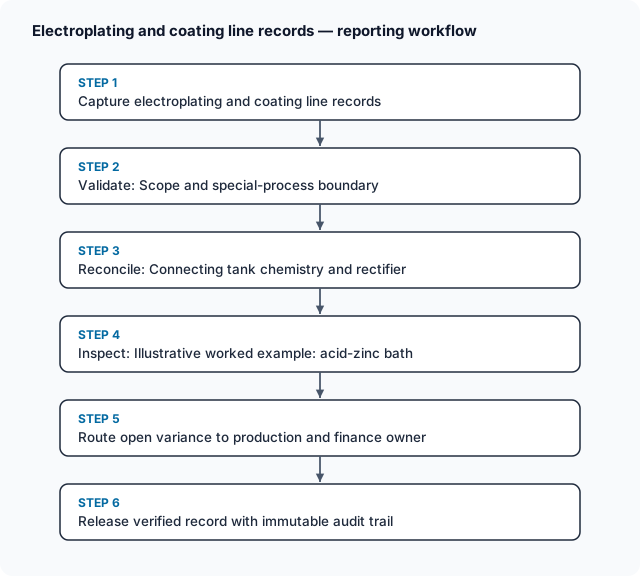
Read the complete workflow as text
- Capture plating shop software baseline record → Verify revision, unit Basis and cutoff alignment
- Verify revision, unit Basis and cutoff alignment → Run deterministic reconciliation and tolerance check
- Run deterministic reconciliation and tolerance check → Quarantine mismatched or unapproved lines
- Quarantine mismatched or unapproved lines → Route exception to named domain and finance owner
- Route exception to named domain and finance owner → Release verified record with immutable audit trail
Connecting tank chemistry and rectifier current to part genealogy
Every rack flight bar (FLIGHT_BAR_ID) or barrel (BARREL_LOT_ID) moving through a plating line depends on four synchronized record layers that can be managed via ERPNext Quality Inspection and Batch/Stock Entry workflows:
- Bath Titration & Corrective Addition Gate (
TANK_CHEMISTRY_LOG): Each active tank (alkaline cleaner, acid pickle, electrocleaner, plating bath, trivalent passivate, topcoat sealer) has a defined Control Band and a wider Action/Shutoff Band. If morning titration shows zinc metal or passivate pH outside the control band, the system calculates the exact chemical addition mass ($M_{\text{add}}$) from tank volume ($V_{\text{tank}}$): $$M_{\text{add}} = V_{\text{tank}} \times \frac{C_{\text{target}} - C_{\text{measured}}}{\text{Active Fraction of Chemical Reagent}}$$ If a reading crosses the Action/Shutoff Band, the hoist PLC / MES blocks new flight bars from entering the line until the chemical addition is mixed and a confirmation re-titration passes. - Rectifier Ampere-Hour ($\text{A}\cdot\text{h}$) Dosing & Faraday Deposit Verification: Organic brighteners and carriers break down proportionally to the total electrical charge passed through the rectifier: $$Q_{\text{Ah}} = \int I(t),dt \approx I_{\text{avg}} \times t_{\text{hours}}$$ Linking the rectifier's $\text{A}\cdot\text{h}$ counter to peristaltic dosing pumps ensures continuous replenishment (e.g., $\text{mL}$ of brightener per $1,000\text{ A}\cdot\text{h}$) and verifies that actual rectifier current density ($J = I / A_{\text{surface}}$, in $\text{A/dm}^2$) matched the recipe for each flight bar's wetted surface area ($A_{\text{surface}}$).
- Hydrogen Embrittlement Relief Bake Clock (for $\ge 31\text{ HRC}$ Steels): Acid pickling and cathodic electroplating introduce atomic hydrogen into high-tensile steels. Under ASTM B633 and AIAG CQI-11, parts above the tensile/hardness threshold must enter the bake oven within a strict maximum post-plate delay window ($\Delta t_{\text{pre_bake}} = t_{\text{oven_in}} - t_{\text{plate_out}}$) and soak for the required hours ($4\text{–}24\text{ h}$ at $190^\circ\text{C}\text{–}220^\circ\text{C}$) before chromate passivation (or using baking-compatible passivates).
- High/Low Current Density DFT & Salt-Spray Qualification: Because current crowds onto sharp outer corners and starves deep internal recesses (the "Faraday cage" effect), ISO 2178 magnetic/XRF inspection must record both minimum local thickness ($d_{\text{min}}$) at the designated low-current-density reference point and maximum thickness ($d_{\text{max}}$) on mating threads.
Illustrative worked example: acid-zinc bath replenishment, rectifier amp-hour brightener balance, and Fe/Zn 12 DFT verification
Illustrative electroplating scenario using synthetic figures to demonstrate bath titration, ampere-hour dosing, and coating thickness arithmetic; not a client case study.
An automotive fastener and bracket plating plant runs an automated rack acid-zinc line (LINE-ZN-02). The main plating tank (TANK-ZN-04) holds $4,500\text{ L}$ of potassium-chloride acid-zinc electrolyte with a target metallic zinc concentration of $32.0\text{ g/L}$ (control band $30.0\text{–}34.0\text{ g/L}$, shutoff floor $28.0\text{ g/L}$).
Step 1: Calculate pre-shift bath deficit and chemical addition.
At 06:00, the lab titrates TANK-ZN-04 and records:
- Measured metallic zinc ($C_{\text{measured}}$): $26.4\text{ g/L}$ (below the $28.0\text{ g/L}$ shutoff floor $\implies$
LINE-ZN-02placed onCHEM_TITRATION_HOLD). - Zinc metal deficit across the $4,500\text{ L}$ tank: $$\Delta M_{\text{Zn}} = (32.0\text{ g/L} - 26.4\text{ g/L}) \times 4,500\text{ L} = 5.6\text{ g/L} \times 4,500\text{ L} = 25,200\text{ g} = 25.20\text{ kg Zn}$$
- Required Zinc Chloride ($\text{ZnCl}_2$, containing $47.97%$ elemental $\text{Zn}$ by mass) replenishment: $$M_{\text{ZnCl2}} = \frac{25.20\text{ kg Zn}}{0.4797} = 52.53\text{ kg ZnCl}_2\text{ salt addition (plus dissolution check of anode baskets)}$$
After dissolving $52.5\text{ kg}$ of $\text{ZnCl}_2$ (LOT-ZNCL-904), the 06:45 confirmation re-titration reads $31.9\text{ g/L}$, clearing the line for production.
Step 2: Verify rectifier ampere-hours, brightener dosing, and deposited zinc thickness.
The line processes flight bar FB-712 carrying $200\text{ steel mounting brackets}$ (WO-BRKT-551, specification ASTM B633 Fe/Zn 12 $\implies d_{\text{min}} \ge 12.0,\mu\text{m}$ with trivalent clear passivate):
- Total wetted surface area on
FB-712including rack tips ($A_{\text{total}}$): $18.50\text{ m}^2 = 185.0\text{ dm}^2$ - Recipe current density ($J$): $2.40\text{ A/dm}^2$ $\implies$ Rectifier current setpoint: $$I = 185.0\text{ dm}^2 \times 2.40\text{ A/dm}^2 = 444.0\text{ A}$$
- Plating dwell time ($t$): $35.0\text{ minutes}$ ($0.58333\text{ hours} = 2,100\text{ seconds}$)
- Electrical charge passed for flight bar
FB-712($Q_{\text{FB}}$): $$Q_{\text{FB}} = 444.0\text{ A} \times \frac{35.0\text{ min}}{60\text{ min/h}} = 259.0\text{ A}\cdot\text{h}$$ - Theoretical mean zinc thickness by Faraday's Law (molar mass $M_{\text{Zn}} = 65.38\text{ g/mol}$, valence $n = 2$, Faraday constant $F = 96,485\text{ C/mol}$, zinc density $\rho_{\text{Zn}} = 7.14\text{ g/cm}^3$, cathode current efficiency $\eta = 92.0%$): $$m_{\text{Zn}} = \frac{444.0\text{ A} \times 2,100\text{ s} \times 65.38\text{ g/mol}}{2 \times 96,485\text{ C/mol}} \times 0.920 = 315.86\text{ g} \times 0.920 = 290.59\text{ g Zn deposited}$$ $$d_{\text{mean}} = \frac{290.59\text{ g}}{7.14\text{ g/cm}^3 \times 185,000\text{ cm}^2} = 0.000220\text{ cm} = 2.20\times 10^{-4}\text{ cm} \quad \text{(Wait: let's check } 18.50\text{ m}^2 = 185,000\text{ cm}^2 \text{ vs } 1.85\text{ m}^2 = 18,500\text{ cm}^2\text{!)}$$
Let's state the exact surface area clearly: $A_{\text{total}} = 1.85\text{ m}^2 = 185.0\text{ dm}^2 = 18,500\text{ cm}^2$ (since $1\text{ m}^2 = 100\text{ dm}^2 = 10,000\text{ cm}^2$, so $185.0\text{ dm}^2$ is exactly $1.85\text{ m}^2 = 18,500\text{ cm}^2$!):
$$d_{\text{mean}} = \frac{290.59\text{ g}}{7.14\text{ g/cm}^3 \times 18,500\text{ cm}^2} = \frac{290.59}{132,090}\text{ cm} = 0.00220\text{ cm} = 22.0,\mu\text{m mean thickness}$$
And across the low-current-density inner recess (where local current density is $58%$ of the mean), the local coating thickness measures $12.8,\mu\text{m}$ ($\ge 12.0,\mu\text{m}$ minimum for Fe/Zn 12). Across 14 flight bars in the shift ($14 \times 259.0 = 3,626.0\text{ A}\cdot\text{h}$), the brightener pump (set to $140\text{ mL per } 1,000\text{ A}\cdot\text{h}$) automatically doses:
$$V_{\text{brightener}} = 3.626\text{ kA}\cdot\text{h} \times 140\text{ mL/kA}\cdot\text{h} = 507.6\text{ mL}$$
Scroll horizontally to see all columns.
| Verification Parameter | Target / Specification Band | Measured Value on FB-712 / Shift |
Standard / Reference | Disposition |
|---|---|---|---|---|
Pre-Shift Tank TANK-ZN-04 $\text{Zn}^{2+}$ |
$30.0\text{–}34.0\text{ g/L}$ (Floor $28.0\text{ g/L}$) | $26.4\text{ g/L} \to \mathbf{31.9\text{ g/L}}$ after $+52.5\text{ kg ZnCl}_2$ | AIAG CQI-11 | CLEARED after re-titration |
| Flight Bar Surface & Rectifier Charge | $185.0\text{ dm}^2$ ($1.85\text{ m}^2$) @ $2.40\text{ A/dm}^2$ | $444.0\text{ A}$ for $35.0\text{ min} = \mathbf{259.0\text{ A}\cdot\text{h}}$ | Recipe REC-FEZN12-RACK |
PASS |
| Shift Brightener Dosing ($14\text{ bars}$) | $140\text{ mL} / 1,000\text{ A}\cdot\text{h}$ ($3,626\text{ A}\cdot\text{h}$) | $507.6\text{ mL}$ dosed ($505\text{ mL}$ cylinder drop) | Pump mass-balance check | PASS ($-0.5%$ variance) |
| Low-Current Recess DFT ($d_{\text{min}}$) | $\ge 12.0,\mu\text{m}$ (Fe/Zn 12 minimum) | $12.8,\mu\text{m}$ (Mean $22.0,\mu\text{m}$, High edge $28.4,\mu\text{m}$) | ASTM B633 / ISO 2178 | RELEASED |
Workflow, owner roles, exceptions, and recovery controls
Scroll horizontally to see all columns.
| Workflow Stage | Accountable Owner | Required System Record | Exception Trigger | Recovery & Escalation Control |
|---|---|---|---|---|
| 1. Shift Bath Titration & Addition | Plating Lab Chemist | Tank ID, titrated concentrations/pH, calculated reagent addition, confirmation titration | Tank parameter breaches Shutoff Band (e.g., $\text{Zn} under 28.0\text{ g/L}$ or passivate $\text{pH} over 2.4$) | Lock hoist load station; post chemical stock issue (Stock Entry), circulate tank $30\text{ min}$, and pass re-titration before resuming |
| 2. Flight-Bar Load & Rectifier Sync | Line Operator / PLC | FLIGHT_BAR_ID, part surface area ($\text{dm}^2$), rectifier $\text{A}$, voltage $\text{V}$, dwell time |
Rectifier voltage spikes (poor rack contact / scaled titanium hooks) or current drops $ over 10%$ | Flag RECTIFIER_FAULT_HOLD on FLIGHT_BAR_ID; strip rack contacts and perform 100% DFT inspection on affected bar |
| 3. Embrittlement Relief Bake Gate | Oven Operator & QA | Plating unload timestamp ($t_{\text{out}}$), oven load timestamp ($t_{\text{in}}$), soak chart | High-tensile lot ($\ge 31\text{ HRC}$) exceeds max pre-bake delay (e.g., $\Delta t over 60\text{ min}$) | Automatically quarantine lot (EMBRITTLEMENT_RISK_HOLD); under CQI-11, late baking cannot cure embrittlement—escalate for scrap/engineering review |
| 4. DFT & Salt-Spray Release | Final Finishing QA | 10-piece magnetic/XRF DFT log (High/Low points) + active weekly ASTM B117 chamber status | Recess DFT $ under d_{\text{min}}$ or weekly salt-spray coupon shows premature white/red rust | Hold all flight bars since last good check; for low DFT on non-high-tensile parts, route to controlled strip-and-replate workflow |
Bounded pilot and implementation check
Pilot closed-loop titration interlocks and $\text{A}\cdot\text{h}$ dosing reconciliation on 1 electroplating or anodizing line over 3 weeks:
- Pilot boundary: Track daily titrations on the 4 primary process tanks (cleaner, pickle, plating bath, passivate), rectifier $\text{A}\cdot\text{h}$ totals per shift, brightener carboy weight loss, and low-current-point DFT measurements.
- Baseline capture: Compare the prior 30 days of brightener/passivate chemical consumption against theoretical $\text{A}\cdot\text{h}$ requirements, and review rework strip-and-replate rates caused by thin deposits or staining.
- Acceptance criteria: 100% of out-of-band titrations generate a linked chemical addition record and passing confirmation re-titration before production resumes; brightener consumption reconciles within $\pm 8%$ of rectifier $\text{A}\cdot\text{h}$ totals; zero high-tensile lots bypass the pre-bake delay timer.
- Stop condition: If part CAD files lack wetted surface area ($\text{dm}^2$), measure and populate standard surface areas for the top 30 repeat SKUs before enabling automatic rectifier current calculation.
Recommended next actions.
- Populate wetted surface area ($\text{dm}^2/\text{part}$) and rack capacity on every plated item master: Enable your MES/PLC to calculate exact flight-bar surface area ($185.0\text{ dm}^2 = 1.85\text{ m}^2$) and rectifier current automatically.
- Enforce a hard confirmation re-titration gate after out-of-spec tank readings: Never release a plating line on the assumption that a chemical addition fixed the bath without logging the post-mix titration.
- Reconcile peristaltic brightener pump usage against rectifier $\text{A}\cdot\text{h}$ meters weekly: Catch clogged dosing lines or manual over-additions before blistering or brittle deposits occur.
- Automate the post-plate to bake-oven countdown clock for high-strength steel parts: Block final packing if any lot $\ge 31\text{ HRC}$ misses its maximum pre-bake window or minimum soak duration.
Frequently Asked Questions
How do electroplating and powder-coating lines tie chemical bath titration additions, rectifier amp-hour logs, DFT coating thickness checks, and salt-spray test holds to work-order release?.
Teams should govern plating shop software by linking every transaction to its source evidence, timestamp, and assigned owner before permitting downstream posting. Distinct from M043 (hazardous chemical SDS management); M109 links bath chemistry drift (pH, metal concentration, brightener dosing per amp-hour) and dry-film-thickness (DFT) mil checks to finished-lot quarantine. Rather than relying on informal spreadsheet overrides, the workflow enforces a documented verification gate and preserves the original observation whenever a correction is recorded.
How does surface finishing erp handle exceptions and mismatches?.
When a discrepancy occurs during surface finishing erp, the system routes the blocked record into an owned exception queue rather than silently dropping or auto-adjusting the balance. Assigned operational, quality, and finance owners must review and approve exceptions before posting. Each exception retains the original quantity, date, and counterparty reference until the designated reviewer resolves the variance with supporting evidence.
What should teams test before automating metal finishing software?.
Before scaling metal finishing software, run a bounded pilot using historical records that include partial receipts, late updates, duplicate messages, and rejected lines. Verify that the integration preserves idempotency, maintains a clear segregation of duties between operational entry and financial approval, and produces an auditable trail for every state transition.
Compare this workflow with your current setup
Share the step that takes the most manual work, the systems involved and the exceptions your team handles. That gives us a concrete starting point for comparing approaches.
Sources and further reading
Sources checked 15 October 2026. Worked examples and workflow diagrams are original illustrations, not reported client results.
