Foundry melt and heat records: link charge makeup, OES spectrometer trims, and casting genealogy
For production managers, planners and plant leaders · Compare approaches
TL;DR — what you’ll learn
- Enforce strict furnace charge recipe limits ([AIAG CQI-27](https://www.aiag.org/quality/automotive-core-tools/cqi-27)) at the crane scale—capping internal foundry returns (gates, runners, risers) by alloy grade so tramp elements ($\text{Ti}, \text{Pb}, \text{S}, \text{P}$) never accumulate across recycled heats.
- Interlock furnace tapping on Optical Emission Spectrometer (OES, [ASTM E1999 / E415](https://www.astm.org/e0415-21.html)) chilled-coin clearance: calculate exact recarburizer and ferro-alloy trim additions from bath mass and element recovery factors, and require a passing post-trim OES sample before tapping into the treatment ladle.
- Start an automatic ladle fade countdown timer ($t_{\text{fade}} \le 10\text{–}12\text{ minutes}$) the instant magnesium spheroidization or ferrosilicon inoculation completes, and quarantine any moulds poured after the timer expires.
- Link every cast part batch to both its Furnace Heat Number (HEAT_NO) and Treatment Ladle Sequence (LADLE_ID, First-to-Last Mould), holding the ladle batch until ultrasonic/microstructural nodularity checks on the last-mould coupon pass.

Illustrative manufacturing inspection room and machine shop floor; not a client facility.
In ferrous (ductile iron, gray iron, alloy steel) and non-ferrous (aluminium, bronze) foundries, two castings poured from the same furnace melt just four minutes apart can have completely different mechanical properties if ladle magnesium fades before the last mould is poured. Also, unlike chemical liquid blending (M028), molten metal chemistry shifts dynamically due to furnace oxidation losses, slag reactions, and the 30%–50% of every pour that becomes solidified gates, runners, and risers recycled back into future furnace charges. This guide (M110) specifies the foundry ERP/MES melt-charge recipe control, OES spectrometer trim calculation, ladle inoculation fade-timer enforcement, and heat-to-mould casting genealogy workflow.
Scope and metallurgical standards boundary
This article defines the shop-floor and ERP record architecture connecting scrap-yard charge make-up, melt deck chemistry, pouring line timing, and fettling/quality release:
- What this workflow governs: Weighing grade-segregated charge materials (pig iron, steel scrap, internal foundry returns), ingesting OES spectrometer results, computing ferro-alloy trim weights, tracking ladle treatment and pouring fade clocks, and recovering gates/risers into grade-specific return inventory.
- What this workflow does not replace: It does not replace gating and riser solidification simulation, green-sand / resin-sand laboratory testing, or metallurgical phase design. Foundry controls should align with AIAG CQI-27 (Special Process: Casting System Assessment), material specifications such as ASTM A536 (Ductile Iron Castings) and ASTM A48 (Gray Iron), and spectrometric analysis standards ASTM E1999 / ASTM E415.
Bounded foundry melt charge heat traceability software verification and exception-routing workflow
Follow the workflow below, or open its complete text version.
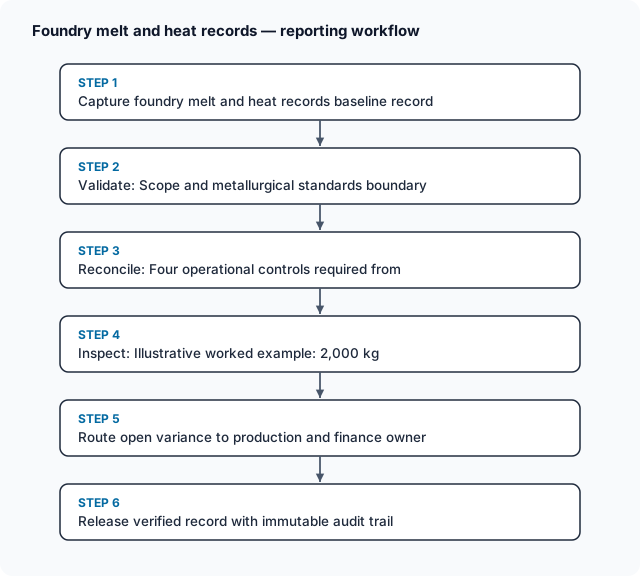
Read the complete workflow as text
- Capture foundry melt charge heat tra baseline record → Verify revision, unit Basis and cutoff alignment
- Verify revision, unit Basis and cutoff alignment → Run deterministic reconciliation and tolerance check
- Run deterministic reconciliation and tolerance check → Quarantine mismatched or unapproved lines
- Quarantine mismatched or unapproved lines → Route exception to named domain and finance owner
- Route exception to named domain and finance owner → Release verified record with immutable audit trail
Four operational controls required from charge deck to shakeout
Using standard ERP batch genealogy, BOMs, and quality gates (such as ERPNext BOM, Batch, and Stock Entry workflows):
- Grade-Segregated Return Scrap & Charge Ratio Control:
When a $500\text{ kg}$ ladle is poured into sand moulds, typically $55%\text{–}65%$ becomes net castings while $35%\text{–}45%$ solidifies as sprue cups, runners, gates, and risers. At shakeout and shotblast, these returns must be booked back into a grade-specific return item (e.g.,
RETURN-GGG40vsRETURN-GGG60vsRETURN-GRAY-FC250). Mixing copper/pearlitic ductile returns into a ferritic ductile charge contaminates the melt and causes elongation failures. - Pre-Tap OES Chilled-Coin Analysis & Recovery-Adjusted Alloy Trims: When the induction furnace reaches base melt temperature, the melter pours a chilled white-iron coin for spark OES analysis (ASTM E1999) and Carbon Equivalent ($CE = %C + \frac{%Si + %P}{3}$) thermal arrest check. For any element $x$ below target, the required ferro-alloy trim addition ($M_{\text{trim}, x}$) accounts for bath mass ($M_{\text{bath}}$), ferro-alloy assay fraction ($f_{\text{assay}, x}$), and furnace dissolution recovery ($\eta_{\text{rec}, x}$): $$M_{\text{trim}, x} = \frac{M_{\text{bath}} \times \left(%x_{\text{target}} - %x_{\text{measured}}\right)}{100 \times f_{\text{assay}, x} \times \eta_{\text{rec}, x}}$$
- Ladle Treatment & Inoculation Fade-Time Cutoff: In ductile (nodular) iron production (ASTM A536), magnesium ($\text{Mg}$) added in the tundish treatment ladle vaporizes and oxidizes rapidly once the reaction finishes (typically losing $\sim 0.001%\text{–}0.002%\text{ Mg/minute}$). If pouring a ladle takes longer than the validated fade window ($t_{\text{max_pour}} = 10\text{–}12\text{ minutes}$), residual $\text{Mg}$ drops below $0.030%$, turning spheroidal graphite back into brittle compacted/flake graphite in the final moulds.
- Last-Mould Coupon Nodularity Gate: Because the last mould poured from each ladle has the lowest residual magnesium and greatest inoculation fade, AIAG CQI-27 requires pouring a micro-coupon right after the last mould of every treatment ladle. If the last-mould coupon passes $\ge 85%\text{–}90%$ nodularity, the preceding moulds in that ladle (poured within the time/temperature window) are qualified.
Illustrative worked example: 2,000 kg ductile-iron induction melt, OES trim calculation, and ladle fade containment
Illustrative ferrous-foundry scenario using synthetic figures to demonstrate charge balance, OES trim, and inoculation fade arithmetic; not a client case study.
An automotive ductile-iron foundry melts heat HEAT-2026-H408 in a $2,000.0\text{ kg}$ medium-frequency coreless induction furnace (FURN-IND-02) to cast steering knuckles (WO-KNUCK-802, specification ASTM A536 Grade 65-45-12 / EN-GJS-450-10).
Step 1: Verify charge makeup against maximum return-scrap cap.
The furnace charge recipe requires $\le 40.0%$ internal ductile returns and low-manganese steel punchings:
- High-Purity Sorel Pig Iron (
LOT-PIG-112): $600.0\text{ kg}$ ($30.0%$) - Low-Residual Structural Steel Punchings (
LOT-STL-309): $700.0\text{ kg}$ ($35.0%$) - Segregated Ferritic Ductile Returns (
RET-GJS450-BIN2): $700.0\text{ kg}$ ($35.0% \le 40.0%$ max return cap) - Total Base Charge Mass ($M_{\text{bath}}$): $2,000.0\text{ kg}$
Step 2: Compute furnace alloy trims from pre-tap OES analysis.
At $1,495^\circ\text{C}$, the melter pulls chilled coin OES-H408-01. Base furnace chemistry targets (prior to ladle $\text{FeSiMg}$ and stream inoculation) are $C_{\text{target}} = 3.68%$ and $Si_{\text{base_target}} = 1.60%$ (as ladle treatment adds $+1.05%\text{ Si}$ to reach $2.65%\text{ final Si}$):
- Measured OES Carbon ($C_{\text{meas}}$): $3.52%$ $\implies$ Deficit $\Delta C = 3.68% - 3.52% = \mathbf{0.16%}$
- Measured OES Silicon ($Si_{\text{meas}}$): $1.48%$ $\implies$ Deficit $\Delta Si = 1.60% - 1.48% = \mathbf{0.12%}$
- Measured Phosphorus ($P = 0.025%$) and Manganese ($Mn = 0.24%$) $\implies$ Pre-trim Carbon Equivalent: $$CE_{\text{initial}} = 3.52 + \frac{1.48 + 0.025}{3} = 3.52 + 0.502 = 4.022%$$
The MES calculates the exact trim additions into the $2,000.0\text{ kg}$ bath:
- Graphitic Recarburizer ($f_{\text{assay}} = 98.0%\text{ C}$, furnace recovery $\eta_{\text{rec}} = 90.0% \implies \text{effective yield} = 0.8820$): $$M_{\text{recarb}} = \frac{2,000.0\text{ kg} \times (3.68 - 3.52)}{100 \times 0.980 \times 0.900} = \frac{3.20\text{ kg pure C}}{0.8820} = 3.63\text{ kg recarburizer}$$
- Ferrosilicon $\text{FeSi75}$ ($f_{\text{assay}} = 75.0%\text{ Si}$, furnace recovery $\eta_{\text{rec}} = 92.0% \implies \text{effective yield} = 0.6900$): $$M_{\text{FeSi75}} = \frac{2,000.0\text{ kg} \times (1.60 - 1.48)}{100 \times 0.750 \times 0.920} = \frac{2.40\text{ kg pure Si}}{0.6900} = 3.48\text{ kg FeSi75}$$
After stirring in $3.63\text{ kg}$ recarburizer and $3.48\text{ kg}$ $\text{FeSi75}$, confirmation coin OES-H408-02 reads $C = 3.68%$ and $Si = 1.60%$ ($CE = 4.22%$), enabling the furnace tap gate.
Step 3: Enforce ladle inoculation fade window across poured moulds.
The $2,000\text{ kg}$ heat is tapped into four $500\text{ kg}$ tundish treatment ladles (LADLE-408-A through D). Each ladle fills 18 sand moulds ($26.5\text{ kg}$ gross pour weight per mould: $17.0\text{ kg}$ net knuckles + $9.5\text{ kg}$ runner/riser tree):
- Ladle
LADLE-408-A$\text{FeSiMg}$ reaction completed ($t_0$):11:10:00 - Maximum validated pouring fade window ($t_{\text{max_fade}}$): $12.0\text{ minutes}$ $\implies$ Hard cutoff at
11:22:00(plus minimum last-mould pour temperature $\ge 1,355^\circ\text{C}$). - Moulds
#01through#16: Poured between11:11:10and11:21:15($t_{\text{elapsed}} \le 11.25\text{ min}$). - Hoist monorail pause (
11:21:20–11:22:30): Delays final two moulds. - Moulds
#17and#18: Poured at11:22:40($12.67\text{ min}$) and11:23:15($13.25\text{ min}$) at $1,348^\circ\text{C}$.
Scroll horizontally to see all columns.
| Heat / Ladle / Mould Range | Elapsed Time Since $\text{Mg}$ Treatment | Optical Pyrometer Pour Temp | Residual $\text{Mg}$ / Nodularity Check | Casting Disposition |
|---|---|---|---|---|
LADLE-408-A — Moulds #01–#15 |
$1.17\text{ – } 10.50\text{ min}$ ($\le 12.0\text{ min}$) | $1,412^\circ\text{C} \to 1,368^\circ\text{C}$ | Qualified by Mould #16 coupon |
RELEASED ($15\text{ moulds} = 30\text{ knuckles}$) |
LADLE-408-A — Mould #16 (Boundary) |
$11.25\text{ min}$ ($\le 12.0\text{ min}$) | $1,362^\circ\text{C}$ ($\ge 1,355^\circ\text{C}$) | Coupon #16: $0.036%\text{ Mg}$, $92%$ nodularity |
RELEASED ($1\text{ mould} = 2\text{ knuckles}$) |
LADLE-408-A — Moulds #17–#18 (Over-Fade) |
$12.67\text{ – } 13.25\text{ min}$ ($ over 12.0\text{ min}$) | $1,348^\circ\text{C}$ ($ under 1,355^\circ\text{C}$) | Coupon #18: $0.024%\text{ Mg}$, $68%$ nodularity |
QUARANTINED & SCRAPPED (FADE_HOLD) |
Because the pouring operator inserted a supplementary test coupon at Mould #16 right before the hoist delay, Moulds #01–#16 ($32\text{ knuckles}$) are saved and released, while Moulds #17–#18 ($4\text{ knuckles}$ with vermicular/low-nodularity graphite) are segregated at shakeout and remelted as returns.
Workflow, owner roles, exceptions, and recovery controls
Scroll horizontally to see all columns.
| Workflow Stage | Accountable Owner | Required System Evidence | Exception Trigger | Recovery & Escalation Control |
|---|---|---|---|---|
| 1. Charge Weighing & Return Cap | Charge Crane / Deck Operator | Bluetooth crane-scale weights by scrap/return bin + recipe validation | Return scrap exceeds $40%$ cap or wrong return grade bin scanned | Sound deck alarm; require operator to discharge excess returns before dropping bucket into furnace |
| 2. Pre-Tap OES & Trim Loop | Melt Deck Supervisor & Lab | OES_SAMPLE_ID, 18-element assay, calculated trim mass, confirmation OES |
Tramp element ($\text{Ti}, \text{Pb}$) exceeds ceiling or melter attempts tap without confirmation OES | For tramp excursion, calculate virgin pig/steel dilution ratio; keep tap interlock locked until post-trim coin passes |
| 3. Ladle Treatment & Pouring Clock | Pouring Operator | LADLE_ID, $\text{FeSiMg}$ weight, reaction timestamp ($t_0$), mould pour timestamps & pyrometer temp |
Elapsed time $ over 12.0\text{ min}$ or pour temperature $ under 1,355^\circ\text{C}$ | Trigger red visual strobe at pouring deck; divert expired iron to pigging moulds or mark poured sand moulds FADE_HOLD |
| 4. Last-Mould Coupon & Shakeout | Foundry Metallurgist | Image-analysis nodularity ($%$), pearlite/ferrite ratio, Brinell hardness on last-mould coupon | Last-mould coupon shows $ under 85%$ nodularity or carbides | Quarantine entire LADLE_ID casting batch for 100% ultrasonic velocity sorting (ASTM A536) |
Bounded pilot and implementation check
Pilot digital OES trim calculation and ladle fade-timer tracking on 1 induction furnace and pouring line over 3 weeks:
- Pilot boundary: Connect the crane scale, OES spectrometer CSV export, and pouring deck tablet to track
HEAT_NOandLADLE_IDacross your highest-volume ductile-iron casting family. - Baseline capture: Review the prior 60 days of ferro-alloy consumption variances, off-chemistry heats, and ultrasonic/machining rejections from low nodularity or chill carbides.
- Acceptance criteria: 100% of heats record a passing confirmation OES coin prior to tap; ferro-alloy trim usage matches bath-deficit formulas within $\pm 5%$; 100% of moulds poured past the 12-minute fade window are automatically flagged and isolated at shakeout.
- Stop condition: If manual mould indexing makes individual mould timestamps impractical, log at minimum the First Mould Timestamp, Last In-Window Mould Number, and Last Mould Timestamp + Temperature per treatment ladle.
Recommended next actions.
- Segregate internal foundry returns (
gates/runners/risers) into grade-specific ERP inventory items: Never pool ductile-iron returns with gray-iron or copper-alloyed grades in a singleFOUNDRY-SCRAPbin. - Automate ferro-alloy trim calculations directly from OES spectrometer imports: Replace mental arithmetic on the melt deck with recovery-adjusted formulas tied to exact furnace bath weight.
- Mount a high-visibility ladle countdown timer on the pouring monorail: Alert operators at 10 minutes so they can pull an intermediate test coupon and pig remaining iron at the 12-minute fade cutoff.
- Trace castings by both
HEAT_NOandLADLE_ID: Ensure that if a single treatment ladle experiences a magnesium reaction fault, you only quarantine 18 moulds rather than the entire $2,000\text{ kg}$ heat.
Frequently Asked Questions
How should ferrous and non-ferrous foundries reconcile induction-furnace charge makeup (pig iron, returns, ferro-alloys), optical emission spectrometer (OES) chemistry holds, and heat-number casting traceability?.
Teams should govern foundry melt charge heat traceability software by linking every transaction to its source evidence, timestamp, and assigned owner before permitting downstream posting. Distinct from M028 (batch potency in chemical blending); M110 governs molten-metal furnace heat numbers, pre-pour CE/spectrometer trim additions, inoculation fade-time windows, andrunner/riser foundry return recycling ratios. Rather than relying on informal spreadsheet overrides, the workflow enforces a documented verification gate and preserves the original observation whenever a correction is recorded.
How does casting manufacturing software handle exceptions and mismatches?.
When a discrepancy occurs during casting manufacturing software, the system routes the blocked record into an owned exception queue rather than silently dropping or auto-adjusting the balance. Assigned operational, quality, and finance owners must review and approve exceptions before posting. Each exception retains the original quantity, date, and counterparty reference until the designated reviewer resolves the variance with supporting evidence.
What should teams test before automating melt shop software?.
Before scaling melt shop software, run a bounded pilot using historical records that include partial receipts, late updates, duplicate messages, and rejected lines. Verify that the integration preserves idempotency, maintains a clear segregation of duties between operational entry and financial approval, and produces an auditable trail for every state transition.
Compare this workflow with your current setup
Share the step that takes the most manual work, the systems involved and the exceptions your team handles. That gives us a concrete starting point for comparing approaches.
Sources and further reading
Sources checked 15 October 2026. Worked examples and workflow diagrams are original illustrations, not reported client results.
