Why MRP shows enough material but the factory still stops
For production managers, planners and plant leaders · Understand the problem
TL;DR — what you’ll learn
- Reconstruct usable material for a particular job and start time; an item total cannot answer that question.
- Separate physical stock, quality status, reservations, revision and expected receipt dates.
- Give each shortage a cause and owner before increasing purchasing or safety stock.
- Test a held lot, delayed receipt and competing reservation against the same production order.
At the morning meeting, the planner's report shows enough components. Two hours later, assembly stops. Stores can point to boxes on a shelf, purchasing can point to an open order, and production can point to an empty workbench. Each statement can be accurate because they describe different kinds of availability.
The useful answer is a dated material account for one job. Ask which quantity is physically present, eligible for the approved design, released for use, uncommitted elsewhere and able to reach the operation before it starts. Material requirements planning, or MRP, cannot make missing or contradictory transaction records true.
Rebuild one shortage before changing the planning rule
Consider an illustrative job needing 120 brackets at 10:00. The warehouse holds 90. Within that stock, 20 are on quality hold and a separate 30 are reserved for another job. These categories do not overlap in this example.
| Availability step | Brackets | Evidence needed |
|---|---|---|
| Physically present | 90 | Location and count at the review time |
| Less quality-held quantity | 20 | Lot status and quality owner |
| Less other-job reservation | 30 | Reservation and order identity |
| Free and eligible now | 40 | Approved item/revision and movement readiness |
| Requirement | 120 | Released job and material requirement |
| Uncovered at 10:00 | 80 | Action needed before promising the start |
An undated stock-plus-order total would show 90 + 80 = 170 brackets against a need for 120. But the purchase order for those 80 arrives at 14:00. Even if its entire quantity becomes usable immediately, it cannot cover the 10:00 start. If incoming inspection or transport to the line takes time, receipt is earlier than production availability. Record those assumptions separately.
For example, Dynamics 365 defines Available physical as physical inventory less physical reservations; its Total available also includes inbound and outbound orders. Those fields therefore answer different questions. Microsoft inventory on-hand definitions.
Do not subtract a hold twice when the ERP's available quantity already excludes it. Start with a documented field definition and reconcile back to physical quantity. Otherwise an attempted improvement creates a different false shortage.
From stock total to a dated decision
Scroll horizontally to explore the full diagram, or open the text version below.
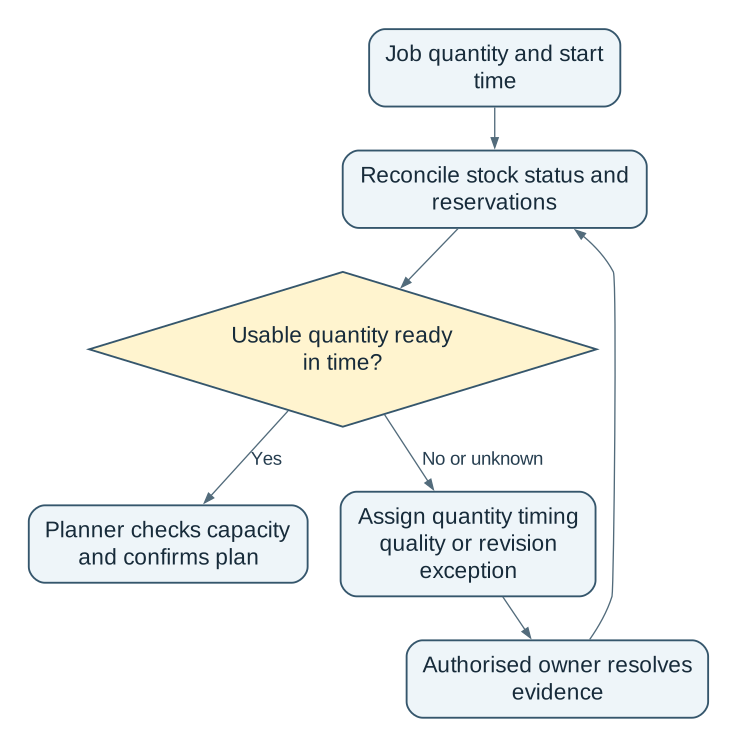
Read the complete workflow as text
- Job quantity and start time → Reconcile stock status and reservations
- Reconcile stock status and reservations → Usable quantity ready in time?
- Usable quantity ready in time? → Yes: Planner checks capacity and confirms plan
- Usable quantity ready in time? → No or unknown: Assign quantity timing quality or revision exception
- Assign quantity timing quality or revision exception → Authorised owner resolves evidence
- Authorised owner resolves evidence → Reconcile stock status and reservations
Classify the exception by the decision it needs
Quantity errors belong with stores and the transaction owner. Quality restrictions belong with the authorised quality team. A competing allocation needs a planning or commercial priority decision. A wrong revision needs engineering review. A supplier's unconfirmed date remains an uncertain supply assumption owned by purchasing.
The planner combines these facts into a feasible schedule. Changing a due date does not release material, and buying more does not resolve a revision mismatch. A proposed substitution must follow its own technical approval path.
The minimum working record contains job, operation, item and revision, required quantity/unit/time, stock location and status, reservation, receipt milestone, owner and next review time. Preserve the reason when an exception changes. A shortage marked resolved because an order was placed should remain visibly different from one resolved by usable receipt.
Decide whether the gap is process, configuration or integration
A controlled exception sheet can be enough when one planner can reconcile a small number of jobs. Existing ERP status and reservation settings may solve the problem at larger volumes. Connect quality, engineering or supplier systems when the decisive fact lives outside planning.
Capacity is another constraint. Microsoft documents finite-capacity planning as considering reserved resources when enabled, with specific engine and time-fence settings. Check the deployed configuration before assuming a material-ready job also has a feasible production slot. Microsoft finite-capacity documentation.
AI may summarise exception notes or propose causes for review. The usable balance should remain reproducible from approved records. A fluent explanation is not evidence that a receipt occurred.
Prove the new view changes a decision
Replay the bracket example, then add a hold after the first allocation. The affected job should lose availability without taking another job's stock silently. Delay the purchase receipt, correct a count and resend a reservation update. Require an explainable balance after each event, with unresolved facts visible and assigned.
The shortage review is working when production can distinguish a recoverable start from an unsupported promise. Its purpose is to choose the next action, not to make every row green.
- Reconstruct one recent stoppage from dated stock, status and reservation records.
- Assign each discrepancy to the person authorised to change that fact.
- Rehearse the same job with a late receipt and new hold before changing replenishment policy.
For a focused NextEdge Labs assessment, share the affected operation, current planning systems and the decision that arrives too late. A redacted shortage example is enough to begin.
Recognise this problem in your operation?
Tell us where the records or handovers break down. We can discuss the process, data and software questions worth examining first.
Sources and further reading
Sources checked 15 October 2026. Worked examples and workflow diagrams are original illustrations, not reported client results.