SMT moisture-sensitive device (MSD) records: control MSL floor-life clocks and bake-out recovery
For production managers, planners and plant leaders · Compare approaches
TL;DR — what you’ll learn
- Assign every moisture-sensitive SMT reel, tray, or tube a unique serialized REEL_UID linked to its [IPC/JEDEC J-STD-020](https://www.jedec.org/standards-documents/results/j-std-020) Moisture Sensitivity Level (MSL 2 through MSL 5a) so floor-life tracking follows the physical reel across multiple setups rather than resetting between work orders.
- Track cumulative ambient exposure time ($\sum t_{\text{ambient}}$) via state-transition barcode scans (SEALED_MBB $\to$ AMBIENT_FLOOR $\to$ DRY_CABINET_5RH $\to$ REFLOW_COMPLETE), pausing or resetting the clock only when the reel is scanned into a verified $\le 5\%\text{ RH}$ (or $\le 10\%\text{ RH}$) dry cabinet per [J-STD-033D](https://www.jedec.org/standards-documents/results/j-std-033).
- Compare a reels remaining floor life ($T_{\text{rem}}$) against the estimated time to complete reflow ($t_{\text{to\_reflow}}$) at feeder setup—blocking reels that would expire mid-run before the populated PCBs enter the reflow oven.
- Enforce carrier-safe bake-out profiles ($40^\circ\text{C}$ on plastic carrier tape vs $125^\circ\text{C}$ in high-temperature JEDEC trays) and cap total cumulative bake cycles so oxidized component leads and brittle intermetallics never compromise solderability.

Illustrative manufacturing inspection room and machine shop floor; not a client facility.
During lead-free Surface Mount Technology (SMT) reflow soldering, component body temperatures reach $245^\circ\text{C}\text{–}260^\circ\text{C}$. If a plastic-encapsulated BGA, QFN, or LQFP package has absorbed ambient shop humidity beyond its certified threshold, that trapped moisture flashes into high-pressure steam inside the IC package—causing internal bond-wire lifting, die-attach delamination, or audible "popcorning" cracks that often pass In-Circuit Test (ICT) only to fail in the field months later. Unlike M029 (which governs which component lot was placed on which serialized PCB) and M112 (solder paste thaw and stencil life), this guide (M111) specifies Moisture Sensitive Device (MSD) ambient floor-life clock calculation, dry-cabinet pause rules, derated high-humidity exposure multipliers, and bake-out clock reset governance.
Scope and standards boundary
This article defines the ERP/MES reel-state machine, environmental derating logic, and bake-recovery workflow for PCBA and EMS manufacturing:
- What this workflow governs: Serialized
REEL_UIDregistration at goods receipt, MSL floor-life assignment, scan-driven state transitions between Moisture Barrier Bags (MBB), SMT line feeders, and $\le 5%\text{ RH}$ dry cabinets, ambient humidity derating, and bake-oven reset signoffs. - What this workflow does not replace: It does not replace package moisture classification testing or reflow oven thermal profiling. All MSD handling rules must align with IPC/JEDEC J-STD-033D (Handling, Packing, Shipping and Use of Moisture, Reflow, and Process Sensitive Devices), IPC/JEDEC J-STD-020E (Moisture/Reflow Sensitivity Classification), and IPC-A-610 / IPC-1601.
Bounded smt line software verification and exception-routing workflow
Follow the workflow below, or open its complete text version.
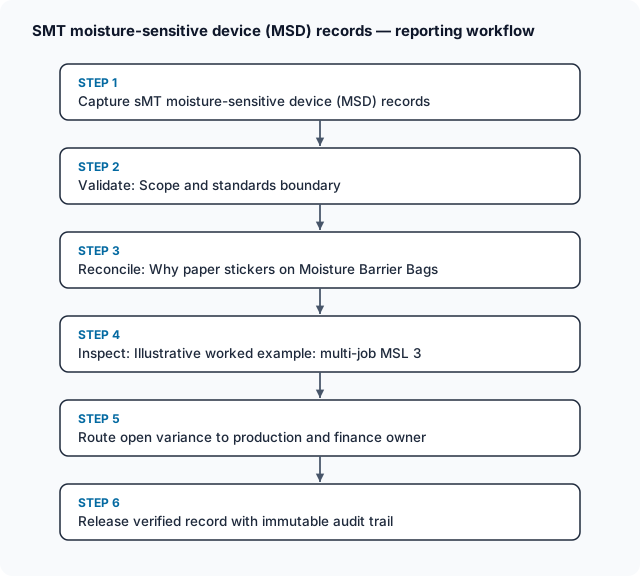
Read the complete workflow as text
- Capture smt line software baseline record → Verify revision, unit Basis and cutoff alignment
- Verify revision, unit Basis and cutoff alignment → Run deterministic reconciliation and tolerance check
- Run deterministic reconciliation and tolerance check → Quarantine mismatched or unapproved lines
- Quarantine mismatched or unapproved lines → Route exception to named domain and finance owner
- Route exception to named domain and finance owner → Release verified record with immutable audit trail
Why paper stickers on Moisture Barrier Bags fail on high-mix SMT floors?
On a high-mix EMS shop floor, a $500\text{-piece}$ reel of MSL 3 microcontrollers ($168\text{-hour}$ floor life at $\le 30^\circ\text{C} / 60%\text{ RH}$) may be loaded onto an SMT pick-and-place feeder four separate times over two months before the reel is exhausted. Writing the initial bag-open date on a paper sticker fails for four reasons:
- Unrecorded Ambient Dwell Between Kitting and Dry-Cabinet Return: Operators pull reels into staging carts 12 hours before setup and leave torn-down feeder carts sitting in the aisle for 18 hours after job completion before scanning them back into the dry cabinet.
- Ambient Shop Temperature and Humidity Excursions ($ over 30^\circ\text{C} / 60%\text{ RH}$): Standard J-STD-033D floor lives assume shop air stays at or below $30^\circ\text{C}$ and $60%\text{ RH}$. During monsoon or summer shifts when shop humidity rises to $30^\circ\text{C} / 70%\text{ RH}$ or $35^\circ\text{C} / 60%\text{ RH}$, standard MSL 3 floor life drops from $168\text{ hours}$ down to $72\text{–}96\text{ hours}$—meaning every hour on the floor consumes $1.75\times$ to $2.33\times$ of nominal budget.
- Mid-Run Expiration Before Reflow: The MSL floor-life clock does not stop when the pick-and-place nozzle mounts the IC onto wet solder paste; it stops only when the populated board completes the reflow oven cycle (or for double-sided boards, when the second-side reflow finishes).
- Melting Polystyrene Carrier Tape in a $125^\circ\text{C}$ Bake Oven: When a reel expires, baking it at $125^\circ\text{C}$ while still wound on standard low-temperature polystyrene carrier tape warps the carrier pockets and ruins the cover-tape peel force. Reels on tape must be baked at $40^\circ\text{C}$ ($\le 5%\text{ RH}$) for $192\text{ hours}$ ($8\text{ days}$) unless the parts are de-taped into high-temperature matrix trays.
Scroll horizontally to see all columns.
| MSL Level (J-STD-020E) | Standard Floor Life ($\le 30^\circ\text{C} / 60%\text{ RH}$) | Dry Cabinet Pause Rule ($\le 5%\text{ RH}$) | Bake Recovery at $125^\circ\text{C}$ (High-Temp Tray, $\le 1.4\text{ mm}$ pkg) | Bake Recovery at $40^\circ\text{C} / \le 5%\text{ RH}$ (On Carrier Tape, $\le 1.4\text{ mm}$ pkg) |
|---|---|---|---|---|
| MSL 1 | Unlimited ($\le 30^\circ\text{C} / 85%\text{ RH}$) | Not required | Not required | Not required |
| MSL 2 / 2a | $1\text{ year}$ / $4\text{ weeks}$ ($672\text{ h}$) | Pauses clock (or resets for short exposures per J-STD-033D Table 4-3) | $4\text{ – } 7\text{ hours}$ | $96\text{ – } 120\text{ hours}$ ($4\text{–}5\text{ days}$) |
| MSL 3 | $168\text{ hours}$ ($7\text{ days}$) | Pauses clock (or resets if exposure $\le 36\text{ h}$ and stored $5\times$ exposure) | $9\text{ hours}$ | $192\text{ hours}$ ($8\text{ days}$) |
| MSL 4 | $72\text{ hours}$ ($3\text{ days}$) | Pauses clock (or resets if exposure $\le 12\text{ h}$ and stored $5\times$ exposure) | $11\text{ hours}$ | $216\text{ hours}$ ($9\text{ days}$) |
| MSL 5 / 5a | $48\text{ hours}$ / $24\text{ hours}$ | Pauses clock ($\le 5%\text{ RH}$ required) | $12\text{ – } 14\text{ hours}$ | $240\text{ – } 336\text{ hours}$ ($10\text{–}14\text{ days}$) |
Illustrative worked example: multi-job MSL 3 BGA reel floor-life tracking and pre-reflow feeder lockout
Illustrative SMT assembly scenario using synthetic figures to demonstrate cumulative floor-life and bake-reset arithmetic; not a client case study.
An EMS plant tracks a serialized reel of $1.2\text{ mm}$-thick fine-pitch BGA processors (REEL-BGA-9042, $450\text{ pcs}$, classified MSL 3 $\implies T_{\text{max}} = 168.0\text{ hours}$ at $\le 30^\circ\text{C} / 60%\text{ RH}$) across three separate production work orders using ERPNext Serial and Batch Bundle location tracking integrated with the SMT line controller.
Step 1: Track cumulative ambient exposure across Jobs 1 and 2.
Job 1 (
WO-CTRL-101, $120\text{ boards}$):- MBB Unsealed & Humidity Indicator Card (HIC) Verified ($ under 10%\text{ spot blue}$):
Day 1 at 08:00(STATE = AMBIENT_FLOOR). - Job 1 Finished & Reel Scanned into Dry Cabinet (
CAB-DRY-02, verified $24^\circ\text{C} / 3.2%\text{ RH}$):Day 3 at 14:00(STATE = DRY_CABINET_5RH). - Exposure #1 ($\Delta t_1$) and Remaining Budget ($T_{\text{rem}, 1}$): $$\Delta t_1 = 54.0\text{ hours}, \qquad T_{\text{rem}, 1} = 168.0\text{ h} - 54.0\text{ h} = 114.0\text{ hours}$$ (Note: Because $\Delta t_1 = 54.0\text{ h}$ exceeds the $36\text{-hour}$ threshold in J-STD-033D Table 4-3 for ambient room-temperature dry-cabinet drying reset of MSL 3 packages, storing the reel in the $\le 5%\text{ RH}$ cabinet for $40\text{ hours}$ pauses the clock at $114.0\text{ hours}$ remaining rather than resetting it to $168.0\text{ hours}$.)
- MBB Unsealed & Humidity Indicator Card (HIC) Verified ($ under 10%\text{ spot blue}$):
Job 2 (
WO-CTRL-108, $180\text{ boards}$):- Removed from Dry Cabinet & Mounted on Feeder
#14:Day 5 at 06:00(STATE = AMBIENT_FLOOR). - Returned to Dry Cabinet (
CAB-DRY-02) after Job 2:Day 9 at 18:00(STATE = DRY_CABINET_5RH). - Exposure #2 ($\Delta t_2$), Cumulative Exposure ($T_{\text{used}}$), and Remaining Budget ($T_{\text{rem}, 2}$): $$\Delta t_2 = 108.0\text{ hours}, \qquad T_{\text{used}} = 54.0 + 108.0 = 162.0\text{ hours}$$ $$T_{\text{rem}, 2} = 168.0\text{ h} - 162.0\text{ h} = 6.0\text{ hours remaining}$$
- Removed from Dry Cabinet & Mounted on Feeder
Step 2: Block Job 3 feeder setup when projected time-to-reflow exceeds remaining floor life.
On Day 12 at 07:00, an operator pulls REEL-BGA-9042 ($150\text{ BGAs}$ left) to kit Job 3 (WO-CTRL-115, $140\text{ double-sided boards}$). The MES calculates the required ambient window until the last board exits second-side reflow ($t_{\text{to_reflow}}$):
- Kitting & Feeder Setup Lead Time: $1.5\text{ hours}$
- Side-1 Placement, Reflow, Flip, Side-2 Placement & Final Reflow Run: $10.0\text{ hours}$
- Total Required Floor-Life Window ($t_{\text{req}}$): $$t_{\text{req}} = 1.5\text{ h} + 10.0\text{ h} = 11.5\text{ hours}$$
Comparing required time against remaining floor life:
$$T_{\text{rem}, 2} - t_{\text{req}} = 6.0\text{ h} - 11.5\text{ h} = -5.5\text{ hours deficit};\left(\text{Projected exposure at final reflow} = 162.0 + 11.5 = 173.5\text{ h} over 168.0\text{ h}\right)$$
Scroll horizontally to see all columns.
Lifecycle Event on REEL-BGA-9042 (MSL 3) |
Event Timestamp | Reel State | Ambient Exposure ($\text{h}$) | Cumulative Exposure ($\text{h}$) | Remaining Floor Life ($\text{h}$) | System Gate Decision |
|---|---|---|---|---|---|---|
| 1. MBB Open (HIC $ under 10%$ Pass) | Day 1 08:00 |
AMBIENT_FLOOR |
$0.0\text{ h}$ | $0.0\text{ h}$ | $168.0\text{ h}$ | PASS: Start clock |
| 2. Job 1 Complete $\to$ Dry Cabinet | Day 3 14:00 |
DRY_CABINET_5RH |
$54.0\text{ h}$ | $54.0\text{ h}$ | $114.0\text{ h}$ | PAUSED ($\Delta t_1 over 36\text{ h}$) |
| 3. Job 2 Pull $\to$ Dry Cabinet Return | Day 5 06:00 – Day 9 18:00 |
DRY_CABINET_5RH |
$108.0\text{ h}$ | $162.0\text{ h}$ | $6.0\text{ h}$ | PAUSED (Low-life warning) |
| 4. Job 3 Feeder Scan ($t_{\text{req}} = 11.5\text{ h}$) | Day 12 07:00 |
MSD_BAKE_HOLD |
Projected $+11.5\text{ h}$ | $173.5\text{ h}$ ($ over 168\text{ h}$) | $-5.5\text{ h}$ (Deficit) | BLOCKED: Route to bake |
| 5. Low-Temp Tape Bake ($40^\circ\text{C} / \le 5%\text{ RH}$) | Day 12 08:00 + $192\text{ h}$ |
DRY_CABINET_5RH |
$0.0\text{ h}$ | Reset to $0.0\text{ h}$ | $168.0\text{ h}$ (BAKE_COUNT=1) |
CLEARED for Job 3 |
Workflow, owner roles, exceptions, and recovery controls
Scroll horizontally to see all columns.
| Workflow Stage | Accountable Owner | Required System Evidence | Exception Trigger | Recovery & Escalation Control |
|---|---|---|---|---|
| 1. MBB Unsealing & HIC Check | Kitting Operator | REEL_UID scan, MSL level, HIC spot reading ($5%, 10%, 60%\text{ RH}$), desiccant check |
$10%$ or $60%$ HIC spot is pink upon opening sealed manufacturer bag | Quarantine reel immediately as MBB_BREACH_HOLD; require mandatory bake-out before first SMT use |
| 2. Dry-Cabinet Door & RH Telemetry | SMT Material Handler | Smart dry-cabinet IoT log ($\le 5.0%\text{ RH}$) + scan-in / scan-out timestamps | Dry-cabinet humidity exceeds $5.0%\text{ RH}$ for $ over 30\text{ min}$ (recovery time after door open) | Automatically un-pause floor-life clocks on all reels inside that cabinet for the duration of the RH excursion |
| 3. Feeder Setup & Reflow Horizon Check | SMT Line Operator | Pick-and-place feeder verification scan + check $T_{\text{rem}} \ge t_{\text{to_reflow}}$ | $T_{\text{rem}} under t_{\text{to_reflow}}$ or board sits populated before reflow past $T_{\text{rem}}$ | Interlock pick-and-place start; if unreflowed boards expire on a stalled line, consult process engineering before reflowing |
| 4. Bake-Out & Solderability Cap | Component Prep QA | Bake oven chart ($40^\circ\text{C}$ tape vs $125^\circ\text{C}$ tray), package thickness, BAKE_COUNT |
Reel reaches maximum permitted cumulative bake cycles (e.g., BAKE_COUNT ≥ 2) |
Block further baking without wetting-balance / solderability test signoff (IPC-A-610) |
Bounded pilot and implementation check
Pilot automated MSD floor-life tracking on 1 SMT line and 1 smart dry cabinet over 3 weeks:
- Pilot boundary: Register all MSL 2a, 3, 4, and 5 component reels used on the pilot line with unique
REEL_UIDbarcodes and enforce scan-in/scan-out transitions at the MBB opening table, SMT feeder trolley, and $\le 5%\text{ RH}$ dry cabinet. - Baseline capture: Audit all open reels currently stored on the shop floor for missing HIC cards, illegible hand-written open dates, or expired MSL windows.
- Acceptance criteria: 100% of MSL $\ge 2\text{a}$ reels on active feeders have verified positive remaining floor life covering the full run-to-reflow window; zero reels on low-temperature plastic carrier tape are loaded into a $125^\circ\text{C}$ oven; 100% of dry-cabinet pauses are backed by logged $\le 5%\text{ RH}$ sensor telemetry.
- Stop condition: If ambient SMT room humidity is not yet logged continuously, apply a conservative derating factor based on daily shift psychrometer highs until automated room Temp/RH sensors are connected.
Recommended next actions.
- Label every moisture-sensitive component reel with a unique
REEL_UIDand MSL code at Goods Receipt: Never track MSD floor life at the generic part-number or batch level. - Require barcode scan transitions whenever a reel leaves or enters a $\le 5%\text{ RH}$ dry cabinet: Eliminate unrecorded ambient exposure on kitting and teardown carts.
- Validate remaining floor life against the full run-plus-reflow horizon ($T_{\text{rem}} \ge t_{\text{to_reflow}}$): Block feeder loading if a reel only has 6 hours left for an 11.5-hour production batch.
- Separate $40^\circ\text{C}$ carrier-tape baking from $125^\circ\text{C}$ matrix-tray baking in your MES: Interlock bake-oven recipe selection against the component's packaging carrier type and body thickness.
Frequently Asked Questions
How should electronics (EMS/PCBA) plants track Moisture Sensitive Device (MSD) dry-bag opening timestamps, ambient floor-life countdowns (IPC/JEDEC J-STD-033), and bake-out recovery cycles?.
Teams should govern smt line software by linking every transaction to its source evidence, timestamp, and assigned owner before permitting downstream posting. Distinct from M029 (component serial traceability); M110/M111 governs SMT reel floor-life exposure clocks across feeder mounts, dry-cabinet pause calculation, and blocking reflow loading when cumulative humidity exposure exceeds MSL limits. Rather than relying on informal spreadsheet overrides, the workflow enforces a documented verification gate and preserves the original observation whenever a correction is recorded.
How does electronics manufacturing erp handle exceptions and mismatches?.
When a discrepancy occurs during electronics manufacturing erp, the system routes the blocked record into an owned exception queue rather than silently dropping or auto-adjusting the balance. Assigned operational, quality, and finance owners must review and approve exceptions before posting. Each exception retains the original quantity, date, and counterparty reference until the designated reviewer resolves the variance with supporting evidence.
What should teams test before automating pcba traceability?.
Before scaling pcba traceability, run a bounded pilot using historical records that include partial receipts, late updates, duplicate messages, and rejected lines. Verify that the integration preserves idempotency, maintains a clear segregation of duties between operational entry and financial approval, and produces an auditable trail for every state transition.
Compare this workflow with your current setup
Share the step that takes the most manual work, the systems involved and the exceptions your team handles. That gives us a concrete starting point for comparing approaches.
Sources and further reading
Sources checked 15 October 2026. Worked examples and workflow diagrams are original illustrations, not reported client results.
