SMT solder paste and stencil records: enforce thaw windows, stencil life, and SPI/AOI defect stops
For quality, engineering and records teams · Compare approaches
TL;DR — what you’ll learn
- Enforce a hard 4-hour refrigerator-to-ambient equilibration (thaw) lockout on every serialized solder-paste jar (PASTE_JAR_ID) before the lid can be opened or the jar loaded into a centrifugal mixer—preventing moisture condensation on cold paste that causes reflow spattering and solder balls ([J-STD-005A](https://www.ipc.org/toc/j-std-005a)).
- Start an 8-to-12-hour Stencil Open-Life Clock the moment a paste jar is opened on the printer, and block any attempt to scoop used paste from a finished stencil back into a fresh refrigerated jar.
- Track every laser-cut SMT stencil (STENCIL_ID) by 5-point mesh tension ($\ge 30\text{–}35\text{ N/cm}$), cumulative squeegee print strokes, and aperture Area Ratio ($\text{AR} \ge 0.66$ per [IPC-7525C](https://www.ipc.org/toc/ipc-7525c)).
- Close the loop between 3D Solder Paste Inspection (SPI) and post-reflow Automated Optical Inspection (AOI): stop the pick-and-place conveyor immediately whenever 3D SPI deposit volume drops below $70\%$ (insufficient/open risk) or exceeds $135\%$ (bridging risk), when washing a misprinted bare board costs pennies compared to reworking a reflowed PCBA.

Illustrative manufacturing inspection room and machine shop floor; not a client facility.
Industry studies consistently attribute 60% to 70% of all SMT soldering defects (solder bridges, Tombstoning, Head-in-Pillow [HiP] on BGAs, and graping/insufficient joints) directly to the solder-paste printing stage. Yet many PCBA plants rely on handwritten masking tape on paste jars to track warming times, let solder paste sit exposed on the stencil during two-hour line changeovers until the flux vehicle dries out, and treat 3D SPI alarms as passive operator warnings rather than hard conveyor stops. Distinct from M111 (MSD component humidity floor life), this guide (M112) specifies serialized solder-paste jar thaw/stencil-life state machines, stencil tension and aperture maintenance records, and closed-loop 3D SPI to AOI defect containment.
Scope and electronics standards boundary
This article defines the ERP/MES consumable-jar tracking, stencil tooling governance, and inline inspection feedback architecture for SMT printing:
- What this workflow governs: Serialized
PASTE_JAR_IDcold-storage FIFO, thaw countdown clocks, mixer and open-stencil expiry timers,STENCIL_IDtension and stroke logs, and 3D SPI volume/offset interlocks linked to AOI defect pareto codes. - What this workflow does not replace: It does not replace stencil CAD aperture modification rules, reflow thermal profile engineering, or flux chemistry selection. Operations should align with IPC J-STD-005A (Requirements for Soldering Pastes), IPC-7525C (Stencil Design Guidelines) and IPC-7526 (Stencil and Misprinted Board Cleaning), and IPC-A-610H (Acceptability of Electronic Assemblies).
Bounded electronics quality management software verification and exception-routing workflow
Follow the workflow below, or open its complete text version.
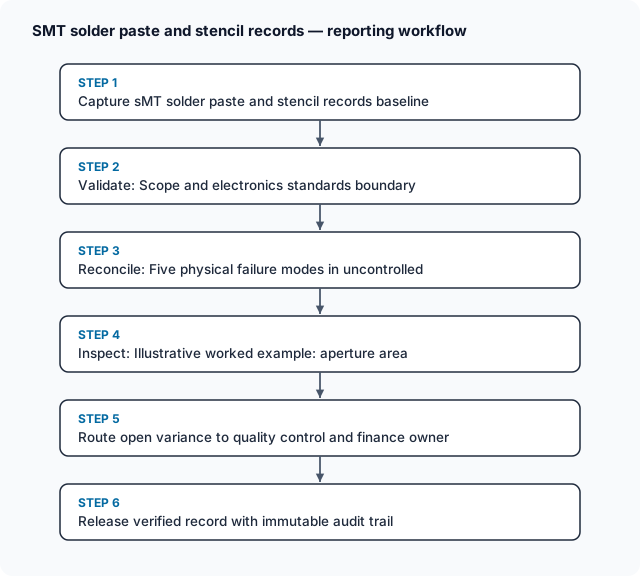
Read the complete workflow as text
- Capture electronics quality manageme baseline record → Verify revision, unit Basis and cutoff alignment
- Verify revision, unit Basis and cutoff alignment → Run deterministic reconciliation and tolerance check
- Run deterministic reconciliation and tolerance check → Quarantine mismatched or unapproved lines
- Quarantine mismatched or unapproved lines → Route exception to named domain and finance owner
- Route exception to named domain and finance owner → Release verified record with immutable audit trail
Five physical failure modes in uncontrolled solder-paste and stencil workflows
- Opening Cold Solder Paste Before Full Thermal Equilibration: Lead-free no-clean solder paste (such as SAC305 Type 4) is stored at $2^\circ\text{C}\text{–}10^\circ\text{C}$ to arrest chemical reactions between the acidic flux activator and the metal powder oxide layer. If an operator pulls a $5^\circ\text{C}$ jar from the fridge and opens the cap after only 45 minutes (or heats it rapidly with a heat gun), ambient water vapour condenses into the cold paste—oxidizing the solder powder and causing explosive steam spattering (mid-chip solder balls) inside the reflow oven.
- Exceeded Stencil Life and Idle-Line Rheology Slump:
Once spread onto the stencil (
STENCIL_ROLL), volatile solvents in the flux evaporate continuously. After 8 to 12 hours on the printer (or after sitting idle without kneading for $ over 45\text{ minutes}$), viscosity spikes, tackiness drops, and paste sticks inside fine-pitch apertures instead of releasing onto the PCB pad. - Aperture Area Ratio ($\text{AR}$) Violation and Clogged Under-Stencil Wipe: Under IPC-7525C, reliable paste release from a stencil aperture requires the ratio of the PCB Pad Opening Area to the Aperture Inside Wall Area to satisfy $\text{AR} \ge 0.66$: $$\text{Area Ratio (AR)} = \frac{\text{Area}{\text{opening}}}{\text{Area}{\text{walls}}} = \frac{L \times W}{2(L + W) \times t}\quad (\text{rectangular}), \qquad \text{AR} = \frac{D}{4t}\quad (\text{circular})$$ When flux residue builds up on the aperture walls because the under-stencil wet/vacuum/dry wipe cycle was skipped or the solvent tank ran dry, the effective opening shrinks ($L_{\text{eff}} under L$), pushing $\text{AR}$ below $0.60$ and starving the pad.
- Sagged Stencil Mesh Tension ($ under 30\text{ N/cm}$): As a framed stencil accumulates tens of thousands of squeegee strokes, the stainless-steel mesh stretches. When tension drops below $30\text{ N/cm}$ (or varies by $ over 5\text{ N/cm}$ across the 5 measurement points), the stencil snaps off the PCB sluggishly after the print stroke, smearing paste edges and causing fine-pitch bridging.
- Passing Marginal SPI Boards into Pick-and-Place: Washing wet solder paste off a misprinted bare PCB in an ultrasonic board cleaner (IPC-7526) takes 10 minutes and costs zero components. Once components are placed and reflowed onto a bridged or starved deposit, rework requires hot-air BGA removal, site dressing, and X-ray re-inspection.
Scroll horizontally to see all columns.
| Control Gate | System Record & Identifier | Hard Interlock Limit | Mandatory MES / Line Action |
|---|---|---|---|
| 1. Paste Jar Thaw Clock | PASTE_JAR_ID (FRIDGE_OUT_TS $\to$ THAW_READY_TS) |
$4.0\text{ hours} \le t_{\text{thaw}} \le 72.0\text{ hours}$ (at $20^\circ\text{C}\text{–}25^\circ\text{C}$) | Printer barcode scanner rejects any PASTE_JAR_ID scanned $ under 4.0\text{ h}$ after fridge removal |
| 2. Stencil Open-Life & Idle Timer | JAR_OPEN_TS + Printer last-stroke timestamp |
Open stencil life $\le 8.0\text{–}12.0\text{ h}$; max idle pause $\le 30\text{ min}$ | Trigger mandatory kneading print + under-stencil wipe after $ over 30\text{ min}$ pause; scrap Bead at $8.0\text{ h}$ |
| 3. Stencil Tension & Clean Check | STENCIL_ID 5-point tension ($\text{N/cm}$) + ultrasonic wash log |
All 5 points $\ge 32.0\text{ N/cm}$; zero blocked apertures on light table | Block STENCIL_ID issue from tool crib if tension $ under 32\text{ N/cm}$ or post-run wash was skipped |
| 4. 3D SPI Volume & Offset Stop | Pad volume ($%\text{ of } V_{\text{nom}}$), height ($\mu\text{m}$), $X/Y$ offset | Volume band $70.0%\text{–}135.0%$; max 2 consecutive boards outside band | Stop conveyor before pick-and-place; trigger auto-wipe or closed-loop printer $X/Y/\theta$ alignment |
Illustrative worked example: aperture area ratio, 4-hour thaw enforcement, and closed-loop 3D SPI volume recovery
Illustrative SMT assembly scenario using synthetic figures to demonstrate aperture geometry, thaw/open-life timing, and SPI volume arithmetic; not a client case study.
An industrial electronics plant prints lead-free SAC305 Type 4 solder paste (JAR-SAC305-819, $500\text{ g}$ jar) through a $100,\mu\text{m}$ ($0.100\text{ mm}$ / $4\text{-mil}$) laser-cut stencil (STN-MAIN-409) for a controller board containing a fine-pitch QFN/BGA with $280,\mu\text{m} \times 280,\mu\text{m}$ square pad apertures.
Step 1: Verify stencil aperture Area Ratio ($\text{AR}$) and nominal 3D SPI deposit volume.
- Aperture Opening Area ($A_{\text{open}}$) and Wall Area ($A_{\text{wall}}$): $$A_{\text{open}} = 280,\mu\text{m} \times 280,\mu\text{m} = 78,400,\mu\text{m}^2$$ $$A_{\text{wall}} = 2 \times (280,\mu\text{m} + 280,\mu\text{m}) \times 100,\mu\text{m} = 1,120,\mu\text{m} \times 100,\mu\text{m} = 112,000,\mu\text{m}^2$$
- Area Ratio ($\text{AR}$) check against IPC-7525C: $$\text{AR} = \frac{78,400,\mu\text{m}^2}{112,000,\mu\text{m}^2} = 0.700 \ge 0.66\text{ minimum threshold (PASS)}$$
- Nominal theoretical paste deposit volume ($V_{\text{nom}}$) and 3D SPI control limits ($70.0%\text{–}135.0%$ ): $$V_{\text{nom}} = 78,400,\mu\text{m}^2 \times 100,\mu\text{m} = 7,840,000,\mu\text{m}^3 = 7.84\text{ nL}$$ $$V_{\text{SPI_min}} = 0.700 \times 7.84\text{ nL} = 5.49\text{ nL}, \qquad V_{\text{SPI_max}} = 1.350 \times 7.84\text{ nL} = 10.58\text{ nL}$$
Step 2: Track JAR-SAC305-819 state transitions and catch mid-shift SPI volume drop.
Using ERPNext Batch and Quality Inspection records linked to the stencil printer and 3D SPI machine:
- Removed from $5^\circ\text{C}$ Refrigerator (
FRIDGE-SMT-01):05:30(STATE = THAWING; earliest enable timestamp =05:30 + 4.0 h = 09:30). - Scanned at Centrifugal Mixer & Stencil Printer:
09:40($4.17\text{ h}$ thaw $\ge 4.0\text{ h}$ PASS); loaded ontoSTN-MAIN-409at09:45(STATE = ON_STENCIL; 8.0-hour stencil life expires at17:45). - Boards
#001–#139(09:45–13:40): 3D SPI mean volume acrossU4pads holds steady at $99.2%$ ($7.78\text{ nL}$). - Line Pause (
13:40–14:15, $35\text{ minutes}$): Downstream pick-and-place stops for feeder troubleshooting while paste sits static on the stencil. - Boards
#140–#142(14:16–14:20): Because partially dried paste skin coats the aperture walls after the $35\text{-minute}$ pause, 3D SPI recordsU4deposit volume falling to $68.1%$ ($5.34\text{ nL}$) on#140, $65.5%$ ($5.14\text{ nL}$) on#141, and $64.2%$ ($5.03\text{ nL}$) on#142(all below the $70.0%$ / $5.49\text{ nL}$ floor).
Scroll horizontally to see all columns.
| Production Event / Board Serial | Timestamp | Jar / Stencil Elapsed Clock | U4 Aperture Mean SPI Volume ($\text{nL} / %$) |
Automated Line Action & Disposition |
|---|---|---|---|---|
| 1. Fridge Out $\to$ Printer Load | 05:30 $\to$ 09:45 |
Thaw: $4.17\text{ h}$ ($\ge 4.0\text{ h}$) | Stencil Tension: $36.5\text{ N/cm}$ | PASS: Enable printer; set expiry 17:45 |
2. Normal Run (#001–#139) |
09:45 – 13:40 |
Open Life: $0.0\text{–}3.92\text{ h}$ | $7.78\text{ nL}$ ($99.2%$) | PASS: Advance to pick-and-place |
3. Post-Pause Starvation (#140–#142) |
14:16 – 14:20 |
Idle Pause: $35\text{ min}$ ($ over 30\text{ min}$) | $5.03\text{ nL}$ ($64.2% under 70.0%$) | CONVEYOR STOP: Divert #140–#142 to wash |
4. Recovery Wipe & Fresh Bead (#143+) |
14:25 – 17:30 |
Open Life: $4.67\text{–}7.75\text{ h}$ | $7.71\text{ nL}$ ($98.4%$) | RESUMED: Zero post-reflow AOI opens |
Diverting bare boards #140–#142 to the board washer before component placement and executing a wet-vacuum-dry under-stencil wipe plus a $50\text{ g}$ fresh paste bead prevents three costly BGA open-joint reworks at post-reflow AOI/X-ray.
Workflow, owner roles, exceptions, and recovery controls
Scroll horizontally to see all columns.
| Workflow Stage | Accountable Owner | Required System Evidence | Exception Trigger | Recovery & Escalation Control |
|---|---|---|---|---|
| 1. Fridge Pull & Thaw Gate | SMT Material Handler | Scanned PASTE_JAR_ID, lot expiry date, FRIDGE_OUT_TS |
Operator attempts to scan jar at mixer/printer at $ under 4.0\text{ h}$ thaw or $ over 72\text{ h}$ unrefrigerated shelf life | Hard-block printer load; keep jar on warming rack until $4.0\text{ h}$ clock completes |
| 2. Stencil Issue & Tension Check | Tool Crib / Setup Tech | STENCIL_ID 5-point tensiometer readings ($\text{N/cm}$) + cumulative stroke count |
Any corner/centre tension $ under 32.0\text{ N/cm}$ or torn foil/damaged nano-coating | Quarantine stencil (STENCIL_SCRAP_HOLD); reorder replacement stencil before scheduling job |
| 3. Print Run & Idle-Pause Rule | SMT Printer Operator | JAR_OPEN_TS, automatic bead replenishment log, under-stencil solvent level |
Printer idle $ over 30\text{ min}$ without kneading stroke or open life reaches $8.0\text{ hours}$ | Lock print cycle on resume until wet/vac/dry wipe and kneading stroke run; at $8.0\text{ h}$, scrape stencil into hazardous waste |
| 4. Closed-Loop SPI-to-AOI Audit | Process Engineer & QA | 3D SPI $C_{pk}$ volume/offset log linked by board barcode (PCB_SN) to post-reflow AOI defects |
AOI detects solder bridge or open joint on a pad that passed 3D SPI | Overlay SPI 3D height map against AOI defect coordinate; tighten SPI volume/offset window or adjust reflow profile |
Bounded pilot and implementation check
Pilot serialized paste-jar thaw gates and closed-loop SPI-to-AOI tracking on 1 SMT line over 3 weeks:
- Pilot boundary: Barcode every solder-paste jar (
PASTE_JAR_ID) at goods receipt, enforce the 4-hour thaw and 8-hour stencil-life rules via scanner timestamps, and link 3D SPI board serial logs to post-reflow AOI results. - Baseline capture: Measure the prior 4 weeks of post-reflow AOI solder defects (bridges, insufficient solder, solder balls, tombstoning) and audit how many misprinted boards were caught at SPI vs after reflow.
- Acceptance criteria: Zero paste jars opened before 4.0 hours of thawing; 100% of printer pauses $ over 30\text{ minutes}$ trigger a forced wet/vacuum under-stencil wipe before printing the next production board; post-reflow AOI printing-related defect rate drops as marginal boards are caught at bare-board SPI.
- Stop condition: If operators are returning partially used paste from the stencil into a "re-use jar," eliminate the practice immediately or restrict reworked paste strictly to a single documented second-shift window within the total 8-hour open-life budget.
Recommended next actions.
- Serialize every solder-paste jar (
PASTE_JAR_ID) upon arrival: Track fridge-in, fridge-out, mixer, and printer-load timestamps per individual jar rather than by supplier lot number. - Configure a hard 4.0-hour thaw lockout and 8.0-hour stencil open-life cutoff: Prevent operators from rushing cold jars onto the line or running dried-out paste across two full shifts.
- Enforce an automatic under-stencil wipe after any line stop exceeding 30 minutes: Clear dried flux skin from fine-pitch apertures before the next PCB enters the printer.
- Link 3D SPI volume alarms to an immediate conveyor stop before pick-and-place: Wash misprinted bare PCBs in minutes rather than reworking populated BGA assemblies after reflow.
Frequently Asked Questions
How do SMT assembly lines enforce solder-paste refrigerator-to-thaw warming windows, stencil wipe/aperture life limits, and closed-loop SPI/AOI defect holds?.
Teams should govern electronics quality management software by linking every transaction to its source evidence, timestamp, and assigned owner before permitting downstream posting. Distinct from M111 (MSD humidity floor life); M112 enforces the 4-hour cold-paste warm-up lockout, 8–24 hour stencil open-life expiry, and Solder Paste Inspection (SPI) volume-bridging stops before pick-and-place. Rather than relying on informal spreadsheet overrides, the workflow enforces a documented verification gate and preserves the original observation whenever a correction is recorded.
How does smt traceability software handle exceptions and mismatches?.
When a discrepancy occurs during smt traceability software, the system routes the blocked record into an owned exception queue rather than silently dropping or auto-adjusting the balance. Assigned operational, quality, and finance owners must review and approve exceptions before posting. Each exception retains the original quantity, date, and counterparty reference until the designated reviewer resolves the variance with supporting evidence.
What should teams test before automating pcb assembly software?.
Before scaling pcb assembly software, run a bounded pilot using historical records that include partial receipts, late updates, duplicate messages, and rejected lines. Verify that the integration preserves idempotency, maintains a clear segregation of duties between operational entry and financial approval, and produces an auditable trail for every state transition.
Compare this workflow with your current setup
Share the step that takes the most manual work, the systems involved and the exceptions your team handles. That gives us a concrete starting point for comparing approaches.
Sources and further reading
Sources checked 15 October 2026. Worked examples and workflow diagrams are original illustrations, not reported client results.
