Injection-moulding resin and regrind records: enforce virgin blend caps, drying dwell, and moisture gates
For production managers, planners and plant leaders · Compare approaches
TL;DR — what you’ll learn
- Enforce customer and [UL 746D](https://www.ul.com/services/plastics-recognition-and-testing) maximum regrind blend percentages (e.g., $0\%$ virgin-only for medical/airbag parts, $\le 15\%$ for automotive glass-filled connectors, or $\le 25\%$ standard UL ceiling) at the gravimetric blender and ERP BOM level rather than letting operators dump 100% of granulated sprues back into the press hopper.
- Track regrind by thermal generation count (GEN-1 vs GEN-2+) and parent virgin resin + colorant lot, blocking unlabelled floor sweepings or multi-generation degraded regrind where glass-fibre breakage and polymer chain scission lower impact strength.
- Interlock press cycle start on hygroscopic resin drying verification ([AIAG CQI-23](https://www.aiag.org/quality/automotive-core-tools/cqi-23)): verify desiccant dryer temperature, dew point ($\le -30^\circ\text{C}\text{ to }-40^\circ\text{C}$), minimum hopper residence time ($M_{\text{hopper}} \ge \dot{m}_{\text{press}} \times t_{\text{dwell\_min}}$), and Karl Fischer / Loss-on-Drying moisture ([ASTM D6869 / D6980](https://www.astm.org/d6869-17.html)).
- Reconcile gross shot weight (net parts + cold runner) against virgin gaylord depletion and surplus regrind stock on every closed work order.

Illustrative manufacturing inspection room and machine shop floor; not a client facility.
In technical injection moulding, two silent material variables cause catastrophic structural failures that cannot be caught by simple dimensional inspection: excessive or multi-generation runner regrind (which chops reinforcing glass fibres and breaks polymer chains) and hydrolytic degradation from wet hygroscopic resin (where moisture inside Nylon/PA66, Polycarbonate/PC, PBT, or PET cleaves polymer chains inside the $280^\circ\text{C}$ barrel, leaving parts brittle even when surface silver splay is barely visible). Distinct from M026 (mould changeover scheduling) and M048 (mould cavity life), this guide (M113) governs gravimetric virgin-to-regrind blend ratio enforcement, regrind generation genealogy, desiccant dryer dwell-time math, and residual moisture release gates.
Scope and polymer standards boundary
This article specifies the ERP/MES resin batch genealogy, gravimetric blender control, and dryer moisture verification architecture for injection-moulding plants:
- What this workflow governs: Enforcing BOM virgin/regrind/masterbatch mass percentages, tracking granulated sprue/runner batches (
REG_LOT_ID,GENERATION_NO), calculating minimum desiccant-hopper mass for drying dwell compliance, and gating press release on moisture analyser tests. - What this workflow does not replace: It does not replace rheological capillary testing, Melt Flow Index (MFI) lab procedures, or scientific-moulding cavity-pressure profiling. Polymer handling and moulding records should align with UL 746D (Standard for Polymeric Materials — Fabricated Parts), AIAG CQI-23 (Special Process: Molding System Assessment), and moisture test methods ASTM D6869 and ASTM D6980.
Bounded injection molding erp verification and exception-routing workflow
Follow the workflow below, or open its complete text version.
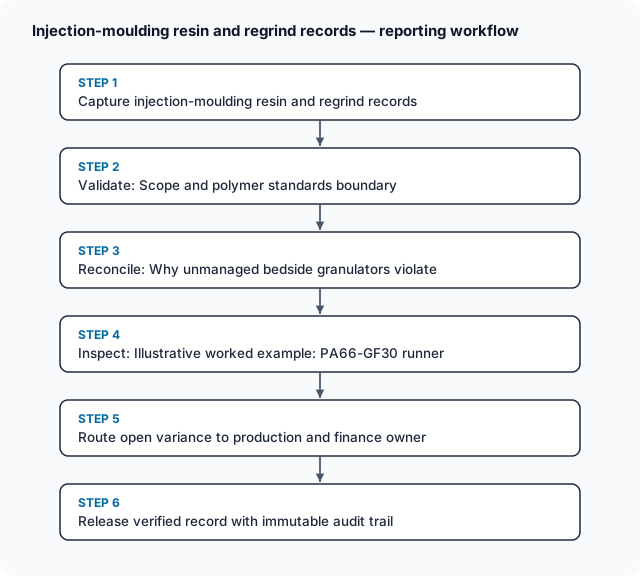
Read the complete workflow as text
- Capture injection molding erp baseline record → Verify revision, unit Basis and cutoff alignment
- Verify revision, unit Basis and cutoff alignment → Run deterministic reconciliation and tolerance check
- Run deterministic reconciliation and tolerance check → Quarantine mismatched or unapproved lines
- Quarantine mismatched or unapproved lines → Route exception to named domain and finance owner
- Route exception to named domain and finance owner → Release verified record with immutable audit trail
Why unmanaged bedside granulators violate regrind caps and moisture limits?
- Runner Fraction Exceeding Customer Allowed Regrind Percentage: Suppose a cold-runner mould produces $144\text{ g}$ of parts and a $36\text{ g}$ sprue/runner per shot ($20.0%$ runner fraction), but the automotive customer specification caps regrind at $\le 15.0%$. If a press-side granulator feeds 100% of the ground runner directly back into a proportional loader valve without metering, the actual blend rises to $20.0%$—violating the drawing and gradually accumulating 2nd-, 3rd-, and 4th-generation thermally degraded polymer.
- Glass-Fibre Attrition and Molecular Weight Drop Across Generations:
In $30%$ glass-filled polyamide (
PA66-GF30), each pass through the granulator blades and press screw reduces mean glass-fibre length from $\sim 350,\mu\text{m}$ down toward the critical reinforcement length ($\sim 180,\mu\text{m}$), dropping Izod impact and tensile strength even when part weight looks normal. - Hopper Short-Circuiting During High-Rate Moulding ("Starved Drying Dwell"): A desiccant dryer set to $80^\circ\text{C}$ and $-38^\circ\text{C}$ dew point still delivers wet resin to the barrel if the hopper level drops too low. For a press consuming $\dot{m}{\text{press}}\text{ (kg/h)}$ of resin that requires a minimum drying dwell time $t{\text{dwell_min}}\text{ (hours)}$, the active resin mass maintained inside the drying hopper ($M_{\text{hopper}}$) must continuously satisfy: $$M_{\text{hopper}} \ge \dot{m}{\text{press}} \times t{\text{dwell_min}}$$ If an operator starts a press only 90 minutes after filling an empty dryer—or lets the hopper level sensor drop to $25%$, resin reaches the barrel throat with $ over 0.25%$ moisture, causing hydrolytic chain scission.
- Regrind Moisture Re-Absorption Before Re-Use: Even when virgin resin is dried properly, sprues ejected into an open granulator bin absorb ambient humidity within 30 to 60 minutes. Under AIAG CQI-23, hygroscopic regrind must be fed through the top of the drying hopper (never dumped cold into the press throat below the dryer) so it undergoes the full drying dwell alongside virgin pellets.
Scroll horizontally to see all columns.
| Polymer Class & Grade | Max Allowable Regrind (CAP) |
Dryer Temp & Dew Point | Min Drying Dwell ($t_{\text{dwell}}$) | Max Residual Moisture (ASTM D6869) |
|---|---|---|---|---|
| Medical / Safety-Critical PC, PEEK, PSU | $0.0%$ (100% Virgin Only) | $120^\circ\text{C}\text{–}150^\circ\text{C}$; DP $\le -40^\circ\text{C}$ | $4.0\text{–}6.0\text{ hours}$ | $\le 0.02%$ ($200\text{ ppm}$) |
Automotive Structural PA66-GF30 |
$\le 15.0%$ (GEN-1 Only) |
$80^\circ\text{C}$; DP $\le -35^\circ\text{C}$ | $4.0\text{ hours}$ | $\le 0.08%\text{–}0.12%$ |
UL-Recognized Enclosure PC/ABS (UL 746D) |
$\le 25.0%$ Same-Grade/Color | $95^\circ\text{C}\text{–}105^\circ\text{C}$; DP $\le -35^\circ\text{C}$ | $3.0\text{–}4.0\text{ hours}$ | $\le 0.03%$ ($300\text{ ppm}$) |
Non-Hygroscopic Commodity PP / HDPE |
$\le 25.0%\text{–}30.0%$ | Hot-air $65^\circ\text{C}$ (if masterbatch requires) | $1.0\text{–}2.0\text{ hours}$ | $\le 0.10%$ |
Illustrative worked example: PA66-GF30 runner mass balance, 15% regrind cap enforcement, and 4-hour dryer dwell calculation
Illustrative injection-moulding scenario using synthetic figures to demonstrate virgin/regrind mass balance and dryer dwell arithmetic; not a client case study.
An automotive plastics supplier moulds $50,000\text{ pcs}$ of PA66-GF30 high-voltage connector housings (WO-CONN-304) in an 8-cavity cold-runner mould (MOULD-HV-08) on a $160\text{-tonne}$ press (PRESS-14) at a cycle time of $18.0\text{ seconds}$ ($200\text{ shots/hour}$).
Step 1: Compute shot mass breakdown and surplus runner generation under a 15% regrind cap.
- Total shots required for $50,000\text{ good parts}$ ($N_{\text{shots}}$): $$N_{\text{shots}} = \frac{50,000\text{ parts}}{8\text{ cavities/shot}} = 6,250\text{ shots};\left(\text{Run time} = \frac{6,250}{200} = 31.25\text{ hours}\right)$$
- Shot mass components:
- Net finished part weight ($8 \times 18.0\text{ g}$): $144.0\text{ g/shot}$ ($80.00%$ of shot)
- Cold sprue and runner tree ($m_{\text{runner}}$): $36.0\text{ g/shot}$ ($20.00%$ of shot)
- Gross shot weight ($m_{\text{gross}}$): $$m_{\text{gross}} = 144.0\text{ g} + 36.0\text{ g} = 180.0\text{ g/shot} = 0.180\text{ kg/shot}$$
- Total gross polymer plasticized across $6,250\text{ shots}$ ($M_{\text{gross_total}}$): $$M_{\text{gross_total}} = 6,250\text{ shots} \times 0.180\text{ kg/shot} = 1,125.00\text{ kg};\left(900.00\text{ kg net parts} + 225.00\text{ kg runner}\right)$$
Because the customer drawing caps regrind at $R_{\text{max}} = 15.0%$ while the mould generates $20.0%$ runner, the gravimetric blender (BLEND-14) is locked to $85.0%$ Virgin PA66-GF30 (LOT-VIR-772) + $15.0%$ GEN-1 Regrind:
- Maximum regrind consumed back into
WO-CONN-304($M_{\text{reg_used}}$): $$M_{\text{reg_used}} = 1,125.00\text{ kg} \times 0.150 = 168.75\text{ kg};(27.0\text{ g/shot})$$ - Required virgin
PA66-GF30issued toWO-CONN-304($M_{\text{virgin_used}}$): $$M_{\text{virgin_used}} = 1,125.00\text{ kg} \times 0.850 = 956.25\text{ kg};(153.0\text{ g/shot})$$ - Surplus
GEN-1runner regrind diverted to sealed quarantine container (M_{\text{reg\_surplus}}): $$M_{\text{reg_surplus}} = 225.00\text{ kg generated} - 168.75\text{ kg re-blended} = 56.25\text{ kg}$$
This $56.25\text{ kg}$ surplus is bagged into a foil-lined container tagged REG-PA66GF30-BLK-GEN1-772 for use on a thick-walled runnerless (hot-runner) bracket job where $0%$ runner is generated, ensuring zero material is wasted while WO-CONN-304 never exceeds $15.0%$ regrind.
Step 2: Verify desiccant dryer hopper residence mass and moisture gate.
At $200\text{ shots/hour}$ ($0.180\text{ kg/shot}$), the press mass throughput ($\dot{m}_{\text{press}}$) is:
$$\dot{m}_{\text{press}} = 200\text{ shots/h} \times 0.180\text{ kg/shot} = 36.0\text{ kg/h}$$
To guarantee the required $t_{\text{dwell_min}} = 4.0\text{ hours}$ drying residence time at $80^\circ\text{C}$ and $-38^\circ\text{C}$ dew point, the minimum resin mass continuously maintained inside desiccant hopper DRY-04 ($M_{\text{hopper_min}}$) must be:
$$M_{\text{hopper_min}} = 36.0\text{ kg/h} \times 4.0\text{ h} = 144.0\text{ kg}$$
Scroll horizontally to see all columns.
| Material / Process Parameter | Specification / Formula Target | Actual Logged Value on WO-CONN-304 |
Verification Method | Disposition |
|---|---|---|---|---|
Virgin PA66-GF30 Share |
$\ge 85.0%$ ($153.0\text{ g/shot}$) | $956.25\text{ kg}$ ($85.00%$) | Gravimetric load cell log | PASS |
| In-Line Regrind Share | $\le 15.0%$ ($27.0\text{ g/shot}$) | $168.75\text{ kg}$ ($15.00%$) | Gravimetric load cell log | PASS |
| Surplus Runner Diverted | $20.0% - 15.0% = 5.0%$ of melt | $56.25\text{ kg}$ (REG-GEN1-772) |
Weighed foil-lined gaylord receipt | BOOKED TO STOCK |
| Dryer Dew Point & Hopper Mass | $\le -35^\circ\text{C}$; Mass $\ge 144.0\text{ kg}$ ($4.0\text{ h}$) | $-38.2^\circ\text{C}$; $165.0\text{ kg}$ ($4.58\text{ h}$ dwell) | Dryer PLC + low-level probe at $150\text{ kg}$ | PASS |
| Pre-Start Throat Moisture | $\le 0.10%$ ($1,000\text{ ppm}$) | $0.064%$ ($640\text{ ppm}$) | Loss-on-Drying / Karl Fischer (ASTM D6869) | RELEASED |
Workflow, owner roles, exceptions, and recovery controls
Using ERPNext BOM, Batch, and Quality Inspection controls:
Scroll horizontally to see all columns.
| Workflow Stage | Accountable Owner | Required System Evidence | Exception Trigger | Recovery & Escalation Control |
|---|---|---|---|---|
| 1. Resin & Regrind Barcode Load | Material Handler | Scanned VIRGIN_LOT_ID + REGRIND_LOT_ID (GEN-1, matching grade/color/UL file) |
Operator scans GEN-2 regrind, mismatched color/grade, or attempts regrind load on a 0% VIRGIN_ONLY job |
Lock vacuum loader pump; trigger line supervisor alert and block hopper loading |
| 2. Dryer Pre-Dwell & Dew-Point Gate | Moulding Setup Tech | Dryer temp ($80^\circ\text{C}$), dew point ($\le -35^\circ\text{C}$), 4-hour pre-dry countdown, LOD moisture test | Dew point rises $ over -25^\circ\text{C}$, hopper level drops below $M_{\text{hopper_min}} = 144\text{ kg}$, or moisture $ over 0.10%$ | Interlock injection unit start; switch desiccant beds/regenerate molecular sieve and complete full 4-hour soak |
| 3. Gravimetric Blender Monitoring | Press Operator / PLC | Per-shot virgin vs regrind gram weights from gravimetric weigh bin | Regrind feeder bridges or over-doses $ over 15.0%$ cap for 3 consecutive dumps | Divert moulded shots via robot scrap chute until blender ratio returns to $85/15 \pm 0.5%$ |
| 4. Work-Order Mass Tie-Out | Production Supervisor | Virgin issued ($956.25\text{ kg}$) = Net parts ($900.00\text{ kg}$) + Surplus regrind ($56.25\text{ kg}$) + Purge scrap | Unexplained virgin over-consumption or zero surplus regrind returned on a $20%$ runner tool | Audit whether granulator was left feeding $20%$ unregulated back into the hopper |
Bounded pilot and implementation check
Pilot gravimetric regrind-cap enforcement and dryer dwell interlocks on 2 injection-moulding presses running hygroscopic engineering resins over 3 weeks:
- Pilot boundary: Connect gravimetric blender ratio logs, desiccant dryer dew-point/level alarms, and pre-start moisture analyzer results to ERP work-order batches for
PA66,PC, orPBTcomponents. - Baseline capture: Measure the runner-to-shot weight percentage on the pilot moulds, compare against customer drawing regrind limits, and audit how surplus runner was previously handled.
- Acceptance criteria: 100% of jobs where runner generation exceeds the allowed regrind cap book the exact excess ($M_{\text{runner}} - M_{\text{reg_allowed}}$) into serialized
GEN-1stock; 100% of press startups have a verified pre-dry countdown and passing moisture reading (ASTM D6869 / D6980). - Stop condition: If a press uses a volumetric proportional valve instead of a gravimetric load-cell blender, perform a timed catch-weight calibration at every setup and divert surplus sprues at the robot picker (e.g., dropping 1 out of every 4 runners into a sealed surplus bin so only 3 of 4 enter the granulator).
Recommended next actions.
- Calculate the exact runner-to-gross-shot percentage on every cold-runner mould BOM: Whenever $m_{\text{runner}} / m_{\text{gross}}$ exceeds the customer's maximum regrind cap ($R_{\text{max}}$), configure the robot or blender to divert the excess into tagged
GEN-1inventory. - Route all hygroscopic regrind into the top of the desiccant drying hopper: Never feed granulated Nylon, PC, or PBT sprues directly into the press throat below the dryer.
- Position the dryer low-level sensor at $M_{\text{hopper_min}} = \dot{m}{\text{press}} \times t{\text{dwell_min}}$: Prevent hopper levels from dropping so low that pellets pass through in less than 4 hours.
- Hard-block regrind items on
100% VIRGIN_ONLYmedical and safety BOMs: Configure barcode scanner validation at the vacuum loader so regrind lots cannot be scanned onto virgin-only work orders.
Frequently Asked Questions
How should injection-moulding plants enforce maximum runner-regrind blend percentages (e.g., ≤15% first-generation regrind), resin dryer dew-point holds, and UL/automotive virgin-only locks?.
Teams should govern injection molding erp by linking every transaction to its source evidence, timestamp, and assigned owner before permitting downstream posting. Distinct from M026 (mould changeover scheduling) and M048 (mould cavity life); M113 controls gravimetric/volumetric loader virgin-to-regrind ratios, generation count caps, and hygroscopic polymer drying dwell verification. Rather than relying on informal spreadsheet overrides, the workflow enforces a documented verification gate and preserves the original observation whenever a correction is recorded.
How does plastics manufacturing software handle exceptions and mismatches?.
When a discrepancy occurs during plastics manufacturing software, the system routes the blocked record into an owned exception queue rather than silently dropping or auto-adjusting the balance. Assigned operational, quality, and finance owners must review and approve exceptions before posting. Each exception retains the original quantity, date, and counterparty reference until the designated reviewer resolves the variance with supporting evidence.
What should teams test before automating molding production monitoring?.
Before scaling molding production monitoring, run a bounded pilot using historical records that include partial receipts, late updates, duplicate messages, and rejected lines. Verify that the integration preserves idempotency, maintains a clear segregation of duties between operational entry and financial approval, and produces an auditable trail for every state transition.
Compare this workflow with your current setup
Share the step that takes the most manual work, the systems involved and the exceptions your team handles. That gives us a concrete starting point for comparing approaches.
Sources and further reading
Sources checked 15 October 2026. Worked examples and workflow diagrams are original illustrations, not reported client results.
