Turn supplier quality claims into an evidence-backed commercial decision
For quality, engineering and records teams · Compare approaches
TL;DR — what you’ll learn
- Substantiate supplier quality recovery claims by separating verified physical defect and containment costs from disputed consequential claims and approved finance settlement postings.
- Never issue an automatic accounts-payable debit deduction directly from an unreviewed shop-floor Non-Conformance Report (NCR); link every claimed rupee to lot-specific inspection records, segregated scrap or rework tickets, and contract liability clauses.
- Eliminate double counting between replacement credit/return-to-vendor (RTV) stock value and internal rework labour—a rejected unit is either returned/scrapped for material credit or reworked to salvage value, never billed for both full material value and rework recovery.
- Keep commercial dispute negotiation visible in a dedicated claim status ledger (Draft_Evidence, Issued_To_Supplier, Disputed_Under_Review, Agreed_Settlement) so Finance posts only authorised credit notes or debit adjustments.

Illustrative manufacturing inspection room and machine shop floor; not a client facility.
Why supplier debit notes fail during commercial and finance review
In automotive component and fabricated metal plants, a bad batch of castings, stampings, or plated fasteners can trigger immediate shop-floor costs: receiving inspectors sort all a lot, operators rework burrs or thread defects to keep an assembly line running, and scrapped parts create material shortages. Yet when Procurement or Accounts Payable attempts to recover those losses via a unilateral debit note at month end, suppliers routinely reject the claim. Common root causes include:
- Unlinked batch and receipt evidence: The debit note references a monthly summary figure rather than a specific Goods Receipt Note (GRN), supplier heat/batch number, and verified incoming quality inspection record (
M036). - Double counting material and rework: The plant claims full material replacement credit for 150 defective castings while simultaneously charging the supplier for rework labour on 110 of those same 150 castings that were salvaged and used in production.
- Commingled internal inefficiencies and uncontracted penalties: Line-stoppage overhead rates or punitive administrative fees not supported by the signed purchase agreement are bundled with verifiable sorting labour, causing the supplier to dispute the entire package.
- Premature ledger netting: Accounts Payable deducts an unagreed claim from an open supplier invoice before Supplier Quality and Procurement complete joint inspection or contract review, creating an unreconciled vendor statement and blocking future deliveries.
Direct answer: Substantiating a supplier quality claim requires a three-layer separation of records: (1) verified operational cost backed by lot-specific NCRs (S08), time-stamped sorting/rework work orders, and physical scrap versus salvage disposition counts; (2) contractual recovery eligibility reviewed by Procurement against the signed purchase agreement or quality assurance agreement (QAA); and (3) authorised financial settlement (S18) where Finance posts a debit note or matches a supplier credit note only for the agreed amount while keeping any contested balance explicitly flagged as Disputed_Under_Review.
As shown in ERPNext nonconformance tracking, quality procedures record observations, root causes, and corrective actions, while Microsoft Dynamics 365 accounts payable invoice matching governs three-way matching between purchase orders, product receipts, and vendor invoices. Bridging these two domains requires a structured commercial claim ledger so operational quality evidence informs—but never unilaterally executes—accounting entries.
Supplier Quality Claim Evidence, Dispute Partitioning, and Settlement Workflow
Follow the workflow below, or open its complete text version.
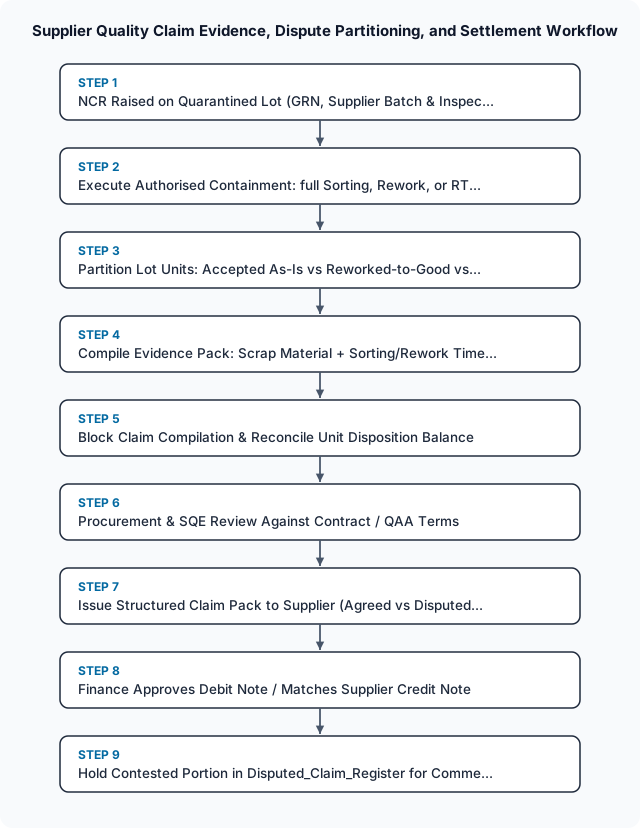
Read the complete workflow as text
- NCR Raised on Quarantined Lot (GRN, Supplier Batch & Inspec... → Execute Authorised Containment: full Sorting, Rework, or RT...
- Execute Authorised Containment: full Sorting, Rework, or RT... → Partition Lot Units: Accepted As-Is vs Reworked-to-Good vs...
- Partition Lot Units: Accepted As-Is vs Reworked-to-Good vs... → Compile Evidence Pack: Scrap Material + Sorting/Rework Time...
- Compile Evidence Pack: Scrap Material + Sorting/Rework Time... → Block Claim Compilation & Reconcile Unit Disposition Balance
- Block Claim Compilation & Reconcile Unit Disposition Balance → Procurement & SQE Review Against Contract / QAA Terms
- Procurement & SQE Review Against Contract / QAA Terms → Issue Structured Claim Pack to Supplier (Agreed vs Disputed...
- Issue Structured Claim Pack to Supplier (Agreed vs Disputed... → Finance Approves Debit Note / Matches Supplier Credit Note
- Finance Approves Debit Note / Matches Supplier Credit Note → Hold Contested Portion in Disputed_Claim_Register for Comme...
Worked example: reconciling sorting, rework, and scrap recovery without double counting
The following scenario, part numbers, unit prices, labour rates, and settlement figures are explicitly illustrative and use assumed values to demonstrate claim math and double-counting prevention.
Suppose an industrial brake-assembly plant receives Lot SUP-LOT-774 consisting of 1,000 machined cast-iron caliper brackets (Part BRK-402) on Goods Receipt GRN-2026-5120 against Purchase Order PO-8830 at a contracted unit price of ₹420.00 per bracket (total lot invoice value = ₹4,20,000.00, excluding taxes).
During incoming and line-side inspection (INS-2026-3910), a mounting-ear flatness and thread-depth nonconformance (NCR-2026-118) is detected. To prevent a customer shipment delay, Supplier Quality and the supplier's quality representative agree via written containment email (CONT-AUTH-118) to perform an immediate full-lot sort at the plant, rework salvageable brackets, and scrap non-salvageable brackets for return-to-vendor (RTV) credit.
1. Physical unit mass balance across the 1,000-piece lot
Before calculating any financial claim, reconcile the physical disposition of all 1,000 brackets:
- Accepted first-pass during full-lot sorting (
Good_As_Received):850 brackets - Defective brackets isolated during sorting (
Total_Defective):150 brackets(1,000 - 850 = 150)- Salvaged via secondary thread-chasing and milling rework (
Reworked_To_Good):110 brackets - Irreparable casting porosity / under-metal (
Scrapped_For_RTV):40 brackets
- Salvaged via secondary thread-chasing and milling rework (
- Net usable brackets released to production: 850 + 110 = 960 brackets.
- Conservation check: 850 (good) + 110 (reworked) + 40 (scrapped RTV) = 1,000 received brackets. No bracket appears in both the
Reworked_To_GoodandScrapped_For_RTVbuckets.
2. Comparing an inflated (double-counted) claim vs the verified claim ledger
If an unreviewed spreadsheet claims material credit for all 150 defective brackets (150 × ₹420 = ₹63,000) plus rework labour on the 110 salvaged brackets, it overstates material loss by 110 × ₹420 = ₹46,200 because the plant kept and used those 110 brackets after rework.
Now examine the verified, non-overlapping cost ledger compiled under CLM-2026-044:
Scroll horizontally to see all columns.
| Claim line ID | Cost category | Operational evidence reference | Quantity & rate calculation | Recorded internal cost (₹) | Contractually eligible claim (₹) | Supplier response & settlement status |
|---|---|---|---|---|---|---|
| L1 | Scrapped / RTV material replacement credit | RTV-2026-089 (40 irreparable brackets returned; excludes 110 salvaged units) |
40 units × ₹420.00/unit | ₹16,800.00 | ₹16,800.00 | Agreed (₹16,800.00) — matched to physical RTV gate pass |
| L2 | full containment sorting labour | WO-SORT-118 (2 inspectors × 9.0 hours = 18.0 hours @ ₹350.00/h) |
18.0 h × ₹350.00/h | ₹6,300.00 | ₹6,300.00 | Agreed (₹6,300.00) — pre-authorised via CONT-AUTH-118 |
| L3 | Salvage rework machining & gauge re-verify | WO-RWK-118 (110 units × 0.15 h/unit = 16.5 hours @ ₹600.00/h) |
16.5 h × ₹600.00/h | ₹9,900.00 | ₹9,900.00 | Agreed (₹9,900.00) — cheaper than scrapping 110 units (₹46,200) |
| L4 | Internal assembly line standby / reschedule cost | PROD-LOG-412 (1.5 hours assembly cell micro-delay @ ₹4,000.00/h internal absorption) |
1.5 h × ₹4,000.00/h | ₹6,000.00 | ₹6,000.00 (claimed) | Disputed (₹6,000.00) — PO excludes consequential line-stoppage absorption |
| L5 | Administrative NCR handling fee | Standard quality policy schedule (QA-FEE-01) |
Flat fee per lot NCR | ₹2,500.00 | ₹0.00 (not in signed PO) | Excluded (₹0.00) — not incorporated in signed vendor contract |
| Total | Claim reconciliation summary | NCR-2026-118 / CLM-2026-044 |
1,000-unit lot (850 + 110 + 40) |
₹41,500.00 | ₹39,000.00 issued | ₹33,000.00 Agreed / ₹6,000.00 Disputed |
3. Verifying the commercial and accounting arithmetic
- Total recorded internal cost of poor quality (COPQ):
₹16,800.00 + ₹6,300.00 + ₹9,900.00 + ₹6,000.00 + ₹2,500.00 = ₹41,500.00 - Issued commercial claim (
L1 + L2 + L3 + L4, after Procurement removes uncontractedL5):₹16,800.00 + ₹6,300.00 + ₹9,900.00 + ₹6,000.00 = ₹39,000.00 - Agreed immediate recovery (
L1 + L2 + L3):₹16,800.00 + ₹6,300.00 + ₹9,900.00 = ₹33,000.00 - Economic benefit of salvage rework (
L3) vs scrapping the 110 brackets:Avoided Material Scrap Loss = (110 × ₹420.00) - ₹9,900.00 = ₹46,200.00 - ₹9,900.00 = ₹36,300.00 net saving - Net payable on
PO-8830 / GRN-2026-5120before tax:- Gross invoice for 1,000 brackets:
₹4,20,000.00 - Less authorised credit/debit settlement (
CN-SUP-904forL1 + L2 + L3):−₹33,000.00 - Undisputed net settlement released by Finance: ₹4,20,000.00 - ₹33,000.00 = ₹3,87,000.00
- Contested line-standby claim (
L4 = ₹6,000.00): Held inDisputed_Claim_Registerfor quarterly commercial review with the procurement head; not unilaterally deducted from the invoice payment unless contractually authorised. Applicable GST credit/debit note treatment (S18) is verified by Finance against actual tax invoice references.
- Gross invoice for 1,000 brackets:
Governance matrix: owners, approval boundaries, and exception rules
Scroll horizontally to see all columns.
| Claim stage | Accountable owner | Required system evidence | Exception rule & boundary |
|---|---|---|---|
| 1. Technical defect & unit disposition | Supplier Quality Engineer (SQE) | GRN, supplier lot ID, inspection record (S07), NCR (S08), and physical partition (Good + Reworked + Scrapped = Received) |
If any unit overlaps between Reworked_To_Good and Scrapped_For_RTV, the claim packet cannot advance. |
| 2. Containment & rework costing | Production / Quality Supervisor | Time-stamped sorting (WO-SORT) and rework (WO-RWK) tickets plus written containment authorisation |
Unlogged verbal sorting hours or flat percentage estimates cannot be billed as verified supplier recovery. |
| 3. Commercial eligibility & claim issue | Procurement Lead | Signed PO / Quality Assurance Agreement (QAA) liability terms and written notice within contractual claim window | Consequential downtime or uncontracted admin fees must be separated from direct material/sorting lines. |
| 4. Financial posting & AP matching | Finance Controller / AP Manager | Signed supplier credit note or bilaterally approved debit settlement (S18) |
Finance never posts an automatic AP deduction from an open Draft or Disputed NCR status. |
Acceptance criteria for a supplier quality claim workflow
- Zero unit overlap (
TEST-M044-01): For any lot-based claim, the sum ofAccepted_As_Is + Reworked_To_Good + Scrapped_RTVequals the inspected receipt quantity, and material replacement credit applies solely toScrapped_RTVunits. - Traceable cost backup (
TEST-M044-02): Every rupee on an issued claim links to a specificGRN,NCR, RTV gate pass, or time-stamped sorting/rework work order. - Explicit cost-to-recovery bridge (
TEST-M044-03): The claim register preserves three separate columns—Recorded_Internal_COPQ,Issued_Claim_Amount, andAgreed_Settled_Amount—so internal absorption variances are never disguised as open supplier receivables. - Controlled AP hold and settlement (
TEST-M044-04): Disputed claim lines remain visible in a commercial escalation queue without corrupting three-way AP invoice matching on undisputed deliveries.
Synthesis and next actions
Treating supplier quality claims as a disciplined bridge between lot-level NCR evidence, mutually exclusive unit dispositions, and contractual terms increases actual cash recovery while eliminating month-end invoice standoffs between Procurement, Finance, and key vendors.
- Enforce a three-way unit disposition check on every supplier NCR: Require the NCR screen (
S08) to reconcileAccepted_As_Is + Reworked_To_Good + Scrapped_RTV = Received_Lot_Qtybefore any financial claim worksheet can be generated. - Separate sorting/rework work orders from routine production labour: Issue dedicated containment and rework work orders tied to the supplier
NCRandGRNso labour hours are auditable and never mixed with standard operation routing times (M031). - Add a contractual eligibility review gate for Procurement: Have Procurement classify each cost line as
Contractually_Covered,Commercial_Negotiation, orInternal_COPQ_Onlybefore transmitting the claim pack to the vendor. - Configure Finance settlement statuses separately from technical NCR closure: Ensure AP posts debit/credit settlements (
S18) only againstAgreed_Settlementlines while tracking contested items in a datedDisputed_Under_Reviewregister.
Compare this workflow with your current setup
Share the step that takes the most manual work, the systems involved and the exceptions your team handles. That gives us a concrete starting point for comparing approaches.
Sources and further reading
Sources checked 15 October 2026. Worked examples and workflow diagrams are original illustrations, not reported client results.

