Connect industrial warranty complaints to the part that was actually shipped
For quality, engineering and records teams · Compare approaches
TL;DR — what you’ll learn
- Investigate industrial warranty complaints accurately by reconciling three distinct configuration states: (1) as-ordered engineering BOM, (2) as-shipped serial genealogy, and (3) current as-maintained field configuration after service replacements.
- Record the customer's reported symptom separately from technical root-cause fields at intake so service desks never assign a factory manufacturing defect code before verifying which physical component serial is actually installed in the machine.
- When a field service technician or third-party contractor has replaced a sub-assembly after commissioning, trace the failed component's own serial/lot lineage (As_Maintained) rather than blaming the original factory build lot (As_Shipped).
- Explicitly mark unrecorded field swaps or illegible component serial tags as an Investigation_Configuration_Gap requiring physical return or engineering inspection before authorising supplier chargebacks or factory CAPAs.

Illustrative manufacturing inspection room and machine shop floor; not a client facility.
Why warranty investigations blame the wrong production batch
In engineer-to-order (ETO) and assemble-to-order (MTO) machinery and electrical equipment manufacturing—such as industrial chillers, compressor skids, and variable-frequency drive (VFD) control panels—a single parent serial number covers dozens of life-limited electrical and mechanical sub-assemblies. When a customer logs a warranty failure 9 months after commissioning, many quality teams look up the parent panel's original sales order or standard BOM and immediately open a factory Non-Conformance Report (NCR) against the original assembly shift or supplier batch.
That shortcut breaks down whenever the product's configuration evolved between order entry and the failure date:
- Authorized pre-shipment deviation (
As_Ordered≠As_Shipped): During factory build, an approved engineering concession (M040) substituted an alternate contactor brand on 10 panels, so the standard BOM does not reflect the actual component shipped. - Post-commissioning field service swap (
As_Shipped≠As_Maintained): Four months after installation, a field technician replaced a tripped DC power supply module during a preventive or breakdown visit. When the replacement module fails five months later, looking up only the parent panel's original build record blames the factory-installed batch instead of the spare-parts replacement batch. - Unauthorised third-party modification (
Unverified_Field_State): The customer's site maintenance team swapped a relay or altered control wiring without logging a service bulletin, creating an unknown field configuration that cannot be diagnosed from factory ERP records alone.
Direct answer: To scope a warranty investigation and customer response correctly, your complaint workflow must resolve the parent serial number through an explicit configuration graph—comparing the as-shipped genealogy (S06, M017) and post-shipment service replacement history (S22) against the physical serial/batch tag on the failed sub-assembly—while keeping symptom intake (S08) strictly separated from verified root cause.
As outlined in the GS1 Global Traceability Standard, end-to-end traceability requires linking unique item identifiers across physical transformations, shipments, and lifecycle events. Likewise, Microsoft Dynamics 365 engineering change management documentation explains how product versions control released engineering definitions, while ERPNext nonconformance workflows structure observation and corrective action tracking. Connecting these records into a complaint-to-configuration graph prevents teams from launching costly factory CAPAs on the wrong component lineage.
Warranty Complaint Intake and As-Shipped vs As-Maintained Configuration Resolution
Follow the workflow below, or open its complete text version.
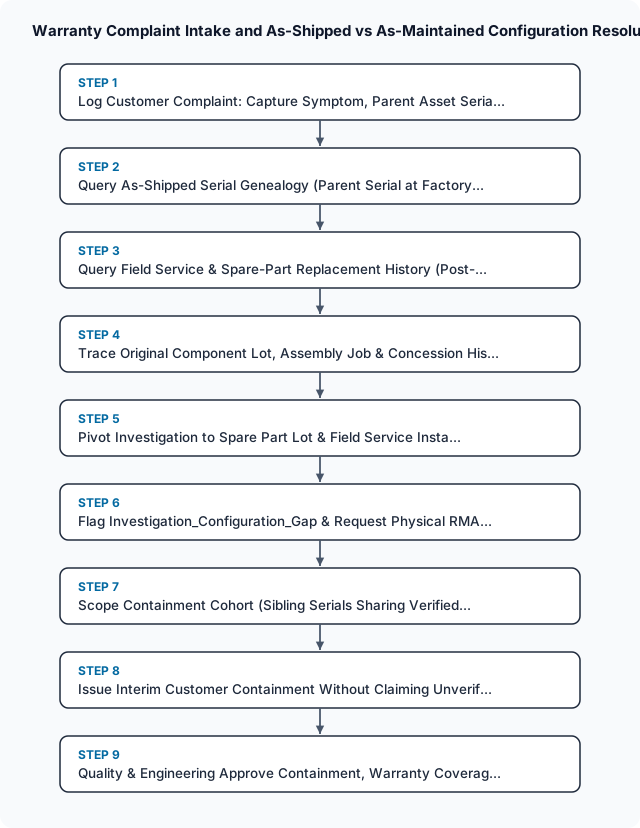
Read the complete workflow as text
- Log Customer Complaint: Capture Symptom, Parent Asset Seria... → Query As-Shipped Serial Genealogy (Parent Serial at Factory...
- Query As-Shipped Serial Genealogy (Parent Serial at Factory... → Query Field Service & Spare-Part Replacement History (Post-...
- Query Field Service & Spare-Part Replacement History (Post-... → Trace Original Component Lot, Assembly Job & Concession His...
- Trace Original Component Lot, Assembly Job & Concession His... → Pivot Investigation to Spare Part Lot & Field Service Insta...
- Pivot Investigation to Spare Part Lot & Field Service Insta... → Flag Investigation_Configuration_Gap & Request Physical RMA...
- Flag Investigation_Configuration_Gap & Request Physical RMA... → Scope Containment Cohort (Sibling Serials Sharing Verified...
- Scope Containment Cohort (Sibling Serials Sharing Verified... → Issue Interim Customer Containment Without Claiming Unverif...
- Issue Interim Customer Containment Without Claiming Unverif... → Quality & Engineering Approve Containment, Warranty Coverag...
Worked example: control panel warranty complaint after an intermediate field replacement
The following scenario, serial numbers, lot identifiers, failure dates, and cohort counts are explicitly illustrative and use assumed records to demonstrate configuration resolution and containment scoping.
Suppose an industrial automation plant manufactures serialised 110 kW Pump Control Panels (Model PCP-110, Engineering Revision Rev 3). On 2026-10-12, Customer CUST-IND-78 reports an intermittent 24 V DC control bus drop-out on Panel Serial PCP-2026-0114 (shipped on 2026-01-20 under Sales Order SO-5510).
1. Resolving the three configuration layers for Panel PCP-2026-0114
Rather than immediately blaming the January 2026 factory production batch, Customer Service and Quality resolve the configuration graph for position POS-04 (24 V DC / 20 A Switched-Mode Power Supply Module, Part PSU-24V-20A):
Scroll horizontally to see all columns.
| Configuration layer | Effective date | Recorded part & revision | Recorded component serial & supplier lot | Evidence source & status |
|---|---|---|---|---|
1. As-Ordered (Engineering BOM) |
2025-12-18 (SO-5510) |
PSU-24V-20A (Rev B) |
Not yet serial-bound | Standard released BOM (S22) |
2. As-Shipped (Factory Build Genealogy) |
2026-01-18 (WO-3104) |
PSU-24V-20A (Rev B) |
Serial PSU-SN-4409 · Supplier Lot LOT-PSU-2511 (60 units) |
Factory dispatch genealogy (M017) — superseded in field |
3. Field Service Event (FSM-2026-0612) |
2026-06-14 (Site visit) |
PSU-24V-20A (Rev C) |
Serial PSU-SN-7812 · Supplier Lot LOT-PSU-2604 (45 units) |
Authorised field service replacement after external lightning surge (FSM-2026-0612) |
4. Physical Failed Unit (RMA Photo / Tag) |
2026-10-12 (CMP-2026-309) |
PSU-24V-20A (Rev C) |
Serial PSU-SN-7812 · Supplier Lot LOT-PSU-2604 |
Customer photo of nameplate inside PCP-2026-0114 matches June spare replacement |
2. Quantitative impact on containment cohort scoping
Observe how resolving As_Shipped versus As_Maintained changes the affected population arithmetic:
Incorrect naive lookup (using
As_ShippedLotLOT-PSU-2511):LOT-PSU-2511contained 60 power supplies installed across 60 factory panels (PCP-2026-0081toPCP-2026-0140) built in January 2026.- Because
PSU-SN-4409(LOT-PSU-2511) was removed on2026-06-14after an external site surge and is not the part that failed on2026-10-12, inspecting or recalling those 60 January panels would target 0 units of the actual failing batch (fullmisdirected containment effort).
Verified configuration-graph lookup (using
As_MaintainedLotLOT-PSU-2604):- The failed unit
PSU-SN-7812belongs to Supplier LotLOT-PSU-2604(45 unitsreceived on2026-04-28underGRN-2026-1904). - Querying the ERP/MES serial genealogy (
M017) and spare-parts dispatch ledger for all 45 units ofLOT-PSU-2604reveals the exact four-way distribution:
- The failed unit
Total Lot Quantity (LOT-PSU-2604) = 45 units
Scroll horizontally to see all columns.
Allocation bucket for LOT-PSU-2604 |
Unit count | Percentage of lot | Specific containment action & owner |
|---|---|---|---|
Bucket 1: Factory panels shipped (May–Jun 2026) |
28 units | 62.22% | Issue targeted field inspection advisory to the 28 affected panel serials (Customer Service Lead). |
Bucket 2: Field service spares installed (Jun–Sep 2026) |
9 units | 20.00% | Includes failed PSU-SN-7812 on PCP-2026-0114 plus 8 other field-serviced panels; schedule proactive voltage-ripple check on the 8 sibling panels (Field Service Manager). |
| Bucket 3: Current warehouse & technician van stock | 6 units | 13.33% | Immediately quarantine all 6 in-stock serials in ERP bin Q-HOLD-SPARES before any further dispatch (Stores & Quality Lead). |
Bucket 4: Active factory WIP (Open assembly jobs) |
2 units | 4.44% | Hold the 2 open assembly work orders (WO-8812, WO-8815) and substitute verified stock before final test (Production Supervisor). |
Total accounted for (LOT-PSU-2604) |
45 units | Full lot (all units) | 28 + 9 + 6 + 2 = 45 units reconciled (zero untracked units). |
Check the arithmetic:
- Lot mass balance: 28 + 9 + 6 + 2 = 45 units (exact reconciliation against
GRN-2026-1904). - In-house immediately quarantined units (Warehouse + WIP): 6 + 2 = 8 units (8 ÷ 45 = 17.78% of the lot stopped before reaching customers).
- Field-exposed units requiring advisory/inspection (Factory-shipped + Field-installed spares): 28 + 9 = 37 units (37 ÷ 45 = 82.22% of the lot, consisting of
1active complaint unit +36sibling field units). - Avoided false field inspections: Focusing on the
36actual sibling units inLOT-PSU-2604instead of the59unrelated January panels inLOT-PSU-2511prevents59unnecessary customer notifications while catching the8field-serviced panels that a factory-BOM-only query would have missed completely.
Handling investigation gaps when field history is incomplete
Real-world industrial complaints frequently involve missing data: a customer refuses to open a live cabinet to photograph the component tag, or a regional dealer replaced a part without recording the serial in the manufacturer's service portal. To prevent premature conclusions, enforce three rules:
- Separate
Symptom_CodefromVerified_Cause_Code: At intake, requireSymptom_Code(e.g.,SYM-24V-DROPOUT) and setVerified_Cause_Code = Pending_Physical_Verification. The system must block closing anNCR(M035) with a confirmed manufacturing root cause whileConfiguration_Match_StatusisUnverified. - Explicit
Investigation_Configuration_Gapstatus: When the component serial observed in the field is neither in theAs_Shippedgenealogy nor in the loggedField_Service_Swapledger, assign statusInvestigation_Configuration_Gap. Customer Service can still authorise commercial goodwill or paid field support to restore customer uptime, but Quality does not charge the original factory assembly line or supplier lot without physical RMA verification. - Link approved engineering concessions (
M040): Ensure the genealogy lookup surfaces any temporary deviation or concession permit bound to the parent serial at dispatch so investigators know immediately if an alternate part or reworked sub-assembly was legitimately installed.
Acceptance criteria for warranty-to-configuration traceability
- Symptom-versus-cause separation (
TEST-M045-01): A new warranty complaint record can be saved and routed for containment with aSymptom_CodeandPending_Physical_Verificationcause status; the form does not force a speculative root-cause selection at intake. - Multi-layer configuration resolution (
TEST-M045-02): Given a parent serial ID, the complaint workspace displaysAs_Ordered,As_Shipped, andAs_Maintained(service replacement) component serials side by side with effective dates. - Complete lot cohort reconciliation (
TEST-M045-03): Once a suspect component lot is identified, the traceability query reconcilesShipped_In_Parent_Units + Installed_As_Field_Spares + In_Stock_Quarantined + Active_WIP + Scrapped = Received_Lot_Qty. - Configuration gap quarantine (
TEST-M045-04): When a field component serial does not match factory or service records, the record flagsInvestigation_Configuration_Gapand prevents automatic supplier debit or factory defect attribution until physical RMA inspection is completed.
Synthesis and next actions
Connecting warranty complaints to the actual physical part in service requires treating post-shipment field replacements and concessions as first-class nodes in your product genealogy rather than relying on static sales-order BOMs.
- Split complaint intake into symptom, configuration verification, and verified root cause: Remove mandatory root-cause dropdowns from stage-one customer service intake screens (
S08) and require photographic or RMA verification of the failed sub-assembly's serial/lot tag. - Record both removed and installed component serials on every field service order: Require field technicians and authorised service partners to scan
Removed_Serial_IDandInstalled_Serial_IDwhenever a serialized or lot-tracked spare part is fitted (S06,M017). - Build a four-bucket cohort query across factory builds, field spares, warehouse stock, and WIP: Ensure your lot-containment report searches spare-parts dispatches and service work orders alongside factory production orders so field-installed spares are never overlooked.
- Gate commercial warranty acceptance and supplier recovery on verified configuration lineage: Allow Customer Service to manage immediate site uptime under clear commercial authority while requiring Quality and Engineering sign-off on
As_Maintainedevidence before issuing supplier claims (M044) or engineering changes (S22).
Compare this workflow with your current setup
Share the step that takes the most manual work, the systems involved and the exceptions your team handles. That gives us a concrete starting point for comparing approaches.
Sources and further reading
Sources checked 15 October 2026. Worked examples and workflow diagrams are original illustrations, not reported client results.


