Track mould and die life across machines and maintenance events
For production managers, planners and plant leaders · Compare approaches
TL;DR — what you’ll learn
- Maintain mould and die life against the unique tool asset ID (Tool_ID) and cavity set rather than relying on press-mounted cycle counters that reset between jobs or stay with the machine when the tool moves.
- Track two distinct accumulators on every tool record: (1) interval shots since last preventive maintenance (Shots_Since_Last_PM, which resets only upon authorised toolroom sign-off) and (2) cumulative lifetime shots (Cumulative_Life_Shots, which never resets across the life of the tool or insert).
- Reconcile gross machine cycles, setup/purge trial shots, and blocked-cavity runs so cavity-level output and tool-frame wear remain arithmetically consistent across transfers between presses.
- Gate finite production scheduling and press setup clearance on toolroom availability status (Released_Ready, PM_Warning_Window, Locked_PM_Overdue, Quarantined_Damage) so planners never schedule a job exceeding remaining approved tool life without an explicit toolroom maintenance slot.

Illustrative manufacturing inspection room and machine shop floor; not a client facility.
Why press counters lose track of mould and die condition
In injection moulding, rubber compression moulding, aluminium die casting, and closed-die forging plants, a single high-value mould or die set routinely runs on three or four compatible presses over a month. When tool usage is tracked only on the machine controller or in an unlinked toolroom spreadsheet, three operational failures occur:
- Machine counter resets during job changeovers: An operator zeros the injection press batch counter at the start of a new production order (
M026) or shifts the mould from PressIMM-02to PressIMM-05after a hydraulic fault. Without an independent tool-level ledger, the cycles accumulated onIMM-02vanish from the maintenance trigger. - Maintenance resets erasing total tool life: When the toolroom performs a 25,000-shot strip-and-clean preventive service (
PM), a clerk resets the single shot counter on the tool card to0. Six months later, nobody knows whether the cavity inserts have accumulated180,000or290,000total lifetime shots against a300,000-shot fatigue limit. - Unreconciled setup cycles and blocked cavities: During start-up, a setter runs 120 purge/short-shot cycles that clamp and stress the mould parting line and guide pillars without producing good parts. Conversely, if Cavity 3 of a 4-cavity mould is temporarily blocked off under an authorised quality concession, machine shots times four cavities overstates actual good parts while active cavities continue accumulating wear.
Direct answer: Reliable mould and die life tracking requires a tool-centric ledger tied to the physical Tool_ID (and individual cavity insert IDs where inserts are replaceable) that increments both an interval counter (Shots_Since_Last_PM) and an immutable lifetime counter (Cumulative_Life_Shots) from every press run—including setup clamping cycles—and blocks production release whenever Remaining_Interval_Shots cannot cover the scheduled job without Toolroom Manager approval.
As documented in Microsoft Dynamics 365 finite capacity planning, resource scheduling depends on configured resource constraints and calendars, while ERPNext quality inspection workflows capture first-off, last-off, and dimensional tool-qualification checks. Because standard ERP capacity engines do not natively separate interval PM resets from lifetime cavity fatigue across multi-press transfers, plants must maintain an explicit tool usage ledger that feeds scheduling and setup-release gates.
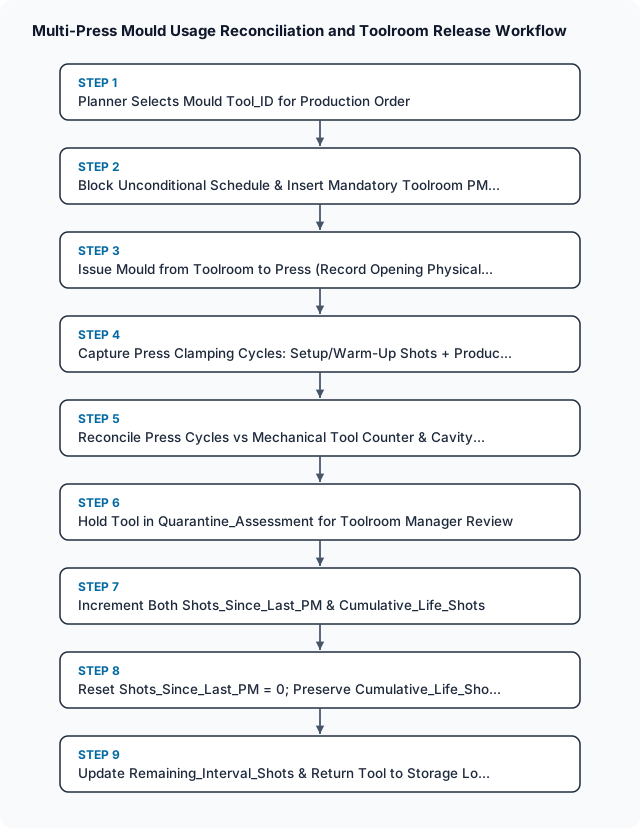
Multi-Press Mould Usage Reconciliation and Toolroom Release Workflow
Follow the workflow below, or open its complete text version.
Read the complete workflow as text
- Planner Selects Mould Tool_ID for Production Order → Block Unconditional Schedule & Insert Mandatory Toolroom PM...
- Block Unconditional Schedule & Insert Mandatory Toolroom PM... → Issue Mould from Toolroom to Press (Record Opening Physical...
- Issue Mould from Toolroom to Press (Record Opening Physical... → Capture Press Clamping Cycles: Setup/Warm-Up Shots + Produc...
- Capture Press Clamping Cycles: Setup/Warm-Up Shots + Produc... → Reconcile Press Cycles vs Mechanical Tool Counter & Cavity...
- Reconcile Press Cycles vs Mechanical Tool Counter & Cavity... → Hold Tool in Quarantine_Assessment for Toolroom Manager Review
- Hold Tool in Quarantine_Assessment for Toolroom Manager Review → Increment Both Shots_Since_Last_PM & Cumulative_Life_Shots
- Increment Both Shots_Since_Last_PM & Cumulative_Life_Shots → Reset Shots_Since_Last_PM = 0; Preserve Cumulative_Life_Sho...
- Reset Shots_Since_Last_PM = 0; Preserve Cumulative_Life_Sho... → Update Remaining_Interval_Shots & Return Tool to Storage Lo...
Worked example: 4-cavity injection mould transferred across two presses with a PM event
The following scenario, mould identifiers, press cycle counts, cavity figures, and maintenance limits are explicitly illustrative and use assumed data to demonstrate dual-counter reconciliation across machines and maintenance resets.
Consider a plastics plant operating a 4-cavity hot-runner injection mould (Tool_ID: MLD-408, Part HSG-220 sensor housing) with the following approved engineering and toolroom limits:
- Approved Tier-1 preventive maintenance interval (
PM_Interval_Limit): 25,000 clamping shots (strip, ultrasonic clean vents, inspect ejector pins, and verify parting-line witness marks). - Approved cavity-insert lifetime ceiling before major refurbishment (
Lifetime_Limit): 250,000 clamping shots. - Opening tool ledger state on Monday
06:00(before Job 1):Cumulative_Life_Shots(opening): 168,400 shotsShots_Since_Last_PM(opening, accumulated since last PM at150,000life shots): 18,400 shotsRemaining_Interval_Shotsbefore mandatory PM: 25,000 - 18,400 = 6,600 shotsRemaining_Life_Shotsbefore cavity refurbishment: 250,000 - 168,400 = 81,600 shots
Now trace four sequential operational events across the week:
Event 1: Run on Press IMM-03 (Job WO-7101, Monday)
- Mould
MLD-408is mounted on PressIMM-03with all 4 cavities active (Active_Cavities = 4). - The setter runs 80 setup/warm-up clamping shots (
320startup scrap/purge pieces), followed by 4,120 production clamping shots. - Total clamping shots on
IMM-03:Run 1 Shots = 80 + 4,120 = 4,200 shots - Total moulded pieces produced during production run: 4,120 shots × 4 cavities = 16,480 pieces (
16,420good pieces +60line-reject pieces). - At
19:30,IMM-03develops a barrel heater fault. The operator dismountsMLD-408, resetsIMM-03's local batch counter to0for maintenance testing, and movesMLD-408to PressIMM-07. - Tool ledger after Event 1:
Shots_Since_Last_PM: 18,400 + 4,200 = 22,600 shotsCumulative_Life_Shots: 168,400 + 4,200 = 172,600 shotsRemaining_Interval_Shots: 25,000 - 22,600 = 2,400 shots
Event 2: Transfer and continuation on Press IMM-07 (Job WO-7101-B, Tuesday)
- On Press
IMM-07, the setter resets the press batch counter to0at mount time and runs 50 setup/stabilisation shots plus 2,150 production shots (Active_Cavities = 4). - Total clamping shots on
IMM-07:Run 2 Shots = 50 + 2,150 = 2,200 shots - Production pieces on
IMM-07: 2,150 × 4 = 8,600 pieces (8,572good +28rejects). - Tool ledger after Event 2 (end of
WO-7101):Shots_Since_Last_PM: 22,600 + 2,200 = 24,800 shotsCumulative_Life_Shots: 172,600 + 2,200 = 174,800 shotsRemaining_Interval_Shots: 25,000 - 24,800 = 200 shots (Status: PM_Due_Window— insufficient remaining interval life to start next scheduled 3,500-shot orderWO-7140without PM).
Event 3: Scheduled Tier-1 PM and inspection in Toolroom (PM-WO-902, Wednesday)
- Because
WO-7140requires3,500shots (> 200remaining interval shots), finite scheduling routesMLD-408into Toolroom OrderPM-WO-902. - The toolroom strips, cleans, lubricates, and inspects
MLD-408(INS-TOOL-884,S07), confirming parting-line vents and all 4 cavities meet drawing specification. - The Toolroom Manager signs off
PM-WO-902:Shots_Since_Last_PMis reset from24,800to0 shots.Cumulative_Life_Shotsis preserved untouched at174,800 shots.Remaining_Interval_Shotsis restored to25,000 shots.Remaining_Life_Shotsremains 250,000 - 174,800 = 75,200 shots.
Event 4: Post-PM run on Press IMM-02 (Job WO-7140, Thursday)
MLD-408mounts onIMM-02and runs 60 setup shots + 3,440 production shots = 3,500 clamping shots (13,760production pieces).- Closing tool ledger after Event 4:
Shots_Since_Last_PM: 0 + 3,500 = 3,500 shots (Remaining_Interval_Shots= 25,000 - 3,500 = 21,500 shots).Cumulative_Life_Shots: 174,800 + 3,500 = 178,300 shots (Remaining_Life_Shots= 250,000 - 178,300 = 71,700 shots).
Scroll horizontally to see all columns.
| Ledger stage | Machine / location | Gross run shots (Setup + Prod) |
Shots_Since_Last_PM (closing) |
Remaining_Interval_Shots (vs 25,000) |
Cumulative_Life_Shots (closing) |
Remaining_Life_Shots (vs 250,000) |
Tool release status |
|---|---|---|---|---|---|---|---|
| Opening state | Toolroom Rack R-12 |
0 | 18,400 | 6,600 | 168,400 | 81,600 | Released_Ready |
Event 1 (WO-7101) |
Press IMM-03 |
4,200 (80 + 4,120) |
22,600 | 2,400 | 172,600 | 77,400 | Released_Transfer |
Event 2 (WO-7101-B) |
Press IMM-07 |
2,200 (50 + 2,150) |
24,800 | 200 | 174,800 | 75,200 | Locked_For_PM (200 below 3,500 next job) |
Event 3 (PM-WO-902) |
Toolroom Bay TB-01 |
0 (PM service) | 0 (reset) | 25,000 (restored) | 174,800 (preserved) | 75,200 | Released_Ready |
Event 4 (WO-7140) |
Press IMM-02 |
3,500 (60 + 3,440) |
3,500 | 21,500 | 178,300 | 71,700 | Released_Ready |
Check the arithmetic across the full week:
- Total physical clamping shots across all three presses: 4,200 + 2,200 + 3,500 = 9,900 shots (comprising 80 + 50 + 60 = 190 setup shots and 4,120 + 2,150 + 3,440 = 9,710 production shots).
- Cumulative lifetime conservation check: Opening life (168,400) + total week shots (9,900) = 178,300 closing life shots (zero shots lost across two machine transfers and one PM reset).
- Production piece reconciliation (
Active_Cavities = 4): 9,710 production shots × 4 cavities = 38,840 total production pieces (16,480 + 8,600 + 13,760 = 38,840).
Handling damaged cavities, missing counts, and regrind service limits
When a die or mould experiences abnormal wear—such as a chipped core pin on Cavity 2 or a forging die impression requiring a -1.5 mm regrind sinking—the tool record must capture three exception controls:
- Missing or unverified machine counter (
Counter_Discrepancy_Hold): If a mechanical mould-frame counter disagrees with the press controller log by more than the plant's verification threshold (for example,> 0.5%of the run) or a manual run log is missing, the tool defaults toQuarantine_Assessment. The Toolroom Manager reconciles the count (using the higher conservative figure or physical inspection) before returning the tool toReleased_Ready. - Blocked-cavity tracking (
Active_Cavities below Nominal_Cavities): If the Toolroom Manager and Quality Lead approve running a 4-cavity mould with 1 cavity blocked (3 active cavities) under a documented concession (M040), each press cycle still adds 1.0 clamping shot to the mould frame (MLD-408) and active cavities (CAV-1, CAV-2, CAV-4), whileCAV-3is flaggedBlocked_Inactiveand scheduled for repair. - Revised service life after major repair or die regrind: When a forging die or stamping tool undergoes a major regrind (for example, Regrind Stage 2 of 3), the Toolroom Manager records the updated
Lifetime_LimitorCurrent_Stage_Limitalongside dimensional qualification records (S07) without deleting prior shot history.
Acceptance criteria for mould and die life tracking
- Cross-machine continuity (
TEST-M048-01): MovingTool_IDfrom Press A to Press B and resetting Press A's local batch counter preserves all Press A's shots on theTool_IDledger. - Dual-counter independence (
TEST-M048-02): Completing and approving a preventive maintenance work order resetsShots_Since_Last_PMto0while keepingCumulative_Life_Shotsunchanged. - Setup-plus-production shot capture (
TEST-M048-03): Both setup/trial clamping cycles and production cycles increment tool wear counters, and production cycles multiplied byActive_Cavitiesreconcile to gross moulded/forged pieces. - Pre-dispatch capacity and PM gate (
TEST-M048-04): Attempting to release a production order whose required shots exceedRemaining_Interval_ShotsorRemaining_Life_Shotstriggers a scheduling block or requires documented Toolroom Manager override/PM insertion.
Synthesis and next actions
Treating every mould and die as a mobile, multi-counter asset with its own setup, production, and maintenance history prevents unexpected cavity flash, mid-order tool breakdowns, and lost lifetime fatigue records.
- Create a master
Tool_IDand cavity register independent of machine IDs: Assign every mould, die, and replaceable cavity insert a unique ID recordingPM_Interval_Limit,Lifetime_Limit,Nominal_Cavities,Active_Cavities, and physical storage rack (S04). - Maintain separate
Shots_Since_Last_PMandCumulative_Life_Shotsfields: Configure production reporting to increment both fields from gross press clamping cycles (Setup_Shots + Production_Shots) while restrictingShots_Since_Last_PMresets to authorised toolroom PM sign-off. - Require last-off piece retention and counter reconciliation at every press dismount: Make tool return to the rack contingent on reconciling the press log against the mechanical tool counter and attaching the last-off quality check (
S07). - Embed remaining tool life into finite press scheduling (
M026): Configure the scheduling workbench so any job whose required shots exceedRemaining_Interval_Shotsautomatically flags a mandatory toolroom PM slot before press release.
Compare this workflow with your current setup
Share the step that takes the most manual work, the systems involved and the exceptions your team handles. That gives us a concrete starting point for comparing approaches.
Sources and further reading
Sources checked 15 October 2026. Worked examples and workflow diagrams are original illustrations, not reported client results.


