Link isolation records to work orders without turning software into a safety authority
For EHS, operations and maintenance teams · Compare approaches
TL;DR — what you’ll learn
- Link equipment isolation certificates (ICC) and multi-lock hasp records to maintenance work orders so the system blocks premature administrative return-to-service while any linked job or personal lock remains open.
- Never allow a software status field to substitute for physical lockout/tagout (LOTO), zero-energy verification (prove dead / try-start), or the on-site judgment of an authorised competent person.
- Model shared-isolation relationships explicitly (1 Isolation Certificate : N Work Orders : M Personal Locks) so completing one mechanical job on an isolated mixer cannot clear the isolation record while an electrical or instrumentation job on the same asset is still active.
- Require shift-handover continuity records that distinguish between a lock handed over under the site's written isolation procedure and an unverified orphan lock requiring formal plant-management safety investigation.

Illustrative manufacturing inspection room and machine shop floor; not a client facility.
Why maintenance software must inform—never replace—physical isolation controls
During plant shutdowns and multi-trade maintenance on process vessels, high-voltage switchgear, and heavy machinery, multiple teams often work under a single primary energy isolation boundary. For example, a mechanical crew replaces a gearbox seal on an agitator while an electrical crew inspects the motor terminal box and an instrumentation technician calibrates a level probe inside the vessel. Both crews depend on the same isolated motor control centre (MCC) breaker, closed feed valves, and multi-lock group lockbox.
Two opposite record-keeping failures create serious operational and safety exposure:
- Unlinked work orders causing premature restoration requests: Maintenance work orders (
WO) in the CMMS/ERP are tracked independently of the physical Isolation Confirmation Certificate (ICC). When the mechanical crew finishes early and closesWO-101, the production supervisor seesWO-101 = Completedon the planning board and calls the control room to de-isolate and restart the mixer—unaware thatWO-102(electrical inspection) is still open under the same isolation boundary. - Treating a digital checkbox as proof of zero energy: Conversely, poorly designed digital permit apps let a planner or technician click
Isolated = Yeson a tablet at a desk without recording physical lock serials, padlocked isolation points, or competent-person zero-energy verification (try-start/ voltage test / line bleed), blurring the line between a planned isolation list and a physically verified isolation state.
Direct answer: A maintenance isolation record system must act strictly as a dependent administrative interlock and visibility ledger: it links the site's approved Isolation Certificate (ICC) to every dependent work order (1:N) and registered personal/group lock, separates Planned_Isolation_Points from Physically_Verified_By_Competent_Person, and prevents any work order or asset from transitioning to Administratively_Cleared_For_De-Isolation until zero dependent work orders and zero active personal locks remain open—while explicitly preserving physical lockboxes, tags, and competent-person authority as the sole governing safety controls.
As emphasised in the UK Health and Safety Executive (HSE) Permit-to-Work guidance and HSE HSG250 guidance on safe maintenance, a permit or record is a communication and coordination tool; it does not by itself make a job safe or replace physical risk assessment, positive isolation, and human verification. Similarly, NIST operational technology (OT) security publications stress that enterprise IT/CMMS workflows must never override or degrade physical safety interlocks. (Note: HSE publications provide general safety-management principles as international reference background; all physical isolation procedures, lockbox rules, and statutory roles must follow applicable national and state factory legislation and your site's EHS-approved safety manual.)
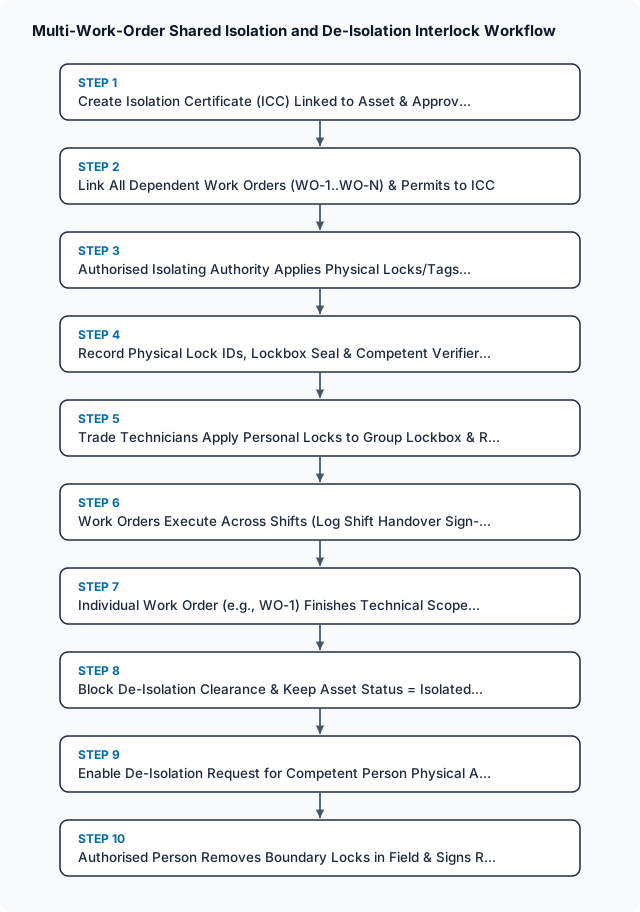
Multi-Work-Order Shared Isolation and De-Isolation Interlock Workflow
Follow the workflow below, or open its complete text version.
Read the complete workflow as text
- Create Isolation Certificate (ICC) Linked to Asset & Approv... → Link All Dependent Work Orders (WO-1..WO-N) & Permits to ICC
- Link All Dependent Work Orders (WO-1..WO-N) & Permits to ICC → Authorised Isolating Authority Applies Physical Locks/Tags...
- Authorised Isolating Authority Applies Physical Locks/Tags... → Record Physical Lock IDs, Lockbox Seal & Competent Verifier...
- Record Physical Lock IDs, Lockbox Seal & Competent Verifier... → Trade Technicians Apply Personal Locks to Group Lockbox & R...
- Trade Technicians Apply Personal Locks to Group Lockbox & R... → Work Orders Execute Across Shifts (Log Shift Handover Sign-...
- Work Orders Execute Across Shifts (Log Shift Handover Sign-... → Individual Work Order (e.g., WO-1) Finishes Technical Scope...
- Individual Work Order (e.g., WO-1) Finishes Technical Scope... → Block De-Isolation Clearance & Keep Asset Status = Isolated...
- Block De-Isolation Clearance & Keep Asset Status = Isolated... → Enable De-Isolation Request for Competent Person Physical A...
- Enable De-Isolation Request for Competent Person Physical A... → Authorised Person Removes Boundary Locks in Field & Signs R...
Worked example: shared vessel isolation across two maintenance work orders and a shift handover
The following scenario, asset IDs, isolation points, lock serials, and timestamps are explicitly illustrative and use assumed records to demonstrate how a relational isolation ledger prevents premature administrative closure without automating safety judgments.
Suppose a chemical-processing plant schedules a 10-hour turnaround on Jacketed Mixing Vessel VSL-302 under Master Isolation Certificate ICC-2026-0412 (linked to approved site isolation standard ISO-STD-VSL302-REV4). The isolation boundary comprises 4 physical isolation points locked into Group Lockbox GLB-09 (sealed with Master Key Lock MLK-09):
IP-01: Main Agitator Drive BreakerMCC-04-B12(racked out, padlockedPAD-401, proved dead at starter and local push-buttontry-start).IP-02: Steam Jacket Supply ValveHV-302-S1(closed, chain-lockedPAD-402, downstream drainDV-302-S2locked open to atmosphere, pressure gauge verified0.0 bar g).IP-03: Process Feed Inlet ValveXV-302-F1(closed, pneumatic actuator air vented and lockedPAD-403, spectacle blind swung to closed position).IP-04: Nitrogen Purge Supply ValveNV-302-N1(closed and lockedPAD-404).
Two separate maintenance work orders share ICC-2026-0412 across Shift A (06:00–14:00) and Shift B (14:00–22:00):
WO-8810(Mechanical): Replace agitator top mechanical seal (2 mechanical fitters, Shift A only).WO-8814(Electrical & Instrumentation): Re-terminate motor thermistor leads and replace internal temperature probeTT-302(2 E&I technicians, spanning Shift A into Shift B).
Reconciling the isolation state ledger across timestamps
Scroll horizontally to see all columns.
| Timestamp (IST) | Event description | Open linked WOs on ICC-2026-0412 |
Active personal locks on GLB-09 |
Verified boundary locks (IP-01..04) |
System administrative state for VSL-302 |
Allowed next administrative action |
|---|---|---|---|---|---|---|
06:30 |
Isolating Authority (IA-14) completes physical isolation & zero-energy verification on IP-01..04 |
2 (WO-8810, WO-8814) |
0 (awaiting trade locks) |
4 / 4 verified |
Isolated_Ready_For_Trade_Locks |
Permit holders may verify and attach personal locks to GLB-09 |
06:45 |
Mechanical (PL-M1, PL-M2) and E&I (PL-E1, PL-E2) attach 4 personal locks to GLB-09 |
2 (WO-8810, WO-8814) |
4 (PL-M1, M2, E1, E2) |
4 / 4 verified |
Isolated_Work_In_Progress |
De-isolation clearance blocked (2 open WOs, 4 locks) |
12:20 |
Mechanical crew finishes seal replacement, signs off WO-8810, and removes PL-M1, PL-M2 |
1 (WO-8814 still open) |
2 (PL-E1, PL-E2 active) |
4 / 4 verified |
Isolated_Work_In_Progress (Hold) |
De-isolation BLOCKED despite WO-8810 completion (1 open WO, 2 locks remain) |
13:50 |
Shift A → Shift B E&I handover: PL-E1, PL-E2 transferred to Shift B techs PL-E3, PL-E4 at lockbox |
1 (WO-8814 active) |
2 (PL-E3, PL-E4 active) |
4 / 4 verified |
Isolated_Work_In_Progress (Handover logged) |
De-isolation blocked (1 open WO, 2 Shift B locks) |
16:40 |
Shift B E&I crew finishes WO-8814, clears work area, and removes PL-E3, PL-E4 from GLB-09 |
0 (All WOs work-complete) |
0 (0 personal locks) |
4 / 4 verified |
Ready_For_De-Isolation_Check |
Isolating Authority authorised to perform physical walkdown & de-isolation |
17:05 |
Isolating Authority (IA-19) completes physical walkdown, removes PAD-401..404, and signs restoration |
0 |
0 |
0 / 4 (restored) |
De-Isolated_Handed_To_Operations |
Operations Lead may accept handover under site start-up procedure |
Check the relational invariants at each critical transition:
- At
12:20 IST(whenWO-8810completes):Remaining Open WOs = 2 - 1 = 1 (WO-8814), | Remaining Personal Locks = 4 - 2 = 2 (PL-E1, PL-E2)Because Remaining Open WOs = 1 > 0 and Remaining Personal Locks = 2 > 0, closingWO-8810leavesVSL-302locked inIsolated_Work_In_Progress. The production planning board displays:VSL-302: ISOLATED — Held by ICC-2026-0412 (Open Work Order WO-8814, 2 Active Locks). - At
13:50 IST(Shift A to Shift B handover onWO-8814):- Shift A technicians (
PL-E1, PL-E2) and oncoming Shift B technicians (PL-E3, PL-E4) perform a face-to-face handover at Group LockboxGLB-09:PL-E3andPL-E4apply their locks (2 + 2 = 4locks momentarily on the hasp) beforePL-E1andPL-E2remove theirs (4 - 2 = 2locks active), preserving continuous physical lock coverage (Active_Locks ≥ 2throughout the handover).
- Shift A technicians (
- At
16:40 IST(Eligibility for de-isolation request):Open Linked WOs = 0 | and | Active Personal Locks = 0 | and | Unresolved Safety Exceptions = 0Even when all three software counts reach0, the software does not mark the assetSafe_To_Start. It transitions only toReady_For_De-Isolation_Check, requiring Competent PersonIA-19to inspect the vessel physically in the field before removingPAD-401..404at17:05 IST.
Governance boundaries: what the software records vs what competent people decide
Scroll horizontally to see all columns.
| Operational question | Software record responsibility | Human safety authority (never automated) |
|---|---|---|
| Which isolation points apply to this job? | Displays the EHS-approved template (ISO-STD) for the asset and requires an authorised person to confirm scope. |
Competent Isolating Authority & Permit Issuer verify actual line configuration, P&IDs, and adjacent hazards in the field. |
| Is the equipment actually at zero energy? | Requires distinct fields for Planned_State, Physical_Lock_Tag_ID, and Zero_Energy_Verified_By with timestamp. |
Authorised Isolating Person physically operates disconnects/valves, applies locks, vents stored energy, and tests (prove dead). |
| Can this work order release the equipment? | Computes Open_Linked_WOs and Active_Personal_Locks across the shared ICC and blocks administrative release while either count exceeds zero. |
Permit Issuer and Area Authority verify physical area clearance before authorising de-isolation. |
| What if a personal lock remains on the box after shift end? | Flags Exception_Unreconciled_Lock and blocks administrative de-isolation closure. |
Plant Manager / EHS Authority executes the site's formal forgotten-lock safety procedure; software never authorises cutting or bypassing a lock. |
Acceptance criteria for maintenance isolation records
- Planned vs verified state separation (
TEST-M050-01): Creating an Isolation Certificate (ICC) from a template populates isolation points inPlanned_Unverifiedstatus; no linked work order or permit (M049) can transition toActive_Workuntil an authorised verifier records physical lock IDs and zero-energy verification sign-off. - Multi-work-order closure interlock (
TEST-M050-02): WhenICC-1is linked toWO-AandWO-B, markingWO-AasTechnical_Work_CompletekeepsICC-1and the parent asset inIsolated_Work_In_ProgressuntilWO-Bis also completed and all personal locks are cleared. - Shift-handover continuity audit (
TEST-M050-03): A shift boundary with open work requires either a logged oncoming lock handover or a documentedSuspended_Under_Shift_Lockstate; unhanded-over locks raise an immediate handover alert. - No automated safety override (
TEST-M050-04): No administrator or planner role can force an asset status fromIsolated_Work_In_ProgresstoAvailable_For_Productionwhile linked work orders, active lock records, or physical restoration sign-offs remain open.
Synthesis and next actions
Linking isolation records to work orders prevents administrative miscommunication across trades and shifts only when the database models shared 1:N isolation certificates accurately and treats software status as a brake against premature closure—never as a green light that replaces physical verification.
- Introduce a dedicated Isolation Certificate (
ICC) entity between assets and work orders: Replace simpleLOTO Required (Yes/No)checkboxes on individual work orders with a sharedICCrecord that links1isolation boundary toNwork orders andMpersonal lock entries (S14,S15). - Separate planned isolation schedules from verified physical state: Require every isolation point row on an
ICCto captureIsolation_Point_ID,Required_Position,Padlock_Tag_Serial,Zero_Energy_Test_Method, andVerified_By_Competent_Person. - Enforce a hard zero-open-work and zero-active-lock check before de-isolation request: Configure the CMMS/ERP so closing one work order never clears the asset's
Isolatedbanner while sibling work orders or personal locks remain registered on the parentICC. - Audit shift handovers and long-duration isolations daily: Review open
ICCrecords at every shift handover alongside the physical group lockbox register (M049) to ensure software records and physical padlocks stay fully aligned.
Compare this workflow with your current setup
Share the step that takes the most manual work, the systems involved and the exceptions your team handles. That gives us a concrete starting point for comparing approaches.
Sources and further reading
Sources checked 15 October 2026. Worked examples and workflow diagrams are original illustrations, not reported client results.

