Returnable dunnage & KLT tote loops: reconcile OEM-supplier container balances, washing holds, and demurrage
For stores, inventory control and production teams · Compare approaches
TL;DR — what you’ll learn
- Model every returnable packaging component in a Packaging Bill of Materials (PACK_BOM) attached to the finished part number—distinguishing serialized custom steel racks / precision thermoformed trays (tracked via unique [GS1 GRAI serials](https://www.gs1.org/standards/id-keys/grai)) from fungible VDA KLT small load carriers, blisters, and pallet lids (tracked by quantity balance per custodian location under [VDA 5000](https://www.vda.de/en/services/Publications)).
- Size the returnable fleet across all six physical loop segments—supplier packing, outbound transit, OEM line-side consumption, OEM empty dock accumulation, return freight, and industrial washing/drying quarantine—so a 36-hour wash backlog never starves the final assembly cell.
- Auto-couple every outbound Advance Shipping Notice (ASN / Delivery Note) and inbound Empty Return Receipt to a four-bucket Custodian Sub-Ledger (AT_SUPPLIER_CLEAN, IN_WASH_OR_REPAIR, IN_TRANSIT, AT_OEM_CUSTODY), issuing monthly VDA-style packaging statements with FIFO ageing for overdue turns.
- Pre-configure an Expendable Fallback Packaging BOM Price Surcharge Rule: when OEM empty return velocity drops below the safety threshold, automatically authorize corrugated fallback packing while billing the contractual per-piece expendable packaging differential if the shortage was caused by OEM container retention.

Illustrative factory raw-material stores and receiving counter; not a client facility.
In automotive, powertrain, EV battery, and precision electronics manufacturing, finished components cannot be tossed into generic cardboard boxes. Machined aluminium transmission housings, painted fascias, and delicate stator windings travel in custom-moulded ESD thermoformed trays, modular VDA 4500 KLT totes, or heavy welded steel stillages equipped with precision urethane nests. Although a Tier-1 supplier or OEM invests $$150,000\text{ to }$800,000$ in a dedicated fleet of custom returnable dunnage for a program, most plants track finished parts to the fourth decimal place in their ERP while managing the returnable trays on a shipping clerk's clipboard. Within six months of SOP (Start of Production), empty trays accumulate unreturned in an OEM plant yard or sit dirty at a third-party washing depot; the Tier-1 machining line halts because there are no clean trays to pack finished parts; and purchasing pays emergency air-freight fees for heavyweight corrugated "expendable backup boxes" without being able to prove which plant lost or hoarded the dunnage.
The direct answer is to run a closed-loop Returnable Transport Item (RTI) sub-ledger inside the ERP and warehouse management system. Distinct from L085 (which covers third-party 3PL wooden pallet pooling such as CHEP or Euro-pallets), this guide (M119) addresses part-specific custom thermoformed dunnage and VDA KLT loops, industrial wash-and-cleanliness turnaround gates, OEM-to-supplier container account reconciliation, and automated expendable-packaging surcharge recovery.
Scope and commercial boundary
This article defines the ERP, WMS, and EDI/ASN data architecture for sizing, tracking, washing, and reconciling returnable dunnage fleets between manufacturing plants, washing depots, and OEM customers:
- What this workflow governs: Defining multi-layer Packaging BOMs (
Pallet + KLT/Tray + Layer Pad + Top Lid), calculating closed-loop fleet quantities, enforcing dirty-to-clean wash quarantine holds, reconciling ASN outbound vs empty inbound custodian balances, ageing overdue containers for demurrage, and triggering approved expendable fallback BOMs. - What this workflow does not replace: Software custody balances do not replace signed commercial packaging bailment agreements, OEM packaging manual terms, or hazardous-material transport regulations. Demurrage rates, free turn windows, lost-container replacement invoicing, and expendable packaging chargebacks must reflect the executed commercial contract and industry guidelines such as VDA 5000 (Returnable Packaging Account Reconciliation) and AIAG RC-13 (Returnable Container Management).
Bounded returnable dunnage klt tote loop oem supplier reconciliation verification and exception-routing workflow
Follow the workflow below, or open its complete text version.
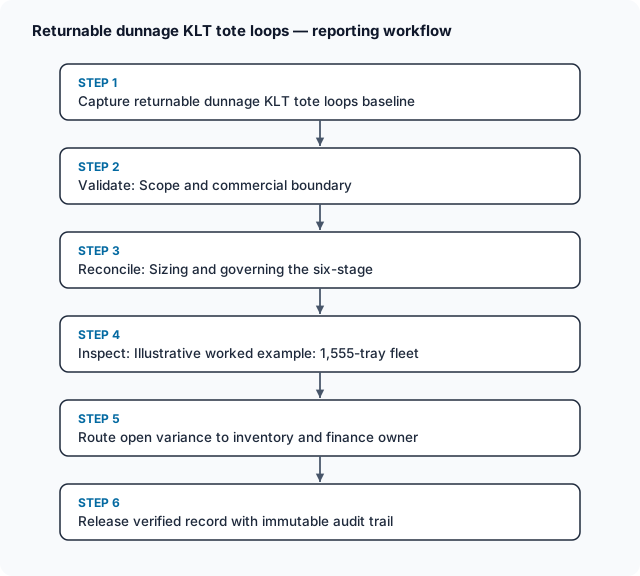
Read the complete workflow as text
- Capture returnable dunnage klt tote baseline record → Verify revision, unit Basis and cutoff alignment
- Verify revision, unit Basis and cutoff alignment → Run deterministic reconciliation and tolerance check
- Run deterministic reconciliation and tolerance check → Quarantine mismatched or unapproved lines
- Quarantine mismatched or unapproved lines → Route exception to named domain and finance owner
- Route exception to named domain and finance owner → Release verified record with immutable audit trail
Sizing and governing the six-stage returnable dunnage loop
1. Dual-mode identification: Serialized GRAI racks vs. Pool-balanced KLT bins. Using GS1 GRAI (Global Returnable Asset Identifier) and ERPNext non-valued custody warehouses, classify returnable assets into two tracking tiers:
- Serialized Custom Assets (
GRAI + Unique Serial): Welded steel engine cradles, battery module stillages, and high-precision CNC-machined dunnage frames carry twin UHF RFID / 2D DataMatrix tags. Every unit load tracks exact serial history, tare weight, and structural drop/weld inspection cycles. - Quantity-Balanced Pool & Custom Trays (
GRAI Asset Type): VDA R-KLT/RL-KLT plastic totes, vacuum-formed blister trays (TRAY-THM-440), and twin-wall polypropylene dividers are tracked by quantity per custodian warehouse (SUPPLIER_CLEAN,SUPPLIER_DIRTY_WASH,EXTERNAL_WASH_DEPOT,OEM_PLANT_A,DAMAGED_QUARANTINE).
2. Closed-loop fleet sizing equation including wash and cleanliness quarantine. In precision machining (transmission valves, fuel-injection housings, EV rotors), returned trays coated in assembly oils, road dust, or metallic swarf cannot be reloaded straight off the return truck. They must pass through an aqueous ultrasonic/spray wash-and-dry tunnel verified to residual particulate standards (e.g., ISO 16232 / VDA 19 cleanliness checks). For a daily production demand of $D\text{ parts/day}$, a container unit-load capacity of $Q_{\text{load}}\text{ parts/load}$ ($Q_{\text{load}} = n_{\text{parts/tray}} \times n_{\text{trays/load}}$), a total six-stage loop turnaround time of $T_{\text{loop}}\text{ days}$, and a peak/schedule-volatility buffer factor $\beta_{\text{peak}}$, the required fleet of unit loads ($N_{\text{loads}}$) is:
$$N_{\text{loads}} = \left\lceil \left(\frac{D}{Q_{\text{load}}}\right) \times T_{\text{loop}} \times (1 + \beta_{\text{peak}}) \right\rceil$$
where: $$T_{\text{loop}} = t_{\text{pack_stage}} + t_{\text{outbound}} + t_{\text{oem_dwell}} + t_{\text{return_transit}} + t_{\text{wash_dry}} + t_{\text{repair_buffer}}$$
3. Expendable fallback authorization and chargeback governance.
Every part number using returnable dunnage must maintain an engineering-approved Alternate Expendable Packaging BOM (PACK_BOM_EXPENDABLE) (e.g., VCI poly-bag + die-cut heavy-duty double-wall corrugated partitions + heat-treated ISPM-15 wooden pallet).
- If
AT_SUPPLIER_CLEANinventory falls below 1.5 days of production cover, the WMS checks the OEM Custody Variance ($\Delta N_{\text{oem}} = N_{\text{actual_at_oem}} - N_{\text{contract_allowance}}$):- Case A (OEM Holding Excess Containers Past Grace Window): The ERP authorizes the expendable fallback BOM for the shift and automatically appends the contracted Expendable Packaging Recovery Surcharge ($S_{\text{exp}}/\text{part}$) to the customer invoice, citing the overdue OEM container balance statement.
- Case B (Internal Wash Depot Breakdown or Supplier Over-Building): The ERP authorizes the expendable fallback BOM but books the extra corrugated box cost to Internal Plant Logistics Variance (
0%customer surcharge).
under div over
under table over
under thead over
under tr over
under th over Loop Stage / Custodian Bucket under /th over
under th over ERP Virtual Warehouse Code under /th over
under th over Standard Turn Allocation ($t_i$) under /th over
under th over System Trigger & Physical Scan Event under /th over
under th over Containment / Exception Rule under /th over
under /tr over
under /thead over
under tbody over
under tr over
under td over under strong over 1. Supplier Clean Buffer & Line Pack under /strong over under /td over
under td over under code over WH-RTP-CLEAN-READY under /code over under /td over
under td over $1.5\text{ days}$ under /td over
under td over Wash-tunnel exit scan + operator pack-station HU (Handling Unit) association under /td over
under td over Block HU creation if tray status is under code over DIRTY_UNWASHED under /code over or under code over CRACKED_HOLD under /code over under /td over
under /tr over
under tr over
under td over under strong over 2. Outbound Transit to OEM under /strong over under /td over
under td over under code over WH-RTP-IN-TRANSIT-OUT under /code over under /td over
under td over $1.0\text{ day}$ under /td over
under td over EDI ASN / Delivery Note dispatch scan at supplier shipping dock under /td over
under td over Auto-generate packaging lines on ASN from under code over PACK_BOM under /code over ($5\text{ trays} + 1\text{ pallet} + 1\text{ lid}$) under /td over
under /tr over
under tr over
under td over under strong over 3. OEM Line-Side & Empty Yard under /strong over under /td over
under td over under code over WH-RTP-CUST-OEM02 under /code over under /td over
under td over $3.0\text{ days}$ under em over (Max $10\text{d}$ free) under /em over under /td over
under td over OEM Goods Receipt confirmation; FIFO turn clock starts on ASN receipt date under /td over
under td over Flag any ASN layer unreturned after $10\text{ calendar days}$ for daily demurrage accrual under /td over
under /tr over
under tr over
under td over under strong over 4. Return Empty Transit & Dock Sort under /strong over under /td over
under td over under code over WH-RTP-DIRTY-RECEIPT under /code over under /td over
under td over $1.5\text{ days}$ under /td over
under td over Inbound Empty Return Gate Pass; dock sort into under code over GOOD_DIRTY under /code over vs under code over CRACKED_SCRAP under /code over under /td over
under td over Generate photo-backed discrepancy claim within $24\text{h}$ if OEM manifest overstates empty count under /td over
under /tr over
under tr over
under td over under strong over 5. Wash Tunnel & Repair Loop under /strong over under /td over
under td over under code over WH-RTP-WASH-DEPOT under /code over under /td over
under td over $2.0\text{ days}$ ($1.5\text{d}$ wash + $0.5\text{d}$ buffer) under /td over
under td over Wash batch release (65°C alkaline wash + HEPA blow-off dry + surface tension check) under /td over
under td over Trigger low-clean-stock alert if wash depot dwell exceeds $36\text{ hours}$ under /td over
under /tr over
under /tbody over
under /table over
under /div over
Illustrative worked example: 1,555-tray fleet sizing and monthly OEM packaging statement audit
All figures below are illustrative and synthetic. Consider a Tier-1 precision machining plant supplying $D = 1,200\text{ aluminium transmission housings/day}$ to OEM-MOTORS-02 ($22\text{ operating days/month} = 26,400\text{ parts/month}$).
- Packaging BOM (
PACK-BOM-TH80): Each precision vacuum-formed ABS tray (TRAY-THM-440, replacement cost $$42.00/\text{tray}$) holds $8\text{ housings}$. Five stacked trays ($5 \times 8 = 40\text{ housings/unit load}$) sit on $1\text{ plastic twin-sheet pallet base}$ capped by $1\text{ top dust cover}$. - Contractual Turn & Demurrage Rules: Allocated OEM dwell is $3.0\text{ days}$, with a contractual free turn grace window of $10\text{ calendar days}$ from ASN receipt. Trays retained at the OEM beyond $10\text{ days}$ accrue $$1.25/\text{tray-day}$ rental demurrage, and unreturned shortfalls confirmed at the quarterly/monthly physical cycle count are billed at $$42.00/\text{tray}$ replacement cost.
Step 1: Compute required fleet size across the 9.0-day turnaround loop.
- Daily unit loads and trays dispatched: $$\text{Daily Unit Loads} = \frac{1,200\text{ parts/day}}{40\text{ parts/load}} = 30.0\text{ unit loads/day}\quad (30 \times 5 = 150\text{ trays/day})$$
- Total 6-stage loop turnaround time ($T_{\text{loop}}$): $$T_{\text{loop}} = 1.5\text{ d (pack)} + 1.0\text{ d (out)} + 3.0\text{ d (OEM)} + 1.5\text{ d (ret)} + 1.5\text{ d (wash)} + 0.5\text{ d (repair)} = 9.0\text{ days}$$
- Total fleet required with $\beta_{\text{peak}} = 15%$ schedule-surge buffer: $$N_{\text{loads}} = \left\lceil 30.0\text{ loads/day} \times 9.0\text{ days} \times 1.15 \right\rceil = \left\lceil 270.0 \times 1.15 \right\rceil = \left\lceil 310.5 \right\rceil = 311\text{ unit loads}$$ $$N_{\text{trays_fleet}} = 311\text{ unit loads} \times 5\text{ trays/load} = 1,555\text{ custom thermoformed trays}$$
Step 2: Reconcile the October VDA 5000 monthly OEM custody statement.
Across the $22\text{-day}$ month, the Tier-1 plant ships $26,400\text{ housings}$ ($660\text{ unit loads} = 3,300\text{ trays}$):
Scroll horizontally to see all columns.
Packaging Ledger Line (TRAY-THM-440 at OEM-MOTORS-02) |
Unit Loads ($40\text{ pcs}$) | Thermoformed Trays ($\text{qty}$) | Unit Rate ($$$) | Financial Impact ($$$) | Audit & ERP Settlement Disposition |
|---|---|---|---|---|---|
1. Opening Balance at OEM (Oct 01) |
$124.0$ | $620$ | — | — | Reconciled prior-month closing custody balance |
| 2. (+) Dispatched to OEM on October ASNs | $+660.0$ | $+3,300$ | — | — | Linked to $26,400\text{ shipped housings}$ across $44\text{ ASNs}$ |
| 3. (–) Empty Returns Received at Supplier Dock | $-622.0$ | $-3,110$ | — | — | Verified at supplier receiving dock ($3,085\text{ good} + 25\text{ cracked}$) |
4. (=) Expected Book Closing Balance at OEM (Oct 31) |
$162.0$ | $810$ | — | — | Versus standard $3\text{-day}$ float allowance of $450\text{ trays}$ |
5. OEM Physical Yard & Line-Side Cycle Count (Oct 31) |
$149.0$ | $745$ | — | — | Joint signed OEM-Supplier packaging audit sheet |
| 6. Unaccounted / Lost Tray Shortfall ($810 - 745$) | $13.0$ | $65\text{ lost}$ | $$42.00/\text{tray}$ | $$2,730.00$ | Billed at full custom tooling replacement value |
| 7. Overdue Demurrage ($110\text{ trays} \times 8\text{ days} over 10\text{d grace}$) | $22.0$ | $110\text{ overdue}$ | $$1.25/\text{tray-day}$ | $$1,100.00$ | FIFO ASN layer ageing ($880\text{ tray-days}$ past $10\text{-day}$ window) |
| 8. Total Monthly Packaging Settlement Claim | — | — | — | $$3,830.00$ | Issued on VDA 5000 Statement + Replenishment Order for $65\text{ trays}$ |
Independent arithmetic verification.
- Fleet capacity check: $311\text{ unit loads} \times 5\text{ trays/load} = 1,555\text{ trays}$, capable of holding $1,555 \times 8 = 12,440\text{ housings}$ ($10.37\text{ days}$ of $1,200/\text{day}$ production).
- Book-to-physical variance at OEM: $620\text{ opening} + 3,300\text{ shipped} - 3,110\text{ returned} = 810\text{ expected trays at OEM}$; subtracting the $745\text{-tray}$ physical cycle count exposes an exact shortfall of $810 - 745 = 65\text{ missing trays}$.
- Combined financial recovery: $(65\text{ lost trays} \times $42.00 = $2,730.00) + (110\text{ overdue trays} \times 8\text{ overdue days} \times $1.25/\text{tray-day} = $1,100.00) = $3,830.00$.
Workflow, owner roles, exception handling and recovery controls
Scroll horizontally to see all columns.
| Workflow stage | Accountable owner | Required system evidence | Exception condition | System hold & recovery control |
|---|---|---|---|---|
| 1. Pack-Station HU Association | Packing Cell Operator & WMS | Finished part serials + scanned TRAY-THM-440 batch/GRAI + clean wash status |
Operator scans a tray batch that has not cleared the WH-RTP-WASH-DEPOT release gate |
Hard-block Handling Unit label print (ERR_DUNNAGE_UNWASHED); require clean tray scan |
| 2. Outbound ASN Dispatch | Shipping Clerk & EDI Engine | Delivery Note / EDI ASN with coupled finished-part lines and non-valued PACK_BOM lines |
Manual delivery note created without returnable packaging lines attached | Auto-append PACK_BOM lines on Delivery Note save; block gate-out if packaging lines are deleted |
| 3. Empty Return Receiving & Damage Sort | Receiving Dock Inspector | OEM Empty Return Bol, dock scan count, GOOD_DIRTY vs DAMAGED_QUARANTINE split |
OEM manifest claims $150\text{ empty trays}$ returned, but physical dock scan counts $135\text{ trays}$ | Log $135\text{ trays}$ into WH-RTP-DIRTY-RECEIPT; auto-generate 24-hour Packaging Short-Return Discrepancy Notice with dock photos |
| 4. Expendable Fallback Activation | Materials Planner & Commercial Lead | WH-RTP-CLEAN-READY stock $ under 1.5\text{ days}$ + OEM Custody Variance report ($\Delta N_{\text{oem}}$) |
Clean trays exhausted because OEM holds $810\text{ trays}$ vs $450\text{-tray}$ allowance | Authorize PACK_BOM_EXPENDABLE for 48 hours and auto-attach contractual expendable surcharge line to Sales Invoice |
| 5. Monthly VDA 5000 Account Close | Packaging Coordinator & AR Finance | Monthly Opening/In/Out/Closing ledger, FIFO ASN ageing, OEM physical count signoff | OEM disputes $65\text{-tray}$ shortfall or $880\text{ overdue tray-days}$ | Export ASN-by-ASN serial/manifest audit trail showing exact receipt signatures and empty return bills of lading |
Bounded pilot and implementation check
Pilot closed-loop returnable dunnage tracking on 1 high-volume custom thermoformed tray loop and 1 standard VDA KLT bin loop over 4 weeks:
- Pilot boundary: Configure
PACK_BOMauto-coupling on outbound ASNs, mandatory receiving dock scans on empty returns, and a separateWH-RTP-WASH-DEPOTquarantine status before trays return to the packing line. - Acceptance tests:
ACT-M119-01(ASN Packaging Auto-Coupling): Post an outbound Delivery Note for $400\text{ parts}$ ($10\text{ unit loads}$) and verify the ERP automatically transfers $50\text{ trays}$, $10\text{ pallets}$, and $10\text{ lids}$ intoWH-RTP-CUST-OEM02.ACT-M119-02(Unwashed Dunnage Pack Interlock): Attempt to pack finished parts into a tray batch still inWH-RTP-DIRTY-RECEIPTstatus; confirm the WMS blocks label printing.ACT-M119-03(FIFO Grace-Window Demurrage Ageing): Simulate an ASN layer unreturned at Day 18 against a 10-day free window; confirm the statement engine calculates exactly $8\text{ overdue days} \times $1.25/\text{tray-day}$.ACT-M119-04(Deterministic Monthly Statement Reproduction): Run the reconciliation report against the synthetic fixture ($620 + 3,300 - 3,110 = 810$ book vs $745$ physical) and verify exact reproduction of the $$3,830.00$ debit memo.
Next actions
- Build explicit
PACK_BOMstructures for every part shipped in returnable dunnage: Never rely on manual text notes on packing slips to track custom trays, dividers, and pallet lids. - Separate
DIRTY_RETURNEDfromCLEAN_WASHEDdunnage in your WMS: Treat the industrial wash tunnel as a mandatory routing gate so dirty returned trays cannot be counted as available packing stock. - Send automated VDA 5000 container balance statements every month: Reconcile book-to-physical balances with OEM logistics every 30 days rather than waiting until program end-of-life when records are unrecoverable.
- Pre-approve an
EXPENDABLE_FALLBACKBOM and commercial surcharge rule before SOP: Ensure operations can switch to backup corrugated packaging without halting the line or absorbing unbudgeted packaging costs when an OEM stalls returns.
Frequently Asked Questions
How should discrete manufacturers reconcile custom returnable dunnage, thermoformed trays, and KLT bins across OEM assembly lines, Tier-1 plants, and washing depots?.
Teams should govern returnable dunnage klt tote loop oem supplier reconciliation by linking every transaction to its source evidence, timestamp, and assigned owner before permitting downstream posting. Distinct from L085 (3PL pallet pooling); M119 covers part-specific engineered dunnage shortages that halt CNC/moulding pack-out even when finished parts are ready, plus dirty-to-clean dunnage wash-loop turn times. Rather than relying on informal spreadsheet overrides, the workflow enforces a documented verification gate and preserves the original observation whenever a correction is recorded.
How does container tracking software manufacturing handle exceptions and mismatches?.
When a discrepancy occurs during container tracking software manufacturing, the system routes the blocked record into an owned exception queue rather than silently dropping or auto-adjusting the balance. Assigned operational, quality, and finance owners must review and approve exceptions before posting. Each exception retains the original quantity, date, and counterparty reference until the designated reviewer resolves the variance with supporting evidence.
What should teams test before automating automotive supply chain software?.
Before scaling automotive supply chain software, run a bounded pilot using historical records that include partial receipts, late updates, duplicate messages, and rejected lines. Verify that the integration preserves idempotency, maintains a clear segregation of duties between operational entry and financial approval, and produces an auditable trail for every state transition.
Compare this workflow with your current setup
Share the step that takes the most manual work, the systems involved and the exceptions your team handles. That gives us a concrete starting point for comparing approaches.
Sources and further reading
Sources checked 15 October 2026. Worked examples and workflow diagrams are original illustrations, not reported client results.

