Keep machine safety defects open until return-to-service is authorised
For EHS, operations and maintenance teams · Compare approaches
TL;DR — what you’ll learn
- Separate maintenance repair completion (Repair_Work_Done) from competent safety verification (Safety_Verification_Passed) and formal return-to-service authorisation (Authorised_For_Production) whenever a machine safety defect is raised.
- Never allow closing a maintenance work order on a guard interlock, light curtain, two-hand control, or pressure relief device to automatically flip the parent machine's scheduling status back to Available_Ready.
- Expose active operating restrictions (Restricted_Stop_Immediate, Restricted_Conditional_Mode, or Verification_Pending) directly on the production scheduling and dispatch board so planners and shift supervisors see the administrative hold in real time.
- Route any failed functional safety check back to Reopened_Verification_Failed while preserving the original defect ID, repair history, and physical lockout/tagout boundaries.

Illustrative manufacturing inspection room and machine shop floor; not a client facility.
Why closing a repair work order is not permission to restart a machine
In heavy metal fabrication, stamping, and building-material plants (such as hydraulic press brakes, guillotine shears, automated block presses, and rotary packaging lines), maintenance technicians regularly repair safety-critical components: misaligned photoelectric light curtains, damaged interlocked perimeter gates, worn brake-monitor limit switches, or leaking safety dump valves.
In a standard ERP or CMMS configuration, a single status transition governs asset availability: when the technician finishes fitting the replacement switch and marks Maintenance Work Order WO-4410 as Completed, the system automatically removes the breakdown flag on Press Brake PB-04 and shows the machine as Available on the shift supervisor's dispatch terminal. That single-step transition creates three acute operational and safety governance failures:
- Technician trade completion treated as independent safety verification: A fitter or electrician replaces a mechanical bracket or wiring harness and closes their trade task, assuming a competent supervisor or EHSverifier will test the stopping performance before production resumes—while production assumes
Work_Order_Closedmeans the guard has already been functionally verified. - Conditional operating restrictions hidden from production planners: A machine with a degraded secondary conveyor access gate may be restricted by site management to single-cycle maintenance jogging or offline setup only (
Restricted_No_Production), yet the scheduling board sees onlyOpenorClosedand books a three-shift production run. - Failed verification losing historical defect lineage: When a pre-restart check reveals that a replaced guard switch still allows reach-in before motion stops, opening a brand-new work order instead of reopening the existing safety defect record hides repeat verification failures.
Direct answer: To prevent an unverified repair from being mistaken for restart clearance, your maintenance and safety record workflow must decouple trade repair execution from competent functional verification and authorised return-to-service (RTS) release: closing the repair work order transitions the asset only to Repair_Complete_Pending_Safety_Verification, keeping the machine administratively blocked on the production schedule until the site's designated competent authority records verification evidence and signs Return_To_Service_Authorised—or reopens the defect if verification fails.
As documented in UK Health and Safety Executive (HSE) Permit-to-Work guidance, administrative records coordinate handovers and restrictions across teams, but software records never substitute for physical risk assessment, physical guarding, or competent human inspection. In India, the Ministry of Labour & Employment announcement on the implementation of the four Labour Codes (including the Occupational Safety, Health and Working Conditions Code, 2020) underscores employer duties regarding safe plant and machinery maintenance; specific statutory testing intervals, competent-person certifications, and state factory rules must always be verified with qualified legal and EHS counsel for each plant jurisdiction. Furthermore, NIST operational technology (OT) security publications emphasize that enterprise planning and maintenance software must never override physical safety interlocks or protective PLC logic.
Machine Safety Defect Repair, Independent Verification, and Return-to-Service State Diagram
Follow the workflow below, or open its complete text version.
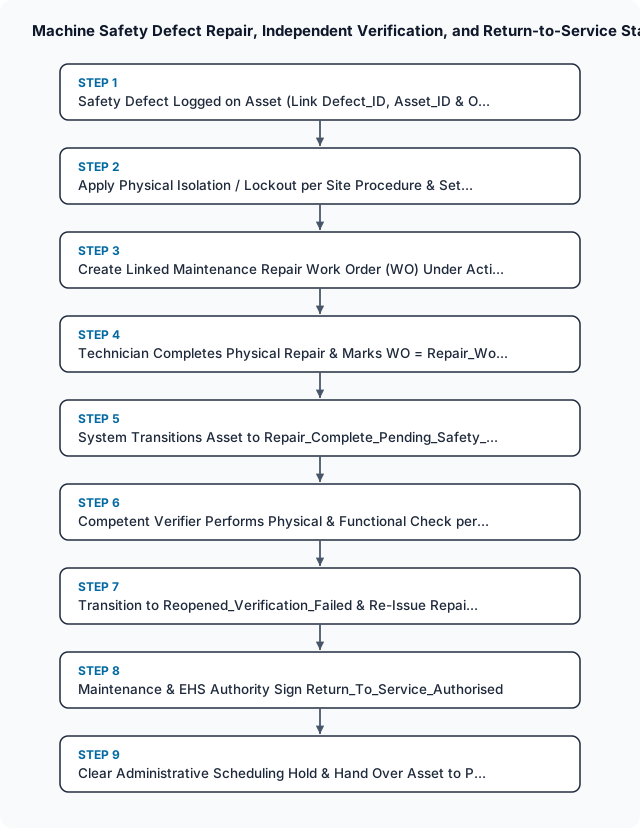
Read the complete workflow as text
- Safety Defect Logged on Asset (Link Defect_ID, Asset_ID & O... → Apply Physical Isolation / Lockout per Site Procedure & Set...
- Apply Physical Isolation / Lockout per Site Procedure & Set... → Create Linked Maintenance Repair Work Order (WO) Under Acti...
- Create Linked Maintenance Repair Work Order (WO) Under Acti... → Technician Completes Physical Repair & Marks WO = Repair_Wo...
- Technician Completes Physical Repair & Marks WO = Repair_Wo... → System Transitions Asset to Repair_Complete_Pending_Safety_...
- System Transitions Asset to Repair_Complete_Pending_Safety_... → Competent Verifier Performs Physical & Functional Check per...
- Competent Verifier Performs Physical & Functional Check per... → Transition to Reopened_Verification_Failed & Re-Issue Repai...
- Transition to Reopened_Verification_Failed & Re-Issue Repai... → Maintenance & EHS Authority Sign Return_To_Service_Authorised
- Maintenance & EHS Authority Sign Return_To_Service_Authorised → Clear Administrative Scheduling Hold & Hand Over Asset to P...
Worked example: hydraulic press brake light-curtain defect across a failed first verification
The following scenario, asset IDs, defect records, timestamps, and schedule hours are explicitly illustrative and use assumed values to demonstrate state transitions and capacity schedule protection without prescribing physical engineering test methods.
Suppose a structural steel fabrication plant operates a 250-tonne Hydraulic Press Brake (Asset_ID: PB-250-02) scheduled across two 8.0-hour shifts per day (16.0 planned production hours/day). On Tuesday at 08:15 IST, during the pre-shift operator check, the operator reports that the front optical safety device and muting sensor bracket on PB-250-02 was struck by a forklift pallet (Safety Defect Record: SDEF-2026-084).
1. Enforcing the four-state administrative lifecycle on PB-250-02
Instead of a binary Down / Up toggle, the plant's asset state table tracks four explicit fields:
Physical_Safety_State: governed strictly on the shop floor by physical isolation locks (M050) and the site's EHS procedure.Defect_Lifecycle_State:Open_Restricted→Repair_Complete_Pending_Verification→ (Reopened_Verification_Failedif rejected) →Verified_Closed.Operating_Restriction_Code:REST-STOP-01 (No Production Operation; Authorised Test/Calibration Only Under Competent Supervision).Scheduling_Board_Status:Blocked_Safety_Defect_Hold(cannot be dispatched to production operators untilReturn_To_Service_Authorised = True).
2. Chronological state and capacity reconciliation across Tuesday (08:15 to 15:45 IST)
Scroll horizontally to see all columns.
| Timestamp (IST) | Event & actor | Repair WO state (WO-6620) |
Safety defect state (SDEF-2026-084) |
Scheduling board status (PB-250-02) |
Elapsed time in state (hours) | Why this boundary matters |
|---|---|---|---|---|---|---|
08:15 |
Operator logs SDEF-2026-084; supervisor applies physical lockout (ICC-709) |
WO-6620 Created |
Open_Restricted (REST-STOP-01) |
Blocked_Safety_Defect_Hold |
0.00 h (start) |
Blocks PB-250-02 on dispatch terminal immediately. |
08:15–11:00 |
Maintenance technician replaces damaged mounting bracket & realigns optical receiver | In_Progress → Repair_Work_Complete at 11:00 |
Repair_Complete_Pending_Verification |
Blocked_Safety_Defect_Hold (Preserved) |
2.75 h (165 min) |
Critical gate: Closing WO-6620 at 11:00 does NOT release PB-250-02 to production. |
11:00–11:45 |
Competent Maintenance/EHS Verifier (VER-12) performs functional check per site procedure |
Held_For_Verification |
Verification_In_Progress (Attempt 1) |
Blocked_Safety_Defect_Hold |
0.75 h (45 min) |
At 11:45, Attempt 1 fails (bracket deflection under vibration causes intermittent alignment fault). |
11:45–14:30 |
SDEF-2026-084 transitions to Reopened_Verification_Failed; fitter installs rigid doweled gusset (WO-6620-R1) |
Reopened_In_Repair → Repair_Work_Complete at 14:30 |
Reopened_Verification_Failed → Pending_Verification (Attempt 2) |
Blocked_Safety_Defect_Hold |
2.75 h (165 min) |
Preserves full history under SDEF-2026-084 rather than hiding failure in an unlinked ticket. |
14:30–15:15 |
Competent Verifier (VER-12) executes Attempt 2 verification per approved checklist CHK-PB-SAFE-04 |
Verification_Passed |
Verified_Awaiting_RTS_Signoff |
Blocked_Safety_Defect_Hold |
0.75 h (45 min) |
Technical check passes at 15:15; awaits formal return-to-service sign-off. |
15:15–15:45 |
Maintenance Authority (MA-04) & EHS Lead (EHS-02) review evidence, remove isolation ICC-709, and sign RTS |
Closed_RTS_Complete |
Closed_Authorised_RTS (RTS-2026-084) |
Released_Available at 15:45 |
0.50 h (30 min) |
Only at 15:45 does the scheduling board allow production dispatch. |
3. Verifying the downtime and schedule impact arithmetic
Check the time and capacity balance across the 16.0-hour Tuesday operating schedule (06:00–22:00 IST):
- Productive run time before defect (
06:00–08:15 IST):08:15 minus 06:00 = 2.25 hours(135 minutes). - Total safety-defect hold duration (
08:15–15:45 IST):2.75 h ( initial repair) + 0.75 h (Attempt 1 check) + 2.75 h (reopened repair) + 0.75 h (Attempt 2 check) + 0.50 h (RTS sign-off & physical de-isolation) = 7.50 hours(450 minutes). - False-release window prevented by the state gate (
11:00–15:45 IST): If the system had releasedPB-250-02at11:00 ISTwhen the technician first markedWO-6620 = Repair_Work_Complete, the press brake would have appearedAvailablefor 4.75 hours (11:00 to 15:45 IST, i.e.,285 minutes) while its guard bracket was still mechanically unstable (Attempt 1 failed at 11:45). - Remaining available production time on Tuesday (
15:45–22:00 IST):22:00 minus 15:45 = 6.25 hours(375 minutes). - Full two-shift schedule conservation check:
2.25 h (pre-defect run) + 7.50 h (safety hold & verified repair) + 6.25 h (post-RTS run) = 16.00 hours(exact match to the 16.00-hour two-shift calendar). Because the planning board received theBlocked_Safety_Defect_Holdsignal at08:15and theReopened_Verification_Failedupdate at11:45, the production planner shifted urgent bending jobWO-BEND-912(4.0 hoursload) to sibling Press BrakePB-250-01at12:00 ISTinstead of waiting blindly by a locked-out machine.
Role responsibilities and authority boundaries
Scroll horizontally to see all columns.
| Workflow stage | Responsible owner | Required record inputs | Explicit safety & system boundary |
|---|---|---|---|
| 1. Defect raising & restriction assignment | Operator, Supervisor, or EHS Inspector | Asset_ID, Defect_ID, symptom description, and Operating_Restriction_Code (Stop vs Restricted_Mode) |
Anyone can raise a safety defect and trigger an immediate administrative hold; physical lockout follows site procedure (M050). |
| 2. Physical repair execution | Maintenance Technician / Team Lead | Linked Work_Order_ID, parts replaced, repair notes, and Repair_Work_Complete timestamp |
Completing the work order never changes Scheduling_Board_Status to Available when Safety_Defect_Flag = True. |
| 3. Independent functional verification | Designated Competent Person (Maintenance/EHS per site procedure) | Approved site checklist reference, test results, verifier identity, and Pass / Fail decision |
Verifier cannot be auto-populated by the software; a Fail result forces Reopened_Verification_Failed on the same Defect_ID. |
| 4. Return-to-service (RTS) authorisation | Maintenance & EHS Authority with Area Operations Owner | Confirmed Verification_Passed, closed isolation certificate (M050), and signed RTS_Authorisation_ID |
Software records the human RTS authorisation; software never overrides physical protective devices or authorises operation under uncertain physical safety. |
Acceptance criteria for machine safety defect closure
- Decoupled repair vs release status (
TEST-M051-01): Marking a maintenance work orderCompletedon an asset with an openSafety_Defect_IDtransitions the defect toRepair_Complete_Pending_Verificationand keeps the asset's production dispatch statusBlocked_Safety_Defect_Hold. - Visible operating restriction on planning boards (
TEST-M051-02): While a safety defect is in any non-closed state, the finite scheduling and shop-floor dispatch screens display the exactOperating_Restriction_Code(REST-STOP-01or conditional restriction) and block operator job clock-on. - Failed verification reopen loop (
TEST-M051-03): Recording aFailedverification result transitions the existingSafety_Defect_IDtoReopened_Verification_Failed, incrementsVerification_Attempt_Count, and generates or reopens a linked repair task without losing Attempt 1 records. - Mandatory RTS authority gate (
TEST-M051-04): An asset can transition fromBlocked_Safety_Defect_HoldtoReleased_Availableonly whenVerification_Result = Passed, linked isolation records (M050) are restored, and an authorised RTS approver role signs the return-to-service record.
Synthesis and next actions
Separating repair completion, competent verification, and return-to-service authorisation in your CMMS/ERP eliminates the dangerous assumption that a closed maintenance ticket means a safety-critical machine is ready for production.
- Add a
Safety_Critical_Defectflag and four-stage state machine to your CMMS/ERP: Configure any work order linked to a safety defect so technician completion moves the record toPending_Safety_Verificationrather thanClosed_Available(S14,S19). - Publish
Operating_Restriction_Codedirectly to production scheduling and MES terminals: Ensure planners and operators see immediately whether a machine is under a total stop or a supervised test-only restriction (M046). - Require named competent-person verification and RTS sign-off fields: Define in your site safety procedure (
S16) which qualified roles may verify safety repairs and authorise return-to-service, and enforce those role checks in the software. - Track first-time verification pass/fail history on a single defect lineage: Configure failed post-repair checks to reopen the original
Safety_Defect_ID(Reopened_Verification_Failed) so recurring guard or interlock issues are visible in EHS management reviews (M053).
Compare this workflow with your current setup
Share the step that takes the most manual work, the systems involved and the exceptions your team handles. That gives us a concrete starting point for comparing approaches.
Sources and further reading
Sources checked 15 October 2026. Worked examples and workflow diagrams are original illustrations, not reported client results.
- UK Health and Safety Executive (HSE), Permit to work systems (Human factors
- Ministry of Labour & Employment, Government of India, Implementation of the Four Labour Codes (including the Occupational Safety, Health and Working Conditions Code, 2020
- National Institute of Standards and Technology (NIST), Operational Technology (OT) Security Publications

