Plan workforce cross-training around real production bottlenecks
For people operations, production and planning teams · Compare approaches
TL;DR — what you’ll learn
- Target operator cross-training by comparing shift-by-shift bottleneck operation demand against assessed, current qualified coverage—never by counting raw department headcount or unverified "in-training" names on a wall chart.
- Calculate the Single-Point-of-Failure (SPOF) Coverage Ratio and Absence-Adjusted Effective Line Capacity for each operation so HR and Production train operators on the specific workstation that caps line throughput when one specialist is absent.
- Compare cross-training against schedule re-sequencing or workstation equipment balancing (M027) before pulling a scarce bottleneck operator off production to act as a trainer.
- Enforce a strict competence gate (In_Training_Supervised vs Assessed_Independent_Qualified) so a training enrolment record never authorises independent assignment on a quality- or safety-critical station until supervised assessment is passed and signed off.

Illustrative manufacturing inspection room and machine shop floor; not a client facility.
Why generic skills matrices fail to relieve shop-floor bottlenecks
In garment sewing lines, footwear assembly, wiring-harness boards, and light mechanical assembly plants, a 25-operator production line is governed by the capacity of its slowest or least-covered operation (M027). Many plants maintain an annual HR "skills matrix" spreadsheet where every operator has a 1-to-4 score across 10 operations. Yet when two operators call in sick on Monday morning, line output still drops by 35% because:
- Raw headcount is confused with qualified coverage: Having 28 operators present on a 24-station line does not help if Operation 4 (
precision collar-band attachmentorultrasonic terminal splice) requires 2 stations running continuously (16.0 station-hours/shift) and only 1 qualified operator is on shift. - Training plans ignore the cost of trainer capacity during training: Pulling the sole qualified specialist on a bottleneck station for 2.0 hours a day to coach a trainee reduces the bottleneck's output during training unless mentored hours are scheduled outside peak cadence or buffered with WIP.
- Training enrolment is counted as immediate shift coverage: Roster software or supervisors count an operator as "covered" the day a cross-training request is logged, assigning them to run a critical station solo before their first-pass quality and cycle-time competence have been assessed (
M055).
Direct answer: A defensible manufacturing cross-training plan starts from finite operation demand by shift (S04), subtracts currently active, assessed operators (M055) after accounting for planned leave and relief coverage, ranks operations by net bottleneck throughput loss under a single-operator absence, schedules supervised training hours around real trainer availability, and counts the trainee toward independent shift capacity only after they pass a documented quality, safety, and cycle-time assessment gate.
As described in Microsoft Dynamics 365 finite capacity planning documentation, scheduling accuracy depends on whether resource constraints reflect true operational capability rather than nominal calendar hours. For workforce governance in India, the Ministry of Labour & Employment notification on the four Labour Codes provides national regulatory context for working hours, shift conditions, and occupational safety; plants must ensure that any cross-training assignments, machine operation authorisations, and wage/grade classifications comply with applicable central and state labour rules and site EHS standards.
Bottleneck-Driven Workforce Cross-Training and Competence Gate Workflow
Follow the workflow below, or open its complete text version.
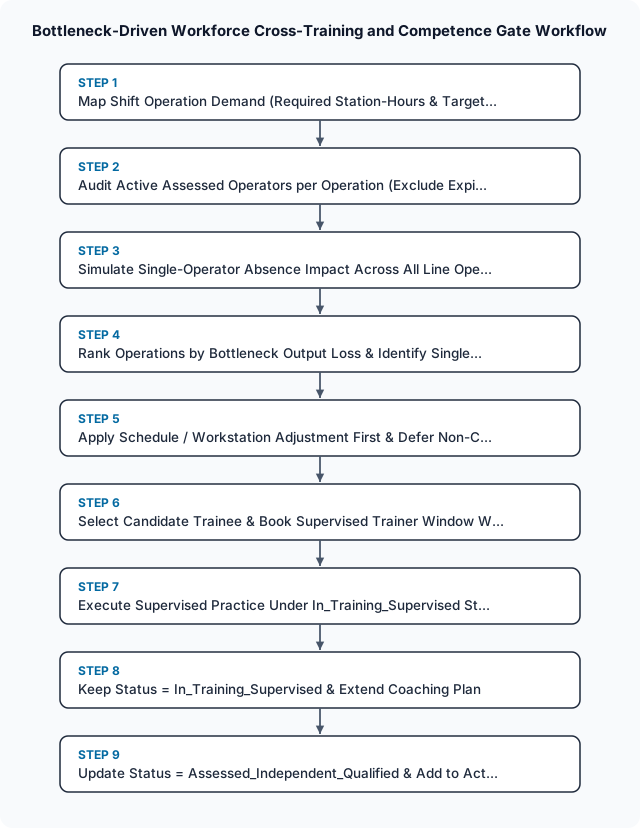
Read the complete workflow as text
- Map Shift Operation Demand (Required Station-Hours & Target... → Audit Active Assessed Operators per Operation (Exclude Expi...
- Audit Active Assessed Operators per Operation (Exclude Expi... → Simulate Single-Operator Absence Impact Across All Line Ope...
- Simulate Single-Operator Absence Impact Across All Line Ope... → Rank Operations by Bottleneck Output Loss & Identify Single...
- Rank Operations by Bottleneck Output Loss & Identify Single... → Apply Schedule / Workstation Adjustment First & Defer Non-C...
- Apply Schedule / Workstation Adjustment First & Defer Non-C... → Select Candidate Trainee & Book Supervised Trainer Window W...
- Select Candidate Trainee & Book Supervised Trainer Window W... → Execute Supervised Practice Under In_Training_Supervised St...
- Execute Supervised Practice Under In_Training_Supervised St... → Keep Status = In_Training_Supervised & Extend Coaching Plan
- Keep Status = In_Training_Supervised & Extend Coaching Plan → Update Status = Assessed_Independent_Qualified & Add to Act...
Worked example: 5-operation industrial garment assembly line cross-training decision
The following scenario, operation cycle times, operator counts, and training hours are explicitly illustrative and use assumed data to demonstrate bottleneck capacity arithmetic and competence gating.
Suppose an industrial workwear assembly plant runs Sewing Line SL-04 on an 8.0-hour shift (450 net productive minutes/shift after two 15-minute breaks) with a target shift demand of 360 flame-retardant coveralls per shift (45.0 units per net productive hour, or 0.80 units per productive minute).
Line SL-04 consists of 5 sequential operation groups (OP-10 through OP-50) staffed by 14 total operators on Shift A.
1. Separating nominal headcount from absence-adjusted bottleneck capacity
Let us audit the required workstations, standard time per unit, and currently qualified (Assessed_Independent_Qualified) operators on Shift A:
Scroll horizontally to see all columns.
| Operation ID & description | Standard time per unit (min) | Required workstations for 360 units/shift | Station capacity per qualified operator (units/shift) | Qualified operators on Shift A (Active_Qualified) |
Nominal shift capacity (All Present, units/shift) |
Capacity if 1 qualified operator is absent (N − 1, units/shift) |
Single-absence line loss vs 360 target (units/shift) |
|---|---|---|---|---|---|---|---|
OP-10 Panel cutting & serging |
2.25 min |
2 stations |
200 units (450 ÷ 2.25) |
3 operators (1 spare) |
400 units (capped by 2 stations) |
400 units (2 ops fill 2 stations) |
0 units loss |
OP-20 Main seam twin-needle join |
3.60 min |
3 stations |
125 units (450 ÷ 3.60) |
4 operators (1 spare) |
375 units (capped by 3 stations) |
375 units (3 ops fill 3 stations) |
0 units loss |
OP-30 Aramid reflective tape heat-seal & stitch |
2.50 min |
2 stations |
180 units (450 ÷ 2.50) |
2 operators (0 spare) |
360 units (2 × 180) |
180 units (1 op on 1 of 2 stations) |
−180 units loss (−50.0%) |
OP-40 Heavy-duty two-way brass zip insertion |
1.20 min |
1 station |
375 units (450 ÷ 1.20) |
1 operator (0 spare) |
375 units (1 × 375) |
0 units (0 ops available!) |
−360 units loss (Total Line Stop) |
OP-50 Bar-tack reinforcement, trim & pack |
2.25 min |
2 stations |
200 units (450 ÷ 2.25) |
4 operators (2 spares) |
400 units (capped by 2 stations) |
400 units (2 ops fill 2 stations) |
0 units loss |
Check the arithmetic across the 5 operations:
- Individual station capacity per shift (
450 productive minutes ÷ Standard_Minutes_Per_Unit):OP-10:450 ÷ 2.25 = 200.0 units/shiftper active workstation (2 stations × 200 = 400 units/shift).OP-20:450 ÷ 3.60 = 125.0 units/shiftper active workstation (3 stations × 125 = 375 units/shift).OP-30:450 ÷ 2.50 = 180.0 units/shiftper active workstation (2 stations × 180 = 360 units/shift).OP-40:450 ÷ 1.20 = 375.0 units/shiftper active workstation (1 station × 375 = 375 units/shift).OP-50:450 ÷ 2.25 = 200.0 units/shiftper active workstation (2 stations × 200 = 400 units/shift).
- Total active workstations on Line
SL-04:2 + 3 + 2 + 1 + 2 = 10 physical workstationsvs14 total operatorson Shift A roster (3 + 4 + 2 + 1 + 4 = 14, note that4excess operators sit inOP-10,OP-20, andOP-50). - Line throughput when all 14 operators are present (
Minimum across OP-10..50):min(400, 375, 360, 375, 400) = 360 units/shift(meets the360 units/shifttarget with zero margin onOP-30). - Line throughput under a 1-operator absence (
N − 1stress test):- If the sole qualified operator on
OP-40(Brass zip insertion) is absent (1 − 1 = 0 qualified operators),OP-40output drops from375to0 units/shift, halting finished line output after existing downstream buffer drains (−360 units/shiftloss). - If 1 of the 2 qualified operators on
OP-30(Reflective tape heat-seal) is absent (2 − 1 = 1 qualified operator),OP-30output drops from360to180 units/shift, cutting line output by180 units/shift(50.0%loss). - Meanwhile,
OP-50has4qualified operators for2stations (2 surplus operators), andOP-10has3qualified operators for2stations (1 surplus operator).
- If the sole qualified operator on
2. Designing the cross-training plan without starving the line during training
Rather than running a generic plant-wide training course, HR and the Production Supervisor cross-train 2 surplus operators from OP-50 (EMP-503 and EMP-504) into the two constrained operations:
- Priority 1 (
EMP-503→OP-40Brass zip insertion): Eliminates the1 → 0single-point-of-failure onOP-40.- Required supervised practice: 18.0 hours across 9 working days (
2.0 hours/day). - How trainer capacity is protected: Because
OP-40requires360 × 1.20 = 432.0 minutesout of450.0 minutes(18.0 minutesspare per shift), pulling the soleOP-40specialist (EMP-401) off-line during normal shift hours would reduce output. Instead,1.5 hours/dayof coaching is conducted on the offline training machine using pre-cut practice panels by the line quality trainer (TRN-02), and0.5 hours/dayof live line observation occurs whileOP-40feeds from a 25-unit pre-built WIP buffer.
- Required supervised practice: 18.0 hours across 9 working days (
- Priority 2 (
EMP-504→OP-30Reflective tape heat-seal): Eliminates the2 → 1bottleneck exposure onOP-30.- Required supervised practice: 24.0 hours across 12 working days (
2.0 hours/day).
- Required supervised practice: 24.0 hours across 12 working days (
3. Before-and-after coverage and competence-gate reconciliation
Scroll horizontally to see all columns.
| Metric | Pre-training baseline (Day 0) | During training (Days 1–12, In_Training_Supervised) |
Post-assessment gate (Day 13+, Assessed_Independent_Qualified) |
|---|---|---|---|
OP-40 qualified count (need 1 station) |
1 qualified (0 backup) |
1 qualified (EMP-503 still In_Training — not counted as solo backup) |
2 qualified (1 active + 1 certified backup) |
OP-30 qualified count (need 2 stations) |
2 qualified (0 backup) |
2 qualified (EMP-504 still In_Training — not counted as solo backup) |
3 qualified (2 active + 1 certified backup) |
OP-50 qualified count (need 2 stations) |
4 qualified (2 surplus) |
4 qualified (2 active on OP-50 while EMP-503/504 train 2.0 h/day) |
4 qualified (EMP-503/504 retain OP-50 + new secondary qualification) |
| Worst-case 1-absence line output | 0 units/shift (if OP-40 absent) |
0 units/shift (until assessment gate passed) |
360 units/shift (full of target preserved under any single absence) |
Check the competence-gate rule on Day 8:
- On Day 8,
EMP-503has completed16.0of18.0training hours onOP-40, but has not yet passed the 30-garment solo quality and cycle-time assessment (target ≤ 1.25 min/unitwith0seam-skip or zip-stop defects). - Therefore, on Day 8, the scheduling matrix still counts
OP-40qualified coverage as1, not2. Only on Day 10—after the Production Supervisor and Line Quality Inspector sign Assessment RecordASM-2026-419(30/30garments passed seam-strength and alignment gauge check at1.22 min/unitaverage)—doesEMP-503transition fromIn_Training_SupervisedtoAssessed_Independent_Qualified.
Governance boundaries: HR, Production, and Quality roles
Scroll horizontally to see all columns.
| Decision stage | Accountable owner | Required system evidence | Exception & compliance boundary |
|---|---|---|---|
| 1. Bottleneck & SPOF identification | Production Planner & Line Supervisor | Station demand hours, standard minutes (M027), and active Assessed_Independent_Qualified counts (S04) |
Expired qualifications or In_Training records are excluded from available shift capacity counts (M055). |
| 2. Candidate selection & training schedule | HR Development Lead & Production Supervisor | Surplus station coverage check, trainer availability, and shift working-hour limits (S16) |
Training hours must respect statutory shift/overtime limits and never starve an active bottleneck station without a planned buffer. |
| 3. Supervised practice execution | Certified Line Trainer / Senior Operator | Logged supervised training hours and trainee batch defect tracking | Trainee work produced on live orders under supervision undergoes full-lot quality inspection until qualification is signed. |
| 4. Competence assessment & release | Production Supervisor + Quality / EHS Verifier | Signed assessment rubric (cycle time, first-pass quality sample, and machine safety check) | Neither HR nor scheduling software can auto-promote a trainee based on elapsed hours alone. |
Acceptance criteria for a workforce cross-training plan
- Bottleneck-linked justification (
TEST-M058-01): Every approved cross-training slot cites a specific operation ID, its required station-hours per shift, current qualified count, and the calculatedN − 1absence output loss. - Separation of training vs qualified status (
TEST-M058-02): Enrolling an operator in cross-training sets status toIn_Training_Supervised; finite scheduling and shift roster screens continue to block solo assignment on that operation until status equalsAssessed_Independent_Qualified. - Trainer capacity verification (
TEST-M058-03): The training schedule identifies who acts as trainer and verifies that coaching hours do not reduce the bottleneck station's net productive hours below shift demand. - Evidence-backed assessment sign-off (
TEST-M058-04): Transitioning toAssessed_Independent_Qualifiedrequires a completed assessment record with measured sample size, defect count, observed cycle time, and dual Production + Quality/EHS sign-off.
Synthesis and next actions
Cross-training protects factory throughput when it is engineered around the exact workstations where a single absence stops the line—and when software refuses to count a trainee as qualified before they pass a supervised quality and safety check.
- Run an
N − 1single-absence simulation across every production line: Calculate shift output if one qualified operator is absent at each operation (M027) and rank stations with zero backup (1 → 0or2 → 1) at the top of the training queue (S04). - Split your skill matrix into
In_Training_Supervised,Assessed_Independent_Qualified, andLapsed_Recertification_Due: Remove subjective 1-to-4 colour grids that allow unassessed trainees to be scheduled solo (M055). - Source trainees from stations with verified surplus coverage: Pair zero-backup bottleneck stations with operators from non-constrained stations (such as
OP-50in the example) and schedule coaching via offline jigs or buffered windows. - Gate independent shift roster eligibility on signed assessment records: Require both Production and Quality/EHS sign-off on a defined sample run before the operator's new skill tag becomes active in shift scheduling (
M057,S16).
Compare this workflow with your current setup
Share the step that takes the most manual work, the systems involved and the exceptions your team handles. That gives us a concrete starting point for comparing approaches.
Sources and further reading
Sources checked 15 October 2026. Worked examples and workflow diagrams are original illustrations, not reported client results.


