Build a factory cash-flow view from committed operations
For production managers, planners and plant leaders · Compare approaches
TL;DR — what you’ll learn
- Do not project short-term factory cash flow from accrual income statements or static accounts-payable/accounts-receivable (AP/AR) ledger ageing alone; build a rolling 13-week operating cash bridge anchored to dated purchase-order milestones, production-schedule dependencies, and customer acceptance gates.
- Separate legally committed outflows (approved supplier advance payments, letter-of-credit maturities, statutory payroll/GST obligations, and matched AP invoices) from conditional inflows that depend on factory test acceptance, dispatch readiness, or customer dispute resolution.
- Model explicit operational timing scenarios—such as a customer factory-acceptance test (FAT) delay or an expedited bought-out component air-freight surcharge—while tagging unconfirmed collection dates as finance-reviewed assumptions rather than guaranteed receipts.
- In an illustrative 4-week operating cash bridge (Weeks 44–47) for an industrial compressor plant opening with ₹1,85,00,000 cash (₹1,50,00,000 minimum covenant buffer), shifting a ₹92,00,000 customer FAT milestone receipt from Week 45 to Week 47 while a ₹68,00,000 bought-out high-voltage motor payment remains locked in Week 45 exposes a ₹41,00,000 Week 45 covenant breach (₹1,09,00,000 closing cash) 14 days early, allowing finance and procurement to sequence working-capital drawdown and milestone re-timing.

Illustrative manufacturing inspection room and machine shop floor; not a client facility.
Manufacturing controllers frequently discover a short-term working-capital squeeze only after purchasing has wired an advance payment for long-lead castings or imported motors while a major customer shipment sits on the shop floor awaiting final inspection sign-off. That surprise occurs because standard ERP financial reports look backward at posted invoices (AP and AR subledgers) or spread monthly accrual budgets evenly across weeks, ignoring the physical and contractual triggers that actually move cash on the factory floor.
The core operational decision for the finance controller, procurement head, and production planning lead is to build a commitment-driven rolling operating cash plan that connects dated purchase orders, subcontracting challans, production completion milestones, and customer acceptance gates into a weekly opening-to-closing cash bridge. Crucially, the workflow must keep finance-reviewed timing assumptions visibly distinct from confirmed contractual dates so that an optimistic dispatch forecast is never mistaken for committed liquidity.
Why accrual budgets and AP/AR ageing miss factory cash gaps
In a discrete or batch manufacturing plant, the largest cash movements over the next two to eight weeks are already locked in by operational commitments weeks before an invoice ever reaches the general ledger:
- Supplier milestone payments precede goods receipt and AP invoice matching: Custom forgings, imported drives, and high-voltage motors typically require a
20% to 30%advance with the purchase order, a40% to 50%pre-shipment payment upon readiness at the vendor's works, and the balance within30 to 45 daysof receipt. An AP ageing report only sees the final invoice after three-way AP invoice matching completes—missing the pre-shipment cash outflow entirely until the buyer requests an urgent remittance. - Customer cash collections depend on operational acceptance gates, not just invoice due dates: Even when a sales order specifies
30% advance, 60% against dispatch, and 10% after commissioning, the60%dispatch tranche cannot be billed or collected if a missing test certificate or a delayed customer Factory Acceptance Test (FAT) holds the machine on the assembly floor. Similarly, if an already-billed shipment has an open quality or quantity query, collection stalls until the commercial team resolves the dispute. - Rescheduling production shifts inflows without shifting committed supplier outflows: When finite-capacity constraints on a bottleneck machining centre push a customer order out by two weeks (as modelled in finite capacity planning workflows), the customer collection slides out by at least two weeks—yet payments for raw materials and bought-out subassemblies already delivered for that job still fall due on their original dates.
Four-tier commitment hierarchy for weekly factory cash planning
To prevent optimistic sales or production forecasts from hiding an approaching liquidity dip, the weekly cash bridge must classify every projected inflow and outflow by its evidence state and assign a clear owner:
Scroll horizontally to see all columns.
| Cash-flow tier | Operational source record in ERP | Cash-date trigger rule | Assumption & uncertainty label | Accountable owner |
|---|---|---|---|---|
| 1. Locked Statutory & Fixed Outflows | Payroll register, statutory tax/PF/ESI calendars, term-loan/working-capital interest schedules, utility bills | Fixed statutory or banking due date | CONFIRMED_FIXED (0 days slip tolerance) |
Finance controller |
| 2. Committed Supplier & Subcontract Outflows | Approved PO milestone schedule, LC maturity register, three-way matched AP vouchers | Contractual milestone date (PO advance, vendor dispatch readiness, or matched invoice net due date) | COMMITTED_PO_AP (changes only via formal vendor deferral agreement or delivery slip) |
Procurement head & AP lead |
| 3. Gate-Dependent Customer Inflows (Unbilled) | Active production work orders + Customer milestone billing schedule (FAT / dispatch / installation) |
Planned Gate Completion Date + Contractual Payment Terms + Historical Customer Settlement Lag |
ASSUMPTION_OPERATIONAL_GATE (automatically shifts if production or QC gate slips) |
Production planner & sales operations |
4. Billed Receivables (AR Ledger) |
Open AR invoices segmented by clean vs disputed status | Clean: Confirmed Customer Payment Run Date; Disputed: Excluded from Base Case until dispute cleared |
CONFIRMED_AR vs HELD_DISPUTED_AR |
AR collections owner & finance controller |
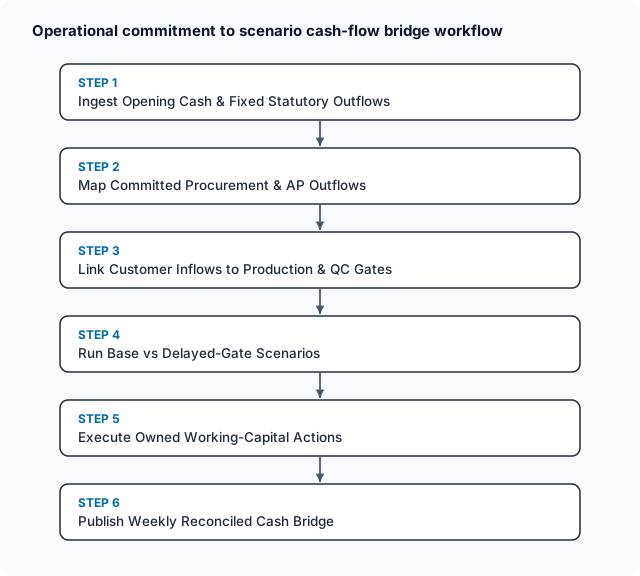
Operational commitment to scenario cash-flow bridge workflow
Follow the workflow below, or open its complete text version.
Read the complete workflow as text
- Ingest Opening Cash & Fixed Statutory Outflows → Map Committed Procurement & AP Outflows
- Map Committed Procurement & AP Outflows → Link Customer Inflows to Production & QC Gates
- Link Customer Inflows to Production & QC Gates → Run Base vs Delayed-Gate Scenarios
- Run Base vs Delayed-Gate Scenarios → Execute Owned Working-Capital Actions
- Execute Owned Working-Capital Actions → Publish Weekly Reconciled Cash Bridge
Worked example: Four-week cash bridge (Weeks 44–47) under a delayed customer FAT and locked motor payment
All rupee balances, order references, and weekly flows below are illustrative examples constructed to show how connecting operational gates to cash commitments exposes a working-capital gap early.
Suppose an industrial process-gas compressor manufacturer operates with an opening cash balance of ₹1,85,00,000 (₹185.00 लाख) at the start of Week 44 (Monday, 26 October 2026) and must maintain a minimum working-capital covenant buffer of ₹1,50,00,000 (₹150.00 लाख) at every weekly Friday close.
1. The operational divergence in Week 45
Two high-value operational commitments intersect on custom compressor package JOB-COMP-804 (contract value ₹1,53,33,333):
- Committed Supplier Outflow (
PO-MOT-4412—₹68,00,000due in Week 45): The plant ordered a custom6.6 kVexplosion-proof electric drive motor from an approved vendor under terms requiring a₹68,00,000(₹68.00 लाख) pre-dispatch milestone payment in Week 45 upon vendor test completion before the motor ships to the compressor plant. Because the vendor completed testing on schedule, this₹68,00,000outflow is contractually locked for Week 45. - Gate-Dependent Customer Inflow (
SO-804-FAT—₹92,00,000originally assumed in Week 45): In the Baseline Plan (Scenario A), customer project teamCUST-PETRO-09was scheduled to witness the mechanical Factory Acceptance Test (FAT) on compressorJOB-COMP-804in Week 44 and wire the60%FAT & readiness milestone (₹92,00,000/₹92.00 लाख) in Week 45. However, during Week 43 assembly inspection, a rotor-housing seal instrumentation rework slips the FAT readiness date by two weeks, moving the expected₹92,00,000customer cash receipt from Week 45 to Week 47 (Scenario B: Operational Delay). Meanwhile, an unrelated₹18,00,000billed invoice (INV-2026-712) is flagged with a documentation dispute and excluded from Week 46 base inflows until resolved.
2. Weekly cash bridge comparison: Scenario A (Baseline) vs Scenario B (Delayed FAT)
For every week t, the cash reconciliation equation is:
Closing_Cash(t) = Opening_Cash(t) + Total_Inflows(t) - Total_Outflows(t)
Opening_Cash(t + 1) = Closing_Cash(t)
Buffer_Surplus_or_Deficit(t) = Closing_Cash(t) - ₹1,50,00,000 (Minimum Buffer)
Scenario A: Baseline Plan (Assuming Week 45 ₹92,00,000 customer FAT receipt holds)
- Week 44:
Opening = ₹1,85,00,000Inflows = ₹64,00,000(confirmed clean AR collections)Outflows = ₹59,00,000(₹41,00,000matched raw-material AP +₹18,00,000weekly utilities/subcontract)Net Flow = +₹64,00,000 - ₹59,00,000 = +₹5,00,000Closing Cash (Wk 44) = ₹1,85,00,000 + ₹5,00,000 = ₹1,90,00,000(+₹40,00,000above₹1,50,00,000buffer) - Week 45 (Baseline):
Opening = ₹1,90,00,000Inflows = ₹1,32,00,000(₹40,00,000routine AR +₹92,00,000assumedSO-804-FATmilestone)Outflows = ₹1,21,00,000(₹68,00,000locked motor paymentPO-MOT-4412+₹53,00,000monthly payroll & statutory GST/PF remittance)Net Flow = +₹1,32,00,000 - ₹1,21,00,000 = +₹11,00,000Closing Cash (Wk 45 Baseline) = ₹1,90,00,000 + ₹11,00,000 = ₹2,01,00,000(+₹51,00,000above buffer) - Week 46 (Baseline):
Opening = ₹2,01,00,000 | Inflows = ₹55,00,000 | Outflows = ₹62,00,000 | Net = -₹7,00,000Closing Cash (Wk 46 Baseline) = ₹2,01,00,000 - ₹7,00,000 = ₹1,94,00,000(+₹44,00,000above buffer) - Week 47 (Baseline):
Opening = ₹1,94,00,000 | Inflows = ₹48,00,000 | Outflows = ₹54,00,000 | Net = -₹6,00,000Closing Cash (Wk 47 Baseline) = ₹1,94,00,000 - ₹6,00,000 = ₹1,88,00,000(+₹38,00,000above buffer)
Scenario B: Updated Operational Reality (₹92,00,000 FAT receipt shifts from Week 45 to Week 47; ₹68,00,000 motor payment stays in Week 45)
- Week 44: Unchanged (
Opening = ₹1,85,00,000,Inflows = ₹64,00,000,Outflows = ₹59,00,000,Closing = ₹1,90,00,000). - Week 45 (Delayed FAT Impact):
Opening = ₹1,90,00,000Inflows = ₹40,00,000(₹1,32,00,000 - ₹92,00,000slippedSO-804-FATreceipt)Outflows = ₹1,21,00,000(₹68,00,000locked motor payment +₹53,00,000payroll/statutory)Net Flow = +₹40,00,000 - ₹1,21,00,000 = -₹81,00,000Closing Cash (Wk 45 Delayed) = ₹1,90,00,000 - ₹81,00,000 = ₹1,09,00,000Buffer Deficit (Wk 45) = ₹1,09,00,000 - ₹1,50,00,000 = -₹41,00,000 (₹41.00 लाख breach below minimum buffer) - Week 46 (Continued Dip Before FAT Recovery):
Opening = ₹1,09,00,000Inflows = ₹55,00,000(excluding₹18,00,000disputedINV-2026-712)Outflows = ₹62,00,000Net Flow = +₹55,00,000 - ₹62,00,000 = -₹7,00,000Closing Cash (Wk 46 Delayed) = ₹1,09,00,000 - ₹7,00,000 = ₹1,02,00,000Buffer Deficit (Wk 46) = ₹1,02,00,000 - ₹1,50,00,000 = -₹48,00,000 (peak cumulative deficit) - Week 47 (FAT Receipt Collects in Week 47):
Opening = ₹1,02,00,000Inflows = ₹48,00,000 (routine AR) + ₹92,00,000 (re-timed SO-804-FAT milestone) = ₹1,40,00,000Outflows = ₹54,00,000Net Flow = +₹1,40,00,000 - ₹54,00,000 = +₹86,00,000Closing Cash (Wk 47 Delayed) = ₹1,02,00,000 + ₹86,00,000 = ₹1,88,00,000(+₹38,00,000above buffer; identical 4-week ending cash, since total 4-week inflows₹2,99,00,000and total 4-week outflows₹2,96,00,000are conserved).
Scroll horizontally to see all columns.
| Week | Scenario A (Baseline) Closing Cash | Scenario B (FAT Delayed 2 Wks) Inflows | Scenario B Outflows | Scenario B Closing Cash | Scenario B Surplus / (Deficit) vs ₹1,50,00,000 Buffer |
Primary operational driver of variance |
|---|---|---|---|---|---|---|
| Week 44 | ₹1,90,00,000 |
₹64,00,000 |
₹59,00,000 |
₹1,90,00,000 |
+₹40,00,000 |
Baseline operational run rate |
| Week 45 | ₹2,01,00,000 |
₹40,00,000 |
₹1,21,00,000 |
₹1,09,00,000 |
-₹41,00,000 (Breach) |
SO-804-FAT (₹92,00,000) slips out while PO-MOT-4412 (₹68,00,000) and payroll (₹53,00,000) pay out |
| Week 46 | ₹1,94,00,000 |
₹55,00,000 |
₹62,00,000 |
₹1,02,00,000 |
-₹48,00,000 (Breach) |
Working-capital trough persists prior to rescheduled FAT sign-off |
| Week 47 | ₹1,88,00,000 |
₹1,40,00,000 |
₹54,00,000 |
₹1,88,00,000 |
+₹38,00,000 |
Rescheduled ₹92,00,000 FAT milestone collected; 4-week cumulative cash reconciles |
| 4-Wk Total | End: ₹1,88,00,000 |
₹2,99,00,000 |
₹2,96,00,000 |
End: ₹1,88,00,000 |
Min: -₹48,00,000 (Wk 46) |
Monthly total hides a ₹48,00,000 intra-month trough |
3. Why the weekly commitment bridge changes management action
Notice the crucial arithmetic lesson: on a monthly summary report covering all four weeks together, Scenario A and Scenario B look identical (Opening ₹1,85,00,000 + Inflows ₹2,99,00,000 - Outflows ₹2,96,00,000 = Closing ₹1,88,00,000). Only the dated weekly bridge reveals the ₹41,00,000 to ₹48,00,000 liquidity trough in Weeks 45 and 46.
Because the commitment bridge surfaces that trough 14 days in advance, the finance controller and procurement head can execute bounded mitigations before Week 45:
- Negotiate a 14-day vendor milestone alignment on
PO-MOT-4412(paying₹20,00,000upon test certificate in Week 45 and₹48,00,000upon delivery in Week 47, which adds+₹48,00,000to Week 45/46 cash and keeps closing cash at₹1,57,00,000in Week 45 and₹1,50,00,000in Week 46, eliminating the covenant breach entirely), or - Schedule a short-term working-capital facility drawdown of
₹50,00,000for exactly 14 days while fast-tracking resolution of the₹18,00,000disputed receivable via manufacturing receivables dispute follow-up, aligning imported-component procurement milestones, and protecting true manufacturing job costing margins.
Observable acceptance tests for the operating cash-flow workflow
Before adopting an operational cash-flow planning module, verify these three acceptance tests:
ACT-M069-01(Automatic cash-inflow shift when a production or QC milestone slips): Advance the scheduled completion date of a milestone-linked production order (JOB-COMP-804) by14 daysin the finite-capacity schedule. Pass condition: The linked unbilled customer collection (SO-804-FAT,₹92,00,000) automatically shifts from Week 45 to Week 47 in the operational scenario view while flagging the change reason (Production Gate Slip: WO-804-OP40) for finance controller review.ACT-M069-02(Strict separation of confirmed commitments from unconfirmed assumptions): Attempt to mark an unbilled customer collection or an unapproved supplier deferral asConfirmed Cashwithout a signed customer acceptance certificate or vendor amendment reference. Pass condition: The workflow retains the item in theUnconfirmed Finance Assumptionbucket and prevents it from overwriting the conservative baseline liquidity check.ACT-M069-03(Exact opening-to-closing balance conservation across scenarios): Run a 13-week cash bridge across Baseline, Delayed-Collection, and Expedited-Procurement scenarios. Pass condition: For every weekt,Opening_Cash(t) + Inflows(t) - Outflows(t) = Closing_Cash(t)andOpening_Cash(t+1) = Closing_Cash(t)with zero unallocated plug lines, and every week-over-week delta traces to a specific PO, work order, AR invoice, or documented finance assumption.
Next actions for finance controllers, procurement leads, and planners
To connect shop-floor and purchasing commitments to your rolling cash plan, complete these four numbered actions:
- Map payment milestone schedules onto all open purchase orders above your materiality threshold: Stop waiting for AP invoice posting; record advance, pre-shipment, and post-receipt payment dates directly on high-value raw material, bought-out equipment, and subcontract purchase orders.
- Tie unbilled customer milestone receipts to real MES/QC gate dates: Link progress-billing milestones (
FAT, pre-dispatch inspection, and site handover) to the actual scheduled completion dates of their governing shop-floor operations rather than static sales-order promise dates. - Quarantine disputed AR invoices out of base-case weekly cash inflows: Exclude any receivable with an open quantity, price, or documentation dispute from expected weekly cash collections until the commercial and quality owners close the dispute record.
- Institute a weekly 30-minute cash-commitment review across Finance, Procurement, and Production Planning: Review the 13-week opening-to-closing bridge every Monday using
ACT-M069-01throughACT-M069-03so schedule slips or vendor expedite requests are evaluated against liquidity buffers before cash is committed.
Compare this workflow with your current setup
Share the step that takes the most manual work, the systems involved and the exceptions your team handles. That gives us a concrete starting point for comparing approaches.
Sources and further reading
Sources checked 15 October 2026. Worked examples and workflow diagrams are original illustrations, not reported client results.


