Mono-carton artwork control: retire the old production pack, not just the PDF
For stores, inventory control and production teams · Compare approaches
TL;DR — what you’ll learn
- Release a compatible set of carton artwork, structural die-line, colour reference and approved text for an identified SKU, market and order scope.
- Connect that set to the physical printing and cutting tools actually used. An approved PDF does not establish that a converter has selected the right plate, cylinder or die.
- Find old-revision stock at the converter, warehouse, line and finished-goods stages before deciding transition effectivity.
- Keep legal text approval, packaging feasibility, colour approval and production release with their authorised owners. File comparison can support review but cannot grant those approvals.

Illustrative factory raw-material stores and receiving counter; not a client facility.
The packaging team approves a new carton PDF. Purchasing forwards it to the converter, but an open print job still references the old tooling. Meanwhile, the packing line has old flat cartons staged for the next order. The document repository is current; the physical supply chain is not.
Preventing that mismatch requires a controlled production pack and a recorded transition decision. In this guide, a production pack is the compatible set of approved design and content references used to procure, convert and issue one carton configuration. Release that set for an explicit order/market scope, acknowledge its receipt at the converter and line, and reconcile old materials before authorising their use, rework or disposal. This is a proposed record workflow, not a statutory labelling guide or a gluer operating procedure.
Give the production pack its own identity
A mono-carton here means the individual folding carton used for one product configuration. A die-line is its referenced structural layout. Neither term identifies which commercial design, market text or colour reference applies. Use stable IDs and revisions for each component rather than one filename that people overwrite.
Scroll horizontally to see all columns.
| Controlled reference | What the release record should resolve | Approval responsibility |
|---|---|---|
| Structural die-line | CAD/layout revision, dimensions and approved fit/structural reference | Packaging/structural engineering |
| Print artwork | Artwork revision, linked structural layout, approved print file and checksum | Artwork owner with required reviewers |
| Colour/shade reference | Identified physical/digital reference, specification and applicable evaluation evidence | Designated colour/quality owner |
| Text and statutory panels | Approved content version, product/market/language applicability and regulatory/legal decision | Authorised legal/regulatory or product-content owner |
| Physical tools | Plate/cylinder and cutting/creasing tool IDs where those processes use them; status and compatible production-pack reference | Converter/prepress/tooling owner |
| Order release | SKU/carton item, pack revision, applicable quantity, order/lot scope and effectivity decision | Packaging/master-data owner and authorised planning/release roles |
Use the tooling records appropriate to the process; not every printer uses cylinders, and not every digital print change needs a plate. A file hash can show that two digital files have identical bytes. It cannot establish colour accuracy, carton fit, legal correctness or which physical tool the converter loaded.
Esko's WebCenter 25.11 documentation describes separate permissions for changing approval setup and starting/stopping approval cycles. It also notes that an approval cycle can finish after approvers have approved or rejected the document. A generic “cycle finished” status is therefore insufficient evidence of an approved release.
Map the actual approval outcome and version, and verify the installed product configuration. WebCenter approval-cycle documentation.
Bounded mono carton packaging verification and exception-routing workflow
Follow the workflow below, or open its complete text version.
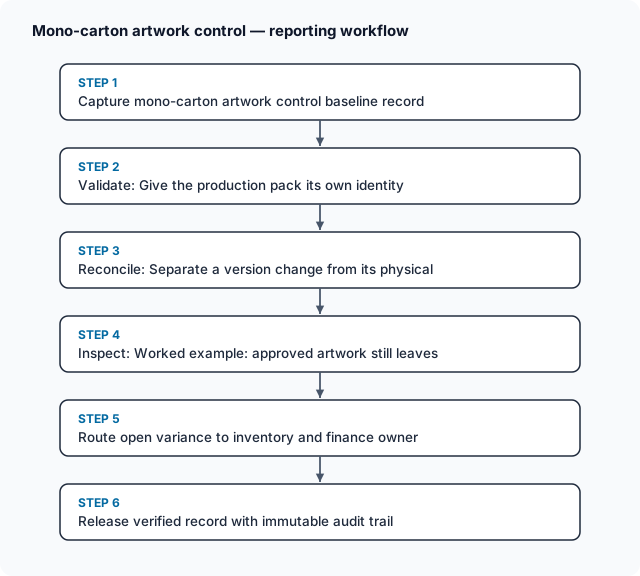
Read the complete workflow as text
- Capture mono carton packaging baseline record → Verify revision, unit Basis and cutoff alignment
- Verify revision, unit Basis and cutoff alignment → Run deterministic reconciliation and tolerance check
- Run deterministic reconciliation and tolerance check → Quarantine mismatched or unapproved lines
- Quarantine mismatched or unapproved lines → Route exception to named domain and finance owner
- Route exception to named domain and finance owner → Release verified record with immutable audit trail
Separate a version change from its physical effectivity
An artwork change can affect open print orders, unconverted sheets, folded cartons, line stock and already packed product differently. Create an impact list before assigning an effective date. The legal/regulatory owner determines which market/product requirements apply to the content, while packaging and quality assess the material configuration. Do not assume an old revision is always usable until exhausted, or always requires destruction.
Product identity needs its own review. GS1's GTIN Management Standard addresses consistent identification of new and changed trade items; it does not make an internal artwork revision number a substitute for the applicable GTIN decision. Ask the master-data owner to assess the actual change against the relevant rules rather than automatically retaining or replacing a barcode. GS1 GTIN Management Standard.
The release decision should state which orders or lots may use which production pack, what happens to existing stock and who approved each disposition. Date alone may be insufficient when two markets or open orders have different approved transition scopes. Record that scope in machine-readable fields and readable instructions reviewed by the owners.
Worked example: approved artwork still leaves a physical carton gap
This scenario is illustrative. All quantities are individual cartons for one SKU and market. Categories are mutually exclusive at a single reconciliation time. There are no losses or undocumented transfers assumed in the fixture.
Artwork revision B is superseded by revision C for a proposed next order. The owners have not yet authorised any B stock for that order. The inventory review finds:
Scroll horizontally to see all columns.
| Location/state of revision B | Cartons | Required follow-up |
|---|---|---|
| Warehouse flat-carton stock | 3,000 | Verify identity and hold/disposition reference |
| Converter work in progress | 1,800 | Obtain acknowledged status and affected print/tooling references |
| Staged at packing line, not consumed | 1,200 | Reconcile staged quantity and controlled return or other disposition |
| Already packed finished goods | 2,000 | Link to finished-product lots and owner-approved impact decision |
| Total old-revision exposure | 8,000 | 3,000 + 1,800 + 1,200 + 2,000 |
The 2,000 packed cartons are not available blank stock. They belong in the impact assessment, but adding them to available packaging would double count their potential use. Marking the old PDF obsolete does not change any of these physical quantities.
Now assume the next order needs 6,000 revision-C cartons. The warehouse holds 4,200 received C cartons with the fixture's approved inventory status. The converter promises another 1,500, but they are not yet received or accepted. On-hand coverage is 4,200 ÷ 6,000 × 100 = 70%, with a current physical gap of 1,800 cartons.
If the promised 1,500 arrive and pass the applicable receipt/release process, projected coverage becomes 4,200 + 1,500 = 5,700 cartons, leaving 300 still uncovered. The projected share is 5,700 ÷ 6,000 × 100 = 95%. Neither the promise nor the arithmetic authorises the use of B stock to fill the gap.
This creates two different decisions: what happens to 8,000 B cartons across their existing states, and how the next order obtains the missing approved C cartons. Keep them separate. A cost-saving estimate that assumes all B stock can be reused or all must be scrapped would require an actual disposition decision and cost evidence; this example makes neither claim.
Make the converter and the line acknowledge the same release
Publish the approved production pack as an identified, immutable release set. Record the exact document versions and required approval outcomes. A changed file creates a new reviewable version; it should not silently replace the set attached to an open order.
At the converter handover, request acknowledgement of the production-pack ID, open-job impact, compatible tooling references and superseded tools/materials requiring control. If the converter uses an older reference, route the mismatch to the release owner. An email saying “latest file received” does not identify which job was changed.
At material receipt and line issue, connect the physical carton item/lot and stated revision to the applicable order scope. Where a supplier label is incomplete, do not infer the revision from appearance alone. Route it for the agreed identity-verification process. Quality and operations own any physical segregation, line checks and disposition under their approved procedures; a dashboard status does not perform those actions.
Warehouse and converter stock movements need acknowledgement in both the physical and system record. A proposed return is not a completed return. A blocked plate record is not evidence that a tool has been physically removed from use. Keep requested, acknowledged and verified actions distinguishable where the process requires them.
Handle changes and failures without resurrecting an obsolete pack
Only the text panel changes. Retain the structural reference, but obtain the applicable content approval and assess the impact on artwork, plates and stock. Do not copy an earlier legal approval onto changed wording.
A colour proof is rejected. Record the rejected proof and its version. A later approved proof supersedes it through an explicit decision, not by replacing the file in a shared folder. The colour owner defines the reference and acceptance basis; the application supplies no universal colour-difference limit.
An old plate or die is requested for a new job. Compare the actual tooling-to-pack mapping and effective scope. Route incompatible or unknown mappings to the tooling/release owners. Do not declare two tools interchangeable because their filenames look similar.
A partial delivery mixes revisions. Split the receipt into traceable revision/lot scopes and preserve the unresolved identity status for any uncertain cartons. One received total must not make every carton eligible for every order.
A duplicate or late approval arrives. Apply an identified event once. Preserve decision time separately from arrival time, and confirm that it applies to the current review version. An older approval arriving after supersession cannot reactivate the old pack automatically.
The artwork-to-ERP connection fails. Keep unreconciled new releases out of automatic propagation. Use the agreed controlled fallback to communicate the approved set and record acknowledgement. On recovery, compare pack IDs, order scope and tool/material states before replaying. Reversing the digital release cannot undo printed cartons; physical impacts need their own disposition.
Decide how much system change the transition actually needs
Begin with a controlled release register if a small team can maintain versioned evidence and acknowledgements. Configure the existing artwork/ERP workflow when it supports approval outcomes, order effectivity and item revisions. Add an integration when the real gap lies between the artwork repository, converter job system and stock/line-issue records. Build a bounded application only where those options leave a demonstrated reconciliation problem.
Deterministic checks should compare revision IDs, scope, approval outcome and tooling compatibility. Visual comparison or AI can help reviewers find possible differences, but the responsible people still judge structural, colour and legal acceptability. Treat a suggested difference as review evidence, not a release instruction.
Assess one SKU/market transition in shadow mode. Inputs are the approved production pack, open converter jobs, tool register, old/new stock by state, proposed order and transition decisions. Establish baseline counts of orders with ambiguous pack references, unacknowledged converter changes and unresolved old stock. Report unknowns explicitly.
Acceptance should demonstrate that the example reproduces the 8,000-carton exposure, the 1,800 physical gap and the conditional 300 projected gap. Every sampled order must retrieve its approved set; a finished-but-rejected approval cycle must remain ineligible. Test mixed receipts, stale approvals, incompatible tooling and outage recovery.
Owners must reconcile the physical stock actions as well as the digital records. These are proposed checks, not measured deployment results.
Close the transition across documents, tools and stock
Mono-carton version control becomes useful when the approved design set reaches the actual converter job and packing order. A clear transition record explains which materials and tools remain applicable, where superseded stock sits and what approvals support its disposition.
- Assemble one production pack with explicit structural, artwork, colour, text and tooling references.
- Reconcile old-revision exposure across converter, warehouse, line and finished goods without double counting.
- Obtain the authorised market/content, engineering and quality decisions for effectivity and stock disposition.
- Test converter acknowledgement, mixed revisions and recovery before relying on automatic order or stock updates.
Frequently Asked Questions
How do packaging and consumer-product plants prevent obsolete mono-carton die-line, shade-card, and statutory-panel revisions from reaching folding-carton gluers or packing lines?.
Teams should govern mono carton packaging by linking every transaction to its source evidence, timestamp, and assigned owner before permitting downstream posting. Distinct from M024 (engineering BOM revision control) and M034 (reel converting scheduling); M105 controls mono-carton CAD die-line revision locks, print-cylinder/plate linked obsolescence, and old-revision carton quarantine during SKU artwork transitions. Rather than relying on informal spreadsheet overrides, the workflow enforces a documented verification gate and preserves the original observation whenever a correction is recorded.
How does flexible packaging types handle exceptions and mismatches?.
When a discrepancy occurs during flexible packaging types, the system routes the blocked record into an owned exception queue rather than silently dropping or auto-adjusting the balance. Control approved packagingartwork revisions and supersession. Legal/regulatory owner confirms current statutorypanels for applicablemarket/product; no universal label wording. Each exception retains the original quantity, date, and counterparty reference until the designated reviewer resolves the variance with supporting evidence.
What should teams test before automating affordable custom packaging?.
Before scaling affordable custom packaging, run a bounded pilot using historical records that include partial receipts, late updates, duplicate messages, and rejected lines. Verify that the integration preserves idempotency, maintains a clear segregation of duties between operational entry and financial approval, and produces an auditable trail for every state transition.
Compare this workflow with your current setup
Share the step that takes the most manual work, the systems involved and the exceptions your team handles. That gives us a concrete starting point for comparing approaches.
Sources and further reading
Sources checked 15 October 2026. Worked examples and workflow diagrams are original illustrations, not reported client results.

