Tamper-evident packaging: reconcile seal usage and inspection evidence before handover
For quality, engineering and records teams · Compare approaches
TL;DR — what you’ll learn
- Reconcile each packaging component in its own unit and identity scheme. A seal-roll ID, a liner lot and an individually serialised seal provide different traceability precision.
- Separate saleable packs, destructive samples, recorded scrap, returns and unexplained differences. A balancing total does not prove seal integrity.
- Connect inspection results to the applicable packaging specification and affected production scope. Quality and engineering determine methods, sampling and acceptance.
- Keep material reconciliation, physical line-clearance evidence and finished-pack disposition as linked decisions with named owners.

Illustrative manufacturing inspection room and machine shop floor; not a client facility.
A packaging run finishes with the expected number of cartons. Stores receives a partly used seal roll, production records a scrap total, and quality retains packs used for destructive inspection. None of those records establishes whether all issued seals are accounted for or whether the inspection evidence covers the cartons awaiting handover.
The useful system decision is whether an identified packaging run has a reconciled component history and the required approved inspection and clearance evidence. Design the records so the quality/release owner can make that decision for the affected packs and cartons. Do not let a good count automatically approve integrity or let an inspection result erase an unexplained component difference.
Start with the identity the component actually carries
A roll-fed external seal and a liner supplied within a cap are separate components. They should not share a consumption ledger merely because both contribute to the package. Use the component item and revision, supplier lot, container or roll ID, issued quantity and unit.
Record individual serial ranges only when the component actually has them and the process captures them reliably. Do not imply that a supplier lot identifies every finished pack uniquely.
GS1's traceability framework distinguishes events affecting a traceable object from the data describing those events. It provides a basis for connecting identities, movements and packaging relationships. It does not certify that the seal works or supply a product-specific line-clearance procedure. GS1 traceability, Global Traceability Standard.
For this workflow, record receipt, issue, consumption, sample withdrawal, scrap disposition, return and carton/pallet association as distinguishable events. Preserve event time, recording time, source and responsible role. Connect the component history to the production run and the packaging specification in effect, not just the current item master.
The terms used in a product search also need care. Induction-equipment supplier Enercon describes tamper evidence among induction sealing's applications. That is not a universal claim of resistance to every interference method, leak prevention for every pack or suitability for a regulated product.
The responsible packaging and quality owners must establish what the chosen package is intended to demonstrate. Enercon: Why induction seal?.
Bounded tamper resistant packaging verification and exception-routing workflow
Follow the workflow below, or open its complete text version.
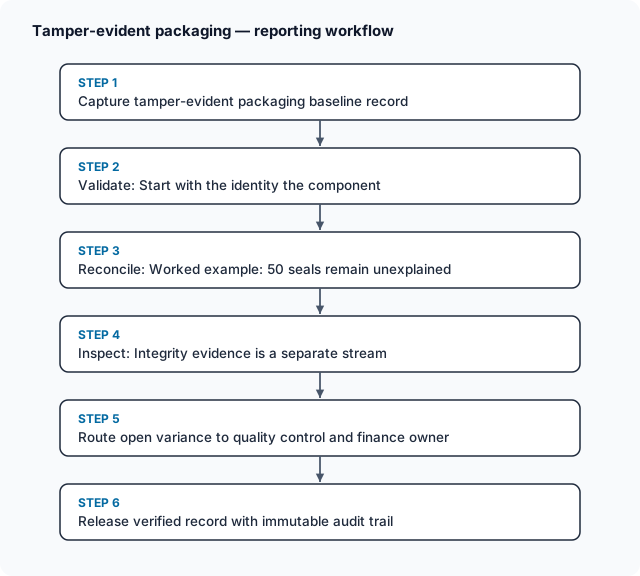
Read the complete workflow as text
- Capture tamper resistant packaging baseline record → Verify revision, unit Basis and cutoff alignment
- Verify revision, unit Basis and cutoff alignment → Run deterministic reconciliation and tolerance check
- Run deterministic reconciliation and tolerance check → Quarantine mismatched or unapproved lines
- Quarantine mismatched or unapproved lines → Route exception to named domain and finance owner
- Route exception to named domain and finance owner → Release verified record with immutable audit trail
Worked example: 50 seals remain unexplained despite a plausible output count
The figures below are illustrative. Assume one run uses one external seal per pack. All quantities in this ledger are individual seals, not metres of web, kilograms of scrap or cartons. No rework reuses a seal, no opening balance exists on the line, and every category below is mutually exclusive. This fixture does not calculate induction-liner usage, which needs its own ledger.
Stores issues 12,000 external seals to the run. The line records 11,360 sealed packs before sample withdrawal. Quality withdraws 80 of those packs for destructive inspection; they are excluded from saleable output. That leaves 11,280 packs awaiting the appropriate disposition.
Scroll horizontally to see all columns.
| Accounting category | Illustrative seals | Evidence needed |
|---|---|---|
| In packs awaiting saleable-output disposition | 11,280 | Run/output reference and carton associations |
| In destructive sample packs | 80 | Sample identities and withdrawal/disposition references |
| Recorded process scrap | 240 | Scrap event, component/run identity and disposition evidence |
| Returned unused to stores | 350 | Counted return and receiving acknowledgement |
| Total accounted for | 11,950 | 11,280 + 80 + 240 + 350 |
The unexplained difference is 12,000 − 11,950 = 50 seals. Using issued quantity as the denominator, the unexplained share is 50 ÷ 12,000 × 100 ≈ 0.417%. That percentage is a diagnostic value, not an acceptable-loss allowance.
At 24 packs per carton, 11,280 ÷ 24 = 470 full cartons could be represented by the remaining pack count. This is a packing arithmetic check, not a release decision. It does not prove which cartons were inspected, whether a seal was effective, or where the 50 seals went.
Counting the 11,360 gross packs and the 80 withdrawn samples as separate consumption categories would double count the samples. The corrected bridge starts with 11,280 remaining packs. Likewise, a scrap bin weight cannot be added to this piece ledger without a justified conversion, its assumptions and the owner's approval. If that conversion is uncertain, retain the uncertainty.
The system should raise a reconciliation exception and identify the affected run scope for the quality owner's decision. It should not automatically enter 50 as “destroyed” to force a zero balance. The physical material and product response follows the approved site process. If the genealogy cannot narrow the affected scope, show that limitation rather than claiming carton-level precision that the records do not support.
Integrity evidence is a separate stream
For an induction liner, capture the applicable closure/container/liner specification, component lots, run or interval, inspection record, method reference and edition, authorised results/disposition and related sample identities. Engineering and quality decide which checks demonstrate the intended properties and how a result applies to production. This article supplies no sealer settings, torque values, peel limits, sampling frequency or machinery intervention instructions.
Method names must not be substituted for one another. ASTM's publisher listing identifies D2063/D2063M-24 as a method concerning torque retention for continuous-thread closures using manual testing equipment. That scope alone does not establish an induction-liner integrity test or a peel-test requirement.
The qualified owner must confirm applicable methods and licensed requirements for the actual package. ASTM D2063/D2063M-24.
Keep withdrawn samples physically and electronically distinct from packs awaiting saleable disposition, under the site's approved arrangements. Record the withdrawal and eventual disposition separately. A sample marked “tested” has not necessarily been destroyed, and a scrap instruction is not evidence that destruction occurred.
Join three records at the packaging handover
Scroll horizontally to see all columns.
| Record | Required decision context | Accountable role |
|---|---|---|
| Component reconciliation | Issued/returned/consumed/sample/scrap quantities, units, identities and unresolved difference | Production records usage; stores acknowledges movements; assigned reconciliation owner investigates differences |
| Line-clearance evidence | Previous and next job/specification references, evidence required by the approved site procedure and recorded completion/verification | Authorised production/quality owners perform and verify the applicable process |
| Pack/carton disposition | Run genealogy, relevant inspections, sample exclusions, outstanding holds, affected carton/pallet references and release decision | Authorised quality/release owner |
The software joins these records; it does not perform physical clearance. A completed electronic checklist without the applicable physical evidence cannot establish that the line was cleared. Likewise, moving a carton to a pallet should not silently convert a held pack into released stock. Where palletisation occurs before final disposition, keep its hold status visible through the warehouse handover.
Use stable references when a carton is split, repacked or moved between pallets. Preserve the original association and add the authorised change. Avoid replacing the history with only the latest pallet number, since an investigation may need the earlier relationship.
Exceptions and recovery to rehearse
A partially used roll returns without a confirmed count. Record it as an unverified return, with its component identity and location. Do not credit an assumed full-roll quantity. The responsible owner resolves the count using the approved method.
The same scrap event is uploaded twice. Recognise the source event ID and apply consumption once. Record duplicate receipts separately. If the scrap amount was wrong, create a linked correction with a reason and authorisation; do not delete its history.
A seal or liner lot changes mid-run. Record the change boundary and affected scope. If only an approximate time interval is known, mark the genealogy as uncertain and route scope determination to quality. Do not manufacture a precise pack serial boundary from a time estimate.
An inspection is rejected or arrives late. Retain the result, the approved applicability decision and the affected hold. A new result should not overwrite the rejected evidence. Quality determines the disposition and any further action; the system routes and tracks it.
A destructive sample is included in a carton scan. Flag the contradictory sample and aggregation states. The authorised owner resolves the physical and record mismatch. A warehouse scan cannot cancel the sample withdrawal.
The line interface fails. Use the site's controlled fallback for component movements and inspection references. Queue events with stable IDs and make the outage visible. Before replay, reconcile the ERP/MES quantities, manual records and carton associations. Recovery is complete only when differences have owners and the authoritative records agree; never invent a balancing consumption event.
Choose controls that match the precision needed
A controlled paper or spreadsheet reconciliation can support a small operation if identities, counts and approvals remain reliable. Configure existing ERP/MES stock and quality records when they can express the required categories and genealogy. Add barcode integration when repeated transcription is the demonstrated problem. Build a bounded workspace only for a proven gap, such as presenting unresolved seal differences alongside the applicable inspection and carton references.
Use deterministic arithmetic, identity checks and state checks. AI might summarise an investigation note for a reviewer, but it cannot infer where missing seals went or declare a package acceptable from an image or count.
Assess one packaging configuration and one run family in a read-only comparison first. Inputs are approved component/specification records, issue/return/output/sample/scrap events, inspection references and carton/pallet associations. Establish the current frequency of unresolved component differences, missing sample references and manual genealogy corrections. Unknown measurements remain unknown.
Observable acceptance includes reproducing the 50-seal difference and 470-carton arithmetic, excluding the 80 samples once, keeping separate component units, blocking duplicate consumption and retrieving all affected carton associations at the precision actually recorded. Rehearse a lot change, rejected inspection, unverified return and outage replay. The production and quality owners must accept the physical-to-record handover before the application is relied upon. These are proposed checks, not reported results.
Make the handover explainable
A useful packaging record can explain the fate of issued components and the evidence behind pack disposition. Reconciliation, integrity inspection and line clearance support that decision in different ways. Keeping them linked but distinct prevents a neat total from concealing an unresolved physical or quality question.
- Identify each seal, liner and closure component's actual lot/roll/serial precision and counting unit.
- Rebuild one run's usage bridge with saleable-scope packs, samples, scrap and returns counted once.
- Ask quality and engineering to confirm the inspection evidence and clearance authorities for the actual packaging configuration.
- Rehearse unexplained usage, lot changes and interface recovery before relying on a new digital handover.
Frequently Asked Questions
How should discrete and consumer-goods manufacturers reconcile tamper-evident seal roll serials, induction-liner integrity checks, and line-clearance scrap counts before finished-carton palletisation?.
Teams should govern tamper resistant packaging by linking every transaction to its source evidence, timestamp, and assigned owner before permitting downstream posting. Distinct from M034 (packaging-reel-converting-schedule, which schedules film/reel slitting); M104 covers tamper-evident closure/seal reconciliation, destructive torque/peel sample quarantine, and unaccounted seal destruction logs on industrial packaging lines. Rather than relying on informal spreadsheet overrides, the workflow enforces a documented verification gate and preserves the original observation whenever a correction is recorded.
How does industrial packaging company handle exceptions and mismatches?.
When a discrepancy occurs during industrial packaging company, the system routes the blocked record into an owned exception queue rather than silently dropping or auto-adjusting the balance. Govern packaging/seal serial genealogy and approved inspection evidence. Engineering/quality owns integrity methods and accept/rejectcriteria; no invented sealtesting SOP. Each exception retains the original quantity, date, and counterparty reference until the designated reviewer resolves the variance with supporting evidence.
What should teams test before automating packaging service?.
Before scaling packaging service, run a bounded pilot using historical records that include partial receipts, late updates, duplicate messages, and rejected lines. Verify that the integration preserves idempotency, maintains a clear segregation of duties between operational entry and financial approval, and produces an auditable trail for every state transition.
Compare this workflow with your current setup
Share the step that takes the most manual work, the systems involved and the exceptions your team handles. That gives us a concrete starting point for comparing approaches.
Sources and further reading
Sources checked 15 October 2026. Worked examples and workflow diagrams are original illustrations, not reported client results.

