Manufacturing AP automation: pilot exception ownership before adding an intake layer
For finance, costing and accounts teams · Plan implementation
TL;DR — what you’ll learn
- Choose AP automation by testing whether the existing ERP can route and close the plants actual exception cases. Invoice capture alone does not resolve freight, tooling or quality disputes.
- Keep the suppliers claim, the comparison calculation and the finance decision separate. A calculated difference is neither an approved debit note nor a payment instruction.
- Use one invoice case with several owned exception tasks. Prevent separate reviewers from each approving the invoice while another task remains unresolved.
- Begin in shadow mode with posting and payment disabled in the pilot interface. Expand only after the finance owner accepts reconciliation, permissions, recovery and measured handling results.

Illustrative manufacturing inspection room and machine shop floor; not a client facility.
A supplier invoice includes components, a freight surcharge and a tooling instalment. Procurement recognises the component price but cannot explain the surcharge. Quality has placed some received parts on hold.
AP forwards the invoice between three departments, and each reply addresses a different part of it. Buying another capture tool will help only if the plant can connect those replies into one accountable decision.
For this decision, assess the exception workflow around the ERP before choosing an external AP intake layer. Use a bounded pilot to establish how each charge obtains evidence, which owner resolves it, and how AP knows the whole invoice is ready for authorised finance review. This guide compares implementation boundaries; it does not set matching tolerances, prescribe liability recognition or authorise deductions from supplier payments.
Test the existing workflow before adding another system
Microsoft's Dynamics 365 documentation distinguishes invoice price, receipt-quantity and charges matching. It separately documents invoice review workflows at header and line level. These capabilities illustrate why invoice capture, discrepancy detection and approval routing should be assessed separately.
They do not establish that a particular plant's installation or another ERP implements every required control. Invoice matching overview, Vendor invoices overview.
Start with evidence from recent cases rather than a product feature checklist. Can the ERP attach a freight agreement to the charge? Can quality update a hold without deleting the original receipt?
Can a tooling milestone be traced to its agreement and prior invoices? Can the AP reviewer see every unresolved task before submitting the invoice for the next approval?
Scroll horizontally to see all columns.
| Implementation choice | Evidence that favours it | Boundary to test |
|---|---|---|
| Improve the current process | Exceptions lack owners or requests arrive without identifiers | A tool cannot settle an absent commercial agreement or unclear authority |
| Configure native ERP workflow | The necessary records, permissions and review tasks already exist | Prove header/line joins, attachments, holds and approval behaviour in the installed version |
| Add an external intake layer | Capture channels and supplier-document handling are the demonstrated gap | Preserve the ERP's authoritative invoice identity, approvals and acknowledgement of imported drafts |
| Build a bounded exception workspace | A specific cross-system evidence/ownership gap remains after configuration assessment | Limit the workspace to proposed routing and evidence; keep financial authority in the approved finance workflow |
The case for an external layer should survive a trial using the same exception fixture as the native workflow. Do not compare a configured demonstration in one option with an unconfigured default in the other. Record implementation effort, ongoing ownership and recovery responsibilities alongside handling observations.
Bounded ap automation software for manufacturing verification and exception-routing workflow
Follow the workflow below, or open its complete text version.
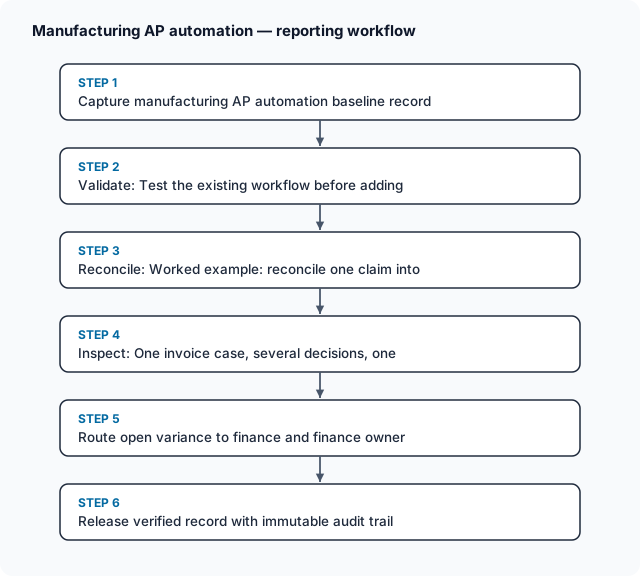
Read the complete workflow as text
- Capture ap automation software for m baseline record → Verify revision, unit Basis and cutoff alignment
- Verify revision, unit Basis and cutoff alignment → Run deterministic reconciliation and tolerance check
- Run deterministic reconciliation and tolerance check → Quarantine mismatched or unapproved lines
- Quarantine mismatched or unapproved lines → Route exception to named domain and finance owner
- Route exception to named domain and finance owner → Release verified record with immutable audit trail
Worked example: reconcile one claim into five review questions
This is an original illustrative fixture, not an accounting entry or a supplier settlement. All amounts are INR before tax. Assume one currency, no discounts, no exchange conversion, no prior invoice allocation and no rounding differences. Finance must determine actual tax, recognition, costing and payment treatment outside this fixture.
The supplier claims 1,000 components at INR 125 each, INR 4,800 freight and INR 6,000 tooling. The approved commercial reference used for comparison is INR 120 per component and INR 4,000 freight. The receiving record shows 970 components; 20 of those are on a quality hold, leaving 950 with the fixture's accepted-for-review status. No supporting tooling milestone evidence has yet been supplied.
The invoice claim is 1,000 × 125 + 4,800 + 6,000 = INR 135,800. A comparison basis using 950 components at INR 120 plus the documented INR 4,000 freight is INR 118,000. Calling that comparison basis an “approved payable” would be an error: the pilot has not obtained a finance decision.
Scroll horizontally to see all columns.
| Difference for review | Calculation | Amount | Proposed accountable reviewer |
|---|---|---|---|
| Components physically received but held | 20 × INR 120 | INR 2,400 | Quality supplies disposition; finance determines financial treatment |
| Invoiced components not recorded received | (1,000 − 970) × INR 120 | INR 3,600 | Receiving/procurement investigate delivery evidence |
| Unit-price difference on the entire claimed quantity | 1,000 × (INR 125 − INR 120) | INR 5,000 | Procurement verifies applicable price/revision |
| Freight above the documented comparison charge | INR 4,800 − INR 4,000 | INR 800 | Procurement/logistics verify agreement and charge evidence |
| Tooling charge without milestone support | INR 6,000 − INR 0 supported so far | INR 6,000 | Tooling/project owner provides evidence; finance reviews treatment |
The five differences total INR 17,800. The bridge reconciles: INR 118,000 + INR 17,800 = INR 135,800. This decomposition counts the INR 5 price difference once across all 1,000 claimed pieces and the quantity/status differences at the reference INR 120 price. Another decomposition could be valid, but it must use a declared basis and must not count the same price/quantity effect twice.
These are five linked review questions on one invoice, not five separate invoices or five automatic debit notes. A quality hold is not necessarily a rejection, and absent tooling evidence is not proof that no liability exists. If the tooling agreement already recovers tooling through the unit price, reviewers must investigate possible double billing; the application should display the agreement rather than decide its interpretation.
Retain the original claim throughout. When owners supply missing evidence or agree corrections, record the resulting reviewed version and decision. Never silently replace INR 135,800 with INR 118,000 and present the supplier's document as if it contained the revised figure.
One invoice case, several decisions, one accountable join
The parent case needs supplier legal-entity identity, invoice number/date, currency, source document reference and hash, line IDs, PO/release links, receipt allocations and the current version. Each child task needs a stable task ID, exception type, affected line/charge and amount, evidence references, owner, due date, decision and resolution version.
The AP case owner coordinates the join. Procurement resolves the commercial price and freight questions. Receiving confirms physical delivery records.
Quality owns the technical disposition. The tooling owner confirms the relevant milestone evidence. Finance owns accounting, tax, credit/debit treatment and the approval path to any payment decision.
System administration owns permissions and interface recovery, without gaining authority to resolve financial exceptions.
An illustrative workflow moves from received, through identity/mapping review and owned exceptions, to ready for authorised finance review. “Ready” means the required evidence tasks are resolved under the agreed policy; it does not mean posted or paid. Do not let one reviewer close the parent case while another required task is open. Record rejected evidence and reopened decisions explicitly.
The integration should read approved PO versions, receipt allocations, quality state and relevant charge agreements. If permitted later, it may propose an ERP draft with its source-case reference. It must receive and store the ERP acknowledgement, including the resulting document ID and version.
A request timeout leaves an unknown outcome; query by the source reference before retrying. A successful API request alone does not prove that the invoice completed review.
Failure cases the pilot must make visible
The same PDF arrives by email and portal. Keep channel receipts separate from the invoice identity. Use agreed supplier/entity/document keys and content comparison to flag a possible duplicate; human review handles number-format changes and legitimate corrections. One accepted source event must not create two target drafts.
A corrected invoice reuses the supplier's number. Link the correction to the original, retain both versions and invalidate affected review tasks. Reusing old approval against changed lines should fail the fixture.
A partial receipt or quality decision arrives late. Preserve event and receipt times. Recalculate only the affected comparison against its new evidence version and reopen the corresponding task. Do not infer a credit merely because a hold becomes a rejection.
A freight charge lacks a PO line. Route it for commercial evidence instead of forcing it into the component unit price. Record whether it belongs to the supplier invoice, a separate carrier invoice or another approved arrangement; finance decides the applicable allocation and treatment.
A debit-note proposal is disputed. Keep proposed, authorised, issued, acknowledged and applied states distinct where they apply. A proposed deduction cannot be treated as a settled vendor credit. The relevant finance and commercial owners decide the path under the applicable contract and jurisdiction.
The interface stops after creating a draft. Reconcile the external case ID with the ERP before replay. Disable additional writes if identity or amount reconciliation fails. AP continues through the approved manual intake process with the same case references. Any already posted transaction requires the finance-controlled correction process; deleting an external case is not rollback of a ledger entry.
Define the pilot s boundaries and exit before starting
Limit the first pilot to one plant, one legal entity, one currency and one agreed supplier category. Include component, freight and tooling examples deliberately, using authorised redacted records or synthetic fixtures. Keep invoice posting and payment execution outside the pilot interface. Do not connect supplier bank-master changes to this scope.
Baseline the current workflow on an agreed sample and window: active AP handling minutes per unique invoice, time waiting for each owner, unresolved case age and number of manually corrected mappings. Record invoice count separately from exception-task count. For example, the worked invoice contributes one invoice and five initial tasks; it must not inflate a denominator of invoices handled. Do not infer savings from a shorter demonstration.
Use the same labelled fixtures for native ERP configuration and any proposed intake layer. The finance owner should agree measurable exit criteria such as:
- Every sampled source invoice has one reconciled parent identity, traceable line/charge references and all required task owners.
- The fixture reproduces INR 135,800, INR 118,000 and the INR 17,800 bridge exactly, without turning the comparison into an authorised settlement.
- Every seeded duplicate, unsupported tooling charge, freight mismatch and held/late receipt reaches the expected queue; no unresolved case bypasses required review.
- A corrected invoice reopens affected tasks, and outage replay creates no second ERP draft or untraceable amount change.
- Measured handling and waiting times are reported against the agreed baseline with sample size, exclusions and unresolved cases visible; the sponsor decides whether the observed result justifies expansion.
These are proposed tests, not verified implementation results. A failure of ownership, reconciliation or recovery keeps the pilot in shadow mode. If the native workflow meets the need, an additional intake layer requires a separate, evidenced benefit. AI can assist with suggested extraction or a cited summary of a dispute; deterministic arithmetic and authorised people still control the decision.
Choose the workflow that can close the evidence gap
Manufacturing AP automation earns its next scope by making a complicated invoice review reconstructable. Capture quality matters, but the decisive evidence is whether commercial, receiving, quality and tooling decisions join into one controlled finance review without losing the original claim.
- Select representative invoice cases with freight, tooling and quality exceptions and identify the missing evidence in each.
- Test the native ERP workflow against those cases before specifying an external intake layer.
- Assign one AP case owner and named decision authorities for every required exception type.
- Run a shadow pilot with explicit baseline, reconciliation, duplicate and recovery checks; let finance approve any later write scope.
Frequently Asked Questions
How should a manufacturing plant design a bounded AP automation pilot that routes price, quantity, freight-surcharge, and quality-hold debit-note exceptions without auto-posting unverified vendor liabilities?.
Teams should govern ap automation software for manufacturing by linking every transaction to its source evidence, timestamp, and assigned owner before permitting downstream posting. Distinct from M065 (manufacturing-three-way-match-pilot, which defines PO-GRN-invoice matching tolerances) and M068 (AR follow-up); M103 evaluates native ERP AP workflow vs external AP automation intake layers for multi-line manufacturing vendor invoices with landed freight, tool amortisation, and quality-rejection debit notes. Rather than relying on informal spreadsheet overrides, the workflow enforces a documented verification gate and preserves the original observation whenever a correction is recorded.
How does manufacturing accounts payable automation handle exceptions and mismatches?.
When a discrepancy occurs during manufacturing accounts payable automation, the system routes the blocked record into an owned exception queue rather than silently dropping or auto-adjusting the balance. Reconcile supplierinvoice exceptions and propose reviewrouting. Finance owns liability recognition/tax/payment release; no autonomous posting of unverified liabilities. Each exception retains the original quantity, date, and counterparty reference until the designated reviewer resolves the variance with supporting evidence.
What should teams test before automating ap automation in manufacturing?.
Before scaling ap automation in manufacturing, run a bounded pilot using historical records that include partial receipts, late updates, duplicate messages, and rejected lines. Verify that the integration preserves idempotency, maintains a clear segregation of duties between operational entry and financial approval, and produces an auditable trail for every state transition.
Scope this automation around your operation
Tell us your current systems, transaction volume and the exception you need to resolve. We can discuss a focused first release, its review controls and how to measure the result.
Sources and further reading
Sources checked 15 October 2026. Worked examples and workflow diagrams are original illustrations, not reported client results.
