Garment pre-production planning: make the cut-order readiness decision traceable
For production managers, planners and plant leaders · Compare approaches
TL;DR — what you’ll learn
- A Time and Action plan needs both milestone dates and evidence that the approval applies to the proposed style, material lot, colour and pattern revision.
- Keep sample approval, fabric test disposition, trim approval and graded-pattern release as separate decisions. A high completion percentage cannot replace a missing prerequisite.
- Calculate the earliest review date from dependencies. Do not add parallel tasks together or quietly compress an owners technical review to recover a missed date.
- Release only the explicitly approved cut-order scope. A later material or specification change needs an impact review before the old approval can be reused.

Illustrative manufacturing inspection room and machine shop floor; not a client facility.
A garment order appears ready because fabric has arrived and most tasks on the merchandising calendar are green. At the cutting review, the team discovers that the sealed pre-production sample used an earlier trim, the test report refers to another fabric lot, and the graded pattern is still awaiting approval. The calendar recorded activity without establishing readiness.
The direct answer is to make cutting readiness an order-specific evidence decision. Identify the required gates with the customer's and factory's authorised owners, connect each gate to its supporting record and applicability, and let the release owner approve the exact scope that those records support. This is a proposed control design, not a universal list of contractual requirements. It does not decide test conditions, fabric acceptance limits or whether a physical production process is safe to start.
Turn the TNA calendar into a dependency record
In this guide, Time and Action (TNA) means the schedule of pre-production tasks, responsible people and dependencies. A pre-production (PP) sample is the identified sample submitted for the relevant approval. A sealed sample is the controlled reference identified by that approval; a photograph or an email attachment alone should not be assumed to have that status.
Separate three questions for every milestone: has the activity happened, has an authorised person accepted its result, and does that acceptance cover this order? A laboratory report may exist while disposition is pending. An approved pattern may cover only some sizes.
A trim approval may apply to one colourway and supplier reference. Store those distinctions rather than squeezing them into one green checkbox.
The following evidence map is a starting point for a factory review. The actual requirement and authority come from the applicable specification, customer agreement and approved quality process.
Scroll horizontally to see all columns.
| Proposed gate | Record to connect to the cut order | Decision owner and boundary |
|---|---|---|
| PP sample reference | Sample ID, style/specification revision, included material and trim references, approval evidence, conditions and physical reference location | Merchandising coordinates; the designated customer or technical authority approves the applicable sample scope |
| Fabric readiness | Lot/roll scope, relevant test report, method and edition, preparation/relaxation evidence where required, disposition and restrictions | Quality and the responsible textile specialist determine applicable methods and acceptance |
| Trim and shade reference | Trim item/revision, supplier, shade-card reference, covered colourways, approval and any lot restrictions | Designated merchandising/quality/customer authority resolves applicability |
| Graded-pattern release | Pattern revision, size range, linked specification, technical approval and superseded file references | Pattern/technical owner approves the released version and covered sizes |
| Cut-order review | Order ID, quantity/variant scope, evidence versions, unresolved holds and named release decision | Authorised production-planning/release owner verifies the complete approved scope |
A fabric test method is not itself a product acceptance specification. For example, the AATCC publisher describes TM135-2025 as addressing fabric dimensional changes after home laundering. ISO's catalogue describes ISO 5077:2007 as a method for dimensional change after specified washing and drying procedures.
Those descriptions do not establish that either method is suitable for every garment or that a particular percentage change is acceptable. They also do not make laundering tests equivalent to a fabric-relaxation requirement. The qualified owner must select the applicable method, edition, conditions and acceptance basis.
AATCC TM135, ISO 5077 catalogue.
Do not build a universal shrinkage limit into the readiness application. Record the report, the applicable specification and the authorised disposition. If those disagree, preserve the hold for resolution.
Bounded pre production planning in garment industry verification and exception-routing workflow
Follow the workflow below, or open its complete text version.
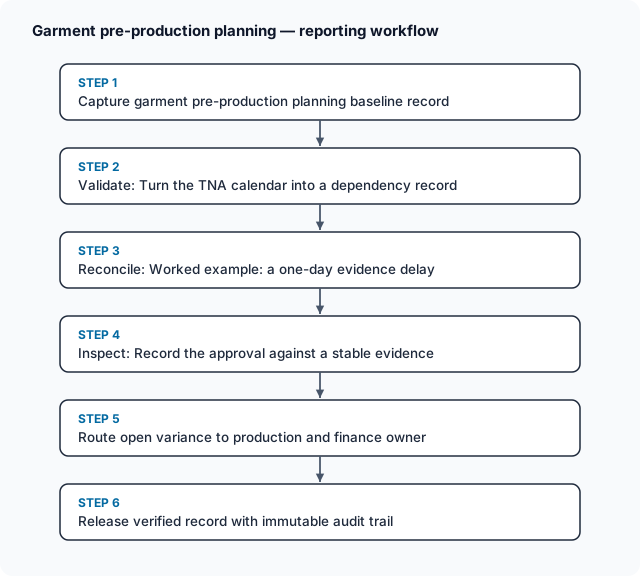
Read the complete workflow as text
- Capture pre production planning in g baseline record → Verify revision, unit Basis and cutoff alignment
- Verify revision, unit Basis and cutoff alignment → Run deterministic reconciliation and tolerance check
- Run deterministic reconciliation and tolerance check → Quarantine mismatched or unapproved lines
- Quarantine mismatched or unapproved lines → Route exception to named domain and finance owner
- Route exception to named domain and finance owner → Release verified record with immutable audit trail
Worked example: a one-day evidence delay changes the release review
All figures and dependencies below are illustrative. They describe a scheduling fixture, not factory lead times or instructions for performing textile tests. Assume one cut order for 2,400 garments, a planning calendar with eight working hours per day, and no weekends or other closures within the example. Time zero is the agreed start of the pre-production plan. Task durations include the capacity and review assumptions supplied for this scenario.
Scroll horizontally to see all columns.
| Task | Dependency | Illustrative duration | Earliest completion, working hours from start |
|---|---|---|---|
| A: fabric evidence review and disposition | None | 16 hours | 16 |
| B: trim approval | None | 8 hours | 8 |
| C: PP sample review and recorded approval | A and B | 16 hours | max(16, 8) + 16 = 32 |
| D: final graded-pattern approval | C | 8 hours | 32 + 8 = 40 |
| E: cut-order evidence/release review | D and all prerequisite approvals | 4 hours | 40 + 4 = 44 |
The earliest scheduled release review completes after 44 working hours, or 5.5 eight-hour working days. Adding all durations would give 52 hours, which would incorrectly count A and B as sequential. The dependency path A–C–D–E determines the earliest completion under the stated assumptions. Another factory may review a pattern earlier or structure the sample dependencies differently; configure the approved dependency graph rather than copying this one.
Now assume A cannot complete until hour 24 because its report's lot reference needs correction. B still finishes at hour 8. C therefore finishes at max(24, 8) + 16 = 40 hours, D at 48 hours, and E at 52 hours.
The eight-hour delay in the controlling prerequisite shifts the review by eight working hours, from day 5.5 to day 6.5. If the planned deadline was hour 48, the revised review is four working hours late.
This calculation identifies the affected commitment; it does not authorise cutting at hour 48. The planner should show the revised forecast and ask the accountable owners to resolve the evidence issue or agree a changed commitment. Replacing a missing report with an assumed pass would hide the dependency instead of resolving it.
Suppose, separately, the approved pattern scope currently covers only 1,800 of the 2,400 garments. The potentially covered share is 1,800 ÷ 2,400 × 100 = 75%, leaving 600 garments outside that scope. This is an applicability count, not permission for partial release.
A partial cut order needs its own identifiable variant/quantity scope and all other applicable approvals. The remaining 600 stay held; they cannot borrow approval from the aggregate percentage.
Record the approval against a stable evidence set
Create one readiness snapshot per proposed cut-order release or approved partial release. Include the order and variants, quantity and unit, style/specification revision, material references, evidence IDs and versions, approval identities, decision timestamps, restrictions and the state of every prerequisite. A link to a folder called “latest approvals” is insufficient because its contents can change after release.
Use separate states such as awaiting evidence, under review, accepted for identified scope, rejected and superseded. These are proposed workflow states; configure them to the organisation's actual authorities. A due date passing should change lateness, never approval. Likewise, a document uploader should not gain technical acceptance authority merely by attaching a report.
ERPNext documents configurable workflow states, transitions and roles. It also documents quality-inspection records with inspection parameters and template criteria. These are possible building blocks, not proof of an existing apparel TNA gate or an automatic cut-order interlock.
Validate permissions, version references and server-side release behaviour in the installed configuration. ERPNext Workflows, Quality Inspection.
If the ERP controls order release, the readiness interface must exchange an explicit decision reference and acknowledge its application. A green dashboard alongside an unrestricted ERP release button does not enforce the proposed gate. Where enforcement remains manual, describe that boundary honestly and require a recorded release checklist.
Resolve exceptions without losing what was decided
A report arrives for the wrong lot. Keep it as received, flag the applicability mismatch and request the correct evidence or a specialist's documented applicability decision. Do not edit the lot number to make the record match.
The customer approves a sample conditionally. Store the conditions and their covered scope. The release owner determines whether each prerequisite is actually satisfied under the approved process. A conditional approval should not automatically become unconditional when imported.
A trim or pattern changes after approval. Create an impact review covering the affected sample, pattern, material and cut-order references. Hold affected unreleased scope until the authorised owners determine the new evidence requirements. For work already released, escalate to the applicable production/quality process; changing a software status is not physical containment.
An approval email arrives late or twice. Preserve the source identity, evidence version and decision time separately from receipt time. Duplicate ingestion should create one decision. A late message referring to a superseded sample must not restore its old release scope.
Only part of an attachment set imports. Display the missing records and keep the snapshot incomplete. Do not treat a successful file upload as successful approval synchronisation.
The interface is unavailable. Show that synchronisation is unavailable and use the factory's agreed controlled fallback, with the same evidence and authority requirements. On recovery, reconcile manual decision IDs and order status before replaying events. Conflicting releases require owner review; a replay must not create a second cut order or erase a hold.
Compare implementation choices against one release decision
A controlled TNA sheet can work when the owner can preserve versions, evidence and approvals reliably. Improve that process first if the main problem is unclear authority. Configure the existing ERP when its workflow and document controls can represent the required scope.
Add an integration when approvals intentionally live in a separate customer portal or quality system. A bounded application is justified when a demonstrated gap remains in comparing evidence applicability and recording the cut-order decision.
Deterministic checks should handle missing references, superseded revisions, duplicate decision IDs and unmet dependencies. AI may help a reviewer summarise correspondence, provided the summary links to the original message. It should not infer a customer's approval, select a shrinkage acceptance criterion or release physical production.
Assess the design in shadow mode for one style family before relying on it. Inputs are the current TNA plan, sample and pattern references, relevant quality evidence, approval authorities and proposed cut orders. Establish a baseline of orders with missing or ambiguous evidence, time from complete evidence to owner decision, and manual corrections. Unknown baseline values stay unknown.
Observable acceptance means another planner can reproduce the 44-hour and 52-hour schedules, distinguish the 1,800-garment scope from the 600 held garments, and retrieve the exact evidence supporting every sampled release. Test a wrong-lot report, superseded pattern, conditional approval, duplicate event and outage recovery. Unresolved fixtures must remain visible holds. These are proposed evaluation checks; no installation has passed them here.
Make readiness a decision the next shift can reconstruct
The useful output of garment pre-production planning is an approved scope supported by applicable evidence. A TNA calendar becomes more dependable when it exposes dependencies and ownership as well as dates. That lets the next planner see why a cut order was released, why another remains held and what must happen next.
- Map one style's required evidence and approval authorities with merchandising, technical, quality and production owners.
- Link each gate to its covered revisions, lots, variants and quantity; identify incomplete or conditional approvals.
- Recalculate the release forecast from actual dependencies and the factory calendar whenever a controlling prerequisite changes.
- Rehearse wrong-scope evidence, partial releases and outage reconciliation before relying on a new system control.
Frequently Asked Questions
What pre-production Time and Action (TNA) readiness gates—PP sample seal, fabric shrinkage relaxation test, trim shade-card approval, and graded pattern release—must clear before a garment cut order can be released?.
Teams should govern pre production planning in garment industry by linking every transaction to its source evidence, timestamp, and assigned owner before permitting downstream posting. Distinct from M027 (cut-bundle size-colour scheduling) and M021 (general MRP shortages); M102 governs apparel pre-production critical-path TNA milestone holds before cutting release. Rather than relying on informal spreadsheet overrides, the workflow enforces a documented verification gate and preserves the original observation whenever a correction is recorded.
How does production planning for garment manufacturing handle exceptions and mismatches?.
When a discrepancy occurs during production planning for garment manufacturing, the system routes the blocked record into an owned exception queue rather than silently dropping or auto-adjusting the balance. Govern preproduction evidence/approval records. Qualified owners determine shrinkage tests, sample approval and pattern acceptance; do not invent universal testlimits or release physical production from missingevidence. Each exception retains the original quantity, date, and counterparty reference until the designated reviewer resolves the variance with supporting evidence.
What should teams test before automating production planning in apparel industry?.
Before scaling production planning in apparel industry, run a bounded pilot using historical records that include partial receipts, late updates, duplicate messages, and rejected lines. Verify that the integration preserves idempotency, maintains a clear segregation of duties between operational entry and financial approval, and produces an auditable trail for every state transition.
Compare this workflow with your current setup
Share the step that takes the most manual work, the systems involved and the exceptions your team handles. That gives us a concrete starting point for comparing approaches.
Sources and further reading
Sources checked 15 October 2026. Worked examples and workflow diagrams are original illustrations, not reported client results.
