Garment line planning: control the operation bulletin before releasing a style
For production managers, planners and plant leaders · Plan implementation
TL;DR — what you’ll learn
- Release a sewing plan against one approved operation-bulletin revision, with an owner for each operation time, workstation assignment and exception.
- Separate total labour minutes from elapsed time at the slowest station. Sufficient aggregate labour capacity does not prove that every operation can meet the plan.
- Treat calculated capacity as a planning hypothesis. Machine availability, task precedence, skills, quality and working conditions still require a supervised trial.
- Start with a read-only comparison of the approved bulletin, ERP routing and actual operation records. Keep changes to production instructions under the factorys approval process.

Illustrative manufacturing inspection room and machine shop floor; not a client facility.
A planner receives a revised shirt specification after the sewing line has been allocated. The planning spreadsheet uses yesterday's operation times, the ERP routing holds an earlier sequence, and the supervisor's printed bulletin has no revision number. Each record looks plausible. Together, they cannot establish which plan was approved for the next order.
The first implementation decision is to make the approved operation bulletin the reference for a specific style, method and revision, then record how that revision maps to the production order. Calculate capacity from that approved record and expose the assumptions behind the calculation. Software should help people see and resolve a mismatch before release; it should not silently turn a suggested balance into a changed production instruction.
The ILO's garment-sector industrial-engineering programme includes work measurement, capacity calculation and line balancing. That establishes these as related disciplines; it does not validate a particular factory's time standard or production target. This guide concerns the records and approval workflow supporting those decisions. [1]
What the operation bulletin needs to govern?
For this workflow, an operation bulletin is the factory's controlled description of the sewing operations and their planning assumptions. Use the terminology and time-study method approved by the plant's industrial-engineering team. If different systems use SAM, SMV or another time field, document the mapping and allowance basis instead of assuming the labels are interchangeable.
The record should allow the planner and supervisor to answer four questions: which method was measured, which time was approved, which resources the plan assumes, and which revision applies to this order.
Scroll horizontally to see all columns.
| Record | Fields that make the decision traceable | Accountable owner |
|---|---|---|
| Style and bulletin revision | Style ID, specification revision, bulletin revision, effective scope, approval date and superseded version | Industrial-engineering lead |
| Operation | Stable operation ID, sequence and prerequisites, method reference, time value, unit, measurement basis and allowance treatment | Approved time-study owner |
| Resource assignment | Workstation or machine class, planned parallel positions, required skill approval and availability window | Production supervisor with engineering review |
| Order snapshot | Order ID, quantity, approved bulletin revision, routing version and release decision | Production planner |
| Exception | Mismatched field, affected orders, evidence, decision owner and resolution reference | Named owner for that exception |
Keep the reference to a qualification or approved skill record where necessary; avoid copying individual performance or sensitive personnel information into a broad planning dashboard. A missing qualification should trigger review, not an inferred permission to assign the work.
ERPNext's Routing documentation, for example, describes operation descriptions, times and batch sizes. Its Work Order documentation describes operations and workstation information associated with production orders. Those are useful integration points, but they do not establish that a garment-specific bulletin approval, revision lock or balance simulation exists automatically.
Check the installed version and configuration before promising such behaviour. [2][3]
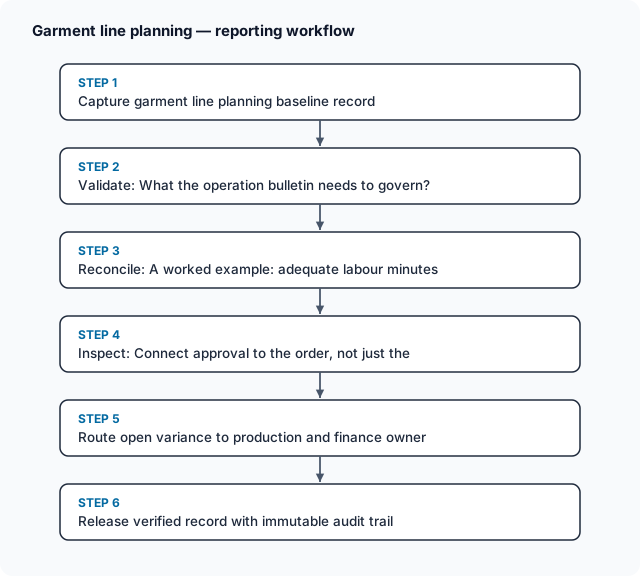
Bounded line planning in garment industry verification and exception-routing workflow
Follow the workflow below, or open its complete text version.
Read the complete workflow as text
- Capture line planning in garment ind baseline record → Verify revision, unit Basis and cutoff alignment
- Verify revision, unit Basis and cutoff alignment → Run deterministic reconciliation and tolerance check
- Run deterministic reconciliation and tolerance check → Quarantine mismatched or unapproved lines
- Quarantine mismatched or unapproved lines → Route exception to named domain and finance owner
- Route exception to named domain and finance owner → Release verified record with immutable audit trail
A worked example: adequate labour minutes, one constrained operation
The following figures are illustrative. They are not a time study, a staffing recommendation or a promised output. Assume a planner is assessing a simplified five-operation flow for 800 garments. The planning window is 420 minutes per assigned position, after the planner has already excluded the time that the factory's approved calendar treats as unavailable. Each garment passes through every operation once.
Assume further that the illustrative times already include the allowance treatment approved for this scenario. Do not add another allowance multiplier without first establishing its basis.
Scroll horizontally to see all columns.
| Operation | Approved planning time per garment | Parallel positions assumed | Theoretical group capacity in the window |
|---|---|---|---|
| A | 0.60 minutes | 2 | 2 × 420 ÷ 0.60 = 1,400 garments |
| B | 0.90 minutes | 2 | 2 × 420 ÷ 0.90 ≈ 933.3 garments |
| C | 1.20 minutes | 2 | 2 × 420 ÷ 1.20 = 700 garments |
| D | 0.75 minutes | 2 | 2 × 420 ÷ 0.75 = 1,120 garments |
| E | 0.55 minutes | 1 | 1 × 420 ÷ 0.55 ≈ 763.6 garments |
Total work content is 0.60 + 0.90 + 1.20 + 0.75 + 0.55 = 4.00 labour-minutes per garment. For 800 garments, nominal required work is 800 × 4.00 = 3,200 labour-minutes.
The nine assumed positions provide 9 × 420 = 3,780 position-minutes. Dividing required work by available minutes gives 3,200 ÷ 3,780 × 100 ≈ 84.7% nominal aggregate utilisation. That is a calculation of planned work against assumed available time, not measured line efficiency.
An aggregate check could therefore appear to support the order. The operation-level check reveals a different result: operation C has a theoretical capacity of 700 garments, below the 800-garment plan. Operation E is also below the plan. Capacity left unused at A cannot be transferred automatically to C or E.
The target interval is 420 ÷ 800 = 0.525 elapsed minutes per finished garment, or 31.5 seconds. Under the idealised assumptions, C's two positions provide an effective interval of 1.20 ÷ 2 = 0.60 minutes, while E provides 0.55 minutes. Both exceed the target interval. These intervals describe simplified group capacity; they do not mean that one person's task time changes when a parallel position is added.
The correct software response is to surface the constraint and preserve the assumptions. The engineering and production owners can then assess feasible options: revise the delivery plan, validate a different method, change assignments where qualifications and equipment permit, or test another sequence. Do not convert this calculation directly into a production commitment. It omits start-up, changeovers, interruptions, first-pass quality losses and the practical constraints of moving work between operations.
Connect approval to the order, not just the latest master record
A useful release workflow creates an order-specific snapshot. Merely displaying the latest bulletin is insufficient if an order was approved against an earlier version.
- Prepare the proposed revision. Engineering records changed operations and the reason for each change. A suggested time remains separate from an approved planning time.
- Compare the records. The application checks operation IDs, units, revision references, required resources and routing mappings. It flags differences without deciding whether a changed method is acceptable.
- Review feasibility. The authorised engineering, production and quality owners assess the proposed plan within their responsibilities. Workplace or equipment changes follow the factory's applicable approval process.
- Approve the order snapshot. The planner releases an identified quantity against the approved revision and resource assumptions. Record who approved it and which exceptions, if any, were explicitly resolved.
- Observe and reconcile. A supervised trial compares actual operation records with the planning assumptions. Unexpected results become exceptions linked to the same order and revision.
For an order already in progress, a newer bulletin should prompt an impact decision. Record whether the revision applies to future orders only or requires a reviewed change to the current order. A background synchronisation should not overwrite the approved snapshot or relabel earlier production as if it used the new method.
Exception handling that preserves a usable history
A time arrives in seconds while the routing expects minutes. Retain the received value and unit. Convert only through an explicit, tested mapping. Route an ambiguous value to engineering review; do not infer its unit from magnitude.
The same update arrives twice. Identify an event by its source, bulletin revision and event ID. A duplicate should leave one applied change, with the second receipt recorded as a duplicate. Replaying an event must not create a second operation or advance an order twice.
A workstation is unavailable after release. Show the affected assignment and order. The supervisor proposes a feasible response and the authorised owner approves any changed snapshot. Preserve the original plan for the variance review.
Only part of a revised bulletin imports successfully. Keep the revision unapproved and display the missing operations. Do not combine the imported rows with an older revision and present the mixture as complete.
Actual records arrive late or include rework. Preserve event time separately from receipt time. Define whether each quantity represents operation completions, first-pass accepted pieces, rework attempts or finished garments. Adding those measures together produces a misleading output number.
The integration fails during a shift. Keep the last approved record available through the factory's agreed fallback. Queue changes for reconciliation, show their status and prevent an unacknowledged update from appearing applied. Recovery requires comparing the target record with the approved snapshot before normal synchronisation resumes.
Choose the smallest implementation that resolves the decision
A controlled spreadsheet may be sufficient when one team manages a small number of styles and can reliably maintain approval and revision history. Its limitations become more material when several people change operation times or when production orders need stable snapshots.
Configuring the existing ERP is a reasonable next option if it already supports the necessary operation records, permissions and revision references. An integration becomes useful when industrial engineering and production execution intentionally keep separate systems. Build a bounded application only where a demonstrated workflow gap remains—for example, comparing an approved bulletin against order-specific assignments and collecting an impact decision.
Deterministic checks suit missing units, duplicate IDs and revision mismatches. AI could assist with summarising a revision note for an engineering reviewer, but it should not invent operation times, approve a balance or assign a worker to an unverified task. Any suggested change needs a traceable source and an accountable human decision.
A bounded pilot and observable exit criteria
Start with one style family and one line in a read-only comparison mode. Inputs are the approved bulletins, routing export, order references, calendar assumptions, resource mappings and a defined sample of actual operation events. Engineering owns the bulletin, production owns assignment feasibility, quality owns the interpretation of acceptance and rework records, and the system owner owns mapping and recovery.
Before enabling writes, measure a baseline: how many sampled orders lack an unambiguous bulletin reference, how many field mismatches require investigation, and how long owners take to resolve them. Record unavailable measurements as unknown. No reduction in lead time or increase in output is assumed.
Agree the sample and evaluation window before starting. Proposed acceptance checks include:
- Every sampled order resolves to its approved bulletin and routing reference; unresolved references remain visibly blocked.
- The five-operation fixture reproduces the calculations above, including the C and E constraints and the stated rounding.
- A duplicate event changes the target once; a partial import cannot be approved as a complete revision.
- A mid-order revision requires an explicit impact decision, with prior records still traceable.
- A simulated outage and replay preserve the approved snapshot and reconcile queued events without duplicate operations.
These are proposed checks for the pilot, not claims that the implementation has passed them. If the controls fail, keep the integration read-only, correct the mapping or workflow, and repeat the affected checks. The pilot should justify its next scope through observed record accuracy and decision reliability before anyone claims a production benefit.
Summary and next actions
Garment line planning becomes easier to evaluate when the operation bulletin, capacity assumptions and production order refer to the same approved decision. Aggregate labour minutes are one check; operation constraints and practical feasibility are separate checks. A useful implementation makes those distinctions visible and preserves the approvals behind any change.
- Select one style family and identify which bulletin revision each sampled order actually used.
- Reconcile operation IDs, time units and allowance treatment with the responsible engineering owner.
- Compare aggregate work content with operation-level capacity using explicitly recorded assumptions.
- Run a read-only pilot covering revision changes, partial imports, duplicates and outage recovery before approving production writes.
Frequently Asked Questions
How should garment plants structure Industrial Engineering (IE) operation bulletins, standard allowed minutes (SAM) pitch times, and workstation balancing before releasing a style to sewing lines?.
Teams should govern line planning in garment industry by linking every transaction to its source evidence, timestamp, and assigned owner before permitting downstream posting. Distinct from M027 (apparel-size-colour-production-planning, which covers cut-order size/colour ratio bundling); M101 covers sewing-line Operation Bulletin (OB) workstation allocation, bottleneck pitch-time balancing, and hourly WIP buffer control. Rather than relying on informal spreadsheet overrides, the workflow enforces a documented verification gate and preserves the original observation whenever a correction is recorded.
How does ie planning of garments handle exceptions and mismatches?.
When a discrepancy occurs during ie planning of garments, the system routes the blocked record into an owned exception queue rather than silently dropping or auto-adjusting the balance. Govern approved operation-bulletin revisions/order snapshots. Factory engineering owns time standards, method feasibility and actualwork allocation. No sewing operating SOP or labour-intensification targets. Each exception retains the original quantity, date, and counterparty reference until the designated reviewer resolves the variance with supporting evidence.
What should teams test before automating garment production planning software?.
Before scaling garment production planning software, run a bounded pilot using historical records that include partial receipts, late updates, duplicate messages, and rejected lines. Verify that the integration preserves idempotency, maintains a clear segregation of duties between operational entry and financial approval, and produces an auditable trail for every state transition.
Scope this automation around your operation
Tell us your current systems, transaction volume and the exception you need to resolve. We can discuss a focused first release, its review controls and how to measure the result.
Sources and further reading
Sources checked 15 October 2026. Worked examples and workflow diagrams are original illustrations, not reported client results.
