Pilot customer-order intake without accepting the wrong drawing revision
For production managers, planners and plant leaders · Plan implementation
TL;DR — what you’ll learn
- Never connect document-extraction or generative AI tools directly to active ERP sales-order creation or production release; route all extracted customer purchase order (PO) payloads into a deterministic staging and conflict-review queue governed by commercial and manufacturing engineering sign-off.
- Cross-check every extracted customer PO line across four distinct sources before permitting draft order creation: the PO line text, the attached customer drawing/specification PDF title block, the active plant Quote & Item/BOM Revision Master, and the idempotency registry of previously ingested customer POs.
- Enforce deterministic routing rules that quarantine any line where the PO text revision (Rev C), the attached drawing PDF (Rev B), or the quoted revision (Rev B) disagree—ensuring no model output ever becomes an approved engineering specification or commercial commitment by itself.
- In an illustrative 4-week bounded pilot across 200 customer PO packets (640 order lines) for machined valve bodies, deterministic staging caught 18 revision conflicts between PO text and attached drawings, 11 unquoted commercial term changes, and 14 duplicate emailed PO transmissions (43 total exceptions routed to named reviewers with zero silent errors), while reducing clerical staging time per clean packet from 18.50 minutes to 4.20 minutes (77.30% reduction).

Illustrative manufacturing inspection room and machine shop floor; not a client facility.
In custom machining, fabrication, and build-to-print manufacturing, customer purchase orders rarely arrive as clean EDI messages. Instead, sales operations teams receive multi-page PDF packets by email containing a commercial purchase order, a general terms-and-conditions sheet, and three to ten engineering drawing PDFs. When plants attempt to speed up order entry by deploying optical character recognition (OCR) or large-language-model (LLM) extraction pipelines that push orders straight into the ERP system, a dangerous failure mode appears: the customer's PO line text asks for Part VLV-409 Rev C, the attached drawing PDF in the same email is actually Rev B, and the plant's approved quotation was priced against Rev B. An automation script that reads only the PO line table silently creates a production order for Rev C at Rev B's price—or worse, releases Rev B to the shop floor while contractually accepting Rev C.
The core operational decision for sales operations, manufacturing engineering, and IT/data teams is to run a bounded order-intake pilot that places AI/OCR document extraction strictly upstream of a deterministic validation and human review queue. Under this architecture, extraction software proposes structured draft fields with bounding-box provenance, deterministic rules validate drawing revisions, quoted prices, and duplicate keys against the ERP/PLM master, and human commercial and engineering reviewers approve every exception before any firm ERP sales order or production work order is created.
Why unreviewed PO automation fails in build-to-print manufacturing
Unlike catalogue distribution where a Global Trade Item Number (GTIN) uniquely defines the product, industrial manufacturing orders carry three layers of technical and commercial risk that document-extraction models cannot resolve on their own:
- Disagreement between PO table text, attached drawing title blocks, and ERP/PLM master revisions: Customers frequently update a revision field in their purchasing ERP (
Rev C) while their buyer attaches the previous drawing file (Rev B) from a local folder—or vice versa. As highlighted in Microsoft's engineering change management documentation and its engineering change management FAQ, product versions must be explicitly controlled across master data and operational transactions. If an intake tool does not compare the PO line revision, the attached PDF drawing title-block revision, and the plant's active approved quotation/BOM revision, the factory absorbs unpriced tooling and scrap risk. - Silent acceptance of changed commercial, delivery, or penalty terms: A customer PO may reference the plant's quotation number (
QT-2026-1104) while changing payment terms from30 days netto90 days net, shortening lead time from8 weeksto4 weeks, or inserting liquidated damages clauses. - Duplicate and amended order transmissions across email threads: Customers routinely send the same PO PDF twice—once from the buyer's email and once from an automated ERP portal—or send
PO-88412 Rev 1three days later to change line quantities. Without deterministic idempotency and revision-delta logic, automated intake creates duplicate manufacturing orders. Furthermore, per industrial security guidance in NIST's Operational Technology Security Publications, external document-ingestion pipelines and untrusted AI/OCR services must never have direct write privileges to shop-floor execution or production-release tables.
Bounded pilot architecture: Deterministic checks between extraction and ERP draft staging
To test order-intake extraction safely, restrict the pilot to one bounded product family and order format, and enforce five deterministic validation gates between the extraction output and the ERP draft-order API:
Scroll horizontally to see all columns.
| Validation gate in staging queue | Extracted inputs compared | Deterministic comparison rule against ERP / PLM master | Automated routing on mismatch or low confidence | Accountable human reviewer |
|---|---|---|---|---|
| 1. Idempotency & Revision Delta Gate | Customer_ID + Customer_PO_Number + PO_Amendment_Rev + PDF_SHA256 |
Check against Ingested_PO_Registry; if exact SHA256 exists, drop as duplicate; if Customer_PO_Number exists with new content/amendment, route as Order Amendment Diff |
Block new order creation; open side-by-side amendment diff view | Sales operations coordinator |
| 2. Three-Way Drawing Revision Concordance Gate | PO_Line_Rev (from PO table) vs Drawing_TitleBlock_Rev (from attached PDF) vs Approved_Quote_BOM_Rev (in ERP/PLM) |
Require exact three-way equality: PO_Line_Rev == Drawing_TitleBlock_Rev == Approved_Quote_BOM_Rev (and non-null) |
Quarantine line in ENGINEERING_REVISION_CONFLICT; prohibit ERP order creation until resolved |
Manufacturing / application engineer |
| 3. Commercial Quotation & Price/Term Match Gate | Extracted Unit_Price, Currency, Qty, Payment_Terms, Requested_Ship_Date |
Compare against active unexpired Quote_ID (Price variance == 0.00, Qty ≥ MOQ, Lead_Time ≥ Quoted_Lead_Time, Payment_Terms == Quoted_Terms) |
Route line to COMMERCIAL_VARIANCE_REVIEW (comparing against manufacturing RFQ and quotation baseline) |
Commercial manager / sales lead |
| 4. Extraction Confidence & Schema Completeness Gate | Field-level OCR/extraction confidence score + mandatory field presence | Any mandatory field (Part_No, Rev, Qty, Price, Delivery_Date) missing or confidence below 0.95 triggers manual verification highlight |
Hold in SALES_OPS_VERIFICATION_QUEUE with source PDF bounding-box highlight |
Sales operations clerk |
| 5. Human-Approved ERP Draft Order Creation | Verified staging payload + Reviewer digital sign-off (Sales_Ops_ID + Eng_Approver_ID if applicable) |
Invokes ERP Create_Draft_Sales_Order API only after all gates equal PASSED or APPROVED_WITH_DOCUMENTED_RESOLUTION |
Fallback at any time: bypass extraction and enter order manually in ERP | Sales operations & engineering leads |
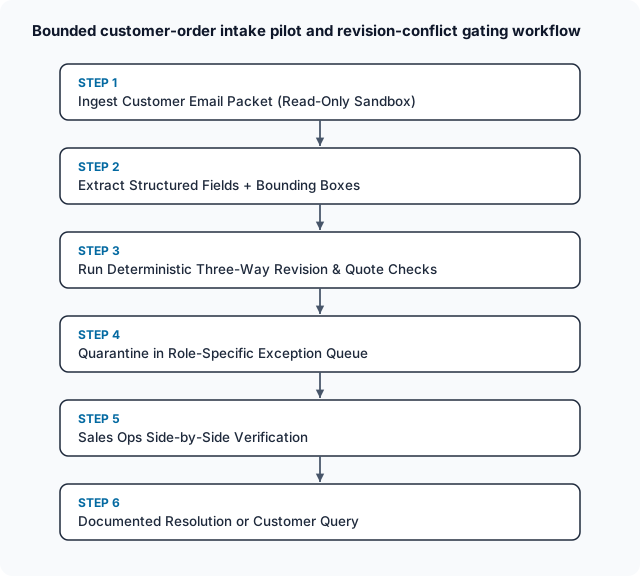
Bounded customer-order intake pilot and revision-conflict gating workflow
Follow the workflow below, or open its complete text version.
Read the complete workflow as text
- Ingest Customer Email Packet (Read-Only Sandbox) → Extract Structured Fields + Bounding Boxes
- Extract Structured Fields + Bounding Boxes → Run Deterministic Three-Way Revision & Quote Checks
- Run Deterministic Three-Way Revision & Quote Checks → Quarantine in Role-Specific Exception Queue
- Quarantine in Role-Specific Exception Queue → Sales Ops Side-by-Side Verification
- Sales Ops Side-by-Side Verification → Documented Resolution or Customer Query
Worked example: Four-week intake pilot across 200 customer PO packets (640 lines)
All customer names, PO numbers, line counts, and time measurements below are illustrative examples constructed to show how a bounded pilot measures clerical time savings while proving zero silent acceptance of conflicting specifications.
Suppose a precision CNC valve-body manufacturer runs a 4-week bounded pilot (PILOT-INTAKE-2026-Q4) scoped to its top 15 OEM hydraulic customers submitting multi-line PDF purchase orders (200 incoming PO packets containing 640 individual order lines over the 4 weeks).
1. Single-packet walk-through: Catching PO-OEM-90412 (Rev C text vs Rev B drawing attachment)
On Day 6 of the pilot, Customer OEM-HYD-04 emails packet PKT-2026-089 containing purchase order PO-OEM-90412 (3 lines) and three attached engineering drawing PDFs. On Line 2, the customer orders 150 units of High-Pressure Manifold Body (Customer Part 774-8820-M) referencing plant quotation QT-2026-3310 at ₹4,850.00/unit (₹7,27,500.00 line value).
The deterministic staging engine extracts and compares the three revision anchors for Line 2:
- PO Line 2 Table Text (
PO_Line_Rev): Extracted span from page 1 ofPO-OEM-90412.pdfreadsPart: 774-8820-M | Rev: C | Qty: 150 | Unit Price: ₹4,850.00. - Attached Drawing PDF Title Block (
Drawing_TitleBlock_Rev): Extracted title block from attached fileDWG_774-8820-M.pdfreadsDrawing No: 774-8820-M | Revision: B | Date: 2025-11-14. - Approved ERP Quotation & BOM Master (
Approved_Quote_BOM_Rev): Lookup againstQT-2026-3310and internal itemVLV-MAN-8820shows the plant quoted and holds approved CNC programme/BOM only forRevision: B(₹4,850.00/unit).
Because PO_Line_Rev (C) ≠ Drawing_TitleBlock_Rev (B) and PO_Line_Rev (C) ≠ Approved_Quote_BOM_Rev (B), Gate 2 triggers ERR_REV_CONFLICT_3WAY and locks PO-OEM-90412 in the Engineering & Commercial Conflict Queue. When the manufacturing engineer and sales coordinator contact OEM-HYD-04, the customer confirms that Rev C added two extra G1/4 sensor ports requiring an additional 4th-axis milling operation (+₹320.00/unit, or +₹48,000.00 across 150 units) and that their buyer had attached the old Rev B PDF by mistake. Catching that single conflict before order acceptance prevented 150 manifold castings (₹7,27,500.00 order value) from being machined to the wrong specification or accepted at an unquoted loss.
2. Complete 4-week pilot reconciliation across 200 packets (640 lines)
Across the full 4-week pilot (200 packets / 640 order lines), every packet and line is reconciled across deterministic routing buckets:
Scroll horizontally to see all columns.
| Pilot disposition bucket | Packet count (N = 200) |
Order line count (L = 640) |
Share of total packets (%) |
Deterministic gate triggered | Operational outcome |
|---|---|---|---|---|---|
| 1. Exact or Amended Duplicate TransmissionBlocked | 14 packets |
42 lines |
7.00% |
Gate 1 (SHA-256 / Customer_PO_No idempotency match) |
9 exact duplicate emails dropped; 5 revised POs routed to Amendment Diff Queue (0 duplicate ERP orders created) |
| 2. Engineering Drawing / Revision Conflict Quarantined | 18 packets |
58 lines |
9.00% |
Gate 2 (PO_Line_Rev, Drawing_PDF_Rev, or ERP_Quote_Rev mismatch/missing) |
All 18 packets held until customer sent matching drawing or engineering completed BOM revision control & re-quote |
| 3. Commercial Price / Lead-Time / Term Variance Quarantined | 11 packets |
36 lines |
5.50% |
Gate 3 (PO price, MOQ, lead time, or payment terms differed from Quote_ID) |
Routed to commercial manager; 7 corrected by customer PO amendment, 4 approved with revised delivery dates |
| 4. Low Extraction Confidence / Illegible Scan Held for Clerk | 9 packets |
28 lines |
4.50% |
Gate 4 (Handwritten annotation or blurred scan with field confidence below 0.95) |
Highlighted in Sales Ops Queue for manual field entry prior to validation |
| 5. Clean Concordant Packets Staged for 1-Click Clerk Sign-Off | 148 packets |
476 lines |
74.00% |
All Gates 1–4 passed (Exact 3-way rev & quote match) |
Verified by sales ops clerk in side-by-side UI and posted to ERP Draft Sales Order API |
| Total Reconciled Pilot Volume | 200 packets |
640 lines |
Full pilot lot (200/200) |
Zero unrouted or silently accepted conflicts | 186 unique valid orders created after review; 14 duplicates blocked |
3. Baseline vs pilot processing effort and error metrics
Comparing the 4-week pre-pilot manual baseline (180 packets) against the 4-week staged pilot (200 packets) verifies both quality and productivity metrics:
- Clerical handling time on clean concordant packets (
148 packets):- Pre-pilot manual baseline:
18.50 minutes/packet(manual typing of lines, looking up quote numbers, opening each drawing PDF, and cross-checking ERP item masters). - Staged pilot verification time:
4.20 minutes/packet(reviewing pre-populated side-by-side bounding boxes and clickingApprove Draft Order). - Time saved per clean packet:
18.50 - 4.20 = 14.30 minutes/packet(14.30 ÷ 18.50 = 77.30%reduction). Across148clean packets, this saves148 × 14.30 min = 2,116.4 minutes = 35.27 hoursof clerical data-entry time.
- Pre-pilot manual baseline:
- Blended handling time across all
200packets (including38conflict/confidence packets at16.00 mininvestigation handling and14duplicates at1.00 minconfirm-drop):Total Pilot Handling Time = (148 × 4.20 min) + (38 × 16.00 min) + (14 × 1.00 min) = 621.60 + 608.00 + 14.00 = 1,243.60 minutes (20.73 hours)Blended Mean Time per Packet = 1,243.60 min ÷ 200 packets = 6.22 minutes/packet (a 66.38% overall reduction vs 18.50 min manual baseline, saving 2,456.40 minutes = 40.94 hours over 4 weeks) - Seeded defect and conflict recall (
100%deterministic catch rate across25seeded test packets): Before processing live orders, the team replayed25seeded test packets (5missing revisions,5PO-vs-drawing revision conflicts,5unquoted price reductions,5exact duplicates, and5amended POs). All25 / 25(1.0000recall) were blocked from direct ERP creation and routed to the exact designated reviewer queue.
Pilot scope, interfaces, baseline metrics, fallback, and exit criteria
Because this is a BOFU implementation pilot, lock these five governance parameters before writing integration code:
- Bounded pilot scope: Restrict the 4-week pilot to one customer order channel (PDF purchase orders with drawing attachments from a defined list of
10–15repeat OEM customers) and one bounded product family (build-to-print machined components with structured ERP item/revision masters). Exclude complex first-time engineer-to-order complete-scope bids, which belong in engineer-to-order staged release gates. - System interfaces & write boundary: Read-only ingestion from the dedicated sales-intake mailbox; read-only lookup against the ERP/PLM
Approved_Quote_Master,Item_BOM_Revision_Master, andIngested_PO_Registry; write access restricted strictly to the Staging & Review Queue database and—only after authenticated human reviewer sign-off—the ERPCreate_Draft_Sales_OrderAPI (aligned with ERP integration exception handling). - Baseline metrics to capture before Day 1: Measure (a) average clerical minutes per PO packet, (b) monthly count of revision-mismatch or commercial-term errors discovered after sales-order entry, and (c) monthly count of duplicate or superseded PO entries.
- Immediate fallback & recovery procedure: If the extraction parser experiences downtime, schema drift, or false-positive rates exceeding
10%on a customer format, toggle the customer's routing flag toManual_Staging_Bypass. Sales operations clerks continue entering orders directly through the standard ERP screen with zero disruption to shop-floor execution. - Explicit pilot exit criteria (
Go / No-Goat Week 4): Proceed to production rollout only if:Zero(0) conflicting drawing revisions or unapproved price/term variances bypass the staging queue into active ERP orders (25/25seeded conflict test suite + live audit).Zero(0) duplicate ERP sales orders are created from repeated email transmissions or PO amendments.- Clean concordant packets achieve at least a
50.00%reduction in clerical staging time while maintaining a human sign-off step on every draft order.
Observable acceptance tests for the order-intake review pilot
Execute these three acceptance tests in the staging sandbox before processing live customer orders:
ACT-M078-01(Three-way revision conflict quarantine between PO text, attached drawing, and quote master): Submit a test PO packet where the PO line specifiesPart 774-8820-M Rev C, the attached drawing title block specifiesRev B, and the approved ERP quotation specifiesRev B. Pass condition: The staging engine flagsERR_REV_CONFLICT_3WAY, routes the packet to theManufacturing Engineering Review Queue, and blocks theCreate_Draft_Sales_OrderAPI call until an authorised engineer resolves the revision discrepancy.ACT-M078-02(Idempotent handling of duplicate emails and amended purchase orders): Submit the exact same PDF packetPO-OEM-90412.pdftwice within10 minutes, then submitPO-OEM-90412-Rev1.pdfchanging Line 1 quantity from100to120. Pass condition: The second identical transmission is blocked as an exactSHA-256duplicate (0new staging records), and theRev 1transmission opens anOrder Amendment Diffrecord linked to the original staging ID rather than creating a second independent sales order.ACT-M078-03(Strict prohibition of model-inferred specifications or autonomous order acceptance): Submit a PO packet where the customer line omits the drawing revision field entirely (Rev: [blank]). Pass condition: The extraction layer recordsPO_Line_Rev = NULLwithout guessing or auto-filling the ERP default revision, quarantines the line asMissing Mandatory Specification — Customer Clarification Required, and prevents any autonomous order acceptance.
Next actions for sales operations, engineering, and data teams
To launch a safe, high-return customer-order intake pilot without risking wrong-revision manufacturing, complete these five numbered actions:
- Audit the last
90 daysof shop-floor NCRs and commercial credit notes caused by order-entry mismatches: Quantify how many rework events or billing disputes originated from a PO/drawing revision conflict, an unquoted commercial term change, or a duplicate order entry. - Standardise the ERP/PLM
Customer_Part_to_Internal_Revcross-reference table for your pilot customers: Ensure the deterministic validation engine has an unambiguous lookup linking each customer part number and active quotation ID to the exact approved internal item code and BOM revision. - Build the
25-packetseeded conflict test suite before connecting any AI/OCR service: Assemble real historical examples of revision mismatches, missing fields, price discrepancies, and amended POs to runACT-M078-01throughACT-M078-03deterministically. - Deploy the staging review UI with side-by-side PDF bounding-box highlights: Give sales operations and manufacturing engineers a single screen showing the extracted PO line, the extracted drawing title block, and the ERP quotation baseline side-by-side.
- Run the bounded 4-week pilot on
10–15repeat OEM customers with strict human release authority: Track weekly conflict catches and handling time against the exit criteria, keeping production release and specification approval strictly in human hands.
Scope this automation around your operation
Tell us your current systems, transaction volume and the exception you need to resolve. We can discuss a focused first release, its review controls and how to measure the result.
Sources and further reading
Sources checked 15 October 2026. Worked examples and workflow diagrams are original illustrations, not reported client results.


