Manufacturing Execution System (MES) Architecture: ISA-95 Level 3/4 Integration, MESA-11 Functions and Shop-Floor ERP Controls
For production managers, planners and plant leaders · Compare approaches
TL;DR — what you’ll learn
- Enforce the ANSI/ISA-95 (IEC 62264) Level 3 versus Level 4 boundary: the Level 4 ERP owns commercial demand, master BOM valuation, and financial general ledger posting (days/shifts), while the Level 3 Manufacturing Execution System (MES) owns real-time work-in-progress dispatching, operation sequence interlocks, serialized genealogy, and machine OEE state tracking (seconds/minutes).
- Never stream raw Level 1/2 PLC tags (100 ms OPC-UA or MQTT edge telemetry) directly into Level 4 ERP database tables; aggregate high-frequency machine cycles at the Level 3 MES edge and publish transactional B2MML ProductionPerformance summaries at operation completion or shift boundary.
- Implement the 11 core MESA functions around four physical shop-floor interlocks: Routing Sequence Enforcement (blocking Op 30 until Op 20 passes), Component Lot/Serial Genealogy (preventing expired or wrong-revision material consumption), Tool/Calibration State Locks, and In-Line SPC Quality Hold injection.
- Reconcile Level 3 MES actuals against Level 4 ERP work order backflushes before shift close: route any yield variance exceeding tolerance (for example, ≥ 1.5% scrap delta or unconsumed lot balance) into a supervised Production Variance Queue before posting inventory decrements.

Illustrative manufacturing inspection room and machine shop floor; not a client facility.
A Manufacturing Execution System (MES) is the real-time shop-floor operations control layer positioned at Level 3 of the ANSI/ISA-95 (ISO/IEC 62264) automation pyramid, bridging the gap between enterprise commercial planning at Level 4 (ERP) and real-time machine automation at Levels 1 and 2 (PLCs, CNC controllers, SCADA, and sensors). While an ERP system answers "What orders must the plant build this week, what materials should be purchased, and what did the finished goods cost?", the MES governs "Is Machine CNC-04 allowed to start Serial #88412 right now, did the operator scan the correct heat-treated alloy lot, is the torque wrench within calibration, and did the part pass Op 20 before entering Op 30?"
When discrete, automotive, electronics, and batch manufacturing plants attempt to run shop-floor execution directly inside a standard ERP—or deploy a standalone MES without a formal ISA-95 / B2MML integration architecture—three systemic failures occur. First, operators spend 45 minutes at the end of every shift manually re-keying paper tally sheets into ERP job cards, creating a 12-to-24-hour blind spot where inventory balances and work-in-progress (WIP) queues are fiction. Second, IT teams attempt to wire high-frequency OPC-UA machine counters directly into the ERP's transactional SQL tables, locking up financial ledger tables during peak production. Third, when a customer issues a field containment recall for a defective sub-tier bearing lot, the plant cannot isolate which 140 finished serial numbers consumed that exact bearing lot, forcing a costly 10,000-unit recall.
The direct architectural solution is to engineer a state-governed ISA-95 Level 3 MES and Level 4 ERP Integration Spine (ERPNext Manufacturing Work Order & Job Card Architecture). Distinct from M028 (which focuses specifically on OEE Availability × Performance × Quality calculation formulas) and M074 (which governs mid-batch Engineering Change Notice BOM cutovers), this pillar guide (M129) establishes the complete ISA-95 five-level functional boundary, MESA-11 capability mapping, B2MML XML/JSON message contracts, OPC-UA/MQTT edge aggregation math, and shift-end ERP inventory reconciliation controls.
Scope and ISA-95 Level 3/Level 4 boundary
This article defines the systems architecture, data ownership boundaries, integration payloads, and shop-floor execution controls connecting Level 1/2 Industrial IoT (IIoT) automation, Level 3 MES, and Level 4 ERP across discrete and batch plants:
- What this architecture governs: Separating Level 0–4 time horizons under ISA-95 Part 1 & Part 3, mapping the 11 core MESA-International MES functions to database state machines, structuring bidirectional
ProductionScheduleandProductionPerformancemessages, and reconciling physical scrap/consumption variances before financial ledger posting. - What this architecture does not replace: A Level 3 MES never replaces Level 1/2 hardwired safety interlocks (
SIL-2 / SIL-3 safety relays, emergency stops, or closed-loop PID temperature/pressure control inside the PLC), nor does it replace the Level 4 ERP's authority over statutory tax invoicing, accounts payable three-way matching, or standard cost rollups.
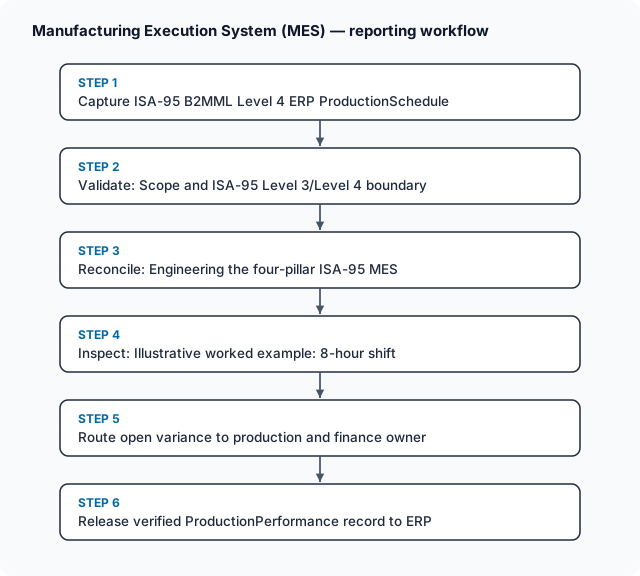
Manufacturing Execution System (MES) — reporting workflow
Follow the workflow below, or open its complete text version.
Read the complete workflow as text
- Capture ISA-95 B2MML Level 4 ERP ProductionSchedule → Validate: Scope and ISA-95 Level 3/Level 4 boundary
- Validate: Scope and ISA-95 Level 3/Level 4 boundary → Reconcile: Engineering the four-pillar ISA-95 MES
- Reconcile: Engineering the four-pillar ISA-95 MES → Inspect: Illustrative worked example: 8-hour shift
- Inspect: Illustrative worked example: 8-hour shift → Route open variance to production and finance owner
- Route open variance to production and finance owner → Release verified ProductionPerformance record to ERP
Engineering the four-pillar ISA-95 MES and ERP integration spine
1. The ANSI/ISA-95 (IEC 62264) 5-Level Automation Pyramid and Time-Horizon Separation. The single most expensive mistake in factory digitalization is blurring the boundary between Level 2 Supervisory Control, Level 3 Manufacturing Operations Management (MOM / MES), and Level 4 Enterprise Resource Planning (ERP). Under ANSI/ISA-95.00.01 and NIST Smart Manufacturing Systems Architecture, each layer operates on a strict deterministic time horizon and data granularity:
Scroll horizontally to see all columns.
| ISA-95 Level | Layer Name & Primary System | Time Horizon | Core Data Granularity & Ownership | Example Decision / Control Action |
|---|---|---|---|---|
| Level 4 | Business Planning & Logistics (ERP / APS) |
Days, Weeks, Months | Master Item, Priced BOM, Customer Sales Orders, MRP Purchase Plans, Financial GL Inventory Value | Release Work Order WO-2026-9040 for 1,200 machined housings due Friday; value FG receipt at $42.50/unit |
| Level 3 | Manufacturing Operations Management (MES / QMS / WMS-Execution) |
Seconds, Minutes, Shifts | Serial/Lot Genealogy (eDHR / eBR), Work Center Dispatch Queue, Op-to-Op Routing Locks, Downtime Reason Codes, In-Line SPC |
Block Serial #SN-0419 from starting Op 30 Laser Weld because Op 20 Leak Test result is missing; log 14-min tooling jam |
| Level 2 | Supervisory Monitoring & Control (SCADA / HMI / Cell Controller) |
Milliseconds to Seconds | Machine Recipe Setpoints, Active Alarm Streams, High-Speed Tag Buffering (OPC-UA / MQTT Sparkplug B) |
Download CNC spindle speed & feed parameters; trigger local HMI high-vibration warning alarm |
| Level 1 | Sensing & Direct Manipulation (PLC / RTU / CNC / Motion Drive) |
Microseconds to Milliseconds | Ladder Logic / Structured Text deterministic scan loops, PID loops, high-speed I/O interlocks | Stop press ram within 4 ms when light-curtain safety beam is broken; regulate servo torque |
| Level 0 | Physical Production Process (Sensors, Actuators, Motors, Valves) |
Continuous / Real-Time Physics | Raw voltage (0–10V), current (4–20mA), encoder pulses, cavity pressure, melt temperature |
Cut metal, inject polymer, torque bolt, or agitate reactor vessel |
2. Mapping the MESA-11 Core Functions to Shop-Floor Interlocks. Originally codified by MESA International and expanded into the four activity models of ISA-95 Part 3 (Production, Maintenance, Quality, and Inventory Operations Management), a production-grade MES must execute 11 interdependent functions. Rather than treating these as passive dashboards, industrial architects group them into three active enforcement rings:
- Resource & Dispatch Readiness Ring:
- Resource Allocation & Status: Tracks real-time machine, fixture, and gauge state (
RUNNING,SETUP,STARVED,BLOCKED,MAINTENANCE_DOWN,CALIBRATION_EXPIRED). - Operations / Detailed Scheduling: Sequences released ERP work orders across parallel work centers (
CELL-CNC-01..04) to minimize setup changeover matrices (for example, grouping aluminium alloys before cast iron). - Dispatching Production Units: Pushes the active job packet to the operator's station tablet in real time as upstream operations complete.
- Document Control: Delivers the exact revision-locked Standard Operating Procedure (
SOP), 3D CAD viewer file, and CNCG-codeprogram tied to the work order'sbom_revision_id.
- Resource Allocation & Status: Tracks real-time machine, fixture, and gauge state (
- Shop-Floor Execution & Traceability Ring:
- Data Collection & Acquisition: Captures machine cycle counts, spindle loads, torque curves, and cavity pressures automatically via
OPC-UAorMQTTwithout human keystrokes. - Labor Management: Validates operator badge scan against required skill/certification matrices (
IATF 16949certified welder check) and tracks direct labor minutes per operation. - Quality Management (In-Line SPC): Enforces first-piece approval (
FPA) and periodic statistical process control (X-bar / Rcharts), automatically placing the work center intoQUALITY_HOLDif a dimension breaches control limits. - Process Management: Enforces poka-yoke routing rules—verifying that
Op 10,Op 20, andOp 30occur in strict sequence with zero bypassed stations.
- Data Collection & Acquisition: Captures machine cycle counts, spindle loads, torque curves, and cavity pressures automatically via
- Genealogy, Maintenance & Analytics Ring:
- Product Tracking & Genealogy: Builds the immutable parent-child tree linking finished Serial
#SN-0419to every consumed component lot, operator badge, machine ID, torque value, and timestamp (As-Built BOM). - Maintenance Management: Triggers autonomous maintenance (
TPM) and preventative tool-life replacement orders based on actual machine strokes (10,000 press hits) rather than calendar days. - *Performance Analysis (
OEE): Computes real-time Availability, Performance, and Quality losses (MTBF,MTTR`, Six Big Losses) against standard cycle times.
- Product Tracking & Genealogy: Builds the immutable parent-child tree linking finished Serial
3. ISA-95 B2MML (Business To Manufacturing Markup Language) Integration Payloads. To prevent point-to-point spaghetti scripts between ERP and MES, ISA-95 Part 2 and Part 5 (B2MML) define four canonical document exchange pairs between Level 4 and Level 3:
Scroll horizontally to see all columns.
| B2MML Message Pair | Direction | Trigger Event | Core Payload Attributes | Idempotency & Error-Handling Control |
|---|---|---|---|---|
1. Definition (ProductDefinition / OperationsDefinition) |
Level 4 ERP → Level 3 MES | Engineering releases approved BOM & Routing revision | item_code, bom_revision, operation_seq, ideal_cycle_time_sec, scrap_allowance_pct, inspection_plan_id |
Reject message if referenced work_center_id or inspection_plan_id does not exist in MES master |
2. Capability (OperationsCapability) |
Level 3 MES → Level 4 ERP | Shift change, unplanned machine breakdown, or tool calibration lock | work_center_id, available_capacity_hrs, equipment_state (AVAILABLE vs DOWN_UNPLANNED), effective_window |
Prevents ERP/APS from scheduling urgent jobs onto a machine currently torn down for spindle replacement |
3. Schedule (OperationsSchedule / ProductionSchedule) |
Level 4 ERP → Level 3 MES | Planner releases firm Work Order (STATUS = RELEASED) |
work_order_id, planned_qty, target_start_ts, target_end_ts, allocated_rm_lots[], routing_version |
Enforces message_uuid deduplication so re-transmitting a schedule updates rather than duplicates the dispatch queue |
4. Performance (OperationsPerformance / ProductionPerformance) |
Level 3 MES → Level 4 ERP | Operation completion, pallet close, or 8-hour shift boundary | work_order_id, op_seq, good_qty, scrap_qty, scrap_reason_code, consumed_lots[], actual_machine_min, actual_labor_min |
Held in ERP staging queue if consumed_lot_qty exceeds available warehouse bin balance or yield variance ≥ threshold |
4. Edge Telemetry Decimation and the Write-Amplification Reduction Formula.
A common anti-pattern in modern factory implementations is connecting 50 CNC machines or packaging lines—each publishing 12 telemetry tags every 100 milliseconds (10 Hz)—directly to the Level 4 ERP REST API. Across a single 8-hour shift (28,800 seconds), 50 machines generate:
N_raw_events = 50 machines × 12 tags × 10 Hz × 28,800 seconds = 172,800,000 raw tag events per shift
Writing 172.8 million rows per shift into an ERP relational database causes severe table locking and index bloat. Under an ISA-95 compliant architecture:
- Level 2/3 Edge Gateway (
OPC-UA / MQTT Sparkplug B) ingests the10 Hzstream into a time-series historian (such as InfluxDB or TimescaleDB) using Report-by-Exception (deadband filtering)—storing only state transitions and out-of-tolerance excursions. - Level 3 MES Transaction Aggregator rolls up the raw machine pulses into deterministic operation/pallet completions and shift-end
B2MML ProductionPerformancepayloads—reducing ERP database writes from 172,800,000 raw events to roughly 400 to 600 transactional ERP postings per shift (a ≥ 99.999% write-amplification reduction).
Illustrative worked example: 8-hour shift MES-to-ERP reconciliation on a 1,200-unit CNC housing order (WO-CNC-9040)
All figures below are illustrative and synthetic. An industrial fluid-power manufacturer runs Work Order WO-CNC-9040 on Machining Cell CELL-CNC-04 during an 8.0-hour (480.0-minute) morning shift to produce 500 units (Shift 1 allocation of a 1,200-unit order) of a high-pressure aluminium valve body (PART-VLV-400).
- Master Engineering & Costing Parameters (
BOM-VLV-400-REV3):- Planned Shift Schedule: 480.0 minutes total shift; 30.0 minutes planned preventive maintenance & shift handover (Planned Production Time = 450.0 minutes).
- Ideal Cycle Time (
Op 20 CNC Finish Machining): 48.0 seconds/unit (0.800 minutes/unit= 75.0 units/hour theoretical max rate). - Raw Material Standard (
RM-ALU-BILLET-6061): 1.000 billet per unit at a standard cost of $18.50/billet (Issued to line-side WIP binWIP-BIN-CNC04: 520 billets across LotLOT-ALU-88A[300 pcs] and LotLOT-ALU-88B[220 pcs]). - Machine & Labor Absorption Standard: $90.00/hour (
$1.500/minute, or $1.200/unit at the standard 0.800 min/unit cycle time).
Step 1: Capture Level 2/3 real-time MES execution and downtime telemetry.
During the 450.0-minute planned run window, the Level 3 MES (CELL-CNC-04 edge gateway + operator terminal) records the following verified events:
- Unplanned Downtime Events (
42.0 minutestotal):DT-TOOL-09(Broken carbide insert on Turret #2): 27.0 minutesDT-MATL-02(Chip conveyor jam): 15.0 minutes- Actual Operating Run Time: 450.0 planned min − 42.0 downtime min = 408.0 operating minutes (Availability = 408.0 / 450.0 = 90.67%).
- Total Machine Cycles & Micro-Stoppages (
485 total pieces cycled):- At the ideal cycle time of
0.800 min/pc, 485 pieces represent485 × 0.800 = 388.0 standard earned minutesinside408.0 actual operating minutes(Performance = 388.0 / 408.0 = 95.10%; 20.0 minutes lost to minor spindle speed overrides on hard billets).
- At the ideal cycle time of
- In-Line SPC & Vision Quality Gate (
468 good pieces,17 scrap pieces):- Good Serialized Units Verified at
Op 20: 468 units (#SN-4001through#SN-4468) - MES Recorded Scrap: 17 units (
11 unitsbore diameter oversize during tool wearSCR-DIM-01;6 unitssetup trial scrapSCR-SET-02) - Quality Rate: 468 / 485 = 96.49%
- Shift OEE: 90.67% × 95.10% × 96.49% = 83.20% (
388.0 × (468 / 485) = 374.40 value-adding standard minutes / 450.0 planned minutes = 83.20%).
- Good Serialized Units Verified at
Step 2: Detect and reconcile the 3-billet unrecorded floor variance before ERP backflush.
If the Level 4 ERP simply executed a Blind Standard Backflush on the 468 good units reported at shift end, it would deduct only 468 billets from WIP-BIN-CNC04 (leaving 520 − 468 = 52 billets on the ERP books). Even if it included the 17 MES-recorded scrap pieces (468 + 17 = 485 billets), the ERP would assume 520 − 485 = 35 billets remain at the machine.
However, at shift-end close, the MES requires the line-side material handler to scan the remaining physical billets in WIP-BIN-CNC04:
- Physical Line-Side Ending Count (
LOT-ALU-88B): 32 billets remaining (not 35!). - Unaccounted Floor Discrepancy:
520 issued − (468 good + 17 logged scrap) − 32 physical remaining = 3 missing billets($55.50material variance). - MES Exception Resolution: Because the 3-billet discrepancy (
3 / 488 = 0.61%unlogged consumption) triggers an automaticERR_WIP_LOT_BALANCE_MISMATCHhold, the shift supervisor inspects the drop-bin beside the saw and discovers 3 billets fromLOT-ALU-88Athat were dropped and dented during forklift loading (SCR-MATL-HANDLING-04) without being scanned into the MES scrap terminal.
Scroll horizontally to see all columns.
Shift Reconciliation Metric (WO-CNC-9040) |
Blind ERP Backflush (Good Only) | Unreconciled MES Feed (Before Physical Count) | Reconciled ISA-95 B2MML Posting (Audited) | Financial & Inventory Impact |
|---|---|---|---|---|
Good Units Completed (PART-VLV-400) |
468 pcs | 468 pcs | 468 pcs | Credited to FG/WIP at standard cost |
Logged Machining Scrap (Op 20) |
0 pcs (hidden!) | 17 pcs | 17 pcs ($314.50 RM + $20.40 conv) |
Charged to COPQ-MACHINING-SCRAP |
| Unlogged Handling Scrap Discovered at Close | 0 pcs (hidden!) | 0 pcs (phantom inventory!) | 3 pcs ($55.50 RM in LOT-ALU-88A) |
Charged to COPQ-MATERIAL-HANDLING |
Total Billets Consumed (LOT-88A + LOT-88B) |
468 pcs | 485 pcs | 488 pcs (300 LOT-88A + 188 LOT-88B) |
Exact lot genealogy preserved |
Ending Line-Side Bin Balance (WIP-BIN-CNC04) |
52 pcs ( overstated by 20!) | 35 pcs (overstated by 3!) | 32 pcs (LOT-ALU-88B verified) |
0.00% physical-to-ERP book drift |
| Earned vs Actual Machine Absorption | 374.40 std min ($561.60) |
408.00 run min ($612.00) |
450.00 shift min ($675.00 actual) |
-$113.40 unfavorable volume/efficiency variance |
Independent arithmetic verification.
- Billet mass-balance conservation: 520 billets issued (
300 LOT-ALU-88A+220 LOT-ALU-88B) = 468 good units + 17 machining scrap + 3 handling scrap (488 total consumed) + 32 ending physical billets inLOT-ALU-88B. - OEE identity check:
- Availability = 408.0 / 450.0 = 0.906667 (90.67%)
- Performance = (485 pcs × 0.800 min/pc) / 408.0 min = 388.0 / 408.0 = 0.950980 (95.10%)
- Quality = 468 / 485 = 0.964948 (96.49%)
- Direct OEE = (468 good pcs × 0.800 min/pc) / 450.0 planned min = 374.40 / 450.0 = 0.832000 (83.20%) = 0.906667 × 0.950980 × 0.964948.
- Financial variance check:
- Total scrap material cost = (17 + 3) billets × $18.50/billet = 20 × $18.50 = $370.00.
- Machine absorption variance = (374.40 earned std min − 450.00 paid shift min) × $1.50/min = −75.60 min × $1.50/min = −$113.40 (composed of
42.0 min downtime × $1.50 = -$63.00,20.0 min speed loss × $1.50 = -$30.00, and17 × 0.80 = 13.60 min scrap cycle loss × $1.50 = -$20.40; −$63.00 − $30.00 − $20.40 = −$113.40).
Workflow, owner roles, exception handling and recovery controls
Scroll horizontally to see all columns.
| Workflow stage | Accountable owner | Required system evidence | Exception condition | System hold & recovery control |
|---|---|---|---|---|
1. ERP Work Order Release (ProductionSchedule) |
Production Planner | Approved WO_ID, locked bom_revision, allocated RM lots, B2MML schedule payload |
ERP attempts to release a Work Order referencing an obsolete or unapproved BOM/Routing revision | MES schema validator rejects the B2MML payload (ERR_BOM_REV_NOT_EFFECTIVE) and alerts Planning |
| 2. Line-Side Material & Tooling Verification | Machine Operator & MES Terminal | Barcode scan of LOT-ALU-88A/B and fixture/gauge IDs before Op 20 cycle start |
Operator scans a raw material lot on Quality Hold or a torque/bore gauge past its calibration due date | MES interlocks the PLC cycle-start relay (CYCLE_START_INHIBITED) until a released lot and calibrated gauge are scanned |
| 3. Sequence & In-Line SPC Execution | MES Edge Gateway & Quality Tech | Serial scan at Op 20, automated OPC-UA cycle counter, periodic SPC dimension check |
Part arrives at Op 30 without a verified Op 20 PASS state, or SPC dimension breaches ±3σ control limit |
Block Op 30 start (ERR_ROUTING_SEQUENCE_VIOLATION); place machine in SPC_HOLD until corrective offset is verified |
| 4. Shift-End WIP & Scrap Reconciliation | Shift Supervisor & Material Handler | Scanned physical ending WIP bin count reconciled against Issued − (Good + Scrap) |
Physical line-side count differs from book expected balance (for example, 32 physical vs 35 expected billets) | Hold B2MML ProductionPerformance posting in RECONCILIATION_EXCEPTION until missing units are coded with root-cause scrap/return tags |
| 5. ERP Backflush & Variance Posting | Cost Accountant & ERP Integration Queue | Reconciled B2MML ProductionPerformance JSON/XML with exact lot consumption & machine minutes |
Network drop between Plant Edge and Cloud ERP during shift handover | Store-and-forward local MES outbox queue (MQTT / Kafka) with idempotent transaction_uuid replay upon reconnection |
Bounded pilot and implementation check
Pilot the ISA-95 Level 3/4 MES-to-ERP integration spine on 1 bottleneck machining or assembly cell (3 to 5 work centers) over 4 weeks:
- Pilot boundary: Deploy the edge
OPC-UAtag aggregator, configure B2MMLProductionSchedule(ERP → MES) andProductionPerformance(MES → ERP) payloads, enforce barcode lot scanning at operation start, and institute shift-end physical WIP bin reconciliation before ERP inventory backflushing. - Acceptance tests:
ACT-M129-01(Routing Sequence Interlock): Attempt to scan Serial#SN-4099intoOp 30whenOp 20is still uncompleted or failed; confirm the MES blocks operation start within≤ 500 ms.ACT-M129-02(Wrong-Lot / Expired Calibration Lock): Scan an unapproved raw material lot or an expired bore gauge atOp 20; confirm the MES prevents the work center from transitioning toRUNNING.ACT-M129-03(Edge Disconnection Store-and-Forward): Disconnect the WAN link between the Plant Level 3 MES server and the Cloud Level 4 ERP for 2 hours while running production; confirm zero interruption to shop-floor scanning and exact idempotent replay (0 duplicate backflushes) once connectivity resumes.ACT-M129-04(Shift-End Mass-Balance Reconciliation Gate): Introduce a 3-piece unrecorded scrap variance between issued lot quantity and ending physical bin count; confirm the integration blocks blind ERP inventory backflushing until the supervisor classifies the 3-piece variance.
Next actions
- Draw a hard architectural line between Level 3 (MES) and Level 4 (ERP) data frequencies: Never write sub-second PLC tags into ERP tables; buffer high-frequency telemetry at the Level 2/3 edge and send summarized B2MML
ProductionPerformancetransactions to the ERP. - Replace blind ERP standard backflushing with MES lot-verified consumption: Require operators to scan the actual raw material lot barcode at the work center and reconcile line-side remaining balances at the end of every shift.
- Enforce physical operation-to-operation sequence interlocks on serialized/lot-tracked parts: Make it impossible for a downstream assembly or test station to start work on a part that bypassed an upstream operation.
- Separate the three components of machine absorption variance (
Downtime,Speed Loss, andScrap Cycle Time): Use MES state timestamps to show Finance and Plant Operations whether a-$113.40shift variance came from broken tooling, slow cycle speeds, or scrap rework.
Frequently Asked Questions
How should discrete and batch plants architect a Manufacturing Execution System (MES) across ISA-95 Level 3 and Level 4 to eliminate double data entry, unbuffered PLC telemetry storms, and inventory backflush drift?.
Teams should govern manufacturing execution system deployments by establishing a strict ANSI/ISA-95 functional boundary: Level 4 ERP manages commercial demand, master BOM revisions, and financial inventory valuation, while Level 3 MES controls real-time work center dispatching, operation sequence interlocks, serialized genealogy, and machine OEE state tracking. Rather than streaming raw millisecond PLC tags into the ERP or relying on blind standard backflushes, the MES aggregates edge telemetry and reconciles physical line-side material balances before publishing verified B2MML ProductionPerformance records.
How does mes software architecture handle exceptions and mismatches?.
When a discrepancy occurs during mes software architecture execution—such as an out-of-sequence part scan, an uncalibrated fixture, or a shift-end mass-balance variance between issued raw material lots and physical remaining WIP—the system routes the blocked record into an owned exception queue rather than silently auto-adjusting inventory. Assigned production, quality, and finance owners must review and resolve the variance with root-cause reason codes before the B2MML performance payload posts to the ERP ledger.
What should teams test before automating isa 95 mes implementation?.
Before scaling isa 95 mes implementation across an entire plant, run a bounded 4-week pilot on a single bottleneck cell using real production orders that include tool-breakage downtime, partial lot consumption, network disconnects, and scrap events. Verify that the edge gateway buffers high-frequency OPC-UA telemetry locally, preserves store-and-forward idempotency during WAN outages, enforces segregation of duties on scrap signoffs, and maintains an immutable parent-child genealogy trail.
Compare this workflow with your current setup
Share the step that takes the most manual work, the systems involved and the exceptions your team handles. That gives us a concrete starting point for comparing approaches.
Sources and further reading
Sources checked 15 October 2026. Worked examples and workflow diagrams are original illustrations, not reported client results.
- ANSI/ISA-95 (ISO/IEC 62264): Enterprise-Control System Integration Parts 1, 2, and 3
- MESA International: ISA-95 / B2MML (Business To Manufacturing Markup Language) & MESA-11 Model
- NIST Smart Manufacturing Systems and ISA-95 Integration Architecture
- ERPNext Manufacturing: Work Order, Job Card, and Shop-Floor Stock Entry Execution
