Early Production Containment (GP-12 / Safe Launch): enforce 200% inspection walls, zero-defect reset clocks, and exit gates
For quality, engineering and records teams · Compare approaches
TL;DR — what you’ll learn
- Configure Early Production Containment (EPC / [AIAG CQI-16](https://www.aiag.org/quality/automotive-core-tools) / [GM GP-12 / BIQS-24](https://www.iatfglobaloversight.org/oem-requirements/customer-specific-requirements/)) as a mandatory, physically separate Offline Redundant Inspection Operation (Op 99-EPC) situated after final production inspection and before shipping label generation—never as an extra checkbox on the regular production operators screen.
- Enforce an Automatic Zero-Defect Counter Reset (N_consec - 0): because the purpose of an EPC wall is to validate the upstream Production Control Plan, finding even 1 defect at the EPC wall proves the regular in-line process failed to catch it—automatically resetting the consecutive zero-defect counter to 0 and requiring an upstream PFMEA/Control Plan update.
- Interlock AIAG Shipping Label ASN Print: while a part number or supplier is in STATUS = EPC_ACTIVE, the WMS blocks standard shipping labels unless every container carries a verified EPC_LOT_PASS stamp and prints the mandatory Green-Dot / GP-12 INSPECTED designation on the master/box label.
- Gate EPC Exit (EPC_ACTIVE - NORMAL_PRODUCTION) on a dual rule: (1) $N_{\text{consec}} \ge N_{\text{exit}}$ consecutive zero-defect units across $\ge D_{\min}$ production days, and (2) when required by OEM Customer Specific Requirements (CSRs), an attached Signed Customer SQE Exit Authorization Letter.

Illustrative manufacturing inspection room and machine shop floor; not a client facility.
During the first 30 to 90 days of a new automotive, heavy-truck, appliance, or industrial program launch—or immediately following a major Engineering Change (ECN), line relocation, sub-tier tooling transfer, or a customer Quality Escape (PRR / 8D CAPA), standard statistical sampling in the Production Control Plan is not enough to protect the customer's assembly plant from ramp-up instability. Under IATF 16949 Section 8.3.4.4 / 8.5.1.1 and AIAG CQI-16 (Early Production Containment / GP-12), the supplier must operate a Pre-Launch / Safe-Launch Containment Wall: a dedicated, offline $100%$ redundant inspection station (200% inspection when combined with the regular $100%$ in-line operator check) that audits high-risk characteristics and applies a unique physical witness mark (such as a colour-coded UV/paint dot) to every part.
When plants manage GP-12 / Safe Launch on paper tally sheets, three severe compliance failures occur. First, when the offline GP-12 inspector catches 3 porous castings on Day 8, the supervisor simply scraps those 3 castings, pats the GP-12 inspector on the back, and graduates the line out of GP-12 on Day 14—completely violating the core rule of Early Production Containment! (A defect caught at the GP-12 wall is a failure of the upstream manufacturing process, requiring the GP-12 exit countdown clock to reset to zero!) Second, shipping clerks print standard barcoded labels and ship pallets that bypassed the GP-12 audit cage during night-shift overtime. Third, nobody tracks the true labour cost of staying stuck in GP-12 for 4 months due to repeated counter resets.
The direct solution is to build a state-governed EPC / GP-12 Containment Wall and Zero-Defect Reset Engine inside the MES and ERP (ERPNext Quality Inspection & Delivery Note Gates). Distinct from M001 (which governs routine sampling-based incoming inspection of purchased raw materials) and M039 (which covers the initial 18-element PPAP submission dossier), this guide (M128) specifies offline redundant inspection routing, consecutive zero-defect counter resets, green-dot shipping label interlocks, and formal GP-12 exit governance.
Scope and quality-authority boundary
This article defines the MES, QMS, WMS shipping, and Supplier Portal data architecture for managing Early Production Containment (EPC / GP-12 / Safe Launch) for both internal outbound manufacturing and inbound post-CAPA suppliers:
- What this workflow governs: Activating
Op 99-EPCredundant inspection routings, tracking serialized/lot-levelconsecutive_zero_defect_count($N_{\text{consec}}$), resetting $N_{\text{consec}} \to 0$ and triggering mandatory upstream Control Plan CAPAs on any EPC wall finding, interlocking container shipping labels, and verifying exit criteria. - What this workflow does not replace: Software counter thresholds never override OEM Customer Specific Requirements (CSRs) or the authority of the Customer Supplier Quality Engineer (SQE). Where a customer contract specifies Customer-Approved Exit (as opposed to Supplier Self-Exit), reaching $N_{\text{consec}} = 3,000$ zero-defect parts only makes the part eligible to submit an Exit Request Packet—the ERP must keep the
Op 99-EPCwall active until the signed customer exit approval is uploaded.
Bounded early production containment gp12 software verification and exception-routing workflow
Follow the workflow below, or open its complete text version.
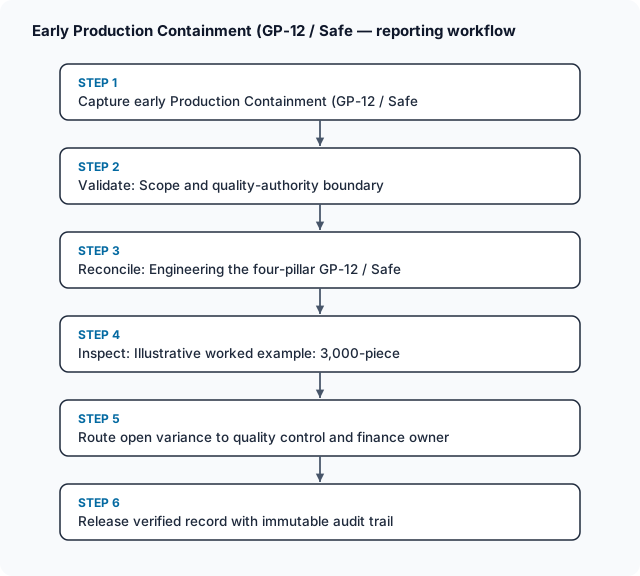
Read the complete workflow as text
- Capture early production containment baseline record → Verify revision, unit Basis and cutoff alignment
- Verify revision, unit Basis and cutoff alignment → Run deterministic reconciliation and tolerance check
- Run deterministic reconciliation and tolerance check → Quarantine mismatched or unapproved lines
- Quarantine mismatched or unapproved lines → Route exception to named domain and finance owner
- Route exception to named domain and finance owner → Release verified record with immutable audit trail
Engineering the four-pillar GP-12 / Safe Launch governance engine
1. Why an EPC wall finding resets the countdown clock to zero. New quality engineers frequently confuse Containment Sorting with Early Production Containment (GP-12) (AIAG CQI-16):
- In regular production, the Production Control Plan (
Op 10..Op 80) is supposed to deliver $100%$ conforming parts to the shipping dock. - The Offline EPC Station (
Op 99-EPC) is an independent audit wall staffed by trained quality auditors using dedicated check fixtures, bore-scopes, and master boundary samples. - Therefore, if
Op 99-EPCinspects Piece#1,892and discovers a missing thread or casting blowhole, the defect already escaped the regular production line (Op 10..Op 80)! If you removedOp 99-EPCtomorrow, that defect would go straight to the OEM assembly plant. Consequently, the MES enforces a strict mathematical state transition on the consecutive zero-defect counter ($N_{\text{consec}}$) after every inspected piece $i$:
$$N_{\text{consec}}(i) = \begin{cases} N_{\text{consec}}(i - 1) + 1, & \text{if } \text{EPC_Result}(i) == \text{PASS} ;\land; \text{Customer_Claim} == 0 \ 0, & \text{if } \text{EPC_Result}(i) == \text{FAIL} ;\lor; \text{Customer_Claim} over 0 \end{cases}$$
Additionally, whenever $N_{\text{consec}}(i)$ resets to $0$, the system prevents the counter from resuming above $0$ until Engineering logs a Verified Upstream Countermeasure (e.g., adding a thread-presence eddy-current sensor at Op 40) so the regular production line now catches the failure mode.
2. Dual-envelope exit rule (Minimum Consecutive Quantity $\land$ Minimum Production Days). OEM Customer Specific Requirements (IATF OEM CSRs / VDA Volume 2) typically define GP-12 exit using both a minimum consecutive zero-defect piece count ($N_{\text{exit}}$, e.g., $3,000\text{ pieces}$ or $2\text{ weeks}$ of full SOP volume) and a minimum number of distinct production days/batches ($D_{\min}$, e.g., $15\text{ production days}$) so a high-speed stamping press cannot clear GP-12 in a single 4-hour shift run:
$$\text{Exit_Eligible} = \left(N_{\text{consec}} \ge N_{\text{exit}}\right) ;\land; \left(D_{\text{consec_clean}} \ge D_{\min}\right) ;\land; \left(\text{Open_Upstream_CAPAs} == 0\right)$$
3. Shipping label and ASN interlock (GP-12 Green Dot verification).
To make it physically impossible for an un-audited tote to slip onto an outbound truck during EPC_ACTIVE:
- Production completion at
Op 80places finished totes into a virtual quarantine warehouse:WH-PENDING-EPC-WALL(blocked from Delivery Note picking). - Only scanning the tote through
Op 99-EPC—where the auditor verifies 100% of pieces, stamps each piece with the required witness mark, and attaches the physical green containment dot to the container label—moves the tote intoWH-FG-EPC-CLEAREDand enables printing the AIAG shipping label carrying theEPC / GP-12 VERIFIEDflag.
under div over
under table over
under thead over
under tr over
under th over EPC / GP-12 Lifecycle Stage under /th over
under th over Trigger / Gate Rule under /th over
under th over MES & WMS System State under /th over
under th over Mandatory Evidence Required to Advance under /th over
under /tr over
under /thead over
under tbody over
under tr over
under td over under strong over 1. Containment Entry (SOP or CAPA) under /strong over under /td over
under td over New PPAP launch, ECN, or Customer PRR / 8D escape under /td over
under td over under code over EPC_STATUS = ACTIVE_CONTAINMENT under /code over ; $N_{\text{consec}} = 0$ under /td over
under td over Pre-Launch Control Plan (Op 99-EPC characteristics), boundary samples, auditor signoff under /td over
under /tr over
under tr over
under td over under strong over 2. Daily Redundant Wall Audit under /strong over under /td over
under td over $100%$ of pieces after final Op 80 pack under /td over
under td over Transfer WH-PENDING-EPC-WALL $\rightarrow$ WH-FG-EPC-CLEARED under /td over
under td over Per-piece/lot Op 99-EPC check log + witness mark confirmation; increment $N_{\text{consec}}$ under /td over
under /tr over
under tr over
under td over under strong over 3. Wall Defect Reset Event under /strong over under /td over
under td over $\ge 1\text{ defect}$ found at Op 99-EPC or OEM plant under /td over
under td over under strong over Reset $N_{\text{consec}} \to 0$ under /strong over & $D_{\text{consec}} \to 0$; COUNTER_FROZEN_CAPA under /td over
under td over Upstream Op 10..80 poke-yoke/station fix + updated PFMEA & Production Control Plan under /td over
under /tr over
under tr over
under td over under strong over 4. Exit Eligibility & Graduation under /strong over under /td over
under td over $N_{\text{consec}} \ge N_{\text{exit}}$ AND $D_{\text{consec}} \ge D_{\min}$ under /td over
under td over under code over EPC_STATUS = EXIT_ELIGIBLE_PENDING_SIGNOFF under /code over under /td over
under td over Zero-defect summary chart + Quality Manager signoff (+ OEM SQE letter if required) under /td over
under /tr over
under /tbody over
under /table over
under /div over
Illustrative worked example: 3,000-piece steering knuckle GP-12 launch with a Day-8 porosity reset
All figures below are illustrative and synthetic. A Tier-1 chassis supplier launches a cast-and-machined aluminium steering knuckle (PART-KNK-550) for an OEM customer at a daily production rate of $250\text{ knuckles/day}$.
- Contractual GP-12 / EPC Exit Criteria (
EPC-PLAN-KNK550):- Minimum Consecutive Zero-Defect Quantity ($N_{\text{exit}}$): $3,000\text{ consecutive pieces}$
- Minimum Consecutive Clean Production Days ($D_{\min}$): $15\text{ production days}$ (Note: if zero defects occur from Day 1, $15\text{ days} \times 250/\text{day} = 3,750\text{ pieces}$; if a reset occurs later, the post-reset run must satisfy both $\ge 3,000\text{ pieces}$ and $\ge 15\text{ total/post-reset days}$ per the OEM CSR—here governed by $\ge 3,000\text{ consecutive clean pieces}$ after any reset).
- Offline
Op 99-EPCInspection Economics: Dedicated EPC auditor checks $6\text{ critical characteristics}$ and applies a green witness dot in $45.0\text{ seconds/piece}$ ($0.0125\text{ hours/piece}$) at a burdened quality technician rate of $$32.00/\text{hour}$ ($$0.4000/\text{piece}$).
Step 1: Track Days 1–7 and the Day-8 counter reset at Piece #1,892.
- Days 1 through 7 (
Lots #01–#07, $7 \times 250 = 1,750\text{ pieces}$):Op 99-EPCinspects $1,750\text{ knuckles}$ with $0\text{ defects}$ ($N_{\text{consec}} = 1,750$, $58.33%$ toward the $3,000\text{-piece}$ quantity target).
- Day 8 (
Lot #08, Pieces#1,751to#2,000) — Defect Caught at Piece#1,892:- Pieces
#1,751through#1,891($141\text{ pieces}$) pass cleanly ($N_{\text{consec}} = 1,891$). - On Piece
#1,892, the offline EPC auditor discovers a $1.8\text{ mm}$ subsurface gas porosity blowhole exposed on the machined brake-caliper mounting boss (DEF-POROSITY-04) that theOp 60CNC operator missed! - MES Reset Action: The system immediately resets $N_{\text{consec}}$ from $1,891$ to $0$, quarantines
Lot #08, and freezes the EPC counter until Manufacturing Engineering installs a high-intensity oblique LED surface inspection check atOp 60.
- Pieces
Step 2: Compute post-reset graduation volume and the $$756.80$ containment labour penalty.
Once the Op 60 countermeasure is verified, the plant must run a full $3,000\text{ new consecutive zero-defect pieces}$ (Piece #1,893 through Piece #4,892 across the remaining $108\text{ pieces}$ of Day 8 plus Days 9 through 20, totaling $12\text{ additional clean days} = 3,000\text{ pieces}$):
- Total Pieces Inspected at
Op 99-EPCto Achieve Exit: $$N_{\text{total_inspected}} = 1,892\text{ pcs (pre-reset)} + 3,000\text{ pcs (post-reset clean run)} = \mathbf{4,892\text{ pieces}}\quad (\text{across } 20\text{ production days})$$ - Financial Cost of the Day-8 Reset:
- Baseline Planned EPC Cost ($3,000\text{ pieces}$): $3,000 \times $0.4000/\text{pc} = \mathbf{$1,200.00}$ ($37.50\text{ auditor hours}$)
- Extra Containment Penalty from Piece
#1,892Reset: $1,892\text{ wasted count} \times $0.4000/\text{pc} = \mathbf{$756.80}$ ($23.65\text{ extra auditor hours}$) - Total EPC Wall Labour Spend: $4,892 \times $0.4000/\text{pc} = \mathbf{$1,956.80}$ ($61.15\text{ total auditor hours}$).
Scroll horizontally to see all columns.
EPC Launch Timeline (PART-KNK-550) |
Inspected Pieces ($\text{qty}$) | Defects Found at Op 99-EPC |
Ending Consecutive Counter ($N_{\text{consec}}$) | Auditor Hours (@ $45\text{s/pc}$) | Containment Labour Cost ($$$) | MES / GP-12 Gate Status |
|---|---|---|---|---|---|---|
Days 1–7 (Lots #01–#07) |
$1,750\text{ pcs}$ | $0$ | $1,750\text{ pcs}$ | $21.875\text{ hrs}$ | $$700.00$ | EPC_ACTIVE ($58.3%$ of $3,000$) |
Day 8 Part A (#1,751–#1,891) |
$141\text{ pcs}$ | $0$ | $1,891\text{ pcs}$ | $1.7625\text{ hrs}$ | $$56.40$ | EPC_ACTIVE ($63.0%$ of $3,000$) |
Day 8 Piece #1,892 (Porosity Escape!) |
$1\text{ pc}$ | $1\text{ DEFECT}$ | $0\text{ pcs}$ (RESET!) | $0.0125\text{ hrs}$ | $$0.40$ | COUNTER_RESET_CAPA_HOLD ($-$756.80\text{ lost}$) |
Day 8 Part B + Days 9–20 (#1,893–#4,892) |
$3,000\text{ pcs}$ | $0$ | $3,000\text{ pcs}$ ($100%$) | $37.500\text{ hrs}$ | $$1,200.00$ | EXIT_ELIGIBLE (20 Total Days / $3,000$ Consec) |
| Cumulative GP-12 Campaign Total | $4,892\text{ pcs}$ | $1\text{ defect}$ | $3,000\text{ pcs}$ | $61.150\text{ hrs}$ | $$1,956.80$ | Graduated upon SQE Exit Signoff |
Independent arithmetic verification.
- Pre-reset piece count: $1,750\text{ (Days 1–7)} + 141\text{ (Day 8 clean)} + 1\text{ (Piece #1,892 defect)} = 1,892\text{ pieces}$.
- Total campaign piece count: $1,892\text{ pre-reset} + 3,000\text{ post-reset consecutive clean} = 4,892\text{ total pieces}$ ($4,892 / 250 = 19.568\text{ days} \implies \text{Day 20 completion}$).
- Containment labour arithmetic: $45.0\text{ s/pc} / 3,600\text{ s/hr} = 0.0125\text{ hr/pc}$; $0.0125\text{ hr/pc} \times $32.00/\text{hr} = $0.4000/\text{pc}$; $(1,892 \times $0.40 = $756.80\text{ penalty}) + (3,000 \times $0.40 = $1,200.00\text{ base}) = $1,956.80\text{ total}$.
Workflow, owner roles, exception handling and recovery controls
Scroll horizontally to see all columns.
| Workflow stage | Accountable owner | Required system evidence | Exception condition | System hold & recovery control |
|---|---|---|---|---|
| 1. Pre-Launch Control Plan Activation | Launch Quality Engineer | EPC_PLAN_ID, $N_{\text{exit}} = 3,000$, $D_{\min} = 15$, offline Op 99-EPC routing step, customer_exit_approval_required flag |
First SOP production work order released without Op 99-EPC attached |
Auto-inject Op 99-EPC on all parts in PPAP_INTERIM or SOP_RAMP status; block direct-to-FG receipts |
| 2. Offline 100% EPC Wall Inspection | Dedicated EPC Quality Auditor | Scanned tote/part serials at Op 99-EPC, checked attributes, witness dot applied |
Production operator (Op 60) attempts to sign off Op 99-EPC using the same badge |
Enforce Role & Badge Separation (op99_auditor_id != op60_operator_id) so in-line operators cannot self-certify GP-12 |
| 3. Wall Defect Detection & Reset | Quality Engineer & Mfg Engineer | Logged defect at Op 99-EPC, automatic reset $N_{\text{consec}} \to 0$, linked upstream CAPA |
Supervisor attempts to resume incrementing $N_{\text{consec}}$ without updating the upstream station Control Plan | Lock $N_{\text{consec}}$ at 0 (COUNTER_FROZEN_CAPA) until QE attaches verified upstream Op 10..80 poke-yoke/inspection update |
| 4. Green-Dot Shipping Label Print | Shipping Clerk & WMS | Tote in WH-FG-EPC-CLEARED + verified EPC_LOT_PASS stamp |
Clerk attempts to print AIAG shipping label or ASN for a tote still in WH-PENDING-EPC-WALL |
Hard-block label print and Delivery Note submission (ERR_GP12_CONTAINMENT_BYPASSED) |
| 5. Formal GP-12 Exit & Graduation | Quality Manager & Customer SQE | Chart of $3,000$ consecutive zero-defect pieces, zero customer PRRs, signed SQE Exit Letter | Internal team attempts to disable Op 99-EPC at $3,000\text{ pcs}$ when customer_exit_approval_required == TRUE |
Keep Op 99-EPC active in EXIT_ELIGIBLE_AWAITING_CUSTOMER until signed OEM SQE exit form PDF is attached |
Bounded pilot and implementation check
Pilot the MES Op 99-EPC redundant inspection gate, zero-defect counter reset engine, and green-dot shipping label interlock on 2 newly launched or post-CAPA part numbers over 3 weeks:
- Pilot boundary: Configure
WH-PENDING-EPC-WALLtoWH-FG-EPC-CLEAREDtransfers, enforce badge separation between production operators and EPC auditors, and test the automatic counter reset and CAPA lock. - Acceptance tests:
ACT-M128-01(Operator Self-Signoff Prohibition): Attempt to log anOp 99-EPCpass using the same badge ID that logged the upstreamOp 60machining operation; confirm the MES blocks the self-check.ACT-M128-02(Single-Defect Counter Reset to Zero): Advance $N_{\text{consec}}$ to $1,891$, log $1\text{ porosity defect}$ on Piece#1,892atOp 99-EPC, and confirm $N_{\text{consec}}$ immediately drops to0and freezes until an upstream CAPA is linked.ACT-M128-03(Un-Audited Tote Shipping Block): Attempt to add a tote sitting inWH-PENDING-EPC-WALLto an outbound Delivery Note / ASN; confirm the WMS blocks shipment.ACT-M128-04(Customer SQE Exit Signoff Gate): Reach $N_{\text{consec}} = 3,000$ and $D_{\text{consec}} = 15$ on a part withcustomer_exit_approval_required = TRUE; confirmOp 99-EPCcannot be deactivated until the signed SQE exit document is uploaded.
Next actions
- Enforce strict badge and physical separation between Final Production Inspection (
Op 80) and the EPC Wall (Op 99-EPC): GP-12 is a redundant audit of the production process—the same operator cannot perform both checks. - Automate the $N_{\text{consec}} \to 0$ reset whenever
Op 99-EPCcatches a defect: Stop treating defects caught inside the GP-12 cage as "successes that count toward graduation"; every GP-12 catch proves an upstream station needs a poka-yoke fix. - Interlock AIAG shipping label printing to
WH-FG-EPC-CLEAREDstatus: Make it systemically impossible for a night-shift shipping clerk to print a master label for a pallet that bypassed the GP-12 containment wall. - Track GP-12 containment labour hours (
$0.40/pcin our fixture) in a dedicated Cost-of-Poor-Quality (COPQ) account: Showing management that a single Day-8 reset cost $$756.80$ in extra inspection labour drives rapid investment in upstream poka-yoke sensors.
Frequently Asked Questions
How should OEMs and Tier-1 plants enforce Early Production Containment (EPC / GP-12) 100% inspection walls and zero-defect exit criteria for newly launched or post-CAPA suppliers?.
Teams should govern early production containment gp12 software by linking every transaction to its source evidence, timestamp, and assigned owner before permitting downstream posting. Distinct from M001 (initial supplier onboarding) and M039 (engineering change PPAP); M128 governs the time-boxed 30/60/90-day heightened containment wall, mandatory extra check stamps, and formal exit criteria before reverting to normal sampling. Rather than relying on informal spreadsheet overrides, the workflow enforces a documented verification gate and preserves the original observation whenever a correction is recorded.
How does apqp ppap software handle exceptions and mismatches?.
When a discrepancy occurs during apqp ppap software, the system routes the blocked record into an owned exception queue rather than silently dropping or auto-adjusting the balance. Assigned operational, quality, and finance owners must review and approve exceptions before posting. Each exception retains the original quantity, date, and counterparty reference until the designated reviewer resolves the variance with supporting evidence.
What should teams test before automating incoming quality control software?.
Before scaling incoming quality control software, run a bounded pilot using historical records that include partial receipts, late updates, duplicate messages, and rejected lines. Verify that the integration preserves idempotency, maintains a clear segregation of duties between operational entry and financial approval, and produces an auditable trail for every state transition.
Compare this workflow with your current setup
Share the step that takes the most manual work, the systems involved and the exceptions your team handles. That gives us a concrete starting point for comparing approaches.
Sources and further reading
Sources checked 15 October 2026. Worked examples and workflow diagrams are original illustrations, not reported client results.
