Rework teardown & serial cannibalisation: govern parent-child de-kitting, recertification holds, and WIP cost reversal
For finance, costing and accounts teams · Compare approaches
TL;DR — what you’ll learn
- Never delete or overwrite historical parent-child links in the As-Built Serial Genealogy Ledger when a unit is torn down; use an append-only lifecycle state machine (INSTALLED_ACTIVE - REMOVED_DEFECTIVE or REMOVED_HARVESTED - INSTALLED_REPLACEMENT) so warranty and regulatory audits preserve the complete history of every component that ever touched the parent serial ([SAE AS9100D §8.5.2](https://www.sae.org/standards/content/as9100d/) / [21 CFR Part 820](https://www.ecfr.gov/current/title-21/chapter-I/subchapter-H/part-820)).
- Classify every BOM item with a Teardown Harvest Policy (REUSABLE_AFTER_QA_RECERT, MANDATORY_TEARDOWN_SCRAP, or REPAIRABLE_MRB): automatically scrap single-use torque-to-yield bolts, crush gaskets, O-rings, and thermal interface pads upon disassembly, and route harvested serialized sub-assemblies into WH-HARVEST-RECERT-HOLD (never directly to free stock).
- Restrict Donor-Unit Cannibalisation (robbing a good component from WIP/FG Unit B to ship urgent Unit A) behind a formal Dual-Signoff Cannibalisation Order that logs both donor and recipient parent serials, forces a recertification check on the robbed part, and creates a linked Donor Restoration Work Order.
- Enforce [IAS 2 Inventory Cost Cap Rules](https://www.ifrs.org/issued-standards/list-of-standards/ias-2-inventories/) during teardown and rebuild: reverse the scrapped components cost and teardown consumables/labour directly to Rework Scrap Variance GL accounts so a reworked unit never enters finished-goods inventory at $125\%$ of its standard cost.

Illustrative manufacturing inspection room and machine shop floor; not a client facility.
In high-value discrete manufacturing—electric-vehicle traction inverters, aerospace actuators, diagnostic medical imaging systems, industrial turbines, and defense communications gear, each finished unit is a serialized parent assembly (PARENT_SN) containing 10 to 80 serialized child sub-assemblies (CHILD_SN: PCBs, sensors, motors, castings). When a finished unit fails End-of-Line (EOL) functional testing, or when a desperate production manager robs ("cannibalises") a scarce micro-controller board out of a partially built unit on the shop floor to ship a quarter-end customer order, standard ERP systems break down in three ways. First, to issue a replacement IGBT module or PCB to the failed work order, the clerk either deletes the old serial link or issues a second module onto the same work order, leaving the ERP claiming that INV-48V-SN088 contains two power modules and costing the unit at $$1,790$ instead of $$1,420$.
Second, during a complete teardown where only 1 child component is faulty and 4 expensive child sub-assemblies are healthy, operators place the harvested good sub-assemblies back on the line-side shelf without routing them through a Quality Recertification Gate to check for ESD damage, bent connector pins, or thermal cycling exhaustion. Third, donor units robbed during informal floor cannibalisation sit half-gutted in a corner with corrupt WIP balances and untracked missing parts.
The direct solution is to implement a structured Disassembly / Teardown Work Order, Append-Only Serial Genealogy State Machine, and IAS 2 Cost-Reversal Engine in the ERP and MES (ERPNext Stock Entry Repack & Serial Ledger). Distinct from M035 (which covers simple in-line touch-up rework where no serialized components are removed) and M064 (aggregate labour/overhead variance reporting), this guide (M127) specifies parent-child serial de-kitting, teardown consumable destruction rules, harvested-part recertification holds, donor cannibalisation controls, and WIP cost-layer unrolling.
Scope and regulatory boundary
This article defines the ERP, MES, QMS, and cost-accounting record architecture for serialized product teardown, component harvesting, cannibalisation, and rebuild valuation:
- What this workflow governs: Executing partial component swaps (
DEKIT_SWAP) vs full parent disassembly (FULL_TEARDOWN), updating append-only parent-child serial genealogy states, routing harvested child serials through mandatory QA recertification (WH-HARVEST-RECERT-HOLD), governing donor-to-recipient cannibalisation orders, and posting IAS 2 compliant cost reversals. - What this workflow does not replace: Software genealogy transactions never replace Material Review Board (MRB) engineering dispositions, customer concession requirements, or regulatory airworthiness/medical-device signoffs. In aerospace (SAE AS9100D) and defense contracting, cannibalising parts from a customer-allocated or flight-certified assembly—or reusing a harvested component that has undergone thermal/stress acceptance testing—often requires explicit written authorization from the Engineering Authority and Customer Quality Representative.
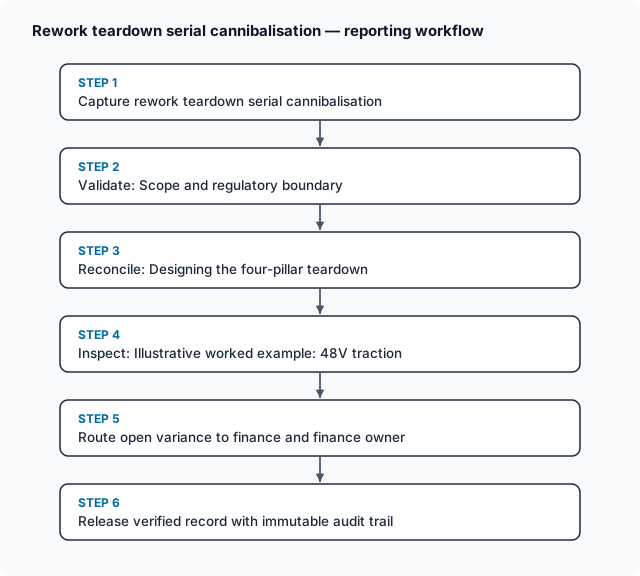
Bounded rework tear down cannibalisation serial genealogy cost reversal verification and exception-routing workflow
Follow the workflow below, or open its complete text version.
Read the complete workflow as text
- Capture rework tear down cannibalisa baseline record → Verify revision, unit Basis and cutoff alignment
- Verify revision, unit Basis and cutoff alignment → Run deterministic reconciliation and tolerance check
- Run deterministic reconciliation and tolerance check → Quarantine mismatched or unapproved lines
- Quarantine mismatched or unapproved lines → Route exception to named domain and finance owner
- Route exception to named domain and finance owner → Release verified record with immutable audit trail
Designing the four-pillar teardown, genealogy, and cost-reversal architecture
1. Append-only As-Built Serial Genealogy state machine (Never delete history).
When Child Serial SN-IGBT-402 is bolted into Parent Serial INV-48V-SN088, pressurized, energized on the EOL test stand, and subsequently removed after failing a high-voltage leakage check, that physical event happened. Deleting the database row linking SN-IGBT-402 to INV-48V-SN088 falsifies the Device/Unit History Record (21 CFR Part 820) and hides the fact that the parent unit's mating busbars experienced a fault current event. Structure the as_built_serial_genealogy table as an immutable append-only event log:
INSTALLED_ACTIVE: Component serial is currently mounted in the parent unit (build_pass = 1).REMOVED_DEFECTIVE: Component was unmounted underTEARDOWN_WO_ID; linked toNCR_IDand routed toWH-MRB-SCRAPor vendor RMA.REMOVED_HARVESTED_GOOD: Healthy component unmounted during parent scrap/teardown or authorized cannibalisation; routed toWH-HARVEST-RECERT-HOLDwithharvest_cycle_count += 1.INSTALLED_REPLACEMENT: Replacement component serial mounted during rework (build_pass = 2, linked toreplaces_genealogy_row_id).
2. Three-tier BOM Teardown Harvest Policy & Harvest-Cycle Ceilings.
Every item on a Manufacturing BOM must carry an explicit teardown_policy flag:
MANDATORY_TEARDOWN_SCRAP($100%$ Auto-Write-Off): Torque-to-yield (TTY) aluminium/steel fasteners, Loctite-coated screws, compressed elastomer O-rings, liquid FIPG gaskets, potting compounds, and thermal interface pads. Whenever a teardown or partial swap touches an operation that disturbs these items, the ERP automatically writes off $100%$ of the disturbed single-use items and forces the operator to scan a fresh replacement kit during re-assembly.REUSABLE_AFTER_QA_RECERT(Quarantine & Cycle Cap): Machined housings, multi-layer PCBs, wire harnesses, and optical sensors. Upon de-kitting, the ERP moves these serials intoWH-HARVEST-RECERT-HOLD(a non-allocatable quarantine warehouse). Additionally, because every thermal test and mechanical unbolting cycle stresses solder joints and threads, each serialized child item enforces aMAX_HARVEST_CYCLEScap (typically $1\text{ or }2\text{ teardowns}$)—automatically blocking a component that has already survived two previous teardowns from being harvested a third time.FAULTY_MRB_QUARANTINE: The failed component triggering the teardown, locked inWH-MRB-SCRAPfor root-cause failure analysis (RCFA) or supplier chargeback.
3. Controlled donor-to-recipient cannibalisation workflow.
In an ideal factory, cannibalisation never happens; in real manufacturing, a customer aircraft-on-ground (AOG) or line-down order sometimes forces management to authorize robbing CHILD-PCB-99 from WIP Donor Unit SN-DONOR-105 to finish Recipient Unit SN-RECIP-102. To prevent informal "midnight toolbox robbing," enforce a 4-Rule Cannibalisation Transaction:
- Requires joint electronic signoff by Production Manager + Quality Manager (plus Customer Representative if contractually required).
- Executes a linked pair of transactions: a De-Kit from
SN-DONOR-105(movingCHILD-PCB-99through a rapid QA visual/ESD check and incrementingharvest_cycle_count) and an Install intoSN-RECIP-102. - Automatically places Donor Unit
SN-DONOR-105intoWIP_CANNIBALISED_SHORT_HOLD, deducts the exact value ofCHILD-PCB-99plus disturbed single-use fasteners fromSN-DONOR-105's WIP valuation, and pegs the incoming purchase order for the replacement PCB directly toSN-DONOR-105's restoration work order.
4. IAS 2 WIP cost-layer unrolling (Preventing reworked inventory inflation). Under IAS 2 (Inventories, Paragraph 16), abnormal amounts of wasted materials, labour, or other production costs must be recognized as expenses in the period in which they are incurred—never capitalized into the balance-sheet value of the finished unit. For a parent unit with standard material cost $C_{\text{mat, std}}$ and standard conversion cost $C_{\text{conv, std}}$ ($C_{\text{total, std}} = C_{\text{mat, std}} + C_{\text{conv, std}}$):
- When a faulty component ($C_{\text{faulty}}$) and disturbed single-use consumables ($C_{\text{single_use}}$) are removed and replaced with fresh parts ($C_{\text{faulty}} + C_{\text{single_use}}$) using rework labour ($C_{\text{rework_lab}}$), the Net Rework & Scrap Period Expense ($V_{\text{rework_total}}$) is: $$V_{\text{rework_total}} = C_{\text{faulty}} + C_{\text{single_use}} + C_{\text{rework_lab}} - R_{\text{vendor_warranty}}$$
- The finished parent unit enters Finished Goods inventory at exactly $C_{\text{total, std}}$, while $V_{\text{rework_total}}$ posts immediately to
GL-INTERNAL-REWORK-SCRAP-VARIANCE(orGL-VENDOR-WARRANTY-RECEIVABLEif caused by a supplier defect).
under div over
under table over
under thead over
under tr over
under th over Component / Cost Stream in Teardown under /th over
under th over BOM Teardown Policy under /th over
under th over Target ERP Warehouse / GL Account under /th over
under th over Genealogy State Transition under /th over
under th over IAS 2 Valuation Rule under /th over
under /tr over
under /thead over
under tbody over
under tr over
under td over under strong over 1. Faulty Child Component (SN-IGBT-402) under /strong over under /td over
under td over under code over FAULTY_MRB_QUARANTINE under /code over under /td over
under td over under code over WH-MRB-SCRAP under /code over $\rightarrow$ under code over GL-SCRAP-OR-RMA under /code over under /td over
under td over under code over INSTALLED_ACTIVE under /code over $\rightarrow$ under code over REMOVED_DEFECTIVE under /code over under /td over
under td over Credit WIP by $$210.00$; debit Scrap Expense or Vendor RMA Claim under /td over
under /tr over
under tr over
under td over under strong over 2. Disturbed Gaskets, Paste & TTY Bolts under /strong over under /td over
under td over under code over MANDATORY_TEARDOWN_SCRAP under /code over under /td over
under td over Immediate Write-Off $\rightarrow$ under code over GL-REWORK-CONSUMABLES under /code over under /td over
under td over Batch lot marked under code over CONSUMED_DESTROYED_ON_TEARDOWN under /code over under /td over
under td over Credit WIP by $$65.00$; debit Rework Consumable Scrap Expense under /td over
under /tr over
under tr over
under td over under strong over 3. Harvested Good Sub-Assemblies (4 Pcs) under /strong over under /td over
under td over under code over REUSABLE_AFTER_QA_RECERT under /code over under /td over
under td over under code over WH-HARVEST-RECERT-HOLD under /code over $\rightarrow$ under code over WH-SUPERMARKET under /code over under /td over
under td over under code over INSTALLED_ACTIVE under /code over $\rightarrow$ under code over REMOVED_HARVESTED under /code over ( under code over cycle=1 under /code over ) under /td over
under td over Carry original standard cost ($$965.00$) into Quarantine; zero P&L hit if recertified under /td over
under /tr over
under tr over
under td over under strong over 4. Teardown & Re-Assembly Labour under /strong over under /td over
under td over Non-Capitalizable Rework under /td over
under td over under code over GL-REWORK-LABOUR-VARIANCE under /code over under /td over
under td over Logged on under code over REWORK_JOB_CARD under /code over against NCR_ID under /td over
under td over Expense $$95.00$ in current period; under strong over never under /strong over add to FG unit cost under /td over
under /tr over
under /tbody over
under /table over
under /div over
Illustrative worked example: 48V traction inverter EOL failure teardown, component harvest, and IAS 2 cost reversal
All figures below are illustrative and synthetic. An electric-drivetrain plant builds serialized 48V traction inverters (INV-48V-SN088) with a standard built cost of $$1,420.00$:
- Standard Material Cost ($C_{\text{mat, std}} = $1,240.00$):
- $4\text{ Reusable Serialized Sub-Assemblies}$ (CNC liquid-cooled housing
SN-HSG-88at $$340$, Control PCBSN-PCB-88at $$290$, DC-Link Capacitor BankSN-CAP-88at $$225$, Hall Current SensorSN-SNS-88at $$110$) = $$965.00$ - $1\text{ Serialized 3-Phase IGBT Power Module}$ (
SN-IGBT-402) = $$210.00$ - $1\text{ Single-Use Fastener & Thermal Seal Kit}$ (silver-filled thermal phase-change pad, die-cut EPDM perimeter gasket, $12\text{ torque-to-yield busbar bolts}$) = $$65.00$
- $4\text{ Reusable Serialized Sub-Assemblies}$ (CNC liquid-cooled housing
- Standard Assembly & EOL Test Conversion Cost ($C_{\text{conv, std}}$): $$180.00$.
During End-of-Line hot-load testing, INV-48V-SN088 fails Phase-W short-circuit protection due to an internal bond-wire lift inside IGBT Power Module SN-IGBT-402.
Step 1: Execute partial teardown (RWK-WO-088), scrap single-use kit, and install replacement IGBT.
The technician opens Rework Teardown Order RWK-WO-088 on INV-48V-SN088:
- De-Kit Faulty IGBT & Auto-Scrap Single-Use Kit:
SN-IGBT-402($$210.00$) is scanned out toWH-MRB-SCRAP(STATE = REMOVED_DEFECTIVE).- Because unbolting the IGBT disturbs the thermal pad, housing perimeter gasket, and torque-to-yield busbar bolts, the MES automatically writes off the $$65.00$ single-use kit (
STATE = DESTROYED_ON_TEARDOWN) and blocks re-closing the housing until a fresh $$65.00$ kit is scanned. - Total cost reversed out of
INV-48V-SN088WIP = $$210.00 + $65.00 = \mathbf{-$275.00}$ (bringing residual WIP down from $$1,420.00$ to $$1,145.00$).
- Install Replacement IGBT (
SN-IGBT-519) & Fresh Seal Kit:- The technician scans replacement IGBT
SN-IGBT-519($$210.00$) and a fresh single-use seal/bolt kit ($$65.00$), adding $+$275.00$ back toINV-48V-SN088WIP (restoring material + standard conversion to $$1,145.00 + $275.00 = \mathbf{$1,420.00}$). - Teardown, heatsink solvent cleaning, re-assembly, and full EOL re-test consume $1.90\text{ hours}$ at $$50.00/\text{hr} = \mathbf{$95.00}$ of rework conversion cost, which posts directly to
GL-REWORK-LABOUR-VARIANCE.
- The technician scans replacement IGBT
Step 2: Compare naive uncapped ERP costing vs. IAS 2 compliant teardown accounting.
(Note: If the parent unit had instead suffered a cracked housing lug requiring a Full Unit Disassembly without rebuild, the $4\text{ good serialized sub-assemblies}$ worth $$965.00$ would enter WH-HARVEST-RECERT-HOLD with harvest_cycle_count = 1, while the $$210.00$ IGBT + $$65.00$ seals + $$180.00$ sunk conversion + $$45.00$ teardown labour would be expensed.)
For the rebuilt unit INV-48V-SN088, the ledger comparison is:
Scroll horizontally to see all columns.
Cost & Genealogy Ledger Step (INV-48V-SN088) |
Naive Uncapped ERP (Add-On Issue) |
Compliant Teardown & IAS 2 Reversal (M127) |
Inventory Balance (WIP / FG) |
Period Variance / Scrap Expense (P&L) |
Genealogy Record Integrity |
|---|---|---|---|---|---|
| 1. Initial Build Completion (Pre-EOL Fail) | $$1,420.00$ | $$1,420.00$ | $$1,420.00$ | $$0.00$ | SN-IGBT-402 = INSTALLED_ACTIVE (Pass 1) |
2. De-Kit Faulty SN-IGBT-402 ($$210$) |
Not reversed ($0$) | $-$210.00$ | $$1,210.00$ | $+$210.00$ (Scrap/RMA) | SN-IGBT-402 $\rightarrow$ REMOVED_DEFECTIVE |
| 3. Auto-Scrap Single-Use Seals/TTY Bolts ($$65$) | Not reversed ($0$) | $-$65.00$ | $$1,145.00$ | $+$65.00$ (Rework Scrap) | Seal Lot $\rightarrow$ DESTROYED_ON_TEARDOWN |
4. Issue Replacement SN-IGBT-519 + Fresh Kit |
$+$275.00$ | $+$275.00$ | $$1,420.00$ | $$0.00$ | SN-IGBT-519 $\rightarrow$ INSTALLED_REPLACEMENT (Pass 2) |
| 5. Teardown, Clean & Full EOL Re-Test ($1.9\text{h}$) | $+$95.00$ | **$+$95.00$ (To Var GL) ** | $$1,420.00$ | $+$95.00$ (Rework Lab) | EOL Test #1 (FAIL) & Test #2 (PASS) both retained |
| Final Reconciled Outcome | **$$1,790.00$ (+$370 Overstated!) ** | **$$1,420.00$ (Exact Std) ** | $$1,420.00$ | $$370.00$ | 100% Append-Only Audit Trail |
Independent arithmetic verification.
- Material conservation on
INV-48V-SN088: $$965.00\text{ (4 healthy sub-assemblies)} + $210.00\text{ (IGBT)} + $65.00\text{ (single-use kit)} = $1,240.00\text{ standard material}$; plus $$180.00\text{ standard conversion} = $1,420.00$. - WIP reversal and restoration: $$1,420.00\text{ (initial)} - $210.00\text{ (faulty IGBT de-kit)} - $65.00\text{ (single-use kit write-off)} + $210.00\text{ (new IGBT)} + $65.00\text{ (new kit)} = $1,420.00\text{ final FG valuation}$.
- Total rework/scrap period variance: $$210.00\text{ (faulty IGBT)} + $65.00\text{ (destroyed single-use kit)} + $95.00\text{ (rework labour)} = $370.00$ ($26.06%$ of standard unit cost prevented from inflating inventory).
Workflow, owner roles, exception handling and recovery controls
Scroll horizontally to see all columns.
| Workflow stage | Accountable owner | Required system evidence | Exception condition | System hold & recovery control |
|---|---|---|---|---|
| 1. EOL Failure & Teardown Authorization | Test Technician & Quality Engineer | Failed EOL test log, NCR_ID, selected scope (PARTIAL_SWAP vs FULL_TEARDOWN) |
Operator attempts to issue a second serialized IGBT to the original Work Order without a de-kit | Hard-block duplicate child serial issue (ERR_SLOT_ALREADY_OCCUPIED); require formal RWK_DEKIT transaction |
| 2. Physical De-Kit & Consumable Auto-Scrap | Rework Technician & MES | Scanned removed child serials + automatic write-off of MANDATORY_TEARDOWN_SCRAP items |
Technician attempts to close rework order without scanning a fresh single-use gasket/TTY bolt kit | Block RWK-WO completion (ERR_MISSING_REPLACEMENT_SEAL_KIT); enforce 100% single-use replacement |
| 3. Harvested Part Recertification Gate | Receiving / MRB Quality Inspector | Harvested serial in WH-HARVEST-RECERT-HOLD, visual/ESD/functional check, harvest_cycle_count |
Harvested PCB has harvest_cycle_count == 2 (already survived 2 prior teardowns) |
Automatically block recertification (ERR_MAX_HARVEST_CYCLES_EXCEEDED) and route to MRB scrap |
| 4. Donor Cannibalisation Control | Production Mgr + Quality Mgr | Signed CANNIBALISATION_ORDER, Donor Serial SN-DONOR, Recipient Serial SN-RECIP |
Floor supervisor attempts to pull a component from a partially built WIP unit without dual signoff | Lock installed child serials to SN-DONOR; upon approved cannibalisation, set donor to WIP_CANNIBALISED_SHORT_HOLD |
| 5. Rebuild Full Regression EOL Test | EOL Test Station & QMS | Complete Step-1-to-End EOL functional & hipot test pass after rework | Technician runs only the failed Phase-W sub-test instead of the full EOL regression sequence | Force MES router to reset EOL test pointer to Step 1 (FULL_REGRESSION_REQUIRED) whenever any housing fastener is broken |
Bounded pilot and implementation check
Pilot append-only serial de-kitting, harvested-component recertification quarantine, and IAS 2 cost reversal on 1 serialized assembly line (e.g., EOL test & rework bay) over 3 weeks:
- Pilot boundary: Tag every BOM component with its
teardown_policy(REUSABLE_AFTER_QA_RECERTvsMANDATORY_TEARDOWN_SCRAP), configureWH-HARVEST-RECERT-HOLD, and automate the WIP cost-reversal journal entry on rework orders. - Acceptance tests:
ACT-M127-01(Append-Only Genealogy Preservation): De-kitSN-IGBT-402fromINV-48V-SN088and installSN-IGBT-519; confirm queryingINV-48V-SN088shows both serials with exact timestamps (REMOVED_DEFECTIVEat Pass 1 andINSTALLED_REPLACEMENTat Pass 2).ACT-M127-02(Mandatory Single-Use Kit Replacement Interlock): Open a teardown swap on an operation with a linked $$65.00$ gasket/TTY bolt kit; confirm the ERP automatically scraps the original kit and blocks rebuild signoff until a new kit is issued.ACT-M127-03(Harvest Quarantine & Cycle-Count Ceiling): Harvest 4 sub-assemblies from a torn-down unit; confirm they land in non-allocatableWH-HARVEST-RECERT-HOLDand that any serial withharvest_cycle_count ≥ 2is blocked from returning to stock.ACT-M127-04(IAS 2 Standard Cost Cap Verification): Execute the $$275.00$ component replacement + $$95.00$ rework labour fixture and verify the finished unit posts to FG inventory at exactly $$1,420.00$ while $$370.00$ posts to period rework/scrap variance accounts.
Next actions
- Make your As-Built Serial Genealogy table strictly append-only: Never
DELETEorUPDATEan installed component serial in place; append aREMOVED_DEFECTIVEorREMOVED_HARVESTEDstate transition so full history survives for field recalls and warranty audits. - Flag every single-use fastener, gasket, O-ring, and thermal pad as
MANDATORY_TEARDOWN_SCRAPon the BOM: Ensure your MES automatically writes off disturbed single-use items and forces the rework tech to scan fresh seals and torque-to-yield bolts. - Route all harvested components through
WH-HARVEST-RECERT-HOLDwith a hardMAX_HARVEST_CYCLEScap: Never let a component unbolted from a failed assembly go straight back to the line-side rack without QA recertification. - Reverse removed component costs out of WIP and expense rework labour in the current period: Comply with IAS 2 and keep reworked units at standard cost rather than inflating finished-goods inventory with buried failure costs.
Frequently Asked Questions
How should discrete manufacturers record finished-unit teardown, component harvest/recertification, and parent-child serial disassembly without corrupting warranty genealogy or double-counting component costs?.
Teams should govern rework tear down cannibalisation serial genealogy cost reversal by linking every transaction to its source evidence, timestamp, and assigned owner before permitting downstream posting. Distinct from M035 (NCR disposition) and M064 (variance analysis); M127 governs negative-issue disassembly orders, harvested serialized module recertification holds, and splitting salvage value from teardown labour variance. Rather than relying on informal spreadsheet overrides, the workflow enforces a documented verification gate and preserves the original observation whenever a correction is recorded.
How does mes quality management handle exceptions and mismatches?.
When a discrepancy occurs during mes quality management, the system routes the blocked record into an owned exception queue rather than silently dropping or auto-adjusting the balance. Assigned operational, quality, and finance owners must review and approve exceptions before posting. Each exception retains the original quantity, date, and counterparty reference until the designated reviewer resolves the variance with supporting evidence.
What should teams test before automating shop floor control software?.
Before scaling shop floor control software, run a bounded pilot using historical records that include partial receipts, late updates, duplicate messages, and rejected lines. Verify that the integration preserves idempotency, maintains a clear segregation of duties between operational entry and financial approval, and produces an auditable trail for every state transition.
Compare this workflow with your current setup
Share the step that takes the most manual work, the systems involved and the exceptions your team handles. That gives us a concrete starting point for comparing approaches.
Sources and further reading
Sources checked 15 October 2026. Worked examples and workflow diagrams are original illustrations, not reported client results.
- SAE AS9100D: Quality Management Systems — Requirements for Aviation, Space, and Defense Organizations (§8.5.2 & §8.7)
- 21 CFR Part 820: Quality System Regulation — Device History Record & Rework Controls
- IAS 2: Inventories (Paragraph 16 — Abnormal Waste and Rework Expense Recognition)
- Stock Entry (Repack / Disassembly) and Serial Number Traceability
