ESD & cleanroom garment records: interlock wrist-strap continuity, wash-cycle limits, and Helmke drum audits to MES login
For production managers, planners and plant leaders · Compare approaches
TL;DR — what you’ll learn
- Interlock MES Workstation / Job Card Sign-On to three real-time environmental compliance gates: (1) the operators daily [ANSI/ESD S20.20](https://www.esda.org/standards/ansi-esd-s20-20/) wrist-strap and dual-footwear resistance check, (2) the RFID-chipped ESD/cleanroom smocks valid wash-cycle and panel-to-panel resistance status, and (3) the bench overhead ionizers offset voltage balance and decay verification.
- Track every cleanroom/ESD garment individually via a washable UHF RFID or 2D barcode tag (SMOCK_RFID), incrementing wash_cycle_count on each laundry receipt and hard-retiring the garment at MAX_WASH_CYCLES (e.g., $50\text{ washes}$) or whenever carbon-filament grid resistance exceeds $1.0 \times 10^9\,\Omega$ ([ESD TR53](https://www.esda.org/standards/ansi-esd-s20-20/)).
- Require cleanroom laundry vendor lots to pass [IEST-RP-CC003](https://www.iest.org/Standards-RPs/Recommended-Practices/IEST-RP-CC003) Helmke Drum Particulate Shedding ($\ge 0.5\,\mu\text{m}$ particles/min) and point-to-point electrical continuity audits upon receiving before releasing the garment batch to the gowning locker dispense racks.
- Log independent Left-Foot and Right-Foot Footwear Resistance ($R_{\text{left}}, R_{\text{right}}$) alongside Wrist-Strap Resistance ($R_{\text{wrist}}$) as actual numerical values ($\text{M}\Omega$) rather than binary PASS checkboxes so degraded heel straps (750 MΩ - 920 MΩ) are replaced before they fail mid-shift.

Illustrative manufacturing inspection room and machine shop floor; not a client facility.
In surface-mount technology (SMT) PCB assembly, semiconductor backend packaging, defense avionics, LiDAR/camera module cleanrooms, and medical-electronics manufacturing, latent Electrostatic Discharge (ESD) damage and sub-micron particulate contamination cause catastrophic field failures that pass initial board power-up tests. Even though plants mount combo wrist/footwear testers outside the ESD Protected Area (EPA) and purchase conductive carbon-grid cleanroom smocks, three operational gaps routinely invalidate compliance during customer or ISO/IATF audits. First, operators sign a paper clipboard next to the ESD tester—or walk past the turnstile when one heel grounder is coated in floor wax ($R_{\text{right}} = 1,420\text{ M}\Omega over 1,000\text{ M}\Omega$), and log directly into an SMT pick-and-place or manual soldering station because the MES terminal does not query the ESD turnstile database.
Second, cleanroom ESD smocks are washed 80+ times in harsh alkaline detergents without tracking per-garment wash counts, fracturing the woven carbon threads so the smock acts as an ungrounded insulator shielding a charged operator shirt. Third, overhead bench air ionizers drift out of balance ($+48\text{ V}$ offset instead of $\pm 15\text{ V}$), actively charging sensitive CMOS image sensors while the operator works.
The direct solution is to enforce a three-way Personnel-Garment-Workstation ESD & Particulate Interlock inside the MES and QMS (ERPNext Job Card & Quality Inspection). Distinct from P035 (which covers sterile pharmaceutical aseptic gowning qualification and microbiological Contact Plate / CFU bioburden limits), this guide (M126) specifies non-sterile precision cleanroom and EPA compliance: ANSI/ESD S20.20 numerical resistance logging, RFID garment wash-cycle & Helmke drum particulate gates, ionizer decay/balance audits, and real-time MES workstation sign-on blocks.
Scope and safety boundary
This article defines the MES, access-control turnstile, RFID laundry ledger, and QMS audit architecture for ESD and cleanroom garment compliance:
- What this workflow governs: Capturing daily numerical wrist-strap and dual-footwear resistance readings ($\text{M}\Omega$), tracking individual RFID garment wash cycles and electrical/particulate lot releases, verifying workstation ground and ionizer calibration windows, and blocking MES Job Card start when any element is expired or out of tolerance.
- What this workflow does not replace: Software login interlocks never replace physical electrical-safety protection—specifically the mandatory $1.0\text{ M}\Omega$ current-limiting series resistor built into operator wrist cords to limit fault current to $ under 0.25\text{ mA}$ at $250\text{ V AC}$, nor do they replace GFCI/RCD bench protection or continuous dual-wire workstation monitors. All resistance limits, ionizer offset voltages, and Helmke drum particulate categories must follow ANSI/ESD S20.20-2021, IEST-RP-CC003.5, and ISO 14644-5.
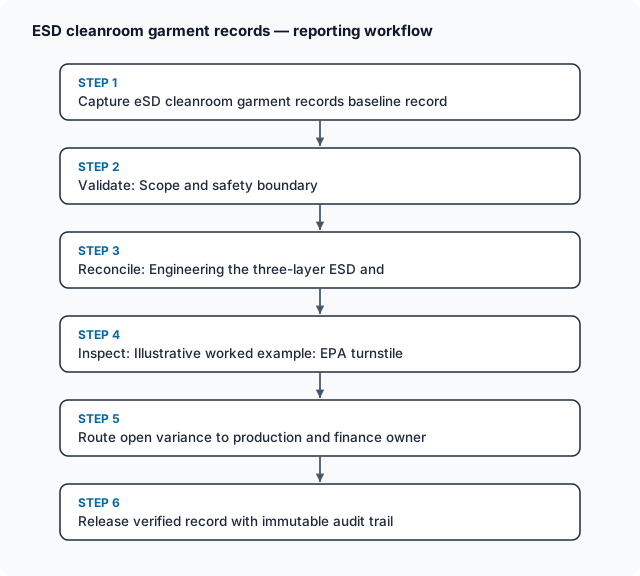
Bounded manufacturing compliance tracking verification and exception-routing workflow
Follow the workflow below, or open its complete text version.
Read the complete workflow as text
- Capture manufacturing compliance tra baseline record → Verify revision, unit Basis and cutoff alignment
- Verify revision, unit Basis and cutoff alignment → Run deterministic reconciliation and tolerance check
- Run deterministic reconciliation and tolerance check → Quarantine mismatched or unapproved lines
- Quarantine mismatched or unapproved lines → Route exception to named domain and finance owner
- Route exception to named domain and finance owner → Release verified record with immutable audit trail
Engineering the three-layer ESD and cleanroom garment governance model
1. Numerical operator wrist-strap and dual-footwear resistance gates (ANSI/ESD S20.20).
A compliant EPA entry gate does not merely output a dry-contact relay pulse; it transmits the operator's BADGE_ID, timestamp, ambient relative humidity ($\text{RH}%$), and three exact resistance values to the MES:
- Wrist-Strap System Resistance ($R_{\text{wrist}}$, operator hand $\rightarrow$ band $\rightarrow$ $1\text{ M}\Omega$ resistor cord $\rightarrow$ plug): $$7.5 \times 10^5,\Omega;(0.75\text{ M}\Omega) \le R_{\text{wrist}} under 3.5 \times 10^7,\Omega;(35.0\text{ M}\Omega)$$ (Note: While ANSI/ESD S20.20 Table 1 specifies $ under 3.5 \times 10^7,\Omega$ as the system upper limit, plant safety rules enforce a $\ge 0.75\text{ M}\Omega$ lower limit to verify the $1\text{ M}\Omega$ current-limiting safety resistor is not shorted!)
- Independent Left & Right Footwear Resistance ($R_{\text{left}}, R_{\text{right}}$ via dual-footplate电极): $$R_{\text{left}} under 1.0 \times 10^9,\Omega;(1,000\text{ M}\Omega) \quad\land\quad R_{\text{right}} under 1.0 \times 10^9,\Omega;(1,000\text{ M}\Omega)$$ (For Class 0 ultra-sensitive devices, plants often tighten the footwear ceiling to $ under 1.0 \times 10^8,\Omega = 100\text{ M}\Omega$.)
- Shift-Bounded Compliance Token (
TTL = 12 Hours): Passing all required resistance channels grants the operator badge a time-bounded digital token (ESD_PASS_UNTIL = shift_end). If the operator leaves the cleanroom/EPA for lunch and re-enters, or starts a new shift, the MES requires a fresh combo-tester reading.
2. RFID cleanroom garment wash-cycle limits and Helmke drum particulate checks (IEST-RP-CC003).
Cleanroom ESD smocks, hoods, and coveralls woven with $98%$ polyester filament and $2%$ conductive carbon grid degrade along two axes over repeated laundering: polyester micro-fibers abrade (increasing particle shedding), and conductive carbon fibers break (causing open-circuit panels). Govern every garment via an embedded UHF RFID chip (SMOCK_RFID):
- Cumulative Wash-Cycle Ceiling (
MAX_WASH_CYCLES = 50): Each time the cleanroom laundry returns a sealed lot, the bulk RFID portal incrementswash_cycle_count += 1on every scanned garment. Any smock reachingwash_cycle_count == 50automatically flips toRETIRED_MAX_WASH_CAP. - Helmke Drum Non-Viable Particulate Shedding Rate ($B_{\ge 0.5,\mu\text{m}}$): Under IEST-RP-CC003, sample garments from the washed lot are tumbled in an open rotating drum at $10\text{ rpm}$ for $t_{\text{test}} = 10\text{ minutes}$ while an optical particle counter draws air at $1.0\text{ cfm}$ ($28.3\text{ L/min}$). The average particle emission rate per minute is: $$B_{\ge 0.5,\mu\text{m}} = \frac{N_{\text{total_particles}\ge 0.5,\mu\text{m}}}{t_{\text{test}};(\text{min})} \le B_{\text{limit}};\left(\text{e.g., } \le 1,200\text{ particles/min for Category I}\right)$$
- Garment Point-to-Point & Groundable Panel Continuity (ESD TR53): Verify sleeve-to-sleeve resistance across the conductive seams ($R_{\text{smock}} under 1.0 \times 10^9,\Omega$ for Static Control Garments or $ under 1.0 \times 10^7,\Omega$ for Groundable Garment Systems).
3. Workstation ground, mat resistance, and ionizer offset balance interlock.
Even a properly grounded operator in a certified smock will damage parts if the assembly workstation itself is faulty. Link each MES Workstation_ID to its periodic ESD TR53 verification schedule:
- Worksurface Mat-to-Ground Resistance ($R_{\text{mat}} under 1.0 \times 10^9,\Omega$) and Continuous Monitor Verification.
- Benchtop / Overhead Air Ionizer Audit: Verify Discharge Decay Time ($+1,000\text{ V}\text{ to }+100\text{ V}$ and $-1,000\text{ V}\text{ to }-100\text{ V}$ in $ under 10.0\text{ seconds}$) and Offset Voltage (Ion Balance) within $\pm 35\text{ V}$ (or $\pm 15\text{ V}$ for Class 0). If the workstation's weekly ionizer check is overdue or out of balance, the MES locks the terminal (
WORKSTATION_ESD_HOLD).
under div over
under table over
under thead over
under tr over
under th over Compliance Element under /th over
under th over Standard & Metric under /th over
under th over Acceptable Pass Window under /th over
under th over MES / Turnstile Action on Failure under /th over
under /tr over
under /thead over
under tbody over
under tr over
under td over under strong over 1. Operator Wrist-Strap System under /strong over under /td over
under td over ANSI/ESD S20.20 Table 1 ($R_{\text{wrist}}$) under /td over
under td over $0.75\text{ M}\Omega \le R_{\text{wrist}} under 35.0\text{ M}\Omega$ under /td over
under td over Lock EPA turnstile & block MES Job Card login; prompt cord/band swap under /td over
under /tr over
under tr over
under td over under strong over 2. Operator Dual Footwear under /strong over under /td over
under td over ANSI/ESD S20.20 Table 1 ($R_{\text{left}}, R_{\text{right}}$) under /td over
under td over Both feet $ under 1,000\text{ M}\Omega$ ($1.0 \times 10^9,\Omega$) under /td over
under td over Reject entry if either foot fails; flag preventive replacement at $ over 750\text{ M}\Omega$ under /td over
under /tr over
under tr over
under td over under strong over 3. Cleanroom ESD Smock (SMOCK_RFID) under /strong over under /td over
under td over IEST-RP-CC003 & ANSI/ESD S20.20 under /td over
under td over $\text{Washes} under 50$ AND $R_{\text{panel}} under 1.0 \times 10^9,\Omega$ under /td over
under td over Block smart-locker dispense & reject MES bench scan if smock RFID is retired/quarantined under /td over
under /tr over
under tr over
under td over under strong over 4. Laundry Lot Helmke Drum under /strong over under /td over
under td over IEST-RP-CC003 Category I ($\ge 0.5,\mu\text{m}$) under /td over
under td over $B_{\ge 0.5,\mu\text{m}} \le 1,200\text{ particles/min}$ ($10\text{m}$ avg) under /td over
under td over Hold entire laundry lot in under code over QC_REWASH_HOLD under /code over if particle rate exceeds Category I limit under /td over
under /tr over
under tr over
under td over under strong over 5. Bench Air Ionizer Balance under /strong over under /td over
under td over ANSI/ESD S20.20 / ESD SP3.3 ($V_{\text{offset}}, t_{\text{decay}}$) under /td over
under td over $\left|V_{\text{offset}}\right| \le 35\text{ V}$ (or $\pm 15\text{ V}$) & $t_{1000\to 100} under 10\text{ s}$ under /td over
under td over Lock MES Workstation (ERR_IONIZER_BALANCE_HOLD) until emitter needles are cleaned & re-zeroed under /td over
under /tr over
under /tbody over
under /table over
under /div over
Illustrative worked example: EPA turnstile gate, 10-min Helmke drum check, and 360-smock RFID fleet audit
All figures below are illustrative and synthetic. Consider an ISO Class 6 cleanroom / EPA optical-sensor and SMT assembly facility (EPA-SMT-01) operating with $120\text{ shift operators}$ and a rotating fleet of $360\text{ RFID-tagged cleanroom ESD smocks}$ (3 sets per operator).
Step 1: Evaluate Operator OP-408 at the EPA morning combo-tester gate.
At 06:52, Operator OP-408 (wearing smock SMOCK-RFID-1104, currently at Wash #29) steps onto the dual-footplate combo tester and plugs in their wrist cord:
- Wrist-Strap System Reading ($R_{\text{wrist}}$): $4.20\text{ M}\Omega$ ($4.20 \times 10^6,\Omega$) $\implies \mathbf{\text{PASS}}$ (inside $[0.75,; 35.0]\text{ M}\Omega$; $12.0%$ of the $35.0\text{ M}\Omega$ ceiling).
- Left Footwear Reading ($R_{\text{left}}$): $18.5\text{ M}\Omega$ ($1.85 \times 10^7,\Omega$) $\implies \mathbf{\text{PASS}}$ ($ under 1,000\text{ M}\Omega$).
- Right Footwear Reading ($R_{\text{right}}$): $1,420.0\text{ M}\Omega$ ($1.42 \times 10^9,\Omega$) $\implies \mathbf{\text{FAIL}}$ (exceeds the $1,000.0\text{ M}\Omega$ limit by $+420.0\text{ M}\Omega$ due to a broken conductive ribbon inside the right heel strap).
Because R_right ≥ 1,000 MOhm, the turnstile remains locked and the MES sets OP-408 to ESD_STATUS = FAILED_FOOTWEAR_RIGHT. Even if someone holds the cleanroom door open for OP-408, attempting to scan Badge OP-408 at SMT Line 2 (WS-SMT-02) throws ERR_OPERATOR_NO_VALID_ESD_TOKEN. After replacing the right heel strap and re-testing at 06:55 ($R_{\text{right, retest}} = 22.4\text{ M}\Omega$), the MES grants a 12-hour pass token (06:55 to 18:55).
Step 2: Reconcile Laundry Lot WASH-LOT-2026-88 Helmke drum and 360-smock RFID status.
During the shift, the cleanroom laundry delivers WASH-LOT-2026-88 ($120\text{ freshly laundered smocks}$). Quality Control runs a $10\text{-minute}$ Helmke Drum test on a sample smock and scans all $120\text{ smocks}$ through the RFID & ESD TR53 cuff-to-cuff tester:
- Helmke Drum Shedding Rate ($B_{\ge 0.5,\mu\text{m}}$ across $t = 10.0\text{ min}$ at $1.0\text{ cfm}$):
- Total cumulative particles ($\ge 0.5,\mu\text{m}$) counted over $10\text{ minutes}$ = $11,400\text{ particles}$. $$B_{\ge 0.5,\mu\text{m}} = \frac{11,400\text{ particles}}{10.0\text{ minutes}} = \mathbf{1,140.0\text{ particles/min}} \le 1,200.0\text{ particles/min Category I limit}\quad (\text{PASS — } 95.0%\text{ of limit})$$
- Fleet-Wide 360-Smock RFID & ESD Grid Reconciliation:
Scroll horizontally to see all columns.
Cleanroom ESD Smock Fleet Bucket (EPA-SMT-01) |
Garment Count ($\text{pcs}$) | Fleet Share ($%$) | Wash-Cycle Range | Cuff-to-Cuff Resistance ($R_{\text{smock}}$) | Locker & MES System Disposition |
|---|---|---|---|---|---|
1. ACTIVE_CLEAN_READY (Issued / In Lockers) |
$312$ | $86.67%$ | $1\text{ – }49\text{ washes}$ | $1.2 \times 10^6\text{ to }4.8 \times 10^8,\Omega$ | Cleared for operator badge pairing & MES sign-on |
2. IN_LAUNDRY_TRANSIT (Outbound Dirty Batch) |
$28$ | $7.78%$ | $12\text{ – }46\text{ washes}$ | Pending next wash receipt | Temporarily unavailable; tracked on laundry gate pass |
3. RETIRED_MAX_WASH_CAP (Hit 50-Wash Ceiling) |
$14$ | $3.89%$ | Exactly $50\text{ washes}$ | $6.5 \times 10^8,\Omega$ (Pass, but aged) | Permanently deactivated; auto-trigger PO for $14\text{ new smocks}$ |
4. QUARANTINED_ESD_GRID_BREAK (Early Failure) |
$6$ | $1.67%$ | $38\text{ – }44\text{ washes}$ | $2.8 \times 10^9,\Omega over 1.0 \times 10^9,\Omega$ | Blocked at locker; failed sleeve-to-ground continuity |
| Total RFID Smock Fleet Accounted | $360$ | $100.00%$ | — | — | 20 retired/quarantined smocks blocked from EPA use |
Independent arithmetic verification.
- Operator resistance check: $R_{\text{wrist}} = 4.20\text{ M}\Omega \in [0.75, 35.0]\text{ M}\Omega$ (Pass); $R_{\text{left}} = 18.5\text{ M}\Omega under 1,000\text{ M}\Omega$ (Pass); $R_{\text{right}} = 1,420.0\text{ M}\Omega over 1,000\text{ M}\Omega$ (Fail by $+42.0%$).
- Helmke drum rate: $11,400\text{ particles} / 10.0\text{ min} = 1,140.0\text{ particles/min}$ ($1,140 / 1,200 = 95.00%$ of Category I ceiling).
- 360-smock conservation: $312\text{ active} + 28\text{ in transit} + 14\text{ retired at 50 washes} + 6\text{ failed ESD continuity} = 360\text{ total smocks}$ ($20\text{ smocks} = 5.56%$ blocked from cleanroom entry).
Workflow, owner roles, exception handling and recovery controls
Scroll horizontally to see all columns.
| Workflow stage | Accountable owner | Required system evidence | Exception condition | System hold & recovery control |
|---|---|---|---|---|
| 1. Laundry Receipt & Helmke / TR53 Audit | Cleanroom QA Inspector & Laundry Vendor | RFID portal scan count, incremented wash_cycle_count, Helmke rate $B_{\ge 0.5}$, cuff-to-cuff $R_{\text{smock}}$ |
Smock hits wash_cycle_count == 50 or $R_{\text{smock}} \ge 1.0 \times 10^9,\Omega$ or Helmke $ over 1,200\text{ p/min}$ |
Auto-retire 50-wash and high-$R$ smocks in RFID database; hold entire laundry lot if Helmke drum fails |
| 2. Morning EPA Combo-Tester Check | Operator & Access-Control System | BADGE_ID, SMOCK_RFID, numerical $R_{\text{wrist}}, R_{\text{left}}, R_{\text{right}}$, timestamp |
Any channel fails S20.20 limits or operator skips wrist-cord test on a wrist-strap bench role | Keep turnstile locked; deny 12-hour ESD_PASS_TOKEN; log failed attempt and require re-test after strap replacement |
| 3. MES Bench Sign-On & Job Card Start | SMT / Assembly Operator & MES | Active 12-hour ESD_PASS_TOKEN + valid SMOCK_RFID + workstation IONIZER_VALID |
Operator walks through propped door without testing or wears a 51-wash retired smock | Hard-block MES Job Card start (ERR_ESD_OR_GARMENT_NONCOMPLIANT) and flash bench stack light Yellow |
| 4. Weekly Bench Ground & Ionizer Audit | ESD Coordinator / Metrology Tech | Calibrated megohmmeter & charged-plate analyzer readings ($R_{\text{mat}}, V_{\text{offset}}, t_{\text{decay}}$) | Bench ionizer offset voltage drifts to $+42\text{ V}$ ($ over \pm 35\text{ V}$ limit) or audit is $ over 24\text{h}$ overdue | Automatically place workstation in WORKSTATION_ESD_HOLD, preventing new Job Cards until ionizer is cleaned and re-verified |
| 5. Mid-Shift Continuous Monitor Alarm | Line Leader & Quality Engineer | Continuous dual-wire wrist/mat monitor alarm timestamp from bench PLC | Operator's wrist cord breaks mid-assembly on sensitive Class 0 board | Halt station cycle; quarantine current serial board (SN) for latent ESD inspection if required by customer quality plan |
Bounded pilot and implementation check
Pilot integrated combo-tester numerical logging, RFID smock wash-cycle tracking, and MES login interlocks on 1 EPA / cleanroom assembly line (20–30 operators and 60–90 RFID smocks) over 3 weeks:
- Pilot boundary: Connect the EPA entry combo tester via TCP/API to the MES badge table, tag all pilot smocks with UHF RFID chips, and configure the MES Job Card login check on 6 assembly workstations.
- Acceptance tests:
ACT-M126-01(Asymmetric Footwear Failure Block): Simulate an operator passing wrist ($4.20\text{ M}\Omega$) and left foot ($18.5\text{ M}\Omega$) but failing right foot ($1,420.0\text{ M}\Omega$); confirm both the turnstile and MES workstation login block the badge.ACT-M126-02(50-Wash RFID Smock Auto-Retirement): Increment a test smock'swash_cycle_countfrom $49$ to $50$ on laundry receipt; confirm its status flips toRETIRED_MAX_WASH_CAPand blocks MES bench sign-on.ACT-M126-03(Helmke Drum Lot Hold): Enter a 10-minute Helmke drum particle count of $13,500\text{ particles}$ ($1,350\text{ particles/min} over 1,200\text{ limit}$) on a laundry receipt; confirm all smocks in that laundry lot remain locked inQC_REWASH_HOLD.ACT-M126-04(Overdue Workstation Ionizer Interlock): Expire the weekly ionizer balance check on WorkstationWS-SMT-02and verify that even an operator with a valid 12-hour ESD token is blocked from starting a Job Card onWS-SMT-02.
Next actions
- Capture exact numerical $\text{M}\Omega$ readings from your ESD combo testers instead of binary PASS/FAIL bits: Trend rising heel-strap and wrist-cord resistance so worn straps are replaced at $750\text{ M}\Omega$ before they fail at morning shift change.
- Interlock MES Workstation sign-on to the operator's active 12-hour ESD token: Ensure that an operator who bypasses a physical turnstile or enters through a material airlock still cannot log into a production bench without passing the combo tester.
- Track cleanroom ESD smocks by individual RFID serial and enforce a hard wash-cycle cap: Retire garments automatically at 50 washes (or upon failing ESD TR53 cuff-to-cuff continuity) and auto-trigger purchasing replenishment when active stock drops below par.
- Bind workstation ground-mat and ionizer calibration dates to the MES Workstation master: Prevent operators from assembling static-sensitive boards under an unbalanced or unverified overhead ionizer.
Frequently Asked Questions
How do electronics and precision-optics plants trackESD wrist/footwear daily continuity checks, cleanroom smock wash-cycle limits, and workstation ionizer balance audits?.
Teams should govern manufacturing compliance tracking by linking every transaction to its source evidence, timestamp, and assigned owner before permitting downstream posting. Distinct from P035 (sterile pharma gowning qualification); M126 covers ANSI/ESD S20.20 turnstile resistance interlocks, conductive garment wash degradation limits, and blocking operator sign-on at SMT/assembly benches when ESD checks fail. Rather than relying on informal spreadsheet overrides, the workflow enforces a documented verification gate and preserves the original observation whenever a correction is recorded.
How does esd monitoring system handle exceptions and mismatches?.
When a discrepancy occurs during esd monitoring system, the system routes the blocked record into an owned exception queue rather than silently dropping or auto-adjusting the balance. Assigned operational, quality, and finance owners must review and approve exceptions before posting. Each exception retains the original quantity, date, and counterparty reference until the designated reviewer resolves the variance with supporting evidence.
What should teams test before automating quality control software manufacturing?.
Before scaling quality control software manufacturing, run a bounded pilot using historical records that include partial receipts, late updates, duplicate messages, and rejected lines. Verify that the integration preserves idempotency, maintains a clear segregation of duties between operational entry and financial approval, and produces an auditable trail for every state transition.
Compare this workflow with your current setup
Share the step that takes the most manual work, the systems involved and the exceptions your team handles. That gives us a concrete starting point for comparing approaches.
Sources and further reading
Sources checked 15 October 2026. Worked examples and workflow diagrams are original illustrations, not reported client results.
- ANSI/ESD S20.20-2021 & ESD TR53: Protection of Electrical and Electronic Parts, Assemblies and Equipment
- IEST-RP-CC003.5: Garment System Considerations for Cleanrooms and Other Controlled Environments
- ISO 14644-5: Cleanrooms and Associated Controlled Environments — Part 5: Operations
- Job Card, Workstation Controls, and Quality Inspection
