Advance Authorisation & EPCG export registers: reconcile SION BOM wastage norms, duty-free lots, and EODC redemption
For finance, costing and accounts teams · Compare approaches
TL;DR — what you’ll learn
- Segregate duty-free imported raw material lots (Advance Authorisation / Inward Processing Relief) in a dedicated ERP warehouse (WH-DUTY-FREE-AA) with a Hard Domestic-Diversion Lock (ACTUAL_USER_EXPORT_ONLY: TRUE) so shop-floor kitting can never issue duty-exempt stock to a domestic work order ([DGFT FTP Chapter 4](https://www.dgft.gov.in/) / [WCO Inward Processing](https://www.wcoomd.org/)).
- Maintain a Dual-BOM Scrap Ledger on every export work order: compare Actual Shop-Floor Consumption ($Q_{\text{actual}}$) against Statutory Normative Eligible Consumption ($Q_{\text{SION}}$ per Standard Input-Output Norms) so any excess shop scrap ($Q_{\text{actual}} - Q_{\text{SION}} 0$) is immediately flagged for customs duty-plus-interest regularization before an audit.
- Enforce a Four-Way Export Redemption Match (Licence ID - Bill of Entry - Export Shipping Bill - Bank e-BRC) before counting any export shipment toward Export Obligation Discharge Certificate (EODC) fulfilment.
- For EPCG (Export Promotion Capital Goods) machinery licences, track both the Annual Average Export Obligation ($\text{AEO}$ baseline) and the Specific Export Obligation ($6\times\text{Duty Saved}$ across Block 1 Years 1–4 [$50\%$] and Block 2 Years 5–6 [$50\%$]) attached to the specific asset work center.

Illustrative manufacturing inspection room and machine shop floor; not a client facility.
Manufacturers exporting engineered goods, specialty chemicals, pharmaceuticals, textiles, and automotive components frequently import raw materials and capital machinery duty-free under inward-processing schemes—such as India's Advance Authorisation (AA) and Export Promotion Capital Goods (EPCG) schemes (DGFT Foreign Trade Policy), EU Inward Processing (IP), or US Manufacturing Substitution / Direct Identification Drawback. While the commercial team celebrates saving $20%\text{ to }30%$ in upfront Basic Customs Duty and IGST at the port, three severe compliance traps emerge inside the factory's ERP. First, the stores team receives duty-free imported stainless-steel bars into the general raw-material warehouse alongside domestic tax-paid stock; within weeks, an urgent domestic repair order consumes the duty-free batch, violating the strict Actual User Condition (CBIC Customs Rules).
Second, the engineering BOM uses a $23.75%$ actual machining swarf loss, whereas the Advance Authorisation licence was issued under a Standard Input-Output Norm (SION) allowing only $20.00%$ wastage, leaving an unrecorded $690\text{ kg}$ customs shortfall at licence closure. Third, shipping clerks dispatch export containers under a generic Duty Drawback scheme code (Scheme Code 19) instead of tagging the Advance Authorisation / EPCG licence number on the Shipping Bill, rendering those exports legally ineligible for Export Obligation Discharge Certificate (EODC) redemption!
The direct solution is to build a Licence-Linked Export Obligation and Normative Wastage Sub-Ledger inside the ERP (ERPNext BOM & Batch Traceability). Distinct from L096 (which covers port-side customs house agent clearance and container demurrage), this guide (M125) specifies in-plant duty-free batch segregation, SION-vs-actual BOM scrap reconciliation, Appendix-4H consumption register automation, and EPCG Block-1/Block-2 obligation tracking.
Scope and regulatory-compliance boundary
This article defines the ERP, inventory batch, manufacturing BOM, and export billing data architecture for reconciling duty-free import licences and export obligations:
- What this workflow governs: Segregating Bill of Entry (
BoE) duty-free batches, locking material issue to export work orders, computing normative (SION) vs actual shop-floor raw material consumption, tracking value-addition thresholds and bank realisation (e-BRC), and monitoring EPCG block deadlines. - What this workflow does not replace: Software sub-ledgers do not replace statutory certification by an independent Chartered Engineer (CE) or Chartered Accountant (CA), nor do they constitute legal customs or foreign-trade advice. All SION/Ad-hoc norm interpretations, duty-foregone interest calculations, and EODC redemption filings must follow current notifications from the Directorate General of Foreign Trade (DGFT) and the Central Board of Indirect Taxes and Customs (CBIC) (or equivalent national customs authorities under the WCO Revised Kyoto Convention).
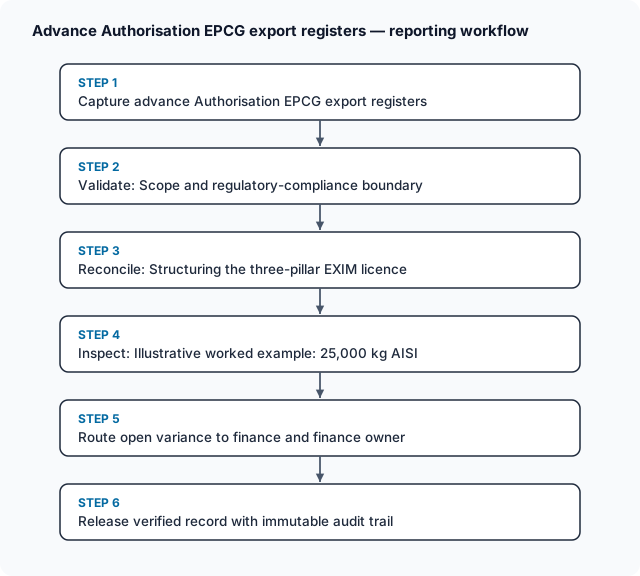
Bounded export oriented unit software verification and exception-routing workflow
Follow the workflow below, or open its complete text version.
Read the complete workflow as text
- Capture export oriented unit softwar baseline record → Verify revision, unit Basis and cutoff alignment
- Verify revision, unit Basis and cutoff alignment → Run deterministic reconciliation and tolerance check
- Run deterministic reconciliation and tolerance check → Quarantine mismatched or unapproved lines
- Quarantine mismatched or unapproved lines → Route exception to named domain and finance owner
- Route exception to named domain and finance owner → Release verified record with immutable audit trail
Structuring the three-pillar EXIM licence and BOM wastage engine
1. Actual-User batch quarantine and Dual-BOM wastage math (SION vs. Shop Actual).
When raw material is imported duty-free under an Advance Authorisation licence $L$, the licence specifies both a Maximum Import Quantity ($M_{\text{import_cap}}$) and a Normative Input-Output Ratio ($r_{\text{SION}}$) per unit of exported finished good (FG): $$r_{\text{SION}} = m_{\text{net_FG}} \times \left(1 + w_{\text{SION}}\right)$$ where $m_{\text{net_FG}}$ is the net weight of the finished export item and $w_{\text{SION}}$ is the maximum allowable wastage percentage over net weight permitted by the DGFT SION (or Norms Committee Ad-hoc ruling).
In the ERP, every export batch $b$ of quantity $N_{\text{export}, b}$ must compute two distinct consumption figures:
- SION Eligible Duty-Free Consumption ($Q_{\text{SION}, b}$)—the maximum quantity that can be legally written off in the Appendix-4H Consumption Register: $$Q_{\text{SION}, b} = N_{\text{export}, b} \times r_{\text{SION}}$$
- Actual Shop-Floor Consumption ($Q_{\text{actual}, b}$)—the physical raw material issued from
WH-DUTY-FREE-AAafter accounting for bar-end remnants, setup scrap, and turning swarf: $$\Delta Q_{\text{excess_scrap}, b} = \max\left(0,; Q_{\text{actual}, b} - Q_{\text{SION}, b}\right)$$ If $\Delta Q_{\text{excess_scrap}, b} over 0$, the plant cannot pretend that extra $690\text{ kg}$ is still sitting in the warehouse! The ERP moves $\Delta Q_{\text{excess_scrap}, b}$ out of the eligible EODC write-off column and calculates the exact Pro-Rata Customs Duty Foregone ($\Delta Q_{\text{excess_scrap}} \times d_{\text{unit}}$) plus statutory interest required to regularize the shortfall.
2. Value Addition ($\text{VA} \ge 15%$) and the 4-way EODC redemption chain.
Under DGFT FTP Chapter 4, an Advance Authorisation must achieve a minimum positive Value Addition ($\text{VA}$) (standard minimum $\text{VA} \ge 15.0%$, or higher for specified sectors): $$\text{VA}% = \left(\frac{A - B}{B}\right) \times 100 \ge \text{VA}{\min}%$$ where $A$ is the realized FOB Value of Exports (backed by electronic Bank Realisation Certificates, e-BRC) and $B$ is the CIF Value of Duty-Free Inputs actually consumed (plus any foreign commission/royalty). An export invoice may only increment $A$ and credit $Q{\text{SION}}$ when all four links are verified in the ERP:
BoE_Numberlinked toAA_Licence_ID- Batch genealogical link from
BoElot $\rightarrow$ Manufacturing Work Order $\rightarrow$ Finished Goods Lot - Export
Shipping_Bill_Numbercarrying the exactAA_Licence_IDand scheme code on ICEGATE (LEODate recorded) - Bank
e-BRC_Numberconfirming foreign-exchange realization in convertible currency.
3. EPCG Capital Goods dual obligation tracker (AEO + 6x Duty Saved across 2 Blocks). When a plant imports CNC machinery, cleanroom HVAC, or testing equipment under an EPCG Licence, the ERP Asset record must track two simultaneous obligations over a 6-year window:
- Annual Average Export Obligation ($\text{AEO}$): The company's baseline 3-year historical average export turnover of the same/similar products, which must be maintained every year before exports count toward the new machine's specific obligation.
- Specific Export Obligation ($\text{SEO} = 6 \times \text{Total Duty Saved}$):
- Block 1 (Years 1 to 4 from licence issue): Must fulfill a minimum of $50.0%$ of $\text{SEO}$ ($3 \times \text{Duty Saved}$).
- Block 2 (Years 5 to 6): Must fulfill the remaining $50.0%$ of $\text{SEO}$ ($100.0%$ cumulative).
under div over under table over under thead over under tr over under th over EXIM Control Gate under /th over under th over Statutory / Scheme Rule under /th over under th over ERP System Record & Formula under /th over under th over Automated Interlock on Breach under /th over under /tr over under /thead over under tbody over under tr over under td over under strong over 1. Actual-User Stock Lock under /strong over under /td over under td over Duty-free inputs cannot be sold or used in domestic orders (FTP §4.16) under /td over under td over under code over Warehouse = WH-DUTY-FREE-AA under /code over linked to under code over BoE_Licence_ID under /code over under /td over under td over Hard-block under code over Stock Entry under /code over if target Work Order is not tied to an Export Sales Order under /td over under /tr over under tr over under td over under strong over 2. SION Wastage Cap under /strong over under /td over under td over Appendix-4H write-off capped at $Q_{\text{SION}} = N_{\text{exp}} \times r_{\text{SION}}$ under /td over under td over Compare $Q_{\text{actual}}$ issued vs $Q_{\text{SION}}$ eligible per Work Order under /td over under td over Isolate $\Delta Q_{\text{excess}} = Q_{\text{actual}} - Q_{\text{SION}}$ into under code over UNALLOWED_SCRAP_DUTY_DUE under /code over ledger under /td over under /tr over under tr over under td over under strong over 3. Shipping Bill Scheme Tag under /strong over under /td over under td over Export counts toward EODC only if licence # is endorsed on Shipping Bill under /td over under td over Pre-populate under code over AA_Licence_ID under /code over & under code over EPCG_Licence_ID under /code over on Commercial Export Invoice under /td over under td over Block dispatch release if CHA draft Shipping Bill omits active EXIM licence numbers under /td over under /tr over under tr over under td over under strong over 4. 18-Month EO Expiry & EPCG Block-1 under /strong over under /td over under td over AA Export Obligation window = $18\text{ months}$; EPCG Block-1 = $4\text{ years}$ ($50%$) under /td over under td over Countdown dashboard of unfulfilled $Q_{\text{EO}}$ and $\text{FOB}_{\text{EO}}$ vs days remaining under /td over under td over Fire 90-day advance alert for EO extension filing or voluntary duty regularization under /td over under /tr over under /tbody over under /table over under /div over
Illustrative worked example: 25,000 kg AISI 316L Advance Authorisation EPCG reconciliation
All figures below are illustrative and synthetic. An export engineering manufacturer holds:
- Advance Authorisation
AA-LIC-2026-091: Imports $25,000.0\text{ kg}$ of AISI 316L stainless-steel round bar on Bill of EntryBoE-884120at a CIF value of $$100,000.00$ ($$4.00/\text{kg}$), saving $27.50%$ customs duty ($=$27,500.00$ duty foregone, or $$1.10/\text{kg}$), with a contracted $25.0%$ Value Addition target ($\text{Minimum FOB Export Obligation} = $100,000 \times 1.25 = \mathbf{$125,000.00}$ across $13,021\text{ valves}$).- Exported Product (
FG-VALVE-316L): Net finished machined weight $m_{\text{net}} = 1.600\text{ kg/valve}$. - DGFT SION Wastage Norm ($w_{\text{SION}}$): $20.00%$ over net weight $\implies$ Maximum SION Eligible Input $r_{\text{SION}} = 1.600 \times 1.20 = \mathbf{1.920\text{ kg/valve}}$ ($0.320\text{ kg}$ allowed swarf).
- Exported Product (
- EPCG Licence
EPCG-2026-044: Imported a 5-axis CNC mill-turn center saving $$85,000.00$ in customs duty, creating a $6\times$ Specific Export Obligation ($\text{SEO}$) of $6 \times $85,000.00 = \mathbf{$510,000.00}$ over 6 years (Block 1 Years 1–4 minimum $50% = $255,000.00$).
Step 1: Reconcile SION eligible consumption vs. actual shop-floor swarf across 11,500 exported valves.
To date, the plant has manufactured, exported, and realized bank e-BRC proceeds on $N_{\text{exp}} = 11,500\text{ valves}$ at $$12.40/\text{valve}$ ($\text{Realized FOB} = \mathbf{$142,600.00}$):
- Net Finished Metal Exported: $11,500\text{ valves} \times 1.600\text{ kg/valve} = \mathbf{18,400.0\text{ kg}}$.
- Maximum SION Eligible Duty-Free Input ($Q_{\text{SION}}$ for Appendix-4H): $$Q_{\text{SION}} = 11,500\text{ valves} \times 1.920\text{ kg/valve} = \mathbf{22,080.0\text{ kg}}\quad (18,400.0\text{ kg net} + 3,680.0\text{ kg SION swarf})$$
- Actual Shop-Floor Consumption ($Q_{\text{actual}}$): Due to thicker bar-end chucking remnants on early batches, the shop actually consumed $1.980\text{ kg/valve}$ ($23.75%$ swarf over net): $$Q_{\text{actual}} = 11,500\text{ valves} \times 1.980\text{ kg/valve} = \mathbf{22,770.0\text{ kg}}\quad (18,400.0\text{ kg net} + 4,370.0\text{ kg actual swarf})$$
- Physical Closing Stock in
WH-DUTY-FREE-AA: $$Q_{\text{closing_phys}} = 25,000.0\text{ kg imported} - 22,770.0\text{ kg issued} = \mathbf{2,230.0\text{ kg remaining in warehouse}}$$
Step 2: Quantify the 690.0 kg excess-scrap duty clawback and remaining export requirement.
Comparing $Q_{\text{actual}}$ against $Q_{\text{SION}}$ exposes a critical compliance gap that a standard ERP inventory report misses: $$\Delta Q_{\text{excess_scrap}} = 22,770.0\text{ kg (actual)} - 22,080.0\text{ kg (SION cap)} = \mathbf{690.0\text{ kg of unallowed excess shop scrap}}$$ Because DGFT will only credit $22,080.0\text{ kg}$ for the $11,500\text{ valves}$ (leaving $25,000.0 - 22,080.0 = 2,920.0\text{ kg}$ unaccounted on the licence, whereas only $2,230.0\text{ kg}$ physically remains in stock), the $690.0\text{ kg}$ excess scrap carries an immediate Customs Duty Clawback Liability: $$\text{Excess Scrap Duty Liability} = 690.0\text{ kg} \times $1.10/\text{kg duty foregone} = \mathbf{$759.00}\quad (\text{plus statutory } 15%\text{ p.a. interest})$$
Scroll horizontally to see all columns.
Advance Authorisation AA-LIC-2026-091 Ledger Line |
Mass ($\text{kg}$ 316L Bar) | Valve Equivalent ($\text{pcs}$) | CIF / FOB Value ($$$) | Customs Duty Exposure ($$$ @ $27.5%$) | EXIM & Appendix-4H Audit Disposition |
|---|---|---|---|---|---|
1. Duty-Free Import (BoE-884120) |
$25,000.0\text{ kg}$ | $13,021\text{ pcs}$ (SION) | $$100,000.00\text{ CIF}$ | $$27,500.00$ (Saved) | Debited to AA-LIC-2026-091 in WH-DUTY-FREE-AA |
| 2. SION Eligible Write-Off ($11,500 \times 1.920\text{ kg}$) | $-22,080.0\text{ kg}$ | $11,500\text{ pcs}$ | $$142,600.00\text{ FOB}$ | $-$24,288.00$ (Discharged) | Cleared on Appendix-4H ($18,400\text{ kg net} + 3,680\text{ kg SION scrap}$) |
| 3. Unallowed Excess Shop Scrap ($1.980 - 1.920$) | $-690.0\text{ kg}$ | — | $$2,760.00\text{ CIF}$ | $$759.00\text{ DUE}$ | Disallowed above SION $20%$ cap; pay duty + interest |
| 4. Physical Closing Stock in Bonded Store | $2,230.0\text{ kg}$ | $1,161\text{ pcs}$ (SION) | $$8,920.00\text{ CIF}$ | $$2,453.00$ (Open EO) | Export $1,162\text{ more valves}$ within 18m window to clear |
Independent arithmetic verification.
- Mass balance conservation: $22,080.0\text{ kg (SION eligible)} + 690.0\text{ kg (excess shop scrap)} + 2,230.0\text{ kg (physical closing stock)} = 25,000.0\text{ kg total import}$.
- Customs duty conservation: $$24,288.00\text{ (discharged on }22,080\text{ kg)} + $759.00\text{ (clawback due on }690\text{ kg excess scrap)} + $2,453.00\text{ (open obligation on }2,230\text{ kg stock)} = $27,500.00\text{ total duty foregone}$ ($25,000 \times $1.10$).
- Value Addition check: Even though total realized FOB ($$142,600.00$) already exceeds the full licence $$125,000.00$ FOB floor ($\text{VA on consumed }22,080\text{ kg CIF } $88,320 = ($142,600 - $88,320)/$88,320 = +61.46%$), physical quantity accountability under Advance Authorisation still requires exporting the remaining $2,230.0\text{ kg}$ ($1,162\text{ valves}$) and paying duty on the $690.0\text{ kg}$ excess scrap.
Workflow, owner roles, exception handling and recovery controls
Scroll horizontally to see all columns.
| Workflow stage | Accountable owner | Required system evidence | Exception condition | System hold & recovery control |
|---|---|---|---|---|
| 1. Licence & SION BOM Registration | EXIM Manager & Cost Engineer | AA_Licence_ID, BoE CIF & duty saved, SION norm $r_{\text{SION}} = 1.920\text{ kg/pc}$ vs Shop BOM $1.980\text{ kg/pc}$ |
Engineering BOM gross input exceeds SION allowed input ($1.980 over 1.920\text{ kg}$) | Flag Structural SION Variance ($+0.060\text{ kg/pc}$) at licence creation; either apply to Norms Committee for Ad-hoc enhancement or accrue duty provision per batch |
| 2. Bonded Receipt & Kitting Lock | Stores Controller & ERP | Batch received into WH-DUTY-FREE-AA with ACTUAL_USER_EXPORT_ONLY: TRUE |
Planner attempts to allocate duty-free batch to a domestic Sales Order Work Order | Hard-block Stock Entry (ERR_DOMESTIC_DIVERSION_PROHIBITED); force pick from tax-paid domestic store |
| 3. Export Shipping Bill Endorsement | Export Logistics & CHA | Commercial Invoice + Draft Shipping Bill JSON/XML with AA_Licence_ID & EPCG_Licence_ID |
CHA files Shipping Bill under generic Duty Drawback without Advance Authorisation number | Block Factory Gate-Out / e-Way Bill generation until draft Shipping Bill XML confirms licence endorsement |
| 4. Bank e-BRC & Appendix-4H Match | Trade Finance & Treasury | Realized e-BRC number, realized FOB in USD/INR, 4-way matched Appendix-4H line |
Export shipped 180 days ago still lacks realized e-BRC from AD Bank |
Trigger 150-day RBI/DGFT realization alert; hold EODC application packet until e-BRC is reconciled |
| 5. EODC Redemption & Bond Cancellation | EXIM Compliance Lead & Chartered Accountant | Reconciled Appendix-4H register, excess-scrap TR-6/e-Challan duty receipt ($$759.00$), e-BRC bundle |
Unfulfilled balance or unallowed scrap remains at Month 16 of 18-month EO window | Compute exact voluntary regularization duty + $15%$ interest worksheet (690 kg) or file 6-month EO extension prior to expiry |
Bounded pilot and implementation check
Pilot the Advance Authorisation Appendix-4H sub-ledger and EPCG obligation tracker across 1 active Advance Authorisation licence and 1 EPCG capital machinery licence over 4 weeks:
- Pilot boundary: Configure
WH-DUTY-FREE-AAdomestic-diversion locks, linkBoEbatches to export Work Orders, run the Dual-BOM SION-vs-Actual scrap comparison, and reconcile Shipping Bills to banke-BRCrecords. - Acceptance tests:
ACT-M125-01(Domestic Diversion Hard-Block): Attempt to issue $50\text{ kg}$ ofBoE-884120duty-free 316L bar to a domestic Work Order; confirm the ERP blocks the transaction.ACT-M125-02(SION vs Actual Excess Scrap Calculation): Post production of $11,500\text{ valves}$ consuming $22,770.0\text{ kg}$ against a $1.920\text{ kg/pc}$ SION cap; confirm the report splits $22,080.0\text{ kg}$ to Appendix-4H eligible write-off and $690.0\text{ kg}$ ($$759.00$ duty exposure) toUNALLOWED_SCRAP_DUTY_DUE.ACT-M125-03(Shipping Bill Licence Endorsement Gate): Attempt to mark an export shipment asEO_ELIGIBLEwhen either theShipping_Bill_Licence_Noore_BRC_Nofield is blank; confirm the system holds the shipment inPENDING_REALIZATION.ACT-M125-04(EPCG Block-1 50% Progress Alert): Load the $$510,000.00$ EPCG obligation fixture and verify the dashboard tracks AEO maintenance first before crediting surplus exports toward the $$255,000.00$ Block-1 milestone.
Next actions
- Isolate duty-free Advance Authorisation batches in a locked ERP warehouse (
WH-DUTY-FREE-AA): Never co-mingle duty-exempt imports with domestic tax-paid raw materials without an automated system block against domestic work-order consumption. - Track both
SION Eligible ConsumptionandActual Shop Consumptionon every export batch: If your CNC shop loses $23.75%$ in swarf while SION allows $20.00%$, accrue the customs duty on the $3.75%$ excess scrap monthly instead of facing a penalty notice during EODC audit. - Mandate pre-shipment verification of Advance Authorisation + EPCG licence numbers on the draft Shipping Bill: Omitting a licence number on the customs Shipping Bill permanently disqualifies that shipment from EODC discharge.
- Automate the 4-way match (
BoE - over Work Order Batch - over Shipping Bill - over Bank e-BRC): Generate your Chartered Accountant's Appendix-4H consumption register directly from reconciled ERP batch genealogy.
Frequently Asked Questions
How should exporting manufacturers reconcile duty-free imported raw material consumption, SION/normative scrap wastage norms, and export-shipping-bill fulfilment registers?.
Teams should govern export oriented unit software by linking every transaction to its source evidence, timestamp, and assigned owner before permitting downstream posting. Distinct from L096 (port customs brokerage); M125 governs factory-level BOM duty-exemption registers (Advance Authorisation / bonded manufacturing), linking imported lot consumption to exported FG serials/batches and accounting for recoverable scrap duty. Rather than relying on informal spreadsheet overrides, the workflow enforces a documented verification gate and preserves the original observation whenever a correction is recorded.
How does exim management software handle exceptions and mismatches?.
When a discrepancy occurs during exim management software, the system routes the blocked record into an owned exception queue rather than silently dropping or auto-adjusting the balance. Assigned operational, quality, and finance owners must review and approve exceptions before posting. Each exception retains the original quantity, date, and counterparty reference until the designated reviewer resolves the variance with supporting evidence.
What should teams test before automating manufacturing compliance software?.
Before scaling manufacturing compliance software, run a bounded pilot using historical records that include partial receipts, late updates, duplicate messages, and rejected lines. Verify that the integration preserves idempotency, maintains a clear segregation of duties between operational entry and financial approval, and produces an auditable trail for every state transition.
Compare this workflow with your current setup
Share the step that takes the most manual work, the systems involved and the exceptions your team handles. That gives us a concrete starting point for comparing approaches.
Sources and further reading
Sources checked 15 October 2026. Worked examples and workflow diagrams are original illustrations, not reported client results.
