Sheet-metal nesting records: allocate multi-job skeleton scrap and serialized remnant offcuts in ERP
For production managers, planners and plant leaders · Compare approaches
TL;DR — what you’ll learn
- Separate reusable rectangular/DXF remnants (REMNANT_SUBPLATE) from non-reusable perforated skeleton and kerf scrap (SKELETON_SCRAP) before allocating nested plate consumption across customer work orders.
- Deduct the exact area and mass of any shear-cropped reusable remnant first, returning it to ERP inventory as a serialized child batch that inherits the parent plates Mill Test Report (MTR) heat number, material grade, and thickness.
- Allocate the remaining consumed plate mass (net finished parts plus skeleton web and hole-slug scrap) across all work orders sharing the 2D CAD/CAM nest using a consistent net-part-area or true-shape bounding-box allocation factor rather than charging 100% of the skeleton to the first work order on the sheet.
- Enforce minimum remnant dimension and shape rules at the laser/plasma unloading table so irregular Swiss-cheese skeletons are weighed directly into scrap bins instead of polluting ERP stock with unusable phantom remnants.

Illustrative manufacturing inspection room and machine shop floor; not a client facility.
In laser, high-definition plasma, waterjet, and turret-punch fabrication shops, dynamic 2D CAD/CAM nesting software routinely combines parts from three to ten different customer work orders onto a single master steel or aluminium plate to maximize sheet utilization. However, standard single-order ERP production entries struggle with two realities of multi-job nesting: how to split the shared skeleton web and internal hole-slug scrap fairly across the participating work orders, and how to return a clean $600\text{ mm} \times 1,500\text{ mm}$ unused end-crop back to inventory without losing its mill heat number or double-charging the next customer. Distinct from M025 (continuous 1D coil slitting width optimization), this guide (M107) governs 2D multi-job sheet-metal nest cost/mass allocation, skeleton scrap reconciliation, and serialized remnant offcut inventory control.
Scope and standards boundary
This article specifies the CAD/CAM-to-ERP nest execution, material valuation, and heat-traceability record architecture for sheet and plate fabricators:
- What this workflow governs: Ingesting post-cut CAD/CAM nest manifests into ERP, splitting master-plate mass into (a) returned reusable remnants, (b) net finished part weights per work order, and (c) allocated skeleton/kerf scrap, and preserving parent-to-remnant heat traceability.
- What this workflow does not replace: It does not prescribe laser resonator wattage, assist-gas pressure, or structural engineering design. Plate traceability, thermal cut geometry, and inventory valuation should align with ASTM A6 / A6M and A480 / A480M (Plate Mill Heat Traceability & Mass Calculation), ISO 9013 (Thermal Cutting Geometrical Product Specification), and IAS 2 (Inventories — Cost of Conversion and Scrap Allocation).
Bounded sheet metal remnant nesting erp verification and exception-routing workflow
Follow the workflow below, or open its complete text version.
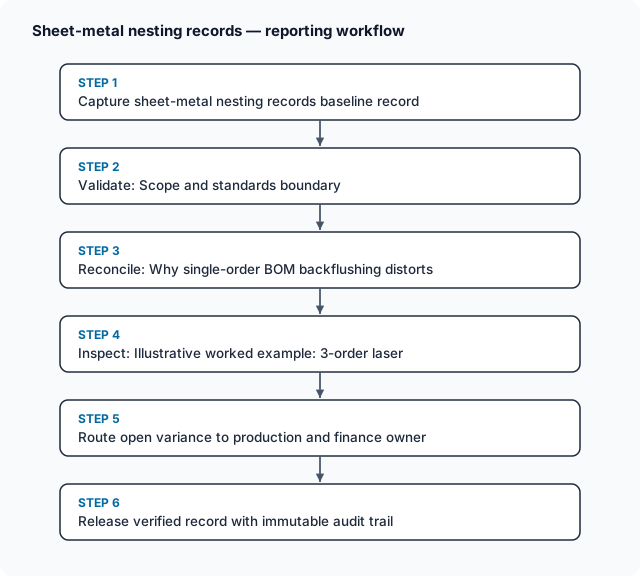
Read the complete workflow as text
- Capture sheet metal remnant nesting baseline record → Verify revision, unit Basis and cutoff alignment
- Verify revision, unit Basis and cutoff alignment → Run deterministic reconciliation and tolerance check
- Run deterministic reconciliation and tolerance check → Quarantine mismatched or unapproved lines
- Quarantine mismatched or unapproved lines → Route exception to named domain and finance owner
- Route exception to named domain and finance owner → Release verified record with immutable audit trail
Why single-order BOM backflushing distorts sheet-metal job costing and inventory?
When a fabricator runs a shared nest (NEST-2026-441) containing parts for three different customer orders (WO-101, WO-102, WO-103) on one $1,500\text{ mm} \times 3,000\text{ mm}$ plate, standard BOM backflushing creates three severe accounting and shop-floor errors:
- First-Job Skeleton Penalty or Theoretical-Only Under-Consumption:
If the operator issues the entire $353.25\text{ kg}$ plate to
WO-101,WO-101absorbs 100% of the skeleton scrap whileWO-102andWO-103show zero raw-material cost. Conversely, if each work order backflushes only its theoretical net CAD part weight ($220.00\text{ kg}$ total), $62.60\text{ kg}$ of skeleton scrap disappears from consumption—leaving phantom steel on the ERP stock ledger until the annual physical count write-off. - Unusable "Phantom Remnants" Clogging the Rack: If CAM programmers mark every irregular L-shaped corner web as a "reusable remnant" to boost software utilization scores, the ERP shows $14\text{ tonnes}$ of available steel while laser operators refuse to load warped, irregular offcuts—forcing urgent full-sheet purchases.
- Broken Mill Test Report (MTR) Heat Genealogy:
Under ASTM A6 / A6M and pressure/structural fabrication codes (
M114), every cut part and every returned remnant sub-plate must retain the parent plate's Heat Number and Mill Certificate ID. Returning an unmarked offcut to a genericREMNANT-10MMbin strips its certifiability for structural orders.
To resolve all three issues using standard ERP multi-item stock entries (such as ERPNext Repack and Multi-Order Manufacture Stock Entries), enforce a two-step conservation-of-mass rule on every executed nest ID:
$$\text{Master Plate Mass } (M_{\text{plate}}) = M_{\text{remnant_returned}} + M_{\text{consumed_zone}}$$
$$M_{\text{consumed_zone}} = \sum_{i=1}^{k} M_{\text{net_parts}, i} + M_{\text{skeleton_plus_kerf}}$$
For each work order $i \in {1 \dots k}$ on the nest, its allocated gross consumed mass ($M_{\text{alloc}, i}$) and allocated skeleton share ($M_{\text{skel}, i}$) are:
$$M_{\text{alloc}, i} = M_{\text{net_parts}, i} \times \left(\frac{M_{\text{consumed_zone}}}{\sum_{j=1}^{k} M_{\text{net_parts}, j}}\right), \qquad M_{\text{skel}, i} = M_{\text{alloc}, i} - M_{\text{net_parts}, i}$$
(Note: Where a part has large internal cutouts that are not back-nested with smaller parts, the CAM system can substitute each part's true outer contour / bounding-box area in the allocation weight so hollow rings pay for their unnested internal slugs.)
Scroll horizontally to see all columns.
| Plate Mass Component | ERP Inventory Treatment | Valuation & Costing Rule (IAS 2) | Traceability Requirement |
|---|---|---|---|
1. Reusable Remnant (REM-ID) |
Returned to REMNANT-STOCK as serialized child batch |
Valued at parent plate's exact $$/\text{kg}$ rate $\times M_{\text{remnant}}$ | Hard-stencil/barcode REM-ID + parent HEAT_NO before unloading laser table |
| 2. Net Finished Parts ($M_{\text{net}, i}$) | Absorbed into Work Order $i$ WIP / Finished Goods | Direct material weight of cut geometry | Link NEST_ID and parent HEAT_NO to work-order traveler |
| 3. Skeleton, Hole Slugs & Kerf ($M_{\text{skel}, i}$) | Charged to Work Order $i$; physical skeleton moved to SCRAP-STEEL-BIN |
Gross consumed cost allocated to WO $i$ minus scrap recovery credit | Reconcile monthly weighed scrap-bin pickups against cumulative $M_{\text{skel}}$ |
Illustrative worked example: 3-order laser nest allocation and serialized remnant return
Illustrative sheet-metal fabrication scenario using synthetic figures to demonstrate nest mass-balance and cost-allocation arithmetic; not a client case study.
A laser job shop executes nested program NEST-2026-441 on a $6\text{ kW}$ fiber laser using one master plate of $10.0\text{ mm}$ S355JR structural steel (PLATE-LOT-884, Heat #H99204, dimensions $1,500\text{ mm} \times 3,000\text{ mm}$, cost $$1.10/\text{kg}$).
Step 1: Compute master plate mass, reusable remnant return, and net consumed zone.
- Master plate gross mass ($M_{\text{plate}}$, at steel density $\rho = 7,850\text{ kg/m}^3$): $$M_{\text{plate}} = 1.50\text{ m} \times 3.00\text{ m} \times 0.010\text{ m} \times 7,850\text{ kg/m}^3 = 353.25\text{ kg};(\text{Total plate cost} = $388.58)$$
- Reusable rectangular remnant cropped by the laser (
REM-884-A): The nest occupies the first $2,400\text{ mm}$ of sheet length and executes a clean guillotine laser crop across the width at $X = 2,400\text{ mm}$, leaving a rectangular $1,500\text{ mm} \times 600\text{ mm}$ remnant ($0.90\text{ m}^2$, clearing the shop's minimum reusable remnant rule of $\ge 400\text{ mm} \times 400\text{ mm}$): $$M_{\text{remnant}} = 1.50\text{ m} \times 0.60\text{ m} \times 0.010\text{ m} \times 7,850\text{ kg/m}^3 = 70.65\text{ kg};(20.00%\text{ of master plate})$$REM-884-Ais laser-etched with Heat#H99204, tagged with a barcode label, and returned to ERP inventory at $70.65\text{ kg} \times $1.10/\text{kg} = $77.72$. - Net consumed plate zone ($M_{\text{consumed_zone}}$, covering $1,500\text{ mm} \times 2,400\text{ mm} = 3.60\text{ m}^2$): $$M_{\text{consumed_zone}} = 353.25\text{ kg} - 70.65\text{ kg} = 282.60\text{ kg};(\text{Consumed material cost} = $310.86)$$
Step 2: Allocate consumed plate mass and skeleton scrap across the 3 nested work orders.
The $282.60\text{ kg}$ consumed zone produces finished parts for three distinct work orders:
WO-101(Base Gussets, 20 pcs): Net CAD part mass = $104.50\text{ kg}$WO-102(Motor Brackets, 15 pcs): Net CAD part mass = $68.30\text{ kg}$WO-103(Stiffener Rib Plates, 30 pcs): Net CAD part mass = $47.20\text{ kg}$
$$\text{Total Net Part Mass } \left(\sum M_{\text{net}}\right) = 104.50 + 68.30 + 47.20 = 220.00\text{ kg};\left(\text{Net Consumed Utilization} = \frac{220.00}{282.60} = 77.85%\right)$$
$$\text{Total Skeleton Web, Slugs & Laser Kerf Loss } (M_{\text{skel_total}}) = 282.60\text{ kg} - 220.00\text{ kg} = 62.60\text{ kg};(22.15%)$$
$$\text{Gross-to-Net Consumption Multiplier} = \frac{282.60\text{ kg}}{220.00\text{ kg}} = 1.284545$$
Applying the $1.284545$ multiplier allocates the exact $282.60\text{ kg}$ consumed zone across the three work orders:
Scroll horizontally to see all columns.
| Work Order / Disposition | Net CAD Part Mass ($\text{kg}$) | Net Share of Parts ($%$) | Allocated Skeleton & Kerf ($\text{kg}$) | Gross Charged Steel ($\text{kg}$) | Gross Material Cost at $$1.10/\text{kg}$ |
|---|---|---|---|---|---|
WO-101 (20 Gussets) |
$104.50\text{ kg}$ | $47.50%$ | $29.74\text{ kg}$ | $134.24\text{ kg}$ | $$147.66$ |
WO-102 (15 Brackets) |
$68.30\text{ kg}$ | $31.05%$ | $19.43\text{ kg}$ | $87.73\text{ kg}$ | $$96.50$ |
WO-103 (30 Ribs) |
$47.20\text{ kg}$ | $21.45%$ | $13.43\text{ kg}$ | $60.63\text{ kg}$ | $$66.70$ |
| Consumed Zone Subtotal | $220.00\text{ kg}$ | $100.00%$ | $62.60\text{ kg}$ | $282.60\text{ kg}$ | $$310.86$ |
Returned Remnant REM-884-A |
— | — | — | $70.65\text{ kg}$ | $$77.72$ (Inventory Asset) |
| Total Master Plate Tie-Out | $220.00\text{ kg}$ | — | $62.60\text{ kg}$ | $353.25\text{ kg}$ | $$388.58$ |
(Verification: $134.24 + 87.73 + 60.63 = 282.60\text{ kg}$ consumed; $282.60 + 70.65 = 353.25\text{ kg}$ master plate; skeleton shares $29.74 + 19.43 + 13.43 = 62.60\text{ kg}$.)
Workflow, owner roles, exceptions, and recovery controls
Scroll horizontally to see all columns.
| Workflow Stage | Accountable Owner | Required System Evidence | Exception Trigger | Recovery & Escalation Control |
|---|---|---|---|---|
| 1. CAM Nest Release & Remnant Priority | CAD/CAM Nesting Programmer | NEST_ID XML/JSON manifest, nested part list, remnant crop geometry |
Programmer creates full-plate nest when a compatible certified remnant (REM-ID) already exists in stock |
CAM/ERP rule checks active remnant bin by grade/thickness first; require supervisor override to skip aged remnants |
| 2. Laser Cut & Remnant Etching | Laser / Plasma Operator | Scanned parent plate batch (PLATE-LOT-884), laser-etched REM-ID + HEAT_NO on cropped offcut |
Offcut smaller than minimum shop rule ($ under 400\text{ mm} \times 400\text{ mm}$) or warped by thermal stress | Reclassify small/warped offcut as SKELETON_SCRAP; do not create a stock remnant batch |
| 3. Part Unloading & Cut-Scrap Handling | Material Handler & QA | Part count per WO + scrap replacement request if thermal tip-up ruins 1 part | Laser head collision or dross ruins 2 brackets on WO-102 |
Log defective parts against WO-102 scrap reason; cut replacement parts from REM-884-A via child nest rather than editing original nest weights |
| 4. Monthly Scrap Bin Weigh-Out | Warehouse & Cost Accountant | Accumulated ERP skeleton ledger ($M_{\text{skel}}$) vs scrap dealer weighbridge tickets | Weighed scrap pickup differs $ over \pm 6.0%$ from ERP accumulated skeleton + kerf allowance | Audit whether unrecorded remnants were thrown into scrap bins or full plates were cut without posting nest completions |
Bounded pilot and implementation check
Validate multi-job nest allocation and serialized remnant tracking on one laser or plasma cutting table over 3 weeks:
- Pilot boundary: Connect the CAM nesting post-processor output (
NEST_ID, parent plate batch, net part masses per work order, and cropped remnant dimensions) to ERP multi-order stock entries for two high-volume thicknesses (e.g., $6\text{ mm}$ and $10\text{ mm}$ carbon/stainless steel). - Baseline capture: Count all physical offcuts currently leaning in shop racks without barcode/heat tags, and measure the variance between theoretical BOM sheet usage and actual steel purchases over the prior 2 months.
- Acceptance criteria: 100% of executed multi-job nests reconcile $M_{\text{plate}} = M_{\text{remnant}} + \sum M_{\text{net}, i} + \sum M_{\text{skel}, i}$ to within $0.1\text{ kg}$; 100% of returned remnants carry laser-etched heat numbers and barcode rack locations; physical remnant rack audit matches ERP
REMNANT-STOCK100%. - Stop condition: If irregular non-rectangular remnants slow down table loading, restrict
REMNANT-STOCKeligibility strictly to full-width straight guillotine crops and scrap all L-shaped skeletons immediately.
Recommended next actions.
- Enforce a strict minimum rectangular size rule for reusable remnants: Only book clean, straight-cropped offcuts (e.g., $\ge 400\text{ mm}$ length across full or half sheet width) into
REMNANT-STOCK; route all perforated skeletons directly toSKELETON_SCRAP. - Laser-etch the parent Heat Number and new
REM-IDonto every remnant before table unload: Preserve ASTM A6 / A6M Mill Test Report genealogy before the cropped sub-plate leaves the cutting bed. - Import CAM nest manifests to allocate consumed plate mass across all participating work orders: Deduct the returned remnant first, then distribute net part weight plus proportional skeleton scrap across every work order on the sheet.
- Prioritize aged remnants in daily CAM nesting queues: Configure your nesting workflow to consume compatible
REMNANT-STOCKsub-plates before piercing a fresh master plate.
Frequently Asked Questions
How should laser/plasma sheet-metal fabricators allocate master-sheet consumption, reusable remnant offcut tags, and skeleton-scrap weight across multi-job nested layouts?.
Teams should govern sheet metal remnant nesting erp by linking every transaction to its source evidence, timestamp, and assigned owner before permitting downstream posting. Distinct from M025 (coil slitting width optimization); M107 governs 2D multi-part laser/punch nesting where components from 5 different customer work orders share one plate, requiring true part-area vs skeleton allocation and serialized remnant-plate return to stock. Rather than relying on informal spreadsheet overrides, the workflow enforces a documented verification gate and preserves the original observation whenever a correction is recorded.
How does metal fabrication erp handle exceptions and mismatches?.
When a discrepancy occurs during metal fabrication erp, the system routes the blocked record into an owned exception queue rather than silently dropping or auto-adjusting the balance. Assigned operational, quality, and finance owners must review and approve exceptions before posting. Each exception retains the original quantity, date, and counterparty reference until the designated reviewer resolves the variance with supporting evidence.
What should teams test before automating remnant inventory management?.
Before scaling remnant inventory management, run a bounded pilot using historical records that include partial receipts, late updates, duplicate messages, and rejected lines. Verify that the integration preserves idempotency, maintains a clear segregation of duties between operational entry and financial approval, and produces an auditable trail for every state transition.
Compare this workflow with your current setup
Share the step that takes the most manual work, the systems involved and the exceptions your team handles. That gives us a concrete starting point for comparing approaches.
Sources and further reading
Sources checked 15 October 2026. Worked examples and workflow diagrams are original illustrations, not reported client results.

