Keep chemical safety documents tied to current materials and locations
For production managers, planners and plant leaders · Compare approaches
TL;DR — what you’ll learn
- Do not link Safety Data Sheets (SDS) solely to a generic internal ERP item number; bind every approved safety document to the composite key of Internal Material Code + Supplier ID + Manufacturer Trade Designation + SDS Revision Date + Active Storage/Point-of-Use Location.
- Maintain simultaneous active SDS linkages during mixed-stock transition windows when a supplier reformulates a chemical or updates its trade designation while drums of the earlier formulation remain in factory stores or line-side cabinets.
- Route every incoming supplier SDS revision or new trade-name receipt into an explicit EHS review queue before goods-receipt release; never allow optical character recognition (OCR) or generative AI tools to invent exposure limits, personal protective equipment (PPE) rules, or storage compatibility matrices.
- In an illustrative 48-container chemical register audit across Paint Shop LOC-PNT-02 and Flammable Store LOC-FLM-01, separating legacy Xylene-Blend-2024 (SDS-REV-03, flash point 27.0°C) from reformulated SolvoClean-X2 (SDS-REV-04, flash point 21.5°C) across 18 active containers closes a 37.50% container-to-document mismatch and ensures offline emergency access at every work cell.

Illustrative manufacturing inspection room and machine shop floor; not a client facility.
When a line operator, maintenance technician, or plant emergency responder looks up a solvent, resin, or pickling acid at a workstation, searching an intranet folder of PDF files by generic material name often returns the wrong document. Purchasing may have switched from one chemical vendor to another under the same internal ERP consumable code; a supplier may have issued a reformulated product with a lower flash point or changed sensitiser classification while drums from the previous delivery still sit in line-side dispensing cabinets; or an unreviewed PDF emailed by a distributor may have been uploaded without checking whether the plant's local exhaust ventilation and PPE controls match the revised document.
The core operational decision for environment, health, and safety (EHS), materials management, and quality teams is to govern a lot- and location-aware factory chemical register that links every physical container in stores and on the shop floor to the exact EHS-approved Safety Data Sheet (SDS) and local workplace safety card governing that specific supplier, trade designation, and formulation revision. Where product identity is uncertain or a supplier revision has not yet been reviewed by a competent EHS specialist, the system must flag the lot as Unverified SDS — Hold Issue and escalate to EHS rather than guessing handling limits.
Why generic item-level PDF folders fail on the factory floor
Most ERP systems treat indirect process chemicals—such as degreasers, mould-release agents, welding fluxes, hydraulic fluids, and touch-up coatings—as interchangeable catalogue items under a single internal part number (for example, CHEM-SOLV-014: Industrial Degreasing Solvent). Attaching a single SDS PDF to CHEM-SOLV-014 breaks down across three real-world factory conditions:
- Multi-sourcing under one internal ERP part number: If Vendor A supplies a hydrocarbon blend containing n-hexane while Vendor B supplies a modified alcohol-ester blend under the same internal purchasing code
CHEM-SOLV-014, the two products have completely different hazardous decomposition products, occupational exposure limits, and fire-extinguishing media. Storing only one PDF per ERP item code guarantees that at least one supplier's stock is misrepresented. - Supplier reformulation while legacy stock remains on the floor: When a manufacturer updates a product's formulation (often indicated by a suffix change such as
Series 400toSeries 400-Nor a new SDS revision date) and ships it against an existing purchase order, simply overwriting the old SDS PDF in the document portal orphans the legacy drums still open at paint booths or dip tanks. Conversely, failing to register the new revision leaves operators unaware of tightened hazard controls on the newly received batch. - Network outages during chemical spill or first-aid emergencies: If the approved SDS and emergency response instructions exist only inside a cloud document portal that requires an active login and network connection, shift teams cannot retrieve first-aid or spill-containment instructions if Wi-Fi drops or a responder does not hold an ERP user licence.
Process-safety guidance such as the UK Health and Safety Executive (HSE) HSG250 guidance on operating procedures for chemical and allied industries emphasises that operational safety documents must accurately reflect actual plant substances and remain immediately accessible to operators at the point of use. Within India, factory management must verify compliance with applicable statutory chemical-safety, hazardous-process, and worker-information rules, including transition and state-rule provisions under the Ministry of Labour and Employment announcement on the four Labour Codes implemented from 21 November 2025. Software document control supports internal traceability; a qualified local EHS specialist must review and approve all hazard classifications, storage segregation rules, and workplace safety instructions.
Data model for lot-, supplier-, and location-specific SDS control
To eliminate ambiguity between purchasing catalogues, warehouse bins, and shop-floor workstations, the chemical document register must separate the internal ERP material master from the Manufacturer Product & SDS Revision Record:
Scroll horizontally to see all columns.
| Control layer | Primary key / identifier | Mandatory attributes tracked | Location & lot binding | Governance & exception rule |
|---|---|---|---|---|
| 1. Internal ERP Material Class | ERP_Item_ID (e.g., CHEM-SOLV-108) |
Engineering/purchasing specification, unit of measure, general procurement category | Links to approved vendor list (AVL) |
Cannot hold a single blanket SDS if multiple manufacturers or trade formulations are approved |
| 2. Manufacturer Product & SDS Revision | SDS_Record_ID (Supplier_ID + Trade_Designation + SDS_Rev_Date) |
Exact product trade name on container label, manufacturer name, SDS revision number & date, language, cryptographic PDF hash (SHA-256), EHS reviewer ID & approval date |
Bound to specific received lot numbers (GRN_Lot_ID) at goods receipt |
Any change in trade designation or SDS revision date triggers PENDING_EHS_REVIEW and blocks automatic lot release |
| 3. Point-of-Use Location Register | Location_ID + Active_Lot_ID |
Physical storage zone or workstation (LOC-FLM-01, LOC-PNT-02), current container count, active SDS_Record_ID(s), local offline cache sync timestamp |
Updated automatically when a container barcode is scanned into or out of a store or line-side cabinet | If both old and new revisions are physically present in a location, the location register displays both active SDS records distinguished by container label and lot ID |
| 4. Emergency & Offline Access Pack | Offline_Sync_Pack_ID |
Synchronised local read-only PDF cache on shop-floor kiosk/tablet + printed QR-linked workplace safety card at cabinet | Verified weekly against active Location_ID inventory |
Accessible in zero-login emergency kiosk mode; stale cache older than 24 hours raises an EHS alert |
Chemical safety document revision, lot binding, and location availability workflow
Follow the workflow below, or open its complete text version.
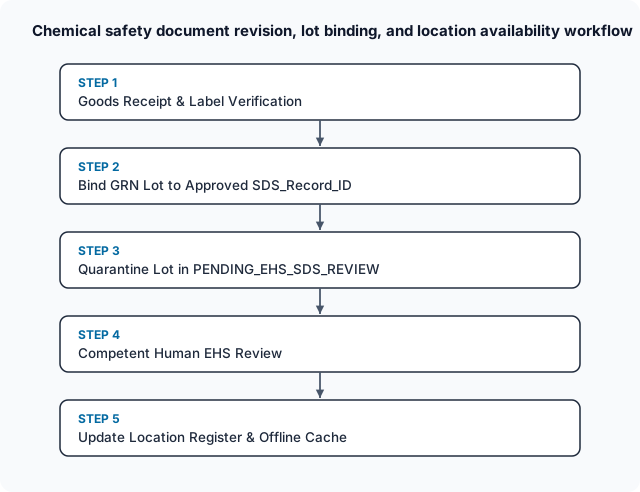
Read the complete workflow as text
- Goods Receipt & Label Verification → Bind GRN Lot to Approved SDS_Record_ID
- Bind GRN Lot to Approved SDS_Record_ID → Quarantine Lot in PENDING_EHS_SDS_REVIEW
- Quarantine Lot in PENDING_EHS_SDS_REVIEW → Competent Human EHS Review
- Competent Human EHS Review → Update Location Register & Offline Cache
Worked example: Managing a supplier solvent transition across 48 containers in two locations
All material codes, trade names, flash points, and location counts below are illustrative examples constructed to show how a lot- and location-linked chemical register prevents document mismatches during a supplier product transition.
Suppose an industrial equipment plant uses an aromatic-ester cleaning and thinning solvent under internal ERP item code CHEM-SOLV-108 across two physical areas: Central Flammable Store LOC-FLM-01 and Paint Preparation Cell LOC-PNT-02.
1. The supplier transition and mixed-stock problem
Until October 2026, Approved Supplier SUP-CHEM-04 supplied the material under trade designation Xylene-Blend-2024, governed by EHS-approved document SDS-108-R3 (Revision Date 2024-06-15, closed-cup flash point 27.0°C, vapour respirator cartridge specification Organic Vapour Type A).
On 18 October 2026, SUP-CHEM-04 delivers 20 new 20-litre drums (Lot GRN-2026-1018, 400.0 litres total) against open purchase order PO-2026-4410. Because of an upstream raw-material change, the supplier has updated the product designation on the drum labels to SolvoClean-X2 and enclosed a revised Safety Data Sheet (SDS-108-R4, Revision Date 2026-09-30) showing a higher low-boiling ester fraction, a lower closed-cup flash point of 21.5°C (down by 5.5°C), and an updated glove permeation requirement (Butyl or PVA laminate instead of standard nitrile for prolonged contact).
At the moment Lot GRN-2026-1018 arrives, the plant still holds 28 containers (560.0 litres) of the earlier Xylene-Blend-2024 (Lot GRN-2026-0890), bringing the total plant inventory across both lots to 48 containers (960.0 litres):
- Central Flammable Store (
LOC-FLM-01):22 containers(440.0 L) of legacyXylene-Blend-2024(Lot GRN-2026-0890) +14 containers(280.0 L) of newSolvoClean-X2(Lot GRN-2026-1018) =36 containers(720.0 L). - Paint Preparation Cell (
LOC-PNT-02):6 containers(120.0 L) of legacyXylene-Blend-2024(Lot GRN-2026-0890) +4 containers(80.0 L) of newSolvoClean-X2(Lot GRN-2026-1018) +2 decanted secondary transfer cans(CAN-PNT-07andCAN-PNT-08,40.0 Ltotal) whose workplace labels listed onlyCHEM-SOLV-108without a lot number or trade designation =12 containers(240.0 L).
2. Quantifying the mismatch under a single-PDF item master vs lot-linked register
If the plant used a conventional item-level folder that either kept only SDS-108-R3 or overwrote it globally with SDS-108-R4, the error rate across the 48 containers would be severe:
- Failure Mode A (Failure to update
SDS-108-R3on receipt): All18 containersofSolvoClean-X2(14inLOC-FLM-01+4inLOC-PNT-02) plus the2ambiguous decanted cans (20containers total) would lack the approvedSDS-108-R4document:Unmatched or Unverified Container Share = (18 new-revision containers + 2 unlabelled decant cans) ÷ 48 total containers = 20 ÷ 48 = 41.67%Specifically,18 ÷ 48 = 37.50%of containers would be governed by an obsolete document that overstates the flash point (27.0°Cinstead of21.5°C) and lists the wrong glove material, while2 ÷ 48 = 4.17%have ambiguous identity. - Failure Mode B (Global overwrite of
SDS-108-R3withSDS-108-R4): Overwriting the item-level file orphans the28 containers(28 ÷ 48 = 58.33%) of legacyXylene-Blend-2024still in stock, causing container labels (Xylene-Blend-2024) to conflict with the displayed SDS title (SolvoClean-X2).
3. Reconciled lot-by-location chemical register table
Under the controlled workflow, receiving clerk RC-04 logs the trade-name and revision mismatch on Lot GRN-2026-1018 at the receiving dock, placing the 20 new drums into PENDING_EHS_SDS_REVIEW. Competent EHS specialist EHS-CHEM-02 reviews SDS-108-R4, verifies that Paint Cell LOC-PNT-02's Class I Division 1 / Zone 1 grounding and ventilation meet the 21.5°C flash-point requirement, updates the required glove issue at LOC-PNT-02 to butyl laminate, and approves SDS-108-R4 as a concurrent active record alongside SDS-108-R3 until Lot GRN-2026-0890 is fully consumed.
Simultaneously, the 2 unlabelled secondary cans (CAN-PNT-07, CAN-PNT-08) in LOC-PNT-02 are quarantined until the paint-shop supervisor verifies from the dispensing log that they were filled from Lot GRN-2026-0890 and applies compliant secondary workplace labels bearing Lot GRN-2026-0890 / Xylene-Blend-2024 / SDS-108-R3:
Scroll horizontally to see all columns.
| Location ID & area name | Internal ERP code | Active lot ID | Label trade designation | Container count (and volume) | Linked approved SDS record & rev date | Local offline kiosk & QR card status |
|---|---|---|---|---|---|---|
LOC-FLM-01 (Flammable Store) |
CHEM-SOLV-108 |
GRN-2026-0890 |
Xylene-Blend-2024 |
22 drums (440.0 L) |
SDS-108-R3 (2024-06-15, EHS approved) |
Synced (SHA-256 verified) |
LOC-FLM-01 (Flammable Store) |
CHEM-SOLV-108 |
GRN-2026-1018 |
SolvoClean-X2 |
14 drums (280.0 L) |
SDS-108-R4 (2026-09-30, EHS approved 2026-10-19) |
Synced (SHA-256 verified) |
LOC-PNT-02 (Paint Prep Cell) |
CHEM-SOLV-108 |
GRN-2026-0890 |
Xylene-Blend-2024 (original drums) |
6 drums (120.0 L) |
SDS-108-R3 (2024-06-15, EHS approved) |
Synced + Cabinet Card WC-108-R3 |
LOC-PNT-02 (Paint Prep Cell) |
CHEM-SOLV-108 |
GRN-2026-0890 |
Xylene-Blend-2024 (re-labelled cans CAN-PNT-07/08) |
2 cans (40.0 L) |
SDS-108-R3 (2024-06-15, EHS approved after lot trace) |
Synced + Secondary Label Applied |
LOC-PNT-02 (Paint Prep Cell) |
CHEM-SOLV-108 |
GRN-2026-1018 |
SolvoClean-X2 |
4 drums (80.0 L) |
SDS-108-R4 (2026-09-30, EHS approved 2026-10-19) |
Synced + Cabinet Card WC-108-R4 |
| Total Reconciled Register | — | 2 active lots | 2 active designations | 48 containers (960.0 L) |
48 / 48 containers (1.0000 match) linked to exact approved SDS |
Zero unresolved mappings |
Strictly bounding software and AI roles in chemical document control
Software automation can accelerate indexing and alerts, but it must never cross into safety engineering judgement:
- No AI-invented exposure limits, PPE rules, or storage compatibility: Optical character recognition (
OCR) or document-extraction scripts may pre-populate index metadata fields (such asSupplier Name,Document Revision Date, orCAS Numbers) into a draft EHS review queue, but the system must never use a language model to summarise first-aid procedures, infer occupational exposure limits, or auto-approve an SDS revision. Every workplace safety card and release approval requires a named human EHS reviewer. - Coordinate with quality release and system boundaries: For plants that manufacture or repackage chemical products, align incoming raw-material SDS control with outbound industrial chemical batch release records. Where a revised chemical hazard requires modifying ventilation interlocks or gas detectors on a process line, manage the hardware verification through machine safety defect and modification closure and keep document-master authority clearly separated across ERP, MES, QMS and PLM boundaries.
Observable acceptance tests for chemical safety document control
Validate these three acceptance tests before accepting a chemical register workflow into production:
ACT-M054-01(Goods-receipt quarantine on changed trade designation or SDS revision date): Attempt to post a goods receipt for an existing ERP item (CHEM-SOLV-108) where the entered supplier trade designation (SolvoClean-X2) or SDS revision date (2026-09-30) differs from the active approved record (Xylene-Blend-2024 / 2024-06-15). Pass condition: The system creates the inventory lot inQUARANTINE_PENDING_EHS_SDS_REVIEW, blocks issue to shop-floor locations, and generates an action item for the EHS owner.ACT-M054-02(Dual-revision display and unresolved-mapping flag at point-of-use location): Query locationLOC-PNT-02while bothLot GRN-2026-0890(SDS-108-R3) andLot GRN-2026-1018(SDS-108-R4) are booked into the cell, plus one test container with an unverified lot mapping. Pass condition: The location lookup screen displays both approved SDS documents clearly keyed by container trade name and lot barcode, and highlights the unverified container with a redUNRESOLVED SDS MAPPING — DO NOT USE / ESCALATE TO EHSbanner.ACT-M054-03(Zero-login offline emergency access verification): Disconnect the shop-floor safety kiosk tablet atLOC-PNT-02from the plant Wi-Fi/LAN network and scan the barcode on drumGRN-2026-1018. Pass condition: Without requiring a username or password, the local offline cache renders the complete EHS-approvedSDS-108-R4PDF and workplace emergency card within3 seconds.
Next actions for EHS, stores, and manufacturing operations teams
To align chemical safety documents with the exact containers present at each factory location, execute these four numbered actions:
- Audit your top
50shop-floor chemicals for multi-vendor or multi-revision overlap: Compare the physical container labels in your flammable stores and line-side cabinets against the PDF currently attached to each ERP item code, flagging every case where supplier trade names or revision dates have diverged. - Add
Supplier Trade DesignationandSDS Revision Dateas mandatory goods-receipt fields for chemical categories: Configure your ERP receiving screen so warehouse clerks cannot release a chemical lot into unrestricted stock if the delivery paperwork or drum label shows a new trade name or SDS date not yet approved by EHS. - Require lot-linked secondary labels on all decanted shop-floor containers: Replace generic marker-pen names on secondary wash bottles and transfer cans with printed barcodes linking the container to its parent
GRN_Lot_IDandSDS_Record_ID. - Deploy offline-cached emergency kiosks at hazardous storage and process areas: Test offline SDS retrieval under
ACT-M054-03so responders and operators have immediate, zero-login access to approved safety documents even during an IT network outage.
Compare this workflow with your current setup
Share the step that takes the most manual work, the systems involved and the exceptions your team handles. That gives us a concrete starting point for comparing approaches.
Sources and further reading
Sources checked 15 October 2026. Worked examples and workflow diagrams are original illustrations, not reported client results.


