Preserve machine-event evidence for a competent safety investigation
For production managers, planners and plant leaders · Compare approaches
TL;DR — what you’ll learn
- Execute physical site emergency response, area securing, and physical energy isolation first; an enterprise software workflow preserves factual investigation records after the scene is made safe and never substitutes for on-site emergency procedures or authorises machine restart.
- Freeze and export raw controller alarm buffers, safety-relay diagnostic logs, CMMS maintenance history, and MES active-job records before power-cycling or resetting a faulted machine, because volatile ring buffers overwrite critical pre-event transitions.
- Reconcile clock drift across unsynchronised programmable logic controllers (PLCs), operator human-machine interfaces (HMIs), badge readers, and ERP terminals by recording an explicit clock-offset and uncertainty window rather than altering raw source timestamps.
- In an illustrative unexpected slide-advance near-miss on servo press cell PRS-SV-06 (INC-2026-1018), measuring a +198 second (+3 min 18 s) PLC real-time clock drift and a -42 second HMI offset reconciles a 240-second apparent contradiction between operator testimony and machine logs while preserving strict human investigator authority over causal determination and return-to-service sign-off.

Illustrative manufacturing inspection room and machine shop floor; not a client facility.
When an unexpected machine motion, guard-interlock fault, or safety near-miss occurs on a factory floor, critical digital and documentary evidence often disappears within the first thirty minutes. Well-meaning technicians cycle main cabinet power to clear a fault latch, overwriting volatile PLC diagnostic ring buffers; production supervisors close the active MES operation to reallocate work; or investigators compare raw controller timestamps against operator shift logs without realising that the machine clock has drifted several minutes away from enterprise network time.
The core operational decision for environment, health, and safety (EHS), plant engineering, and manufacturing IT teams is to implement a post-event evidence-preservation workflow that locks and time-aligns four distinct record streams—controller alarm/diagnostic logs, CMMS maintenance and parameter-change records, MES job/operator context, and witness factual statements—inside a restricted investigation case file. Crucially, the software workflow must enforce two strict boundaries: physical emergency response and energy isolation always come first, and assembling time-aligned evidence never infers root cause or authorises machine restart. Causal conclusions and return-to-service clearance remain the exclusive responsibility of competent human EHS and engineering investigators.
Why ad-hoc post-incident log collection compromises safety investigations
After a safety event or near-miss is contained on the shop floor, competent investigators need to reconstruct the exact sequence of machine states, human interactions, and prior maintenance interventions leading up to the event. In plants without a structured evidence-preservation workflow, three failure modes routinely corrupt that reconstruction:
- Volatile controller ring buffers are overwritten during troubleshooting: Many machine tool CNCs, servo drives, and older PLCs store only the most recent
100to500diagnostic events in volatile RAM or a circular FIFO buffer. If a maintenance technician resets the safety relay, acknowledges repeating alarms, or cycles main cabinet power before exporting the raw buffer, the pre-event fault transition is pushed out of memory. - Unsynchronised OT and IT clocks create false timeline contradictions: In accordance with operational technology segmentation practices described in NIST SP 800-82 Rev. 3 and the NIST Operational Technology Security Publications, shop-floor controllers and safety PLCs are frequently isolated from corporate IT networks and may lack active Network Time Protocol (
NTP) synchronisation. When a standalone PLC clock drifts by three or four minutes over a year, comparing its raw log directly against an NTP-synchronised badge swipe or MES terminal timestamp makes events appear out of order. - Informal narrative summaries replace primary records and mix facts with speculation: When incident reports store only a supervisor's free-text summary instead of immutable snapshots of the open CMMS work orders, recent parameter edits, and active permit-to-work status, investigators cannot verify whether an interlock bypass or maintenance intervention was active at the time of the event. Worse, automated or AI-assisted incident tools that attempt to generate a "probable root cause" from text descriptions risk biasing the investigation and violating statutory and internal governance rules.
Under formal work-authorisation principles such as the UK Health and Safety Executive (HSE) Permit-to-Work guidance, control of hazardous plant states depends on clear written status, defined human competence, and formal handover between operating and maintenance authorities. In India, establishments must also verify their statutory incident-reporting, inquiry, and workplace-safety obligations under applicable central and state factory rules and the Ministry of Labour and Employment announcement on the implementation of the four Labour Codes from 21 November 2025. Software records support internal evidence preservation; they do not define legal compliance or replace statutory registers.
Four-stream evidence architecture and clock-offset reconciliation
To give competent investigators an accurate, tamper-evident factual baseline without altering source systems, the incident evidence workflow captures four primary record sets as read-only snapshots immediately after the physical scene is secured:
Scroll horizontally to see all columns.
| Evidence stream | Source system / physical record | Mandatory fields preserved in snapshot | Clock reference & uncertainty handling | Access & modification boundary |
|---|---|---|---|---|
| 1. Machine & safety controller logs | Main PLC event buffer, safety-controller diagnostic log, servo drive fault history | Raw controller timestamp, alarm/event hex code, guard-door channel state (Ch-A / Ch-B), operating mode selector state (Auto / Inch / Teach) |
Record current controller real-time clock (RTC) reading against calibrated NTP reference at export time; compute signed offset Delta_t and uncertainty ±u |
Read-only export checksum (SHA-256) stored before any fault reset or power cycle |
| 2. Maintenance, isolation & change history | CMMS work-order ledger, LOTO isolation register, engineering parameter/firmware change log | All open/closed work orders in prior 30 days, active isolation record IDs, recent timer/pressure/muting parameter edits, technician IDs |
Enterprise CMMS database timestamp (UTC / IST NTP-synced) plus physical paper LOTO tag sign-on time (±60 s manual entry uncertainty) |
Freeze open work orders against retrospective editing; require addendum log for post-event notes |
| 3. Production & job context | MES / ERP shop-floor execution log | Active work order ID, part/die revision, cycle counter at stop, logged-in operator ID, shift schedule | Enterprise MES server timestamp (IST NTP-synced, ±1 s uncertainty) |
Block automatic work-order rescheduling on the locked asset until EHS hold is cleared |
| 4. Factual witness & scene observations | First-responder EHS log, operator/supervisor factual statement forms, calibrated witness-clock photo | Exact observed symptom, operator position, physical guard/selector switch position found at scene, time event was reported | Reported wall-clock or phone time recorded verbatim alongside estimated observation window (±30 s to ±120 s) |
Restricted to authorised EHS and investigation leads; strictly factual observations only |
Machine safety event evidence preservation and time-alignment workflow
Follow the workflow below, or open its complete text version.
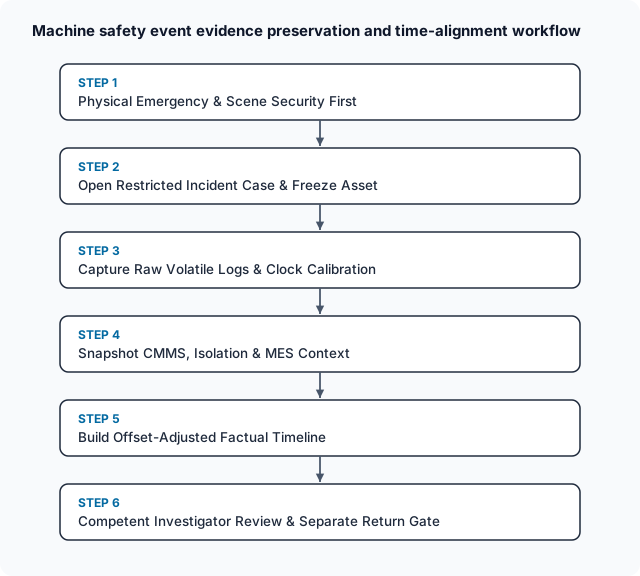
Read the complete workflow as text
- Physical Emergency & Scene Security First → Open Restricted Incident Case & Freeze Asset
- Open Restricted Incident Case & Freeze Asset → Capture Raw Volatile Logs & Clock Calibration
- Capture Raw Volatile Logs & Clock Calibration → Snapshot CMMS, Isolation & MES Context
- Snapshot CMMS, Isolation & MES Context → Build Offset-Adjusted Factual Timeline
- Build Offset-Adjusted Factual Timeline → Competent Investigator Review & Separate Return Gate
Worked example: Reconciling conflicting timestamps on servo press PRS-SV-06
All machine identifiers, timestamps, clock offsets, and personnel codes below are illustrative examples constructed to show how explicit time-calibration resolves apparent contradictions without altering raw logs or inferring causation.
Suppose that during the morning shift on 20 October 2026, an operator at 400-tonne mechanical servo press cell PRS-SV-06 reports an unexpected 35 mm downward slide inching movement (Case INC-2026-1018) while clearing a scrap strip from the die bolster area with the mode selector key switch turned to Manual Setup and the front safety light curtain (LC-01) interrupted. No injury occurs; the operator immediately presses emergency-stop pushbutton E-STOP-02, the shift supervisor secures the cell and applies physical group lockout padlock LOTO-PRS06-91, and the EHS lead opens restricted investigation case INC-2026-1018.
1. Apparent contradiction in raw uncalibrated timestamps
When the plant engineering and EHS investigators collect the initial records from four sources, the raw unadjusted timestamps appear to contradict the operator's account:
- Operator factual statement (
WIT-01): OperatorOP-312states that they interrupted light curtainLC-01at approximately10:14:00 IST, observed the slide creep downward a few seconds later (~10:14:05 IST), and struckE-STOP-02immediately (~10:14:07 IST). - MES shop-floor terminal (
MES-TERM-06, NTP-synced): Logs a machine cycle-stop signal at10:14:06 IST(±1 s) and an operatorIncident Holdbutton press at10:14:22 IST(±1 s). - Main press PLC fault buffer (
PLC-PRS06, non-networked standalone RTC): LogsEvent #481: Light Curtain LC-01 Beam Interruptedat raw PLC time10:17:19,Event #482: Brake Release Solenoid SOL-BRK-B Pressure Drop Warningat10:17:23, andEvent #483: E-STOP-02 Dual-Channel Openat10:17:25. - Local operator panel HMI alarm log (
HMI-PRS06, separate internal clock): LogsAlarm A-109: Safety Relay K-SAF-01 Feedback Mismatchat raw HMI time10:13:22andAlarm A-110: Emergency Stop Activeat10:13:25.
If taken at face value without clock calibration, the raw PLC log (10:17:19 to 10:17:25) suggests the light curtain interruption and emergency stop occurred more than three minutes after the MES terminal recorded the stop (10:14:06), while the HMI log (10:13:22) suggests the alarm occurred 44 seconds before the MES stop.
2. Measured clock offsets and uncertainty calculation
Before touching any controller settings, the automation engineer and EHS investigator perform a documented clock-calibration check at exactly 10:45:00 IST (t_ref = 10:45:00, uncertainty ±1 s via the plant master NTP reference server NTP-PLANT-01):
Main PLC clock offset (
Delta_PLC): Att_ref = 10:45:00 IST, the standalone PLC diagnostic screen displays10:48:18(reading resolution±1 s):Delta_PLC = t_PLC_raw - t_ref = 10:48:18 - 10:45:00 = +198 seconds (+3 minutes 18 seconds fast)Combined Uncertainty u_PLC = ±1 s (NTP ref) + ±1 s (PLC display resolution) = ±2 secondsNormalized IST Time Formula: t_IST = t_PLC_raw - 198 s (±2 s)Local HMI panel clock offset (
Delta_HMI): Att_ref = 10:45:00 IST, the operator HMI status bar displays10:44:18(reading resolution±1 s):Delta_HMI = t_HMI_raw - t_ref = 10:44:18 - 10:45:00 = -42 seconds (42 seconds slow)Combined Uncertainty u_HMI = ±1 s (NTP ref) + ±1 s (HMI display resolution) = ±2 secondsNormalized IST Time Formula: t_IST = t_HMI_raw + 42 s (±2 s)Apparent raw gap between PLC and HMI clocks:
Raw Clock Spread = (+198 s) - (-42 s) = 240 seconds (4 minutes 0 seconds)
3. Reconciled time-aligned factual event table
Applying the measured offsets (-198 s to raw PLC timestamps and +42 s to raw HMI timestamps) while retaining every original timestamp in its own column produces a completely consistent sequence across all four systems:
Scroll horizontally to see all columns.
| Sequence ID | Source system & record ID | Raw recorded timestamp | Measured clock offset (Delta_t) |
Reconciled IST timestamp (t_IST) |
Uncertainty window (±u) |
Factual event preserved in case file (no causal inference) |
|---|---|---|---|---|---|---|
EVT-01 |
CMMS (WO-PM-2026-8812) |
2026-10-19 22:15:10 |
0 s (NTP) |
2026-10-19 22:15:10 |
±1 s |
Night-shift PM work order closed: pneumatic counterbalance & brake valve inspection on PRS-SV-06 |
EVT-02 |
PLC (PLC-PRS06 #480) |
10:16:58 |
+198 s |
10:13:40 |
±2 s |
Mode selector switch SW-MODE-01 transitioned from Auto (State 3) to Manual Setup (State 1) |
EVT-03 |
PLC (PLC-PRS06 #481) |
10:17:19 |
+198 s |
10:14:01 |
±2 s |
Front safety light curtain LC-01 Dual-Channel OSSD inputs transitioned HIGH → LOW (beam interrupted) |
EVT-04 |
Witness (WIT-01 / OP-312) |
~10:14:00 |
0 s (Wall clock) |
10:14:00 |
±15 s |
Operator OP-312 reports reaching across bolster plane after switching to Manual Setup |
EVT-05 |
HMI (HMI-PRS06 A-109) |
10:13:22 |
-42 s |
10:14:04 |
±2 s |
Alarm A-109: Safety Relay K-SAF-01 auxiliary feedback loop mismatch detected |
EVT-06 |
PLC (PLC-PRS06 #482) |
10:17:23 |
+198 s |
10:14:05 |
±2 s |
Brake release solenoid SOL-BRK-B manifold pressure transducer PT-04 dropped below 4.2 bar threshold; encoder registered 34.8 mm slide displacement |
EVT-07 |
MES (MES-TERM-06) |
10:14:06 |
0 s (NTP) |
10:14:06 |
±1 s |
Active production job JOB-STAMP-441 status changed from Setup to Fault Stop at cycle count 1,420 |
EVT-08 |
PLC (PLC-PRS06 #483) |
10:17:25 |
+198 s |
10:14:07 |
±2 s |
Emergency stop E-STOP-02 dual channels opened (0 V DC on Ch-1 and Ch-2) |
EVT-09 |
HMI (HMI-PRS06 A-110) |
10:13:25 |
-42 s |
10:14:07 |
±2 s |
Alarm A-110: Emergency stop circuit active; main drive contactor KM-01 de-energised |
EVT-10 |
MES (MES-TERM-06) |
10:14:22 |
0 s (NTP) |
10:14:22 |
±1 s |
Operator logged Safety Incident Hold on terminal MES-TERM-06 |
4. Preserving the boundary between factual evidence and human investigation
Notice what the reconciled table accomplishes—and what it refuses to do:
- Contradiction eliminated without altering source logs: Once the
+198 sPLC offset and-42 sHMI offset are applied,EVT-03(10:14:01 ± 2 s, light curtain interrupted),EVT-05(10:14:04 ± 2 s, safety relay feedback mismatch),EVT-06(10:14:05 ± 2 s,34.8 mmslide displacement), andEVT-08/EVT-09(10:14:07 ± 2 s, E-Stop actuated) align within their±2 suncertainty bands and matchMES-TERM-06(10:14:06 ± 1 s). - No automated causal conclusion: Although the timeline shows that PM work order
WO-PM-2026-8812occurred the previous night (EVT-01) and thatAlarm A-109(EVT-05) precededSOL-BRK-Bpressure drop (EVT-06) by1.0 second, the software workflow does not generate an automated conclusion blaming the night-shift technician or diagnosing a specific valve fault. Instead, the case file marksCausal_Determination_Status = UNRESOLVED_PENDING_COMPETENT_INVESTIGATIONand routes the preserved evidence package to the appointed human investigation lead (EHS-INV-04) and chief mechanical engineer (ENG-MECH-02). - Return-to-service remains strictly blocked: Completing the evidence snapshot for
INC-2026-1018changes the evidence-collection task toEvidence Preserved (4/4 Streams Hashed), but keeps servo pressPRS-SV-06locked inOUT_OF_SERVICE_SAFETY_HOLD. Returning the press to service requires closing a separate machine safety defect record, maintaining physical maintenance isolation records during physical inspection and repair, and verifying long-term corrective actions through CAPA effectiveness testing.
Observable acceptance tests for the incident evidence workflow
Before deploying an incident evidence-preservation module across CMMS, MES, and EHS workflows, validate these three acceptance tests in a non-production sandbox:
ACT-M053-01(Preservation of raw timestamps alongside explicit clock offset and uncertainty): Seed a simulated incident case with three log uploads bearing unsynchronised clocks (PLC +198 s,HMI -42 s,MES 0 s). Pass condition: The database stores the exact unmodified raw timestamp string, the cryptographicSHA-256hash of each uploaded log file, the measured clock offsetDelta_t, and the uncertainty band±u(±2 s), displaying both raw and reconciled timestamps side-by-side without overwriting the original log values.ACT-M053-02(Prohibition of model-generated or automated causal conclusions): Attempt to configure or trigger an automated summary or AI text-generation field on the incident record that outputs a root-cause statement or fault attribution. Pass condition: The schema rejects any automated or model-generated causal text; theRoot Cause & Contributing Factorssection remains locked inUnresolved — Assigned to Named Competent Investigatoruntil signed by the authorised human EHS and engineering leads.ACT-M053-03(Decoupling of evidence completion from machine restart clearance): Mark all four evidence streams (Controller Logs,CMMS/Isolation History,MES Job Snapshot, andFactual Witness Statements) asComplete & Verifiedon caseINC-2026-1018, then attempt to release a production work order onPRS-SV-06in MES. Pass condition: MES blocks work-order release (Error: Asset PRS-SV-06 locked under active EHS Investigation Hold INC-2026-1018; evidence preservation does not authorise machine restart).
Next actions for EHS, engineering, and manufacturing IT leaders
To stop losing volatile machine evidence and prevent timestamp confusion after shop-floor safety events, complete these four numbered actions:
- Add a mandatory "Do Not Power-Cycle Before Log Export" step to post-event shop-floor protocols: Update supervisor and maintenance response checklists so that—immediately after emergency aid and physical LOTO isolation are secured—volatile PLC, CNC, and safety-relay fault buffers are exported or photographed before any cabinet power-cycle or fault reset is attempted.
- Institute a standard clock-calibration check during every machine evidence export: Require the responding automation technician to record the controller's live real-time clock display against an NTP-synchronised reference clock (
Delta_tand±u) at the moment of log extraction so investigators never compare uncalibrated timestamps across OT and IT systems. - Configure automatic CMMS and MES snapshot locks on safety-hold activation: Set the EHS incident trigger so that placing an asset on
Safety Investigation Holdautomatically freezes the prior30 daysof CMMS work orders, parameter change logs, and active MES job records against retrospective edits. - Enforce role-based access and ban automated causal inference in incident records: Restrict witness statements and raw log attachments to the assigned investigation team, and verify via
ACT-M053-02andACT-M053-03that software records never generate causal conclusions or clear an equipment safety hold.
Compare this workflow with your current setup
Share the step that takes the most manual work, the systems involved and the exceptions your team handles. That gives us a concrete starting point for comparing approaches.
Sources and further reading
Sources checked 15 October 2026. Worked examples and workflow diagrams are original illustrations, not reported client results.
- UK Health and Safety Executive (HSE) — Permit-to-Work Systems in Human Factors
- Ministry of Labour and Employment, Government of India — Implementation of the Four Labour Codes (PIB Release 2209767)
- National Institute of Standards and Technology (NIST) — Operational Technology (OT) Security Publications


