Customer-owned tooling and bailment records: control piece-price amortisation caps and custody audits
For stores, inventory control and production teams · Compare approaches
TL;DR — what you’ll learn
- Segregate Customer-Owned / Bailed Tooling (CUST_BAILED_ASSET) from your plants own fixed-asset ledger (M069) so customer moulds, progressive dies, and check fixtures are never depreciated on your balance sheet or pledged under your banks general asset lien ([IATF 16949 Section 8.5.3](https://www.iatfglobaloversight.org/) / [UCC Article 9](https://www.law.cornell.edu/ucc/9)).
- Separate Base Manufacturing Piece Price ($P_{\text{base}}$) from Per-Piece Tooling Amortisation Surcharge ($P_{\text{tool}}$) on sales orders and invoices; track cumulative amortised units ($N_{\text{cum}}$) so the ERP automatically splits the transition shipment and drops $P_{\text{tool}}$ to $\$0.00$ the exact unit the tooling balance hits $100\%$ recovery.
- Interlock production scheduling (Work Order) so a customer-bailed tool can only be scheduled for the owning customers part numbers—blocking unauthorized runs for aftermarket or competing customers without a signed licence/royalty waiver.
- Require an annual Geo-Tagged Physical Bailment Custody Audit (photo of the riveted OEM property tag on the tool bolster, rack location, and cumulative shot/stroke counter vs guaranteed tool life).

Illustrative factory raw-material stores and receiving counter; not a client facility.
In automotive, medical-device, appliance, and aerospace contract manufacturing, customers frequently pay for the dedicated injection moulds, stamping dies, core boxes, and checking gauges used to produce their parts—either via upfront milestone invoices (e.g., $30%$ at design, $40%$ at first off-tool sample, $30%$ at PPAP approval) or via piece-price tooling amortisation spread across the first $N_{\text{cap}}$ production units. Two expensive control failures occur when contract manufacturers manage bailed tools in spreadsheets: first, sales keeps billing the combined "amortised piece price" ($P_{\text{base}} + P_{\text{tool}}$) long after the $N_{\text{cap}}$ unit threshold is crossed, triggering clawback claims and audit penalties from the OEM purchasing team; second, during an OEM bailment audit or Sub-Tier transfer, the plant cannot prove physical custody, property-plate tagging, or remaining shot life of tools sitting at external sub-tier coaters or toolmakers. Complementing M048 (technical die maintenance) and M069 (plant fixed-asset accounting), this guide (M117) specifies off-balance-sheet bailment registry design, automated piece-price amortisation cap cutoffs, customer-exclusivity scheduling locks, and physical custody audit workflows.
Scope and accounting/quality boundary
This article defines the ERP/MES bailment asset registry, cumulative amortisation billing engine, and custody verification workflow for Tier-1/Tier-2 contract manufacturers:
- What this workflow governs: Registering off-balance-sheet customer-bailed tooling (
BAILMENT_ID), tracking milestone and per-piece tooling amortisation recovery caps, auto-splitting boundary invoices when amortisation reaches $100%$, restricting tool usage to authorized customer SKUs, and logging physical bailment tag audits. - What this workflow does not replace: It does not replace legal bailment contract drafting, UCC-1 financing statement filings, or statutory revenue-recognition audits. Workflows should align with IATF 16949 Section 8.5.3 (Property Belonging to Customers or External Providers), revenue and contract-asset principles under IFRS 15, and commercial bailment notice frameworks (UCC Article 9).
Bounded tooling management software verification and exception-routing workflow
Follow the workflow below, or open its complete text version.
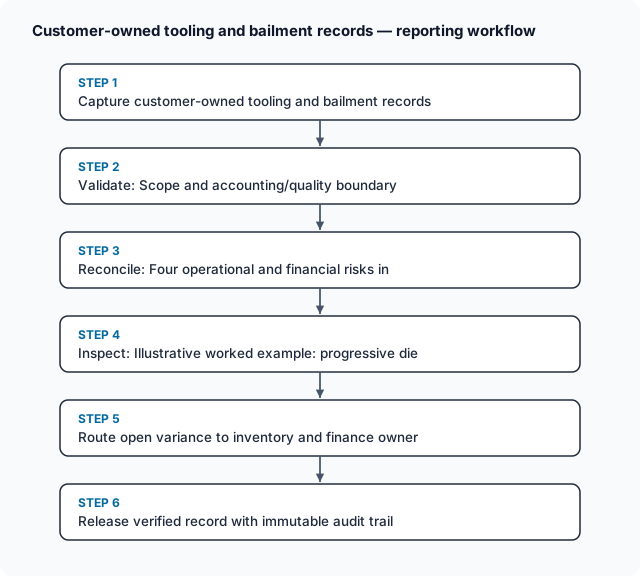
Read the complete workflow as text
- Capture tooling management software baseline record → Verify revision, unit Basis and cutoff alignment
- Verify revision, unit Basis and cutoff alignment → Run deterministic reconciliation and tolerance check
- Run deterministic reconciliation and tolerance check → Quarantine mismatched or unapproved lines
- Quarantine mismatched or unapproved lines → Route exception to named domain and finance owner
- Route exception to named domain and finance owner → Release verified record with immutable audit trail
Four operational and financial risks in unmanaged customer tooling
- Over-Billing Piece-Price Tooling Amortisation Past 100% Recovery: When a supplier agrees to recover $$75,000$ of tooling cost by adding $$0.50/\text{part}$ across the first $150,000\text{ parts}$ on top of a $$2.80/\text{part}$ base price, burying the surcharge inside a single static item price of $$3.30/\text{part}$ guarantees that Shipment #30 (which crosses the $150,000\text{-unit}$ mark) and every shipment thereafter will overcharge the customer by $$0.50/\text{part}$.
- Accidental Capitalization on Supplier Fixed-Asset Books:
If accounting books a customer-reimbursed mould into the plant's standard
Machinery & Equipmentfixed-asset group (M069), the plant claims false depreciation expense and exposes the customer's legal property to creditor liens. - Uncontrolled Sub-Tier Tool Movement ("Lost at the Repair Shop"):
When a bailed mould is shipped outside the plant to an external toolmaker for weld repair, texture etching, or engineering change (
ECN) modification without a Sub-Bailee Gate Pass, custody chains break and insurance coverage lapses. - Hitting End-of-Guaranteed-Shot-Life Without Customer Notification: A bailed Class 102 injection mould guaranteed for $500,000\text{ shots}$ requires formal customer notification at $80%$ of guaranteed life ($400,000\text{ shots}$) so the OEM can fund refurbishment or replacement tooling before lead times disrupt vehicle assembly lines.
Scroll horizontally to see all columns.
| Governance Dimension | Supplier-Owned Tooling (M069) |
Customer-Bailed Tooling (M117) |
Mandatory ERP / MES Control |
|---|---|---|---|
| Legal Title & Balance Sheet | Supplier holds title; capitalized & depreciated on supplier books | Customer holds title (or transfers at $100%$ amortisation); Off-Balance-Sheet Custody Register | Flag is_customer_bailed = True; post zero supplier depreciation; record insurance value |
| Physical Property Identification | Supplier asset barcode (FA-1042) |
Riveted metal plate: PROPERTY OF [OEM NAME] — TOOL #[ID] (IATF 16949 §8.5.3) |
Block PPAP signoff until photo of permanently attached customer property plate is uploaded |
| Scheduling & Part Exclusivity | Can run any compatible part or customer | Restricted strictly to authorized_customer_id and approved part revisions |
Hard-block Work Order creation if customer on Sales Order $\neq$ tool.owner_customer_id |
| Scrap / Modification Authority | Supplier Engineering / Finance signoff | Written Customer Disposal / ECN Authorization mandatory | Lock tool disposal/scrap status until signed OEM Tooling Disposition Letter is attached |
Illustrative worked example: progressive die piece-price amortisation auto-stop on a boundary shipment
Illustrative contract-manufacturing scenario using synthetic figures to demonstrate cumulative tooling amortisation and boundary invoice splitting; not a client case study.
A Tier-1 metal-stamping plant builds and runs a progressive stamping die (BAIL-DIE-409) for OEM Customer CUST-AUTO-01 to produce structural seat brackets (PART-SB-900). Under the signed Tooling Bailment & Amortisation Agreement:
- Total Agreed Tooling Recovery Cap ($C_{\text{tool_cap}}$): $$75,000.00$
- Amortisation Volume Cap ($N_{\text{cap}}$): $150,000\text{ good shipped parts}$
- Per-Piece Tooling Amortisation Surcharge ($P_{\text{tool}}$): $$P_{\text{tool}} = \frac{$75,000.00}{150,000\text{ parts}} = $0.5000/\text{part}$$
- Base Manufacturing Piece Price ($P_{\text{base}}$): $$2.8000/\text{part}$ (Combined rate during amortisation window = $$2.8000 + $0.5000 = $3.3000/\text{part}$; post-amortisation rate = $$2.8000/\text{part}$).
- Guaranteed Tool Life ($S_{\text{guar}}$): $500,000\text{ press strokes}$ ($80%$ refurbishment notice threshold = $400,000\text{ strokes}$).
Step 1: Compute remaining unamortised balance prior to Shipment #30.
Across Shipments #01 through #29, the plant has delivered and invoiced $N_{\text{prior}} = 147,200\text{ parts}$:
- Cumulative Tooling Amortisation Recovered to Date ($C_{\text{recovered}}$): $$C_{\text{recovered}} = 147,200\text{ parts} \times $0.5000/\text{part} = $73,600.00;(98.13%\text{ of cap})$$
- Remaining Unamortised Tooling Balance ($C_{\text{rem}}$) and Remaining Eligible Units ($N_{\text{rem}}$): $$C_{\text{rem}} = $75,000.00 - $73,600.00 = $1,400.00$$ $$N_{\text{rem}} = \frac{$1,400.00}{$0.5000/\text{part}} = 2,800\text{ parts remaining until 100% cap}$$
Step 2: Auto-split boundary Shipment #30 ($5,000\text{ parts}$) to prevent $$1,100.00$ over-billing.
When logistics generates Delivery Note and Sales Invoice INV-2026-0830 for Shipment #30 ($Q_{\text{ship}} = 5,000\text{ parts}$), cumulative shipped volume reaches $147,200 + 5,000 = 152,200\text{ parts}$ (crossing the $150,000\text{-part}$ cap by $2,200\text{ parts}$):
- Naive Single-Line Static Pricing Error:
Billing all $5,000\text{ parts}$ at $$3.30/\text{part}$ charges $$16,500.00$ (including $$2,500.00$ of tooling amortisation), over-billing
CUST-AUTO-01by $2,200 \times $0.50 = $1,100.00$ ($101.47%$ recovery). - ERP Cumulative Cap Auto-Split (ERPNext Sales Invoice / Tooling Ledger):
The billing engine compares $Q_{\text{ship}} = 5,000$ against $N_{\text{rem}} = 2,800$ and automatically generates a clean two-tier invoice:
- Line 1 — Base Manufacturing Piece Price (All $5,000\text{ parts}$): $$\text{Base Line} = 5,000\text{ parts} \times $2.8000/\text{part} = $14,000.00$$
- Line 2 — Tooling Amortisation Surcharge (
BAIL-DIE-409, capped at $N_{\text{rem}} = 2,800\text{ parts}$): $$\text{Tooling Amortisation Line} = \min(5,000,; 2,800)\text{ parts} \times $0.5000/\text{part} = 2,800 \times $0.5000 = $1,400.00$$ - Total Correct Invoice for
Shipment #30: $$\text{Total Invoice} = $14,000.00 + $1,400.00 = $15,400.00$$
Scroll horizontally to see all columns.
| Shipment / Ledger Stage | Shipped Qty ($\text{pcs}$) | Cumulative Shipped ($\text{pcs}$) | Units Charged Tool Surcharge ($\text{pcs}$) | Tooling Surcharge Billed ($$$) | Cumulative Tool Recovery ($$$ / $%$) | Base Part Billing ($$$) | Total Invoice ($$$) |
|---|---|---|---|---|---|---|---|
Shipments #01–#29 |
$147,200$ | $147,200$ | $147,200$ | $$73,600.00$ | $$73,600.00$ ($98.13%$) | $$412,160.00$ | $$485,760.00$ |
Shipment #30 (Boundary Split) |
$5,000$ | $152,200$ | $2,800$ (Capped) | $$1,400.00$ | $$75,000.00$ ($100.00%$) | $$14,000.00$ | $$15,400.00$ |
Shipment #31+ (Post-Cap) |
$5,000$ | $157,200$ | $0$ (Auto-Stopped) | $$0.00$ | $$75,000.00$ ($100.00%$) | $$14,000.00$ | $$14,000.00$ |
Upon posting INV-2026-0830, BAIL-DIE-409 automatically transitions from AMORTISING_IN_PROGRESS to FULLY_AMORTISED_CUSTOMER_TITLE, generating the formal Certificate of Tooling Title & Bailment Confirmation for CUST-AUTO-01 and locking all future invoices (#31+) to $$2.8000/\text{part}$.
Workflow, owner roles, exceptions, and recovery controls
Scroll horizontally to see all columns.
| Workflow Stage | Accountable Owner | Required System Evidence | Exception Trigger | Recovery & Escalation Control |
|---|---|---|---|---|
| 1. PPAP & Bailment Tag Registration | Program Manager & Tooling Eng | BAILMENT_ID, signed Bailment Agreement, photo of riveted OEM property plate, guaranteed life $S_{\text{guar}}$ |
Tool enters production without permanent OEM property tag or signed bailment terms | Block PPAP/production release until physical metal property plate is riveted and photographed |
| 2. Shipment Billing & Cap Auto-Stop | Accounts Receivable / ERP | Cumulative amortised units ($N_{\text{cum}}$), remaining cap ($C_{\text{rem}}$), split invoice lines | Manual invoice override attempts to bill $P_{\text{tool}}$ when $C_{\text{rem}} == $0.00$ | Hard-block tooling surcharge line once cumulative recovery reaches $100.00%$ ($C_{\text{tool_cap}}$) |
| 3. Sub-Tier Tool Outbound Gate Pass | Tool Room Supervisor | Returnable Outbound Delivery Note (SUB_BAILEE_PASS), external toolmaker NDA/insurance, due date |
Tool stays at external repair/texturing shop past 14-day return window | Escalate overdue external custody alert to Purchasing and Program Management |
| 4. Annual Custody & 80% Life Audit | Tool Crib & Finance | Geo-tagged photo of tool in rack, cumulative stroke count ($S_{\text{cum}}$), annual customer confirmation | Cumulative strokes reach $80%$ of guaranteed life ($400,000 / 500,000$) or customer requests dormancy scrap | Issue formal 80% Tool Life Refurbishment Notice to OEM buyer; never scrap dormant tooling without written OEM authorization |
Bounded pilot and implementation check
Pilot off-balance-sheet bailment registration and cumulative piece-price amortisation tracking across all active customer-funded tools for 2 OEM accounts over 3 weeks:
- Pilot boundary: Audit every active mould, die, and gauge for the 2 pilot customers; verify physical property plates, separate base piece prices from tooling amortisation surcharges, and reconcile cumulative invoiced units against contract caps.
- Baseline capture: Identify any active part numbers currently billing an embedded tooling surcharge without an automated cutoff counter, and check whether any customer-owned tools were inadvertently entered into the plant's depreciable fixed-asset ledger.
- Acceptance criteria: 100% of customer-owned tools are segregated in the non-depreciating
CUST_BAILED_ASSETregister with uploaded property-plate photos; 100% of active piece-price amortisation agreements enforce an automatic split/stop at $C_{\text{tool_cap}}$; zero bailed tools are scheduled on non-owner customer orders. - Stop condition: If historical shipment records prior to ERP cutover are in legacy invoices, load the verified historical cumulative amortised quantity ($N_{\text{opening}}$) signed off by both Commercial and Finance before activating automated invoice splitting.
Recommended next actions.
- Audit all active piece-price tooling amortisation parts immediately: Separate the base part price ($P_{\text{base}}$) from the tooling surcharge ($P_{\text{tool}}$) onto distinct invoice lines tied to a hard cumulative dollar/unit cap.
- Segregate customer-bailed tooling into an off-balance-sheet ERP custody register: Ensure customer-owned moulds and dies are never depreciated on your P&L or swept into bank collateral schedules.
- Link cumulative press/mould shot counters (
M048) to an automated 80% guaranteed-life commercial alert: Give OEM buyers 6 months of lead time to fund tool refurbishment or replacement. - Perform an annual barcode-and-photo bailment audit: Send each OEM customer a proactive annual custody report showing tool rack location, property-plate photo, and remaining guaranteed shot life.
Frequently Asked Questions
How should Tier-1/Tier-2 contract manufacturers track customer-owned tooling (bailed moulds, fixtures, gauges), per-piece tool amortisation billing caps, and annual physical custody confirmations?.
Teams should govern tooling management software by linking every transaction to its source evidence, timestamp, and assigned owner before permitting downstream posting. Distinct from M048 (technical die shot maintenance) and M069 (plant fixed-asset register); M117 covers off-balance-sheet customer-bailed tooling registers, piece-price amortisation auto-stop once tool recovery hits 100%, and bailment plate audits. Rather than relying on informal spreadsheet overrides, the workflow enforces a documented verification gate and preserves the original observation whenever a correction is recorded.
How does asset tracking for manufacturing handle exceptions and mismatches?.
When a discrepancy occurs during asset tracking for manufacturing, the system routes the blocked record into an owned exception queue rather than silently dropping or auto-adjusting the balance. Assigned operational, quality, and finance owners must review and approve exceptions before posting. Each exception retains the original quantity, date, and counterparty reference until the designated reviewer resolves the variance with supporting evidence.
What should teams test before automating automotive supplier erp?.
Before scaling automotive supplier erp, run a bounded pilot using historical records that include partial receipts, late updates, duplicate messages, and rejected lines. Verify that the integration preserves idempotency, maintains a clear segregation of duties between operational entry and financial approval, and produces an auditable trail for every state transition.
Compare this workflow with your current setup
Share the step that takes the most manual work, the systems involved and the exceptions your team handles. That gives us a concrete starting point for comparing approaches.
Sources and further reading
Sources checked 15 October 2026. Worked examples and workflow diagrams are original illustrations, not reported client results.

