Textile dyeing and roll-grading records: control Delta-E shade bands, metamerism, and 4-point inspection
For production managers, planners and plant leaders · Compare approaches
TL;DR — what you’ll learn
- Separate on-weight-of-fabric ($\text{\% o.w.f.}$) dyestuff scaling from on-volume-of-liquor ($\text{g/L}$) salt/alkali scaling in your ERP dye-house BOMs so liquor-to-goods ratio changes ($L:G = 6:1 \text{ vs } 10:1$) never distort salt and soda-ash concentrations.
- Classify every finished fabric roll (ROLL_ID) using spectrophotometer $\Delta E_{\text{CMC(2:1)}}$ and 3-digit 555 Shade Sorting codes ([AATCC EP7 / EP9](https://www.aatcc.org/testing/)), verifying both Roll-to-Roll shade group and Side-Center-Side (selvedge-to-center) shading.
- Log multi-illuminant metamerism indices across daylight ($\text{D65}$), retail store fluorescent ($\text{TL84 / F11}$), and warm incandescent ($\text{Illuminant A}$) so fabric rolls that match in the dye house do not clash under retail store spotlights.
- Compute [ASTM D5430](https://www.astm.org/d5430-13r21.html) 4-Point Inspection scores ($\text{Points per } 100\text{ yd}^2$) per roll and hard-lock warehouse picking so only rolls from the exact same 555 Shade Band and Shrinkage Group can be allocated to a single garment cutting lay (M027).

Illustrative manufacturing inspection room and machine shop floor; not a client facility.
Even within a single jet or beam dyeing batch (DYE_LOT), roll-to-roll temperature gradients, stenter frame heat-setting variations, and fabric pick-count tolerances produce subtle differences in lightness ($\Delta L^$), chroma ($\Delta C^$), and hue ($\Delta H^*$). If a textile mill or garment factory tracks fabric inventory only by SKU and Color Code (NAVY-402) without roll-level 555 shade-band attributes and 4-point defect scores, rolls from Shade Band 555 and Shade Band 645 get spread into the same cutting lay—producing garments whose left sleeve and right front panel visibly mismatch on the retail rack. Complementing M027 (garment marker and cut-bundle planning), this guide (M116) specifies dye-bath dual-basis recipe scaling, $\Delta E_{\text{CMC(2:1)}}$ 555 shade-band sorting, multi-illuminant metamerism gates, and ASTM D5430 4-point roll grading.
Scope and textile standards boundary
This article defines the ERP/MES dye-recipe calculation, spectrophotometer shade-band tagging, and 4-point fabric inspection workflow for textile dyeing/finishing mills and apparel cut-make-trim (CMT) plants:
- What this workflow governs: Calculating dual-basis dye-bath recipes ($%\text{ o.w.f.}$ vs $\text{g/L}$), logging spectrophotometer $\Delta E_{\text{CMC(2:1)}}$, metamerism index ($MI$), and
555shade-box codes per roll, scoring warp/weft fabric defects via the 4-Point System, and enforcing shade-band homogeneity during roll picking. - What this workflow does not replace: It does not replace colorist lab-dip formulation chemistry, reactive dye exhaustion kinetics, or wet-fastness / rubbing-fastness laboratory testing. Color and fabric grading rules should align with AATCC Evaluation Procedures EP7 and EP9 (CMC Color Difference & 555 Shade Sorting), ISO 105-J03 (Calculation of Colour Differences), and ASTM D5430 (Standard Test Methods for Visually Inspecting and Grading Fabrics).
Bounded textile erp software verification and exception-routing workflow
Follow the workflow below, or open its complete text version.
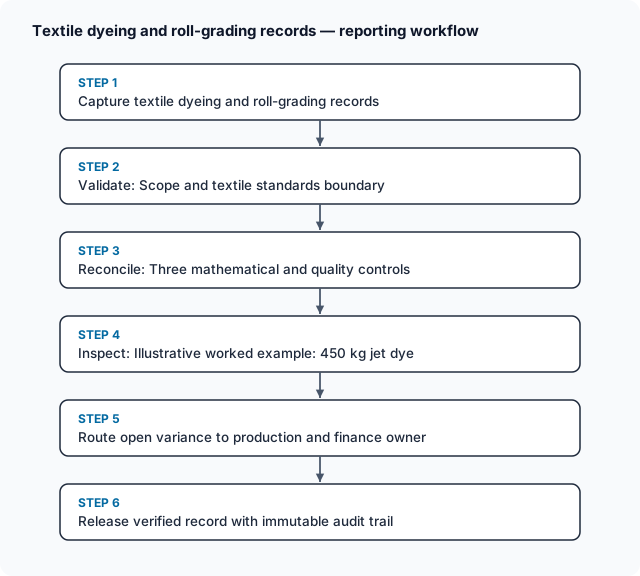
Read the complete workflow as text
- Capture textile erp software baseline record → Verify revision, unit Basis and cutoff alignment
- Verify revision, unit Basis and cutoff alignment → Run deterministic reconciliation and tolerance check
- Run deterministic reconciliation and tolerance check → Quarantine mismatched or unapproved lines
- Quarantine mismatched or unapproved lines → Route exception to named domain and finance owner
- Route exception to named domain and finance owner → Release verified record with immutable audit trail
Three mathematical and quality controls required from dye house to inspection frame
Dual-Basis Dye-Bath Recipe Scaling ($%\text{ o.w.f.}$ vs $\text{g/L}$ at Liquor Ratio $L:G$): In exhaust dyeing, dyestuffs are dosed on weight of fabric ($%\text{ o.w.f.}$) while electrolytes (Glauber's salt / sodium chloride) and alkali (soda ash / caustic) are dosed on total bath liquor volume ($\text{g/L}$). Given dry greige fabric mass $M_{\text{fabric}}\text{ (kg)}$ and machine Liquor-to-Goods ratio $R_{LG}\text{ (L/kg)}$: $$V_{\text{liquor}} = M_{\text{fabric}} \times R_{LG}\quad (\text{in Litres})$$ $$M_{\text{dye}} = M_{\text{fabric}} \times \left(\frac{%\text{o.w.f.}}{100}\right), \qquad M_{\text{chemical}} = V_{\text{liquor}} \times \left(\frac{C_{\text{g/L}}}{1,000}\right)\quad (\text{in kg})$$ Standard single-basis ERP BOMs fail when a $450\text{ kg}$ lot is moved from an $8:1$ low-liquor jet machine ($3,600\text{ L}$ bath) to a $10:1$ overflow machine ($4,500\text{ L}$ bath): keeping dyestuff at $10.80\text{ kg}$ while forgetting to scale salt from $3,600\text{ L}$ to $4,500\text{ L}$ drops salt concentration by $20%$ and leaves the batch pale (under-exhausted).
$\Delta E_{\text{CMC(2:1)}}$,
555Shade-Band Sorting, and Metamerism: Under AATCC EP7 / EP9 and ISO 105-J03, elliptical color difference $\Delta E_{\text{CMC(2:1)}}$ weights lightness ($l=2$) and chroma ($c=1$) to match human visual perception: $$\Delta E_{\text{CMC}(l:c)} = \sqrt{\left(\frac{\Delta L^}{l,S_L}\right)^2 + \left(\frac{\Delta C^{ab}}{c,S_C}\right)^2 + \left(\frac{\Delta H^*{ab}}{S_H}\right)^2}$$ Even when all rolls pass the overall ship tolerance ($\Delta E_{\text{CMC(2:1)}} \le 1.00$), a roll at $+0.45,\Delta L^$ (lighter) and a roll at $-0.45,\Delta L^$ (darker) differ from each other by $0.90$ units—visibly clashing if sewn side-by-side. The 3-digit555Shade Sorting System partitions the accepted tolerance ellipsoid into discrete boxes along $\Delta L^, \Delta C^, \Delta H^*$ (where555is the exact customer master standard,655is one step lighter,455is one step darker, etc.).ASTM D5430 4-Point Fabric Defect Scoring: On the lighted inspection frame (ASTM D5430), every visible warp or weft defect (slub, broken end, oil stain, dye streak, hole) is assigned $1, 2, 3,\text{ or } 4\text{ penalty points}$ based on defect length (capped at a maximum of $4\text{ points}$ per linear yard):
- Defect length $\le 3\text{ in.}$ ($\le 75\text{ mm}$): $1\text{ point}$
- Defect length $ over 3\text{ in.}$ to $6\text{ in.}$ ($75\text{–}150\text{ mm}$): $2\text{ points}$
- Defect length $ over 6\text{ in.}$ to $9\text{ in.}$ ($150\text{–}230\text{ mm}$): $3\text{ points}$
- Defect length $ over 9\text{ in.}$ ($ over 230\text{ mm}$) or any full hole: $4\text{ points}$ The normalized defect density in Points per 100 Square Yards ($\text{Pts}/100\text{ yd}^2$) for a roll of length $L_{\text{yd}}$ (yards) and cuttable width $W_{\text{in}}$ (inches) is: $$\text{Score}{100\text{ yd}^2} = \frac{\text{Total Penalty Points} \times 36 \times 100}{L{\text{yd}} \times W_{\text{in}}} = \frac{\text{Total Penalty Points} \times 3,600}{L_{\text{yd}} \times W_{\text{in}}}$$
Illustrative worked example: 450 kg jet dye recipe, 555 shade-band roll sorting, and ASTM D5430 4-point grading
Illustrative textile dyeing and inspection scenario using synthetic figures to demonstrate liquor-ratio scaling, shade-band sorting, and 4-point grading arithmetic; not a client case study.
A vertical knitwear mill dyes a $450.0\text{ kg}$ batch (DYE-LOT-2026-812, consisting of 12 rolls, R-812-01 through R-812-12) of $100%$ combed cotton interlock fabric in a low-liquor jet dyeing machine (JET-DYE-05) operating at an $8.0:1$ liquor-to-goods ratio.
Step 1: Compute dual-basis dye-bath recipe ($%\text{ o.w.f.}$ and $\text{g/L}$).
- Total dye bath liquor volume ($V_{\text{liquor}}$): $$V_{\text{liquor}} = 450.0\text{ kg fabric} \times 8.0\text{ L/kg} = 3,600.0\text{ L}$$
- Reactive Navy Dyestuff (
DYE-RN-19, recipe = $2.40%\text{ o.w.f.}$): $$M_{\text{dye}} = 450.0\text{ kg} \times \frac{2.40}{100} = 10.80\text{ kg}$$ - Anhydrous Glauber's Salt (
CHEM-SALT-01, recipe = $55.0\text{ g/L}$ of liquor): $$M_{\text{salt}} = 3,600.0\text{ L} \times 0.055\text{ kg/L} = 198.00\text{ kg}$$ - Soda Ash Alkali Fixer (
CHEM-SODA-02, recipe = $15.0\text{ g/L}$ of liquor): $$M_{\text{soda}} = 3,600.0\text{ L} \times 0.015\text{ kg/L} = 54.00\text{ kg}$$
Step 2: Score Roll R-812-04 under the ASTM D5430 4-Point System and assign 555 Shade Bands.
After stenter finishing and compaction, Roll R-812-04 measures $L_{\text{yd}} = 110.0\text{ linear yards}$ ($100.58\text{ m}$) with a cuttable width (between pin holes) of $W_{\text{in}} = 62.0\text{ inches}$ ($157.5\text{ cm}$), giving a roll area of $\frac{110.0 \times 62.0}{36} = 189.44\text{ yd}^2$. The inspection frame operator logs the following defects on R-812-04:
- $6\text{ small slubs/knots}$ ($\le 3\text{ in.}$): $6 \times 1\text{ pt} = 6\text{ points}$
- $4\text{ yarn nep streaks}$ ($3\text{–}6\text{ in.}$): $4 \times 2\text{ pts} = 8\text{ points}$
- $2\text{ coarse picks}$ ($6\text{–}9\text{ in.}$): $2 \times 3\text{ pts} = 6\text{ points}$
- $3\text{ oil spots / drop-stitch holes}$ ($ over 9\text{ in.}$ / hole, on separate linear yards): $3 \times 4\text{ pts} = 12\text{ points}$
- Total Penalty Points on
R-812-04: $$\text{Total Points} = 6 + 8 + 6 + 12 = 32\text{ points}$$ - Normalized ASTM D5430 4-Point Score ($\text{Pts}/100\text{ yd}^2$): $$\text{Score}_{100\text{ yd}^2} = \frac{32 \times 3,600}{110.0\text{ yd} \times 62.0\text{ in.}} = \frac{115,200}{6,820} = 16.89\text{ points per } 100\text{ yd}^2$$
Since the export apparel buyer's maximum threshold for knitted cotton is $\le 24.0\text{ Pts}/100\text{ yd}^2$ (and maximum side-center-side shade variation $\Delta E_{\text{CSV}} \le 0.35$), Roll R-812-04 passes as First-Quality Grade A. Across all 12 rolls of DYE-LOT-2026-812, spectrophotometer header swatches sort into two distinct 555 shade bands:
Scroll horizontally to see all columns.
Roll Group (DYE-LOT-2026-812) |
Overall $\Delta E_{\text{CMC(2:1)}}$ ($\text{D65}$) | Metamerism Index ($\text{D65 vs TL84}$) | Assigned 555 Shade Band |
Side-to-Center $\Delta E_{\text{CSV}}$ | ASTM D5430 4-Point Score | Picking & Cutting Lay Allocation Rule |
|---|---|---|---|---|---|---|
Rolls R-812-01 .. R-812-08 (8 rolls) |
$0.28\text{ – } 0.44$ ($\le 1.00$) | $0.22$ ($\le 0.50$) | Shade Band 555 |
$0.18\text{ – } 0.26$ ($\le 0.35$) | $11.4\text{ – } 16.9\text{ pts}/100\text{ yd}^2$ | Allocate together to Cutting Lay #A |
Rolls R-812-09 .. R-812-11 (3 rolls) |
$0.58\text{ – } 0.74$ ($\le 1.00$) | $0.25$ ($\le 0.50$) | Shade Band 455 (Slightly Darker) |
$0.21\text{ – } 0.29$ ($\le 0.35$) | $14.2\text{ – } 19.8\text{ pts}/100\text{ yd}^2$ | Segregate to separate Cutting Lay #B |
Roll R-812-12 (1 roll — Stenter Stop) |
$0.66$ ($\le 1.00$) | $0.24$ ($\le 0.50$) | Shade Band 455 |
$0.48$ ($ over 0.35$ CSV fail) + Oil Marks | $31.4\text{ pts}/100\text{ yd}^2$ ($ over 24.0$) | QUARANTINED (GRADE-B-HOLD): Cut around or re-dye black |
Workflow, owner roles, exceptions, and recovery controls
Using ERPNext Serial and Batch Bundles with roll-level quality attributes:
Scroll horizontally to see all columns.
| Workflow Stage | Accountable Owner | Required System Evidence | Exception Trigger | Recovery & Escalation Control |
|---|---|---|---|---|
| 1. Dye-Bath Recipe & Liquor Scaling | Dye House Chemist | Fabric mass ($M_{\text{fabric}}$), machine $L:G$ ratio, dual-basis BOM ($%\text{ o.w.f.}$ + $\text{g/L}$), bath pH/conductivity | Operator switches lot to a machine with different $L:G$ without recalculating salt/alkali weights | Lock chemical kitchen dispensing scale until ERP recalculates $\text{g/L}$ additions for the actual machine liquor volume |
| 2. Spectrophotometer & Metamerism Check | Color Lab Technician | Header/tail swatch $\Delta L^, \Delta C^, \Delta H^*$, $\Delta E_{\text{CMC(2:1)}}$ ($\text{D65, TL84, A}$), 555 code, CSV check |
$\Delta E_{\text{CMC(2:1)}} over 1.00$, Metamerism Index $ over 0.50$, or Side-Center-Side $\Delta E_{\text{CSV}} over 0.35$ | Hold roll/batch (SHADE_HOLD); evaluate topping addition in jet machine or submit physical shade band card to buyer |
| 3. 4-Point Inspection & Length/Width Audit | Fabric Inspection Operator | Actual encoder length ($L_{\text{yd}}$), cuttable width ($W_{\text{in}}$), GSM, defect coordinate map, $\text{Pts}/100\text{ yd}^2$ | Roll score exceeds buyer ceiling ($ over 24\text{ Pts}/100\text{ yd}^2$ for knits / $ over 20\text{ Pts}$ for wovens) or $ over 1\text{ major defect per } 10\text{ yd}$ | Downgrade roll to SECOND_QUALITY or calculate optimal physical cut to excise localized high-defect stenter-stop zone |
| 4. Shade-Band-Locked Cutting Issue | Fabric Warehouse & Cutting Lead | Pick list grouped strictly by DYE_LOT + SHADE_BAND_555 + SHRINKAGE_GROUP |
Spreader attempts to scan a 455 roll onto a cutting order table started with 555 rolls |
Hard-block barcode scan at spreading table; require full paper/separator sheet and new bundle sticker series when changing shade bands |
Bounded pilot and implementation check
Pilot dual-basis dye recipes, 555 shade-band tagging, and 4-point roll grading on 2 dyeing machines and 1 inspection frame over 3 weeks:
- Pilot boundary: Track every finished fabric roll (
ROLL_ID) as a unique serialized unit carrying itsDYE_LOT,SHADE_BAND_555, side-center-side $\Delta E_{\text{CSV}}$, cuttable width, shrinkage $%$, and ASTM D5430 4-point score. - Baseline capture: Review the prior 60 days of garment sewing-line rejections caused by panel-to-panel shade mismatching or unexpected narrow-width rolls ruining cutting markers.
- Acceptance criteria: 100% of dye recipes scale dyestuffs on fabric mass ($%\text{ o.w.f.}$) and salt/alkali on actual bath volume ($\text{g/L}$); 100% of released rolls carry a verified
555shade-band barcode and $\text{Pts}/100\text{ yd}^2$ score; zero cutting lays mix two different555shade bands without a physical ply separator and distinct bundle numbering. - Stop condition: If visual shade-card approvals are still used alongside spectrophotometers, require both the instrumental
555code and the physical continuity card slot number on the roll barcode label.
Recommended next actions.
- Configure dual-basis BOM formulas in your dye-house ERP: Separate fabric-mass-proportional dyestuffs ($%\text{ o.w.f.}$) from liquor-volume-proportional salts and alkalis ($\text{g/L}$).
- Print the 3-digit
555Shade Band, cuttable width, and 4-Point Score directly on every roll barcode label: Give warehouse pickers and cutting-room spreaders complete visibility at the roll rack. - Test Side-Center-Side ($\Delta E_{\text{CSV}}$) and multi-illuminant metamerism ($\text{D65 + TL84}$) on every dye lot: Catch selvedge-to-center stenter shading before fabric is cut into garment panels.
- Hard-lock cutting-table barcode scanners to a single
555Shade Band per marker lay: Prevent spreaders from topping off a555lay with a455roll.
Frequently Asked Questions
How should textile dyeing and finishing mills manage lab-dip recipe scaling, spectrophotometer Delta-E shade-band grouping (center-to-selvedge and roll-to-roll), and 4-point inspection fabric grading?.
Teams should govern textile erp software by linking every transaction to its source evidence, timestamp, and assigned owner before permitting downstream posting. Distinct from M027 (garment cut-bundle planning); M116 governs dye-lot shade continuity grouping so rolls with different Delta-E shade bands are never mixed into the same garment cutting lay. Rather than relying on informal spreadsheet overrides, the workflow enforces a documented verification gate and preserves the original observation whenever a correction is recorded.
How does dye house software handle exceptions and mismatches?.
When a discrepancy occurs during dye house software, the system routes the blocked record into an owned exception queue rather than silently dropping or auto-adjusting the balance. Assigned operational, quality, and finance owners must review and approve exceptions before posting. Each exception retains the original quantity, date, and counterparty reference until the designated reviewer resolves the variance with supporting evidence.
What should teams test before automating fabric roll inventory management?.
Before scaling fabric roll inventory management, run a bounded pilot using historical records that include partial receipts, late updates, duplicate messages, and rejected lines. Verify that the integration preserves idempotency, maintains a clear segregation of duties between operational entry and financial approval, and produces an auditable trail for every state transition.
Compare this workflow with your current setup
Share the step that takes the most manual work, the systems involved and the exceptions your team handles. That gives us a concrete starting point for comparing approaches.
Sources and further reading
Sources checked 15 October 2026. Worked examples and workflow diagrams are original illustrations, not reported client results.

