Track rework as a controlled route with its own cost and quality decision
For production managers, planners and plant leaders · Compare approaches
TL;DR — what you’ll learn
- Sending nonconforming parts back to a machine informally without a linked rework routing either hides extra machine hours inside primary operation efficiency or double-counts completed pieces when operators re-scan the operation barcode.
- Require every rework loop to start from an authorised nonconformance disposition (NCR_ID), execute on a linked rework routing (RWK_Order_ID or controlled rework operation step), and pass a mandatory reinspection gate before rejoining good WIP.
- Keep original production cost and incremental rework cost (extra labour + machine time + replacement consumables) in separate ledger buckets tied to the same parent job and lot.
- In an illustrative 50-piece CNC pump-housing batch (JOB-PH-2026-088), routing 8 bore-undersize housings through an authorised honing rework order (RWK-088-A) captures Rs 11,600.00 of incremental rework cost, scraps 1 housing that fails reinspection, and releases exactly 49 good housings (98.00% net batch yield) without inflating Operation 30 output to 58 pieces.

Illustrative manufacturing inspection room and machine shop floor; not a client facility.
When an in-process inspection rejects parts for a correctable defect—such as an undersize bore, rough surface finish, or incomplete weld penetration—factories often hand the parts back to the operator to "touch them up" on the next shift. That informal loop corrupts three factory records at once: quality loses sight of first-pass yield (FPY), production either double-counts output or buries bottleneck machine hours, and finance absorbs rework labour and tooling inside standard work-order absorption. The clean architectural fix is to bind every rework loop to an authorised nonconformance record (NCR), route the quarantined parts through a controlled rework routing with its own labour and material bookings, and require an explicit reinspection release before the recovered units rejoin the parent order's good quantity.
Three ways informal rework corrupts shop-floor and financial data
In ERP and MES environments, a standard production routing assumes parts move forward sequentially (Op 10 → Op 20 → Op 30 → Final QC) and that each operation completion scan increments the count of good parts moving downstream. When parts fail at Op 30 and require corrective machining, factories that lack a dedicated rework workflow typically fall into one of three traps:
- Re-scanning the primary operation inflates output counts: If
50housings are machined atOp 30,8are sent back for re-boring, and the operator scans those8pieces throughOp 30a second time to record their labour hours, the MES reports58 piecescompleted atOp 30against a50-pieceorder (116.00%apparent completion) and issues a second backflush of standard raw materials or consumables. - Off-system touch-up hides capacity loss and quality recurrence: If the operator reworks the
8housings without scanning any ticket, the piece count stays at50, but the machine centre loses6.0 hoursof productive capacity that appears as unexplained slow running on the primary job, while first-pass yield is falsely reported as50 ÷ 50instead of42 ÷ 50 = 84.00%. - Unauthorised rework methods create latent product risk: Repairing a nonconforming industrial part often requires a different fixture, feed rate, pre-heat cycle, or dimensional check than primary production. Without engineering approval of the rework route and quality sign-off at reinspection—as modeled in structured quality and nonconformance systems such as ERPNext Quality Inspection and ERPNext Nonconformance—operators may remove excess material or skip post-repair non-destructive testing.
Architecture of a governed rework routing loop
To preserve piece-count integrity, cost visibility, and quality authority, the rework process must separate four distinct states between defect detection and return to main-line flow:
1. Quarantine split and NCR disposition (Split_To_Hold)
When Op 30 inspection detects 8 nonconforming parts out of 50, the system splits the batch: 42 conforming parts advance to Op 40 (84.00% first-pass yield), while 8 parts move into a virtual or physical Quarantine_WIP location linked to NCR-2026-312.
2. Engineering and quality authorisation of the rework route
Quality and manufacturing engineering review NCR-2026-312 and select the disposition (Rework, Scrap, or Customer Concession Request). When Rework is selected, engineering attaches an approved rework routing (RWK-088-A) specifying:
- The exact rework operations (for example,
RWK-Op 10: Precision HoningandRWK-Op 20: Coordinate Measuring Machine Reinspection). - Required tooling, gauges, and replacement components (with automatic backflush of the primary BOM explicitly disabled).
- A maximum allowed rework cycle count (for example, an illustrative configured limit of
1 rework attemptbefore mandatory Material Review Board escalation).
3. Isolated cost accumulation on the rework order
Operators book setup time, run hours, and any replacement seals or inserts against RWK-088-A. The ERP posts these charges to a dedicated Rework_Variance cost bucket linked to parent job JOB-PH-2026-088 rather than blending them into standard Op 30 absorption.
4. Reinspection gate and single-count merge back to parent WIP
Only after the quality inspector records passing measurements on RWK-Op 20 does the system transfer the recovered pieces from Quarantine_WIP back into the parent order's active WIP queue—incrementing net good batch quantity without double-counting the original Op 30 completion.
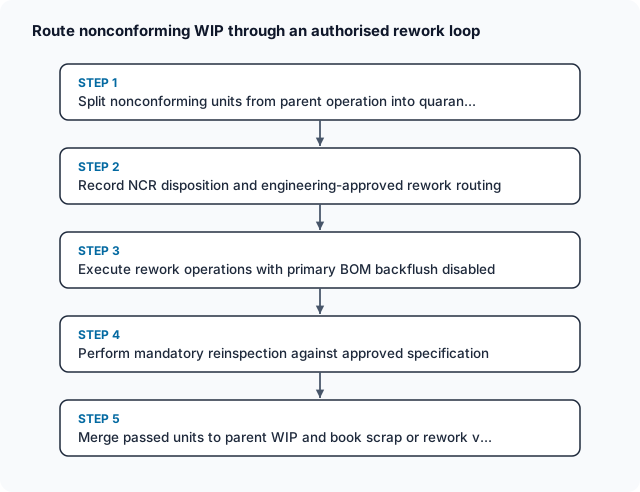
Route nonconforming WIP through an authorised rework loop
Follow the workflow below, or open its complete text version.
Read the complete workflow as text
- Split nonconforming units from parent operation into quaran... → Record NCR disposition and engineering-approved rework routing
- Record NCR disposition and engineering-approved rework routing → Execute rework operations with primary BOM backflush disabled
- Execute rework operations with primary BOM backflush disabled → Perform mandatory reinspection against approved specification
- Perform mandatory reinspection against approved specification → Merge passed units to parent WIP and book scrap or rework v...
Worked example: 50-piece cast-steel pump housing batch (JOB-PH-2026-088)
Consider an illustrative discrete machining job (JOB-PH-2026-088) producing 50 units of a high-pressure cast-steel pump housing (Part PH-440-RevB). All cycle times, labour rates, and rupee figures below are synthetic operational data created to verify rework quantity and cost reconciliation.
Baseline standard job parameters (50 housings)
- Raw casting and pre-machining cost entering
Op 30(Finish Bore & Seal Groove):Rs 4,200.00/unit(Rs 2,10,000.00across50 units). - Standard
Op 30machining cost:0.80 machine hours/unitat an all-in CNC work-centre rate ofRs 1,500.00/hour = Rs 1,200.00/unit(Rs 60,000.00for40.0 hoursacross50 units). - Standard cost per housing after
Op 30:Rs 4,200.00 + Rs 1,200.00 = Rs 5,400.00/unit(Rs 2,70,000.00baseline batch cost for50housings).
What happened at Op 30 inspection and during rework (RWK-088-A)
- In-process inspection (
INSP-088-30): A worn boring insert caused thermal drift on the last8housings (Serials PH-043throughPH-050), leaving the main bearing bore0.04 mmundersize (reworkable by precision honing) and nicking the pre-installed bronze wear ring.- First-pass good output:
42 housings(84.00%first-pass yield) advance toOp 40. - Quarantined for rework (
NCR-2026-312):8 housings(16.00%of batch) transfer toRWK-088-A.
- First-pass good output:
- Incremental rework cost incurred on
RWK-088-A(8 housings):- Replacement bronze wear rings issued (
8 pcs):8 × Rs 450.00 = Rs 3,600.00. - Precision honing (
RWK-Op 10):1.00 hoursetup +0.50 hours/unit × 8 units = 5.00 hoursatRs 1,200.00/hour = Rs 6,000.00. - full-scope CMM reinspection (
RWK-Op 20):0.25 hours/unit × 8 units = 2.00 hoursatRs 1,000.00/hour = Rs 2,000.00. - Total incremental rework spend on
RWK-088-A:Rs 3,600.00 + Rs 6,000.00 + Rs 2,000.00 = Rs 11,600.00(Rs 1,450.00per reworked housing).
- Replacement bronze wear rings issued (
- Reinspection outcome (
INSP-RWK-088-A):- Passed reinspection:
7 housings(PH-043throughPH-049) meet drawing tolerance and merge back intoJOB-PH-2026-088atOp 40, bringing total good batch quantity to42 + 7 = 49 housings(98.00%final net yield). - Failed reinspection (scrapped):
1 housing(PH-050) exhibits an oval bore out of tolerance after honing. Because the configured single-rework limit (Max_Rework_Cycles = 1) is reached,PH-050is disposed asScrapwith an accumulated cost ofRs 5,400.00 (standard cost through Op 30) + Rs 1,450.00 (allocated rework cost) − Rs 350.00 (cast-steel scrap metal recovery credit) = Rs 6,500.00net scrap loss.
- Passed reinspection:
The table below compares the corrupted informal re-scan method against the governed rework-order ledger:
Scroll horizontally to see all columns.
| Metric / ledger line | Informal re-scan on primary Op 30 |
Unrecorded floor touch-up | Governed rework order (RWK-088-A) |
Operational and accounting verification |
|---|---|---|---|---|
Reported Op 30 completed qty (pcs) |
58 pcs (inflated by 8 re-scans) | 50 pcs (masks 1 scrap unit) | 50 pcs machined (42 FPY + 8 to NCR-2026-312) |
Prevents double-counting and false BOM backflush |
Recorded first-pass yield (FPY) |
Not distinguishable (86.21% distorted) |
Falsely appears as 50 ÷ 50 |
84.00% (42 ÷ 50 passed on first run) |
Preserves true process capability signal at Op 30 |
Final good qty merged to Op 40 (pcs) |
57 pcs (corrupted WIP balance) | 49 pcs (1 missing without scrap trail) | 49 pcs (42 FPY + 7 passed RWK-088-A, 98.00% net) |
Exact physical and ledger match at Op 40 |
Standard Op 30 production cost (Rs) |
Rs 69,600.00 (58 × Rs 1,200 over-absorbed) |
Rs 60,000.00 | Rs 60,000.00 (50 × Rs 1,200.00) |
Standard absorption kept clean of rework hours |
Incremental rework cost on RWK-088-A (Rs) |
Hidden in primary hours & material | Hidden in downtime / shop supplies | Rs 11,600.00 (Rs 3,600 mat + Rs 6,000 hone + Rs 2,000 CMM) |
Rs 10,150.00 on 7 recovered units + Rs 1,450.00 on 1 scrapped unit |
Net scrap write-off on PH-050 (Rs) |
Unrecorded | Unrecorded | Rs 6,500.00 (Rs 5,400 + Rs 1,450 − Rs 350 salvage) |
Attributed to NCR-2026-312 with salvage credit |
| Total batch cost accounted (Rs) | Distorted by phantom backflush | Rs 2,70,000.00 (understated by Rs 11,250) | Rs 2,81,250.00 (Rs 2,64,600 std on 49 good + Rs 10,150 rework on 7 good + Rs 6,500 net scrap) |
Rs 2,70,000.00 + Rs 11,600.00 − Rs 350.00 = Rs 2,81,250.00 reconciled |
Arithmetic verification of the batch cost bridge
- Total gross cost input across parent job and rework order:
Rs 2,70,000.00 (50 units through Op 30 at Rs 5,400.00) + Rs 11,600.00 (incremental rework on 8 units) = Rs 2,81,600.00. - Less scrap metal recovery credit on
1scrapped housing (PH-050):Rs 2,81,600.00 − Rs 350.00 = Rs 2,81,250.00net manufacturing cost. - Allocation across outputs:
- 49 good housings advancing to
Op 40:49 × Rs 5,400.00 = Rs 2,64,600.00standard WIP value. - Incremental rework variance on 7 recovered housings:
7 × Rs 1,450.00 = Rs 10,150.00. - Net scrap variance on 1 rejected housing (
PH-050):Rs 5,400.00 + Rs 1,450.00 − Rs 350.00 = Rs 6,500.00. - Total:
Rs 2,64,600.00 + Rs 10,150.00 + Rs 6,500.00 = Rs 2,81,250.00(Rs 0.00unexplained variance).
- 49 good housings advancing to
Governance, ownership, and exception handling
Scroll horizontally to see all columns.
| Decision / control gate | Accountable owner | Required record and system evidence | Exception rule and boundary |
|---|---|---|---|
| Quarantine split & NCR creation | In-process quality inspector | NCR_ID linked to Job_ID, Operation_ID, affected serials/lot, and measured deviation |
Nonconforming units cannot be moved to Op 40 or re-scanned on Op 30 |
| Rework routing approval | Manufacturing engineer & quality engineer | Approved RWK_Order_ID specifying rework steps, tooling, and reinspection plan |
Operators cannot create ad-hoc rework operations or modify drawing tolerances |
| Component issue to rework | Stores / production supervisor | Material issue linked to RWK_Order_ID for replacement components only |
Primary BOM auto-backflush is disabled on rework operations to prevent duplicate casting deductions |
| Reinspection & repeat-failure gate | Quality lead | Signed reinspection record (INSP_RWK_ID) with actual measured values per serial |
Any part failing reinspection after reaching the configured rework cycle limit is routed to MRB / Scrap |
Acceptance tests for rework routing and cost controls
Scroll horizontally to see all columns.
| Test ID | Scenario seeded in test environment | Expected system behavior | Pass/fail verification evidence |
|---|---|---|---|
ACT-M031-01 |
Operator attempts to scan serial PH-043 through primary Op 30 a second time after it was flagged nonconforming |
System blocks the duplicate primary completion scan and prompts for the linked RWK_Order_ID |
Primary Op 30 count remains 50; zero duplicate backflush transactions posted |
ACT-M031-02 |
Release rework order RWK-088-A for 8 housings and complete RWK-Op 10 |
System records 5.00 honing hours and Rs 3,600.00 replacement wear rings without deducting 8 new raw castings |
Rework cost ledger shows Rs 9,600.00 (Rs 3,600 + Rs 6,000); raw casting inventory unchanged |
ACT-M031-03 |
Attempt to merge the 8 housings from RWK-088-A back into parent Op 40 before RWK-Op 20 reinspection is signed off |
System blocks transfer from Quarantine_WIP to Op 40 |
Error Reinspection_Signoff_Required logged; parent Op 40 available quantity remains 42 |
ACT-M031-04 |
Record 7 pass and 1 fail (PH-050) on RWK-Op 20 reinspection |
System transfers 7 housings to Op 40 (49 total good) and routes PH-050 to MRB/Scrap hold |
Parent job good WIP equals 49; PH-050 blocked from further standard rework |
ACT-M031-05 |
Reconcile parent job JOB-PH-2026-088 and RWK-088-A cost summary at batch closure |
Report separates Rs 2,64,600.00 standard WIP, Rs 10,150.00 rework variance, and Rs 6,500.00 net scrap loss |
Total batch ledger equals Rs 2,81,250.00 with 84.00% FPY and 98.00% final net yield preserved |
Summary and next actions
Rework stays under control only when the factory treats corrective operations as a separate, engineering-authorised route rather than an unrecorded detour on the shop floor. Linking every rework order to its originating NCR, disabling primary BOM backflush during rework, and gating return to main-line WIP on documented reinspection keeps both first-pass yield and rework cost visible.
- Configure your MES or ERP to block duplicate completion scans on primary routing operations once a serial or sub-lot has been split to a nonconformance quarantine status.
- Create a controlled rework order template that links directly to the originating
Job_IDandNCR_ID, disables automatic backflush of the parent raw-material BOM, and posts extra labour and replacement parts to a dedicated rework variance account. - Require engineering approval of the rework operation sequence and a mandatory quality reinspection step before reworked units can merge back into parent good WIP.
- Set an illustrative configured maximum rework cycle counter per serial or lot so repeat failures automatically escalate to Material Review Board disposition rather than looping indefinitely on the shop floor.
Compare this workflow with your current setup
Share the step that takes the most manual work, the systems involved and the exceptions your team handles. That gives us a concrete starting point for comparing approaches.
Sources and further reading
Sources checked 15 October 2026. Worked examples and workflow diagrams are original illustrations, not reported client results.


