Release industrial chemical batches against the right approved specification
For production managers, planners and plant leaders · Compare approaches
TL;DR — what you’ll learn
- Releasing an industrial chemical batch against a single generic "internal master specification" allows drums that pass broad catalog limits to ship to customers whose contracted specification requires tighter viscosity, moisture, or colour bands.
- Separate base batch analytical results (bound to the sample identity, test method version, and approved formula revision) from customer-specific allocation and Certificate of Analysis (CoA) eligibility.
- Block batch release and CoA printing whenever a required test method is missing, a retain sample is unlogged, or an analytical result breaches the target customer's active specification version.
- In an illustrative 4,000.0 kg (20 × 200.0 kg drums, Rs 7,20,000.00) industrial polyurethane coating batch (BATCH-PU-2026-215), evaluating actual lab results (Viscosity = 1,460 cP, Water_Content = 0.068%) against customer-specific specification versions blocks a 2,400.0 kg (12-drum, Rs 4,32,000.00) allocation to Customer AeroCoat (whose Spec SPEC-AERO-v3 caps viscosity at 1,420 cP and moisture at 0.050%) while lawfully releasing all 20 drums against approved Standard Industrial Spec SPEC-IND-v2 (1,300–1,550 cP, ≤ 0.10% moisture).

Illustrative manufacturing inspection room and machine shop floor; not a client facility.
Industrial chemical, resin, adhesive, coating, and specialty lubricant manufacturers routinely produce a single base formula in a 4,000 kg or 10,000 kg reactor and fill that batch into drums or IBC totes destined for multiple industrial buyers. While the base chemistry is identical, different customers often contract distinct specification windows—tighter Brookfield viscosity bands for automated spray lines, stricter Karl Fischer moisture limits for moisture-cure applications, or additional test parameters. When the quality lab evaluates the batch against a single generic item master specification and marks the entire lot Unrestricted, warehouse teams can pick and ship those drums to a restricted customer whose specification the batch actually failed.
Three ways chemical batch release workflows fail customer specifications
In process ERP and quality systems—such as ERPNext Quality Inspection, Microsoft Dynamics 365 formula change management, and quality management frameworks aligned with the ISO 9001 catalogue (noting ISO 9001:2026, sixth edition, published 16 September 2026; verify certified scope and licensed clauses for specific requirements)—batch disposition must connect the physical lot to the exact specification governing its intended use. Three recurring design flaws break that connection:
- Collapsing base product specification and customer-specific specifications into one pass/fail flag: If
Item PU-800has an internal catalog viscosity range of1,300–1,550 cP, a batch testing at1,460 cPpasses the item-level check. If the ERP sets the lot status to globallyReleasedwithout checking customer-specific specification overlays, sales order allocation can assign that lot to a customer whose contracted specification (SPEC-AERO-v3) requires1,320–1,420 cP. - Evaluating results against a superseded formula or test-method revision: When a customer updates their specification from
v2tov3(for example, changing viscosity measurement temperature from25 °Cto23 °Cor lowering maximum free-monomer/moisture content), using an unversioned LIMS or spreadsheet template evaluates new batches against obsolete limits. - Treating missing or pending tests as non-blocking during partial release: When a 24-hour salt-spray, pot-life, or Karl Fischer moisture test is still pending while density and solids are already entered, systems that allow manual header sign-off without checking
Mandatory_Tests_Completed == Total_Required_Testscan generate an incomplete Certificate of Analysis (CoA).
Two-tier specification architecture for industrial chemical batch release
This article covers the quality record, specification-matching, and ERP release-gating workflow for non-clinical industrial chemical batches; actual analytical methods, safety/SDS controls, and specification limits must be defined by qualified chemists and approved customer specifications.
To prevent mis-allocation while preserving inventory flexibility, structure batch release into two linked tiers:
Tier 1: Base batch analytical verification and disposition (Batch_Release_Record)
Before any drum or tank quantity leaves Quality_Quarantine, the quality manager reviews the base batch record containing:
Batch_ID,Formula_ID_and_Version, andProduction_Completion_Timestamp.- Verified
Sample_IDchain of custody (composite tank sample vs top/middle/bottom drum samples) and loggedArchive_Retain_Sample_ID. - Complete analytical result set (
Parameter_ID,Test_Method_Ref,Instrument_ID,Raw_Result,Unit_of_Measure,Analyst_ID, andTest_Timestamp). - Automated comparison against the Base Master Specification (
SPEC-BASE-vX) and every Customer Specification Profile (SPEC-CUST-vY) mapped to that item.
Tier 2: Specification-qualified stock matrix and CoA generation gate
Instead of a binary Blocked / Unrestricted flag, the ERP records a Specification Qualification Matrix on the batch lot:
- For each mapped specification profile (
SPEC-IND-v2,SPEC-AERO-v3,SPEC-AUTO-v1), the system computesQualification_State(Qualified,Disqualified_Out_Of_Spec, orIncomplete_Missing_Test). - Sales-order reservation and outbound delivery picking verify that the batch's
Qualification_StateisQualifiedfor the exactCustomer_Spec_Versionon the sales order line. - The Certificate of Analysis (
CoA) generator pulls the batch's verified lab results alongside the customer's exact contractedLSL / USLand test-method references, refusing to print or email a CoA if any parameter isDisqualifiedorIncomplete.
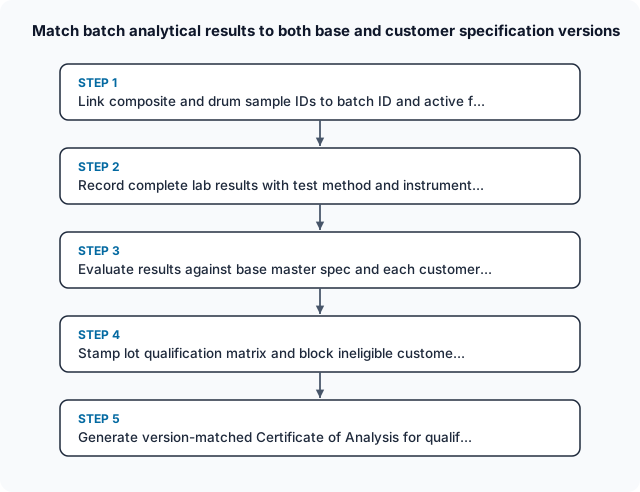
Match batch analytical results to both base and customer specification versions
Follow the workflow below, or open its complete text version.
Read the complete workflow as text
- Link composite and drum sample IDs to batch ID and active f... → Record complete lab results with test method and instrument...
- Record complete lab results with test method and instrument... → Evaluate results against base master spec and each customer...
- Evaluate results against base master spec and each customer... → Stamp lot qualification matrix and block ineligible custome...
- Stamp lot qualification matrix and block ineligible custome... → Generate version-matched Certificate of Analysis for qualif...
Worked example: 4,000 kg polyurethane coating batch (BATCH-PU-2026-215)
Consider an illustrative industrial two-component polyurethane topcoat base batch (BATCH-PU-2026-215, Item PU-COAT-800, Formula FRM-PU800-v5, batch size 4,000.0 kg filled into 20 drums × 200.0 kg, valued at Rs 180.00/kg = Rs 7,20,000.00). All specification placeholders, analytical readings, and rupee figures below are synthetic operational data constructed to verify multi-specification batch release controls.
Active specification versions mapped to PU-COAT-800
- Standard Industrial Catalog Spec (
SPEC-IND-v2— applies to CustomerIndBuildOrderSO-901for8 drums = 1,600.0 kg,Rs 2,88,000.00):- Non-volatile solids (
% w/w):63.0%to67.0% - Brookfield viscosity (
25 °C, Spindle 3, 20 rpm):1,300 cPto1,550 cP - Density (
25 °C):1.120 g/cm³to1.160 g/cm³ - Karl Fischer moisture (
% w/w):≤ 0.10%
- Non-volatile solids (
- Tight-Tolerance Aerospace/Precision Spray Spec (
SPEC-AERO-v3— applies to CustomerAeroCoatOrderSO-904for12 drums = 2,400.0 kg,Rs 4,32,000.00):- Non-volatile solids (
% w/w):64.0%to66.0% - Brookfield viscosity (
25 °C, Spindle 3, 20 rpm):1,320 cPto1,420 cP(tighter atomisation ceiling) - Density (
25 °C):1.130 g/cm³to1.150 g/cm³ - Karl Fischer moisture (
% w/w):≤ 0.050%(stricter isocyanate pot-life protection) - Fineness of grind (
Hegman gauge):≥ 7.0 Hegman(additional customer-specific test required onSPEC-AERO-v3)
- Non-volatile solids (
Analytical results recorded on BATCH-PU-2026-215 (Sample SMP-PU-215-C, Retain RET-PU-215)
- Non-volatile solids:
64.8%(Passes bothSPEC-IND-v2andSPEC-AERO-v3) - Brookfield viscosity:
1,460 cP(PassesSPEC-IND-v2[1,300–1,550 cP], FailsSPEC-AERO-v3[1,320–1,420 cP]by+40 cP) - Density:
1.142 g/cm³(Passes bothSPEC-IND-v2andSPEC-AERO-v3) - Karl Fischer moisture:
0.068%(PassesSPEC-IND-v2[≤ 0.10%], FailsSPEC-AERO-v3[≤ 0.050%]by+0.018%) - Fineness of grind: Initially left blank by the shift technician (
Incomplete_Missing_Test), then measured at7.5 Hegmanafter system block.
The table below reconciles the batch analytical results against both specification profiles and shows the resulting stock allocation decision:
Scroll horizontally to see all columns.
| Analytical parameter / disposition line | Recorded lab result (SMP-PU-215-C) |
Evaluation vs SPEC-IND-v2 (Standard Industrial) |
Evaluation vs SPEC-AERO-v3 (Customer AeroCoat) |
System allocation and CoA gate decision |
|---|---|---|---|---|
Non-volatile solids (% w/w) |
64.8% |
Pass (63.0%–67.0%) |
Pass (64.0%–66.0%) |
Meets both specification bands |
Brookfield viscosity (cP at 25 °C) |
1,460 cP |
Pass (1,300–1,550 cP) |
FAIL (1,320–1,420 cP; +40 cP over USL) |
Disqualifies lot for SPEC-AERO-v3 |
Density at 25 °C (g/cm³) |
1.142 g/cm³ |
Pass (1.120–1.160 g/cm³) |
Pass (1.130–1.150 g/cm³) |
Meets both specification bands |
Karl Fischer moisture (% w/w) |
0.068% |
Pass (≤ 0.10%) |
FAIL (≤ 0.050%; +0.018% over USL) |
Second disqualifying breach for SPEC-AERO-v3 |
Fineness of grind (Hegman) |
7.5 Hegman (entered after initial missing-test block) |
Not required (Informational) |
Pass (≥ 7.0 Hegman) |
System blocked evaluation until missing test was logged |
Archive retain sample (RET-PU-215) |
1.0 kg sealed & indexed |
Verified | Verified | Required before any release sign-off |
| Lot qualification matrix state | Evaluated across 2 profiles | QUALIFIED (SPEC-IND-v2) |
DISQUALIFIED (SPEC-AERO-v3) |
Lot released ONLY for SPEC-IND-v2 orders |
Order allocation (20 drums = 4,000 kg) |
Rs 7,20,000.00 total batch | 8 drums (1,600 kg = Rs 2,88,000) allocated to SO-901 + 12 drums (2,400 kg = Rs 4,32,000) held in SPEC-IND-v2 stock |
0 drums (Rs 0.00) — SO-904 (2,400 kg) blocked from picking BATCH-PU-2026-215 |
Prevents Rs 4,32,000.00 off-spec shipment without scrapping a valid Rs 7,20,000.00 industrial batch |
Arithmetic and operational verification
- Batch quantity and value conservation:
- Total batch produced:
20 drums × 200.0 kg = 4,000.0 kgatRs 180.00/kg = Rs 7,20,000.00. - Immediate compliant dispatch against
SO-901(SPEC-IND-v2):8 drums × 200.0 kg = 1,600.0 kg(40.00%of batch,Rs 2,88,000.00). - Remaining compliant
SPEC-IND-v2inventory available for standard catalog orders:12 drums × 200.0 kg = 2,400.0 kg(60.00%of batch,Rs 4,32,000.00). - Total accounted:
1,600.0 kg (Rs 2,88,000.00) + 2,400.0 kg (Rs 4,32,000.00) = 4,000.0 kg (Rs 7,20,000.00).
- Total batch produced:
- Preventing two opposite costly errors:
- Avoiding an off-spec shipment (
Rs 4,32,000.00exposure): Under a single item-level pass/fail flag,BATCH-PU-2026-215would have been markedUnrestrictedunder catalog limits (1,300–1,550 cP) and picked forAeroCoat(SO-904,12 drums = Rs 4,32,000.00), causing a customer line reject for high viscosity (1,460 cP > 1,420 cP) and excess moisture (0.068% > 0.050%). - Avoiding unnecessary rework or write-off (
Rs 7,20,000.00preserved): Because the system evaluates qualification per specification profile, the batch does not need to be downgraded or scrapped; all20 drums(4,000.0 kg) are fully conforming underSPEC-IND-v2, while production schedules a fresh low-moisture batch forSO-904.
- Avoiding an off-spec shipment (
Roles, approval authorities, and exception handling
Scroll horizontally to see all columns.
| Control gate | Accountable owner | Required system record and evidence | Exception handling and boundary |
|---|---|---|---|
| Specification profile & version maintenance | Quality assurance manager & technical manager | Active Spec_Profile_ID and Version_ID linked to customer master / item-customer cross-reference |
Lab analysts cannot edit specification limits (LSL/USL) on an individual batch record |
| Sample identity & complete result entry | QC lab analyst | Sample_ID, Retain_Sample_ID, Test_Method_Ref, Instrument_ID, and all mandatory parameter readings |
Missing mandatory test results or unlogged retain samples hold disposition in Incomplete_Evidence |
| Batch disposition & matrix sign-off | Quality manager / authorised release person | Electronic signature stamping the batch's Specification_Qualification_Matrix |
Contradictory duplicate tests (e.g., Tank vs Drum sample mismatch) trigger an OOS_Investigation hold before any release |
| Customer concession / deviation waiver | Quality manager + commercial owner (with written customer waiver) | Uploaded customer concession reference (CONC_ID) bound to specific SO_Line_ID and Batch_ID |
An approved concession releases only the designated sales order line, never reclassifying the batch as globally compliant |
Acceptance tests for specification-bound chemical batch release
Scroll horizontally to see all columns.
| Test ID | Scenario seeded in test environment | Expected system behavior | Pass/fail verification evidence |
|---|---|---|---|
ACT-M041-01 |
Attempt to evaluate BATCH-PU-2026-215 against SPEC-AERO-v3 while Fineness of Grind reading is blank |
System blocks SPEC-AERO-v3 qualification and sets status to Incomplete_Missing_Test |
Missing test cannot default to a pass or be omitted from the CoA |
ACT-M041-02 |
Record Viscosity = 1,460 cP and Moisture = 0.068% and run multi-spec evaluation |
System marks SPEC-IND-v2 = Qualified and SPEC-AERO-v3 = Disqualified_Out_Of_Spec |
Qualification matrix accurately reflects per-spec pass/fail state on the same batch |
ACT-M041-03 |
Sales operations or warehouse attempts to allocate 12 drums (2,400.0 kg) of BATCH-PU-2026-215 to AeroCoat Order SO-904 (SPEC-AERO-v3) |
System blocks inventory reservation and picking with Batch_Disqualified_For_Customer_Spec |
Zero drums of BATCH-PU-2026-215 can be picked or shipped against SO-904 |
ACT-M041-04 |
Allocate 8 drums (1,600.0 kg) of BATCH-PU-2026-215 to IndBuild Order SO-901 (SPEC-IND-v2) and generate CoA |
System allows allocation and prints CoA displaying SPEC-IND-v2 limits (1,300–1,550 cP, ≤ 0.10%) and actual results (1,460 cP, 0.068%) |
CoA header cites exact SPEC-IND-v2, FRM-PU800-v5, and SMP-PU-215-C |
ACT-M041-05 |
Seed conflicting top-drum (1,455 cP) and bottom-drum (1,610 cP) viscosity results on the same batch |
System flags Sample_Homogeneity_Conflict and blocks release across all specifications |
Requires formal lab investigation before disposition |
Summary and next actions
Industrial chemical batch release is safe only when the quality system evaluates test results against the exact specification version governing each customer order rather than a single catalog average. Maintaining a per-batch specification qualification matrix prevents off-spec customer shipments while allowing batches that meet standard catalog limits to be allocated to eligible orders without waste.
- Map every customer-specific chemical specification (
Spec_IDandVersion_ID) to the customer-item cross-reference in your ERP and LIMS rather than relying on a single item-level specification. - Require every batch release record to capture the sample identity, retain-sample log, test-method reference, and complete parameter set before disposition can be signed off.
- Configure batch release to stamp a specification qualification matrix on each lot so outbound picking and reservation automatically block orders whose customer specification the batch did not pass.
- Generate Certificates of Analysis (
CoA) directly from the locked batch analytical record and the customer order's active specification version, blocking CoA output whenever any required parameter is missing or out of tolerance.
Compare this workflow with your current setup
Share the step that takes the most manual work, the systems involved and the exceptions your team handles. That gives us a concrete starting point for comparing approaches.
Sources and further reading
Sources checked 15 October 2026. Worked examples and workflow diagrams are original illustrations, not reported client results.


