Make cure age and test status visible before releasing building materials
For production managers, planners and plant leaders · Compare approaches
TL;DR — what you’ll learn
- In precast concrete, autoclaved blocks, cementitious boards, and composite building elements, a unit sitting in the stockyard after demoulding looks identical whether it is 2 days old, awaiting 28-day compressive strength testing, or fully certified for structural erection.
- Separate ERP inventory status into three distinct operational gates: Physical Production Completion (Demoulded_In_Yard), Cure Age / Maturity Gate (Cure_Window_Met), and Quality Test Disposition (Compressive_And_Dimensional_Approved).
- Never configure the ERP to auto-release curing stock to Dispatchable_Available solely because a calendar timer elapsed; elapsed cure age only makes the lot eligible for final release verification alongside its required strength and dimensional test evidence.
- In an illustrative 120-unit precast box-culvert stockyard snapshot (YARD-PC-2026-10, valued at Rs 28,000.00/unit = Rs 33,60,000.00 total yard stock), separating 45 immature curing units (Cast Lot CL-103, Rs 12,60,000.00), 30 age-met units whose 28-day companion cubes failed compressive target (Cast Lot CL-102, Rs 8,40,000.00 held on NCR-PC-88), and 45 fully age-and-test-approved units (Cast Lot CL-101, Rs 12,60,000.00) prevents sales from promising 75 uncertified culvert segments for immediate site installation.

Illustrative manufacturing inspection room and machine shop floor; not a client facility.
In building-material plants manufacturing precast concrete segments, prestressed hollow-core slabs, AAC blocks, fibre-cement boards, or cured refractory shapes, physical production finishes days or weeks before the product achieves its specified structural properties. As soon as moulds are stripped and units are stacked in the open stockyard, standard ERP work-order completion transactions add those pieces to finished-goods inventory. If the inventory screen does not distinguish physically stacked stock from cure-age-verified and test-released stock, dispatch planners book transport trailers for segments that have not reached their required curing age or whose companion test cubes failed strength criteria.
Why calendar timers and work-order completion flags fail building-material release
Under product traceability and quality inspection models—such as the GS1 Global Traceability Standard and ERPNext Quality Inspection—moving a manufactured lot into unrestricted dispatchable stock requires both identity continuity (linking each cast unit to its concrete batch and companion test specimens) and verified conformity against the approved product standard.
Three operational failures occur when plants rely on simple work-order completion or a passive calendar maturity date:
- Demoulding completion is mistaken for dispatch availability: Stripping a precast culvert from its steel mould at
18–24 hours(once demoulding/lifting strength is reached) frees the mould for the next pour and moves the segment to the yard. If the ERP treats that routing completion asAvailable_To_Promise (ATP), commercial teams see120 unitsin stock when only45are structurally releasable. - Calendar-only auto-release ignores failed or missing destructive tests: Some ERP configurations place cast lots on a timed hold (for example,
Hold_Days = 7or28) that automatically flips toReleasedat midnight on the target day. If the laboratory's 28-day companion cube compression test was delayed, or if the cube crushed below the specified characteristic strength, a calendar timer silently releases nonconforming structural elements for shipment. - Yard stack mixing breaks cast-date and cube-specimen linkage: Large precast elements are moved by gantry cranes across yard bays as older stock ships out. Without a durable unit/lot identifier (
Cast_Lot_ID + Serial_ID) linking each stacked piece to its exact pour timestamp, curing regime, and companion cube/core test batch, yard crews load newer front-row segments ahead of certified back-row stock.
Three-gate readiness architecture for cured building materials
This article describes the inventory-state, test-linkage, and dispatch-gating workflow for building materials; specific curing durations, steam-cure temperature profiles, compressive strength thresholds, and structural core testing rules must come from the applicable national product standard, structural design specification, and qualified engineering authority.
To make stockyard readiness unambiguous for production, quality, and dispatch teams, every cast lot (Cast_Lot_ID) must pass three sequential gates before entering Dispatchable_Available inventory:
- Gate 1 — Physical Demoulding & Yard Intake (
State: In_Curing_Yard): Recorded when the unit passes initial demoulding/lifting checks and visual surface inspection, capturingCast_Lot_ID,Unit_Serial_IDs,Batch_Mix_Ref,Pour_Completion_Timestamp,Companion_Specimen_Set_ID, andYard_Bay_Location. Stock is visible for financial WIP/finished-goods valuation and future capacity planning, but hard-blocked (ATP_Now = 0) for immediate loading. - Gate 2 — Approved Cure Age / Maturity Window (
State: Cure_Age_Met_Pending_Test): EvaluatesElapsed_Cure_Time = Current_Timestamp − Pour_Completion_Timestampagainst the approved specification age criterion (T_cure_min, an illustrative configured parameter per product specification—such as a 7-day early-dispatch criterion or a 28-day standard cure criterion, subject to project engineering specification). ReachingT_cure_mindoes not release the lot; it unlocks final release review in the quality queue. - Gate 3 — Verified Test & Dimensional Release (
State: Approved_For_Dispatch): Requires recorded, passing laboratory test results for the linkedCompanion_Specimen_Set_ID(for example, companion cube compressive strengthMPa, dimensional tolerance check, and reinforcement cover verification) signed off by the authorised quality engineer. Any failed specimen routes the entire linked cast lot toStructural_Quarantine_Hold (NCR).
Separate demoulded yard stock, cure-age eligibility, and test-approved release
Follow the workflow below, or open its complete text version.
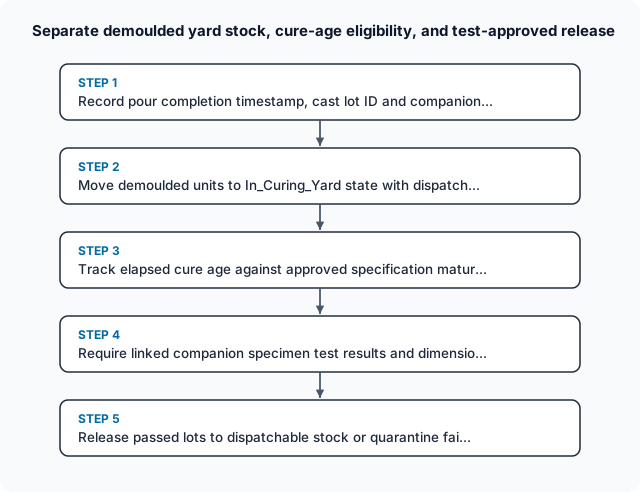
Read the complete workflow as text
- Record pour completion timestamp, cast lot ID and companion... → Move demoulded units to In_Curing_Yard state with dispatch...
- Move demoulded units to In_Curing_Yard state with dispatch... → Track elapsed cure age against approved specification matur...
- Track elapsed cure age against approved specification matur... → Require linked companion specimen test results and dimensio...
- Require linked companion specimen test results and dimensio... → Release passed lots to dispatchable stock or quarantine fai...
Worked example: 120-unit precast concrete box-culvert stockyard (YARD-PC-2026-10)
Consider an illustrative stockyard readiness reconciliation on 2026-10-20 at 09:00 for 120 heavy precast concrete box-culvert segments (Item PC-CULV-2000X2000, unit standard cost Rs 28,000.00/segment, total physical yard value Rs 33,60,000.00) across three cast lots (CL-101, CL-102, CL-103). All cure windows (28 days), target strength values (40.0 MPa illustrative project specification placeholder), and rupee valuations below are synthetic operational data constructed to verify stock-state separation.
Illustrative approved project specification criteria (SPEC-HWY-CULV-v4)
- Required standard curing age before structural dispatch (
T_cure_min):28.0 days(672.0 hours) from pour completion (unless a separate project-engineer early-strength concession is issued). - Required 28-day companion cube compressive strength: Individual cube
≥ 36.0 MPaand 3-cube mean≥ 40.0 MPaon linked specimen set (3 cubestested at7 daysfor trend,3 cubestested at28 daysfor release).
Status of the three cast lots in the stockyard on 2026-10-20
- Cast Lot
CL-101(45 segments, SerialsCULV-001..045, valueRs 12,60,000.00):- Pour completed:
2026-09-18 14:00(Elapsed age = 31.8 days ≥ 28.0 daysrequired). - 28-day companion cube set (
CUBE-101-28D, tested2026-10-16): Readings =42.5, 43.1, 41.9 MPa(Mean = 42.50 MPa ≥ 40.0 MPa; dimensional check passed). - Governed state:
Approved_For_Dispatch(45 segments = Rs 12,60,000.00ready to load today).
- Pour completed:
- Cast Lot
CL-102(30 segments, SerialsCULV-046..075, valueRs 8,40,000.00):- Pour completed:
2026-09-21 10:00(Elapsed age = 29.0 days ≥ 28.0 daysrequired). - 28-day companion cube set (
CUBE-102-28D, tested2026-10-19): Readings =34.2, 35.8, 35.0 MPa(Mean = 35.00 MPa below 40.0 MParequired due to an admixture dosing pump fault during Batch Pour102). - Governed state:
Structural_Quarantine_Hold(NCR-PC-88) pending non-destructive rebound/core testing and structural engineer review (0 segmentsdispatchable today; demonstrates why a 28-day calendar timer alone would have dangerously releasedCL-102).
- Pour completed:
- Cast Lot
CL-103(45 segments, SerialsCULV-076..120, valueRs 12,60,000.00):- Pour completed:
2026-10-08 16:00(Elapsed age = 11.7 days below 28.0 daysrequired; 28-day maturity date is2026-11-05 16:00). - 7-day trend cube set (
CUBE-103-07D, tested2026-10-15):Mean = 29.40 MPa(on track, 28-day release test pending on2026-11-05). - Governed state:
In_Curing_Yard_Immature(0 segmentsdispatchable today; earliest projected availability2026-11-06subject to passingCUBE-103-28D).
- Pour completed:
The table below reconciles the naive ERP stock view against the three-gate readiness board:
Scroll horizontally to see all columns.
| Cast lot ID & yard bay | Physical segments in yard (pcs & Rs) |
Elapsed cure age vs 28.0-day spec |
Companion 28-day cube mean vs 40.0 MPa spec |
Naive ERP Finished_Goods view (pcs) |
Calendar-only 28-day auto-release view (pcs) |
Governed 3-gate dispatchable stock (pcs & Rs) |
|---|---|---|---|---|---|---|
CL-101 (Bay A-01..03) |
45 pcs (Rs 12,60,000.00) | 31.8 days (Met) |
42.50 MPa (Pass CUBE-101-28D) |
45 pcs | 45 pcs | 45 pcs (Rs 12,60,000.00) |
CL-102 (Bay B-01..02) |
30 pcs (Rs 8,40,000.00) | 29.0 days (Met) |
35.00 MPa (FAIL CUBE-102-28D → NCR-PC-88) |
30 pcs (false ATP) | 30 pcs (false calendar release) | 0 pcs (Rs 0.00 — Rs 8,40,000 on NCR-PC-88 hold) |
CL-103 (Bay C-01..03) |
45 pcs (Rs 12,60,000.00) | 11.7 days (Immature; due 2026-11-05) |
Pending (7D trend = 29.40 MPa) |
45 pcs (false ATP) | 0 pcs | 0 pcs (Rs 0.00 — Rs 12,60,000 curing until Nov 5) |
| Total stockyard position | 120 pcs (Rs 33,60,000.00) | 75 pcs age-met / 45 pcs curing | 45 pcs passed / 30 pcs failed / 45 pcs pending | 120 pcs (full overstated) | 75 pcs (62.50% — includes 30 failed pcs) | 45 pcs (Rs 12,60,000.00 / 37.50% truly dispatchable) |
Arithmetic verification of stockyard states
- Physical quantity and valuation reconciliation:
45 pcs (CL-101, Approved_For_Dispatch) + 30 pcs (CL-102, Structural_Quarantine_Hold) + 45 pcs (CL-103, In_Curing_Yard_Immature) = 120 segments(37.50% + 25.00% + 37.50%).- Financial valuation:
Rs 12,60,000.00 + Rs 8,40,000.00 + Rs 12,60,000.00 = Rs 33,60,000.00(Rs 0.00unallocated balance).
- Quantifying dispatch error prevented:
- A standard ERP completion view overstates immediate dispatch availability by
120 − 45 = 75 segments(Rs 21,00,000.00, or62.50%of yard stock). - A calendar-only
28-dayrule correctly holdsCL-103(45 pcs), but still falsely releases30 failed segments(CL-102,Rs 8,40,000.00) whose 28-day cube strength (35.00 MPa) fell5.00 MPashort of the40.0 MPaproject requirement.
- A standard ERP completion view overstates immediate dispatch availability by
Roles, approval boundaries, and exception controls
Scroll horizontally to see all columns.
| Workflow gate | Accountable owner | Required system record and evidence | Exception handling and boundary |
|---|---|---|---|
Pour & specimen registration (Gate 1) |
Batching / casting supervisor | Cast_Lot_ID, Pour_Completion_Timestamp, Unit_Serial_IDs, and barcoded Companion_Specimen_Set_ID |
Demoulded units default strictly to In_Curing_Yard (ATP_Now = 0) |
Cure-age window rule (Gate 2) |
Quality engineer | Approved product specification (SPEC_ID) defining required cure age/maturity criteria |
Reaching the target cure date moves status only to Cure_Age_Met_Pending_Test, never directly to Approved_For_Dispatch |
Strength & dimensional release (Gate 3) |
Quality manager | Verified compression test readings (MPa) for all specimens in Companion_Specimen_Set_ID plus dimensional check |
Missing specimen results or any reading below specification routes the entire Cast_Lot_ID to Structural_Quarantine_Hold |
| Early-age dispatch or structural concession | Qualified structural engineer + customer representative + quality manager | Formal engineering concession (CONC_ID) with verified early-strength test evidence |
Commercial or logistics planners cannot override In_Curing_Yard or Quarantine_Hold flags |
Acceptance tests for cure-age and test-status release controls
Scroll horizontally to see all columns.
| Test ID | Scenario seeded in test environment | Expected system behavior | Pass/fail verification evidence |
|---|---|---|---|
ACT-M042-01 |
Complete demoulding of 45 segments in CL-103 (11.7 days elapsed vs 28.0 days required) and attempt to create a customer delivery note |
System places CL-103 in In_Curing_Yard_Immature and blocks delivery note creation |
Error Cure_Age_And_Release_Test_Not_Satisfied logged; ATP_Now for CL-103 equals 0 |
ACT-M042-02 |
Advance system clock past 28.0 days for CL-102 (29.0 days elapsed) before CUBE-102-28D test results are entered |
System transitions CL-102 to Cure_Age_Met_Pending_Test and keeps dispatch hard-blocked |
Proves elapsed calendar duration alone cannot release stock without test evidence |
ACT-M042-03 |
Enter CUBE-102-28D compression readings (34.2, 35.8, 35.0 MPa, Mean = 35.00 MPa below 40.0 MPa) |
System marks CL-102 (30 pcs, Rs 8,40,000.00) Failed, moves stock to Structural_Quarantine_Hold, and generates NCR-PC-88 |
All 30 serials (CULV-046..075) locked from crane loading and sales allocation |
ACT-M042-04 |
Crane operator scans serial CULV-052 (from failed CL-102 in Bay B) while loading a trailer assigned to order SO-CULV-19 |
Handheld terminal sounds an audio/visual block (Unit_In_Structural_Quarantine) and directs operator to Bay A (CL-101) |
Prevents physical yard loading mix-ups between adjacent stacks |
ACT-M042-05 |
Enter passing CUBE-101-28D readings (Mean = 42.50 MPa) and quality manager signature on CL-101 (31.8 days age) |
System moves 45 segments (Rs 12,60,000.00) of CL-101 to Approved_For_Dispatch |
Stockyard board shows 45 dispatchable, 30 quarantine, and 45 curing (120 total) |
Summary and next actions
Stockyard inventory for precast concrete and cured building materials is trustworthy only when the ERP separates physical demoulding completion, elapsed curing age, and verified laboratory test approval into three distinct states. Blocking calendar-only auto-release ensures no structural element leaves the yard merely because a date arrived on the schedule.
- Split finished-goods stock statuses for cured building materials into
In_Curing_Yard_Immature,Cure_Age_Met_Pending_Test,Structural_Quarantine_Hold, andApproved_For_Dispatchso sales and logistics see true immediate availability (ATP). - Link every demoulded unit serial or pallet lot to its exact pour timestamp and barcoded companion test-specimen set (
Cube/Core_Set_ID) at the moment of casting. - Disable any ERP rule that automatically releases stock when a calendar curing period expires; require passing laboratory specimen results and quality sign-off to unlock dispatch.
- Enforce barcode scanning of unit or lot tags at gantry-crane loading so immature or quarantined cast lots cannot be loaded in place of certified yard stock.
Compare this workflow with your current setup
Share the step that takes the most manual work, the systems involved and the exceptions your team handles. That gives us a concrete starting point for comparing approaches.
Sources and further reading
Sources checked 15 October 2026. Worked examples and workflow diagrams are original illustrations, not reported client results.


