Balance industrial process batches across output, by-product and loss
For production managers, planners and plant leaders · Compare approaches
TL;DR — what you’ll learn
- Process manufacturing batches rarely convert a single input charge into one finished item; they produce primary specification output, recoverable co-products or solvent/wash heels, QC retention samples, and vapour or filter cake losses.
- Normalize every input and output stream to a consistent physical basis (mass in kilograms, corrected for density and temperature when flowmeters measure volume in litres) before computing batch mass balance.
- Never configure the ERP to auto-plug the difference between charged inputs and drummed primary output into "evaporation/process waste"; hold unexplained variance above the approved instrument tolerance band for process engineering review.
- In an illustrative 2,500.0 kg industrial water-based acrylic dispersion teaching batch (BATCH-ACR-2026-042), reconciling 2,180.0 kg of drummed primary resin, 165.0 kg of recoverable wash-water heel, 5.0 kg of QC samples, and 92.0 kg of measured condenser distillate and filter cake isolates an 18.0 kg (0.72%) unexplained deficit caused by a Coriolis meter calibration offset rather than a 320.0 kg (12.80%) false yield loss.

Illustrative manufacturing inspection room and machine shop floor; not a client facility.
When a process plant blends, reacts, or distils a batch, the physical material leaving the vessel splits across multiple streams: primary packaged product, secondary by-products or recyclable wash heels, laboratory samples, filter cake residue, and vapour condensate. If the ERP batch ticket records only total raw materials charged and primary drums filled, any change in vessel heel retention, by-product recovery, or density conversion looks like a swing in reaction yield. Before automating batch completion or standard-cost variance postings, process and quality owners must define every approved output category in the master formula and reconcile measured weights across all discharge streams.
Why single-output batch tickets distort process manufacturing yield
Discrete assembly work orders count integer pieces, whereas industrial process batches—such as resins, coatings, lubricants, surfactants, and industrial salts—transform bulk liquids, powders, and slurries across vessels, filters, and filling lines. Three recurring data errors prevent standard ERP work orders from closing an accurate batch mass balance:
- Missing formula output categories for co-products and recycle heels: In process ERPs such as Microsoft Dynamics 365 formula and co-product/by-product management, a master formula must explicitly declare primary output, co-products (which carry inventory value or re-use identity), and by-products or burden waste. When a formula lists only the primary product, operators either leave recoverable flush heels unrecorded on the plant floor or book them as ad-hoc inventory adjustments detached from the originating batch.
- Mixing volumetric flowmeter readings with gravimetric drum weights: Charging monomer or solvent through a volumetric flowmeter in
litresat32 °Cand weighing finished drums on a platform scale inkilogramswithout applying the specific gravity (kg/L) conversion creates phantom mass gains or losses on every batch. - Auto-plugging residual differences into evaporation or filter waste: Many ERP templates compute
Waste = Total_Charge - Primary_Outputautomatically at batch closure. That formula guarantees a "balanced" ledger on paper while hiding leaking transfer valves, unrecorded drums, or uncalibrated load cells.
Under cross-sector transformation traceability principles such as the GS1 Global Traceability Standard, a batch transformation record is complete only when each input lot and quantity reconciles against measured output lots, retained recycle streams, and explicitly bounded measurement uncertainty.
Designing a multi-output batch mass-balance model
This article describes the data, unit-conversion, and governance workflow for batch mass reconciliation; it does not provide chemical reaction instructions, hazardous operating parameters, or environmental discharge authorisations. To make batch yield reporting auditable, configure each master formula version with five distinct mass-balance buckets:
- Input Stream (
M_in): Total mass (kg) of all raw materials, catalysts, water, and recycled heel charged to the vessel, derived either directly from calibrated vessel load cells / weigh scales or from volumetric flowmeters multiplied by measured batch density (Volume_L × Density_kg_per_L). - Output Class 1 — Primary finished product (
M_primary): Net mass (kg) of approved primary output filled into drums, IBC totes, or bulk storage tanks. - Output Class 2 — Recoverable by-product or recycle heel (
M_recycle): Net mass (kg) of secondary marketable co-product, recovered solvent distillate, or line-flush heel held in a designated intermediate tank for re-use in a specified subsequent batch family. - Output Class 3 — Controlled QC and retention samples (
M_sample): Mass (kg) drawn for in-process testing, final release inspection, and archive retention samples. - Output Class 4 — Measured process residue and abatement capture (
M_waste_measured): Mass (kg) of weighed filter-press cake, knocked-out condenser water/distillate, and vessel scraping residue transferred to labelled waste containers. - Unresolved Mass Balance Delta (
M_delta):M_delta = M_in − (M_primary + M_recycle + M_sample + M_waste_measured). Each formula version defines an illustrative configured mass-balance tolerance band (for example,±0.50%ofM_inbased on combined load-cell and flowmeter uncertainty, subject to site engineering validation). Any batch whose|M_delta|exceeds that band is held inPending_Mass_Balance_Reviewrather than auto-closed.
Reconcile multi-stream batch outputs before closing the batch record
Follow the workflow below, or open its complete text version.
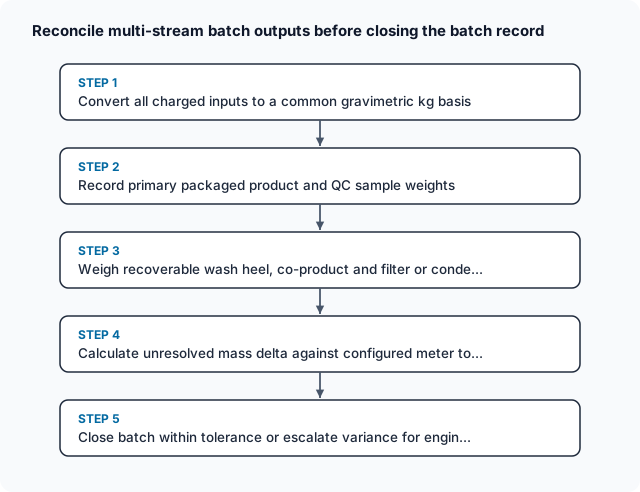
Read the complete workflow as text
- Convert all charged inputs to a common gravimetric kg basis → Record primary packaged product and QC sample weights
- Record primary packaged product and QC sample weights → Weigh recoverable wash heel, co-product and filter or conde...
- Weigh recoverable wash heel, co-product and filter or conde... → Calculate unresolved mass delta against configured meter to...
- Calculate unresolved mass delta against configured meter to... → Close batch within tolerance or escalate variance for engin...
Worked example: 2,500 kg acrylic dispersion batch (BATCH-ACR-2026-042)
Consider an illustrative non-hazardous teaching batch (BATCH-ACR-2026-042) producing a water-based industrial acrylic polymer dispersion under approved formula FRM-ACR-108-v4. All weights, densities, and tolerances below are synthetic data constructed to demonstrate multi-stream mass-balance reconciliation.
Charged inputs (M_in = 2,500.0 kg)
- Deionised water charge (weigh tank
WT-01):1,150.0 kg. - Acrylic monomer pre-emulsion (charged via volumetric meter
FM-04):1,250.0 litresmeasured at25 °Cwith verified specific gravity0.960 kg/L = 1,200.0 kg. (Note: Before unit normalisation, a naive spreadsheet summed1,250.0 Ldirectly as1,250.0 kg, overstating total batch input by50.0 kg.) - Initiator, surfactant, and neutraliser solution (platform scale
SC-02):150.0 kg.
- Total normalised gravimetric input (
M_in):1,150.0 kg + 1,200.0 kg + 150.0 kg = 2,500.0 kg.
Discharged outputs and measured residues
At batch discharge through a bag filter into 200.0 kg net drums, the production operator records the following physical streams:
- Primary finished product (
M_primary):10 full drums × 200.0 kg + 1 partial drum × 180.0 kg = 2,180.0 kg(87.20%ofM_in). - Recoverable line-flush and vessel wash heel (
M_recycle):165.0 kgof dilute acrylic wash water pumped into Dedicated Hold TankHT-WASH-03(Lot WSH-042, assayed at18.0%solids for metered re-use in the next dark-tint dispersion batch). - In-process and final QC retention samples (
M_sample):10 sample bottles × 0.50 kg = 5.0 kglogged in LIMS (SMP-ACR-042). - Measured process residue (
M_waste_measured):- Condenser overhead distillate collected in receiver pot
RP-02:64.0 kg. - Bag-filter coagulum and vessel wall scrapings weighed into Drum
WST-042:28.0 kg. - Total measured waste:
64.0 kg + 28.0 kg = 92.0 kg(3.68%ofM_in).
- Condenser overhead distillate collected in receiver pot
Mass-balance reconciliation table (BATCH-ACR-2026-042)
Scroll horizontally to see all columns.
| Stream / mass-balance bucket | Naive single-output report (uncorrected units) | Normalised multi-output batch ledger (kg) |
Share of 2,500.0 kg input (%) | Inventory / cost disposition | Verification evidence |
|---|---|---|---|---|---|
Charged water & additives (WT-01, SC-02) |
1,300.0 kg | 1,300.0 kg | 52.00% | Consumed in BATCH-ACR-2026-042 |
Load-cell tickets LC-901, LC-902 |
Charged monomer (1,250.0 L × 0.960 kg/L) |
1,250.0 (litres added as kg) | 1,200.0 kg | 48.00% | Consumed in BATCH-ACR-2026-042 |
Flowmeter FM-04 + lab density 0.960 kg/L |
Total normalised batch input (M_in) |
2,550.0 (mixed units) | 2,500.0 kg | Full lot (all units) input basis | Rs 2,25,000.00 total input cost | All inputs on gravimetric kg basis |
Class 1: Primary drummed resin (M_primary) |
2,180.0 kg (85.49% apparent) |
2,180.0 kg | 87.20% | Received into FG-ACR-108 (11 drums) |
Filling scale log FS-042-01..11 |
Class 2: Recoverable wash heel (M_recycle) |
0.0 kg (untracked floor tote) | 165.0 kg | 6.60% | Received into INT-WSH-108 (Lot WSH-042) |
Hold Tank HT-WASH-03 load cell |
Class 3: QC & archive samples (M_sample) |
0.0 kg (ignored) | 5.0 kg | 0.20% | Expensed to QC testing sample code | LIMS chain-of-custody SMP-ACR-042 |
Class 4: Measured distillate & filter cake (M_waste_measured) |
Bundled in 370.0 gap |
92.0 kg | 3.68% | Transferred to labelled waste WST-042 |
Receiver RP-02 (64.0 kg) + filter scale (28.0 kg) |
Total measured output & residue (M_out_total) |
2,180.0 kg | 2,442.0 kg | 97.68% | Accounted across 4 physical streams | 2,180 + 165 + 5 + 92 = 2,442.0 kg |
Unresolved mass balance delta (M_delta) |
370.0 (auto-plugged to waste) | 58.0 kg pre-check / 18.0 kg post-transfer | 2.32% pre-check / 0.72% final | Held in Pending_Mass_Balance_Review |
Exceeds illustrative ±0.50% (±12.5 kg) gate |
Tracing the residual variance (58.0 kg → 18.0 kg)
- When the operator first clicks Compute Batch Balance,
M_deltaequals2,500.0 kg − 2,442.0 kg = 58.0 kg(2.32%), which exceeds the illustrative configured tolerance band of±0.50%(±12.5 kg). The system blocks automatic batch closure. - Checking the discharge manifold reveals
40.0 kgof finished resin still sitting in the jacketed filter-feed header between the reactor bottom valve and the drum-filling lance. Draining that header via the air-purge line into the partial 11th drum increasesM_primaryfrom2,180.0 kgto2,220.0 kg(11 full drums × 200.0 kg + 20.0 kgQC/retain drum), raising total accounted mass to2,220.0 + 165.0 + 5.0 + 92.0 = 2,482.0 kg. - The remaining
2,500.0 kg − 2,482.0 kg = 18.0 kg(0.72%) deficit isstill above12.5 kg(0.50%). Process engineering inspects monomer meterFM-04and confirms an18.0 kgpositive zero-drift offset since its last strainer cleaning. The18.0 kgvariance is recorded explicitly asMeter_Drift_Variancelinked to calibration work orderCAL-FM04-2026, rather than falsifying filter-cake waste.
Roles, approval boundaries, and exception controls
Scroll horizontally to see all columns.
| Workflow step | Accountable owner | Required evidence in batch record | Exception handling and boundary |
|---|---|---|---|
| Master formula stream definition | Process engineer & R&D owner | Approved formula version (FRM-ACR-108-v4) defining all input/output classes, densities, and tolerance band |
Operators cannot add ad-hoc output items or change density factors on an active batch ticket |
| Gravimetric & density normalisation | Shift production supervisor | Scale tickets plus lab-verified density (kg/L) for any volumetric meter charge |
Missing density entry blocks conversion of litres to kg and holds batch balance calculation |
| Recycle heel & waste weighing | Production operator & EHS/waste coordinator | Weighed container/tank records (Lot WSH-042, WST-042) with tare and gross weights |
Unweighed heels or filter cake cannot be estimated by subtraction (Input − Output) |
| Out-of-tolerance delta review | Process owner & quality manager | Investigation note documenting physical line check and instrument verification | Unresolved M_delta stays visible as a named variance; finance approves cost treatment |
Acceptance tests for process batch mass-balance workflows
Scroll horizontally to see all columns.
| Test ID | Scenario seeded in test environment | Expected system behavior | Pass/fail verification evidence |
|---|---|---|---|
ACT-M032-01 |
Charge 1,250.0 L via volumetric meter without a recorded density factor |
System refuses to sum 1,250.0 L with 1,300.0 kg of gravimetric inputs until density (0.960 kg/L) is applied |
Unit-mismatch block triggered; normalized input equals 2,500.0 kg, not 2,550.0 kg |
ACT-M032-02 |
Attempt to close BATCH-ACR-2026-042 when accounted outputs total 2,442.0 kg (M_delta = 58.0 kg vs ±12.5 kg tolerance) |
System holds batch in Pending_Mass_Balance_Review and prevents automatic waste plug |
Batch closure blocked; 58.0 kg (2.32%) variance routed to process engineer queue |
ACT-M032-03 |
Record 165.0 kg of recoverable wash heel without assigning a receiving hold tank or intermediate lot ID |
System rejects the recycle entry until HT-WASH-03 and Lot WSH-042 are specified |
Traceability link created from BATCH-ACR-2026-042 to intermediate lot WSH-042 |
ACT-M032-04 |
Drain 40.0 kg line holdup into primary output (2,220.0 kg) and log 18.0 kg meter-drift exception with engineering sign-off |
System updates accounted mass to 2,482.0 kg and records 18.0 kg (0.72%) under Reviewed_Unresolved_Delta |
Filter waste remains 92.0 kg (measured); 18.0 kg linked to CAL-FM04-2026 |
ACT-M032-05 |
Consume 165.0 kg of Lot WSH-042 in a subsequent batch without re-charging virgin cost |
ERP issues Lot WSH-042 from intermediate recycle stock and tracks solids contribution |
Forward/backward batch genealogy links both batches through Lot WSH-042 |
Summary and next actions
Process batch yield reports become decision-worthy only when every physical stream—primary product, recoverable wash heel, lab samples, and weighed process residue—is measured on a common gravimetric basis and compared against an explicit instrument tolerance band. Disabling automatic waste-plug formulas exposes line holdup and flowmeter drift before they corrupt inventory and waste records.
- Audit active master formulas to ensure every recoverable co-product, wash heel, sample stream, and measured waste output is defined as an explicit output line rather than left off the batch ticket.
- Enforce mandatory density (
kg/L) conversion on all volumetric flowmeter charges and discharges so batch mass balance is calculated strictly in kilograms. - Replace automatic
Waste = Input − Outputplug rules with a weighed waste entry and an explicitUnresolved_Mass_Deltafield gated by a site-validated tolerance band. - Require process engineering and quality review before closing any batch whose unresolved mass delta exceeds the configured instrument tolerance band.
Compare this workflow with your current setup
Share the step that takes the most manual work, the systems involved and the exceptions your team handles. That gives us a concrete starting point for comparing approaches.
Sources and further reading
Sources checked 15 October 2026. Worked examples and workflow diagrams are original illustrations, not reported client results.


