Make the plant margin report show decisions rather than conflicting totals
For finance, costing and accounts teams · Compare approaches
TL;DR — what you’ll learn
- A manufacturing KPI dashboard and a month-end plant margin report will show conflicting totals whenever operations counts gross machine cycles completed before shift close while management finance reporting uses an agreed transfer-of-control sales basis and includes unreviewed draft accruals in cost of sales.
- Agree a single internal operating-and-financial metric contract before building new charts: lock the period cutoff timestamp, define whether output denominators use gross cycles, first-pass good receipts or shipments that meet the company's approved revenue-recognition policy, and separate plant-controllable contribution variances from corporate overhead allocations and unsupported vendor overcharges.
- Keep disputed vendor billing claims and uninspected end-of-month lots visible in a management reconciliation bridge rather than hiding them inside headline margin percentages or silently dropping them from shop-floor KPI cards, while keeping the internal management bridge distinct from statutory general-ledger reporting.
- In a synthetic September management-reporting illustration for an Indian precision-machining plant (PUN-MACH-02)—where finance has approved the applicable accounting policy and verified that contract transfer-of-control evidence coincides with 4,000 invoiced and dispatched units—a three-step cutoff, scrap/rework and controller-verified AP adjustment bridge reconciles the plant head's Rs 30,15,000 dashboard projection (4,300 machined units) and the controller's Rs 24,60,000 preliminary draft extract to an agreed management contribution margin of Rs 25,95,000 (28.05% on Rs 92,50,000 recognised revenue).

Illustrative machining bay workbench review of tagged castings and paper records; not a client facility.
Why the plant head's KPI dashboard and the controller's margin pack disagree at month-end
When Indian factory leaders search for a manufacturing KPI dashboard or redesign their monthly plant profitability report, they rarely suffer from a shortage of charts. Existing industry examples—such as Jobpack's operational manufacturing KPI dashboards tied to machine and scheduling data, SimpleKPI's manufacturing dashboard layout for volume, defects and unit costs, MachineMetrics' shop-floor KPI reporting guide and User Solutions' overview of manufacturing standard costing—already demonstrate visual layouts and standard-cost formulas.
The operational breakdown happens in the monthly management review meeting when two dashboards built from the same factory floor present irreconcilable headline numbers:
- Mismatched completion and cutoff boundaries: The plant head's
production KPI dashboardcounts every unit that finishes the final CNC operation before23:59 ISTon the last day of the month, multiplying total machined units by standard unit contribution. By contrast, financial revenue recognition under MCA Ind AS 115 (Revenue from Contracts with Customers, official PDF indexed by MCA) depends on satisfying performance obligations and transferring control under the customer contract—not universally on a gate pass, invoice or QC status alone. Where a plant's approved accounting policy and customer delivery terms require final quality release and completed dispatch/invoicing before control transfers, machined lots still in QC hold or sitting on the dispatch floor at cutoff remain in inventory rather than current-period revenue. - Unaligned OEE Quality denominators and rework treatment: Shop-floor screens often compute a raw-piece quality ratio by dividing all non-scrapped pieces by total machine cycles—treating units routed to secondary rework or awaiting inspection at shift close as "good output"—whereas standard OEE methodology (OEE.com on calculating OEE,
S12) defines theQualityfactor strictly as first-pass good units that meet specification without rework (Good Count / Total Count), weighted by ideal cycle time when multiple products share a cell. - Unsupported vendor billing overcharges mixed with legitimate accruals and price variances: At month-end, finance must accrue legitimate received-not-invoiced (
RNV) liabilities under applicable accounting policy. However, if a preliminary draft extract also sweeps in an erroneous, duplicate or unsupported vendor overcharge that is sitting in an ERP invoice-matching discrepancy queue (Microsoft Dynamics 365 accounts payable invoice matching,S18), lumping that unverified overcharge into factory conversion cost distorts operational margin for reasons the production manager cannot control.
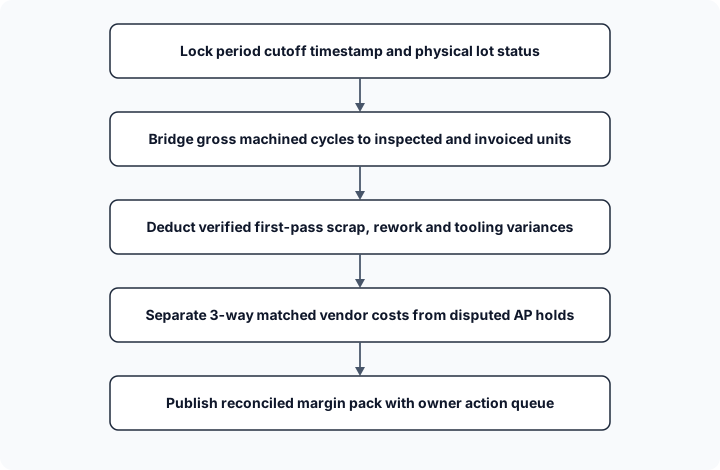
Make the plant margin report show decisions rather than conflicting totals — reporting workflow
Follow the workflow below, or open its complete text version.
Read the complete workflow as text
- Lock period cutoff timestamp and physical lot status → Bridge gross machined cycles to inspected and invoiced units
- Bridge gross machined cycles to inspected and invoiced units → Deduct verified first-pass scrap, rework and tooling variances
- Deduct verified first-pass scrap, rework and tooling variances → Separate 3-way matched vendor costs from disputed AP holds
- Separate 3-way matched vendor costs from disputed AP holds → Publish reconciled margin pack with owner action queue
Define a joint operating-and-financial metric contract before building dashboard tiles
Before connecting BI tools to ERP and MES tables, the plant head and finance controller should sign off a joint internal management-reporting contract (kept distinct from statutory general-ledger disclosures). Every headline tile on the manufacturing KPI dashboard should declare its exact numerator, denominator, cutoff rule, authoritative owner, and the reconciliation bridge bucket where timing or discrepancy items are explained:
Scroll horizontally to see all columns.
| Dashboard / report metric | Authoritative owner | Exact numerator & denominator contract | Cutoff & policy boundary | Reconciliation bridge bucket for timing / exception items |
|---|---|---|---|---|
First-Pass Cell OEE (%) |
Production Manager (verified by Quality) | Good Standard Minutes / Planned Production Time (Availability × Performance × Cycle-Weighted First-Pass Quality, S12). |
Shift-close PLC/MES timestamp; Good Count excludes scrapped units, reworked units and uninspected QC-hold lots. |
Reworked units and lots awaiting CMM sign-off appear in a separate Pending Rework / QC Hold counter, never in first-pass Good Count. |
Management Standard Contribution (₹ & %) |
Finance Controller (agreed with Sales/Operations) | Recognised Shipped Good Units × (Net Realised Selling Price - Standard Variable Material, Direct Power & Subcontract Cost). |
Cutoff (23:59 IST on close date) aligned with Finance's approved Ind AS 115 transfer-of-control policy and evidence. |
Machined units that passed inspection after the last dispatch cutoff sit in Unshipped Finished Goods Bridge; QC-held lots sit in Blocked WIP Bridge. |
Plant-Controllable Variance (₹) |
Plant Head & Costing Lead | Actual verified scrap cost + rework labour/consumables + shop tooling usage variance vs standard bill of materials. | Confirmed QMS scrap/rework tickets and stores issue vouchers up to period close. | Open engineering-change (ECN) trials or customer-requested specification changes are tagged separately from routine shop-floor waste. |
Subcontract & Purchase Price Variance (₹) |
Purchasing Head & Finance Controller | Verified price/surcharge delta on received goods (including matched invoices and valid policy-compliant accruals). | Three-way PO, goods-receipt (GRN) and invoice matching (S18) plus controller review of open discrepancy holds before close. |
Where the controller independently verifies that a held invoice line is an erroneous duplicate or unsupported overcharge, it is reversed from draft COGS and tracked in a Disputed Vendor Claim Note. |
As documented in OEE.com's calculation standard (S12), OEE is an operational effectiveness diagnostic rather than a financial accounting target; combining multi-product cells requires weighting each part family by its own validated ideal cycle time (see our companion guide on calculating OEE across products with different ideal cycle times) rather than averaging raw piece counts. Similarly, Microsoft's accounts payable invoice matching documentation (S18) describes operational software controls for flagging PO, receipt and invoice discrepancies—not statutory authority for revenue or accrual recognition. An ERP three-way-match hold by itself never justifies omitting a valid liability for goods or services actually received; rather, the matching hold triggers an independent controller review to separate legitimate received-not-invoiced accruals from erroneous vendor overbillings.
Worked example: reconciling a ₹5,55,000 month-end gap at a precision-machining plant (PUN-MACH-02)
Scope note: All part numbers, unit volumes, cycle times, rupee totals and document references below are purely synthetic illustrative data created to demonstrate an internal operating-to-financial management bridge. They do not represent a client facility or statutory financial statement. In this synthetic scenario, assume the Finance Controller has approved the applicable accounting policy under MCA Ind AS 115 and verified that contractual transfer-of-control evidence coincides with the
4,000invoiced and dispatched units at cutoff (a gate pass or invoice alone does not establish statutory revenue recognition across all contract types).
Consider the September close (Period 2026-09, cutoff 30 Sep 2026 23:59 IST) for synthetic plant PUN-MACH-02, which machines two cast-iron product families across 60 shifts (28,800 minutes of planned production time):
- Pump Housing (
PH-200): Net selling price₹2,500 / unit; standard variable cost₹1,700 / unit; standard contribution₹800 / unit(32.00%); validated ideal cycle time5.50 minutes / unit. - Valve Body (
VB-150): Net selling price₹2,000 / unit; standard variable cost₹1,450 / unit; standard contribution₹550 / unit(27.50%); validated ideal cycle time5.00 minutes / unit.
Why the two initial reports conflicted by ₹5,55,000
On 02 Oct 2026, the Plant Head's unadjusted manufacturing KPI dashboard and the Controller's preliminary draft extract showed two incompatible stories:
- Plant Head's unadjusted KPI dashboard (
₹30,15,000projected contribution;78.80%headline OEE):- Cell counters recorded
4,300 machined castings(2,600 PH-200and1,700 VB-150) across25,200 minutesof run time (Availability = 25,200 / 28,800 = 87.50%; ideal standard time= (2,600 × 5.50) + (1,700 × 5.00) = 14,300 + 8,500 = 22,800.0 minutes;Performance = 22,800.0 / 25,200.0 = 90.48%). - Because the shop screen computed an unweighted raw-piece quality ratio that only deducted
20 outright scrapped castings(4,280 / 4,300 = 99.53%raw-piece quality), it displayed78.80% OEEand multiplied all4,300 machined castingsby standard contribution:(2,600 × ₹800) + (1,700 × ₹550) = ₹20,80,000 + ₹9,35,000=₹30,15,000.
- Cell counters recorded
- Finance Controller's preliminary draft extract (
₹24,60,000draft contribution, or-₹5,55,000lower):- Under the plant's approved revenue policy and verified transfer-of-control evidence, Finance recognised
4,000 invoiced and dispatched units(2,500 PH-200for₹62,50,000and1,500 VB-150for₹30,00,000, totalling₹92,50,000recognised revenue and₹28,25,000standard contribution). - The preliminary extract then deducted
₹1,45,000of shop scrap, rework and tooling variances plus an unreviewed₹2,20,000preliminary accrual for heat-treatment vendor invoiceINV-HT-884, pulling draft contribution down to₹24,60,000(26.59%).
- Under the plant's approved revenue policy and verified transfer-of-control evidence, Finance recognised
The three-part reconciliation bridge
Applying the joint metric contract reconciles both numbers to an agreed management contribution total of ₹25,95,000 (28.05% of ₹92,50,000 recognised revenue) and a verified First-Pass OEE of 75.87%:
Scroll horizontally to see all columns.
Reconciliation bridge line (Period 2026-09, PUN-MACH-02) |
PH-200 units |
VB-150 units |
Total units | Revenue basis (₹) |
Standard / actual cost impact (₹) |
Contribution margin (₹) |
Margin (% of recognised rev) |
Accountable owner & required decision action |
|---|---|---|---|---|---|---|---|---|
| 1. Plant Head unadjusted dashboard (gross machined cycles) | 2,600 | 1,700 | 4,300 | 99,00,000 | -68,85,000 | 30,15,000 | 30.45% (gross) | Production Manager: Stop multiplying gross machine cycles by sales margin. |
2a. Less cutoff hold: Lot PH-0930-B in CMM QC hold at 23:59 IST |
-100 | 0 | -100 | -2,50,000 | +1,70,000 | -80,000 | — | Quality Lead: Complete CMM check on 01 Oct; held in blocked WIP (₹1,70,000 inventory cost) at close. |
2b. Less cutoff hold: Lot VB-0930-C passed QC after cutoff dispatch |
0 | -120 | -120 | -2,40,000 | +1,74,000 | -66,000 | — | Dispatch Lead: Carried in unrestricted FG stock (₹1,74,000 cost) as control had not transferred by 30 Sep. |
2c. Less failed thread-gauge units (Lot VB-0930-C hold: 20 scrap + 60 rework) |
0 | -80 | -80 | -1,60,000 | +1,16,000 | -44,000 | — | Production & QA: Remove 80 non-conforming units from shipped revenue and first-pass OEE numerator. |
| 3. Standard contribution on 4,000 recognised shipped units | 2,500 | 1,500 | 4,000 | 92,50,000 | -64,25,000 | 28,25,000 | 30.54% | Finance & Sales: Agreed baseline (2,500 × ₹800 = ₹20,00,000 + 1,500 × ₹550 = ₹8,25,000). |
4a. Less verified scrap (20 VB-150 × ₹1,450) & thread rework (60 × ₹600) |
— | — | — | — | -65,000 | -65,000 | -0.70% | Machining Superintendent: Audit tapping head wear on VB-150 (₹29,000 scrap + ₹36,000 rework). |
4b. Less verified CNC carbide insert consumption variance (Stores Iss. #912) |
— | — | — | — | -80,000 | -80,000 | -0.86% | Toolroom Owner: Reconcile high-feed insert breakage on PH-200 roughing op (see material cost variance bridge). |
| 5. Plant-controllable contribution after shop variances | 2,500 | 1,500 | 4,000 | 92,50,000 | -65,70,000 | 26,80,000 | 28.97% | Plant Head: True operational margin basis (₹28,25,000 - ₹1,45,000). |
6. Less verified heat-treatment alloy surcharge (GRN-0928: 2,500 × ₹34) |
— | — | — | — | -85,000 | -85,000 | -0.92% | Purchasing & Finance: Verified index surcharge on 2,500 PH-200 castings supported by PO-4410 and GRN-0928 (S18). |
| 7. Reconciled management contribution margin (agreed final pack) | 2,500 | 1,500 | 4,000 | 92,50,000 | -66,55,000 | 25,95,000 | 28.05% | Plant Head & Controller: Agreed management bridge for September executive review. |
8. Reversal of controller-verified erroneous AP overcharge (INV-HT-884) |
— | — | — | — | (+1,35,000 vs draft) | (+1,35,000 vs draft) | (+1.46% vs draft) | Finance Controller & AP: Controller inspected contract/GRN-0928 and approved reversing unsupported duplicate freight/rate error from ₹24,60,000 draft. |
Every operational and financial figure now cross-checks without hidden plugs:
- Unit & inventory cutoff reconciliation (
4,300machined vs4,000recognised): The300-unitdifference (₹1,90,000standard contribution) is accounted for physical lot by physical lot:100 PH-200in QC hold (₹1,70,000blocked WIP),120 VB-150in unrestricted finished goods where control had not yet transferred at cutoff (₹1,74,000FG stock),60 VB-150in rework (RW-0930, costing₹36,000to restore to good stock), and20 VB-150scrapped (₹29,000written off to scrap variance). - First-Pass OEE reconciliation (
78.80%unadjusted vs75.87%verified): Whereas the initial shop-floor screen used an unweighted raw-piece quality ratio (4,280 / 4,300 = 99.53%), removing the80 failed/reworked VB-150 castingsand the100 uninspected PH-200 castingsleaves4,120 verified First-Pass Good units(2,500 PH-200 × 5.50 min = 13,750.0 minplus1,620 VB-150 × 5.00 min = 8,100.0 min, totalling21,850.0 good standard minutesout of22,800.0 total standard minutes). That yields a cycle-time-weighted First-Pass Quality factor of95.83%(21,850.0 / 22,800.0 = 95.8333%), and an unrounded verified First-Pass OEE of75.87%(21,850.0 / 28,800.0 = 75.868%, or87.50% Availability × 90.48% Performance × 95.83% Cycle-Weighted Quality), linking the₹36,000rework and₹29,000scrap charges directly to theOEE Qualityloss on the dashboard. - Controller review of AP matching exceptions (
₹2,20,000preliminary accrual vs₹85,000verified surcharge +₹1,35,000reversed overcharge): An ERP three-way match hold (S18) is a discrepancy control, not an automatic rule to drop valid accruals. Here, the Finance Controller independently examinedPO-4410, goods receiptGRN-0928and the vendor billINV-HT-884, confirming that₹85,000was a valid alloy surcharge on received castings (retained in September cost of sales alongside all legitimate received-not-invoiced accruals), whereas₹1,35,000was an erroneous rate overcharge and duplicate freight claim with no contractual or receipt basis. The Controller therefore approved reversing the₹1,35,000error from the preliminary₹24,60,000draft and tracking the vendor dispute note separately. For related sub-ledger controls, see how we reconcile job-cost imports with independent source totals, prepare a receivables review queue from current invoice balances and govern item masters so duplicate parts do not break factory planning.
Run a one-close reconciliation pilot before automating executive BI tiles
To eliminate conflicting month-end packs without a multi-month data-warehouse project, run this bounded check on your most recent monthly close:
- Freeze one shared cutoff timestamp (
23:59 ISTon close day): Extract the exact lot list sitting between the final machine operation, QC inspection and dispatch at cutoff so both operations and finance reconcile unshipped and QC-held unit counts against the company's approved Ind AS 115 revenue-recognition policy. - Split variance lines by accountable owner: Separate shop-floor yield, scrap and tooling usage variances (owned by production and toolroom leads) from purchase-price and subcontracting variances (owned by purchasing), and ensure the Finance Controller reviews open three-way match holds (
S18) to separate valid received-not-invoiced accruals from unsupported billing errors. - Require every KPI red flag to carry a transaction reference: Whether a variance stems from a tapping-head rework order (
RW-0930), a stores insert issue (#912) or a disputed vendor invoice (INV-HT-884), require the dashboard drill-through to show the exact document ID and owner due date.
Compare this workflow with your current setup
Share the step that takes the most manual work, the systems involved and the exceptions your team handles. That gives us a concrete starting point for comparing approaches.
Sources and further reading
Sources checked 15 October 2026. Worked examples and workflow diagrams are original illustrations, not reported client results.

