Govern item masters so duplicate parts do not break factory planning
For operations leaders, IT teams and integration owners · Compare approaches
TL;DR — what you’ll learn
- In factory item master data management, two records with similar text descriptions can represent either a true duplicate created under a vendor pack unit or a functionally distinct component whose internal clearance class or seal configuration makes the records non-interchangeable after engineering and datasheet review.
- Separate item master governance across four coordinated owners: engineering owns form-fit-function specification and revision effectivity; stores owns base stockkeeping units and physical bin transfers; purchasing owns approved manufacturer aliases and order-pack conversion factors; and finance owns moving-average or standard inventory valuation layers.
- Never allow automated fuzzy-matching scripts or AI classifiers to auto-merge item masters in production; treat similarity scores strictly as a candidate triage queue requiring engineering equivalence sign-off and open-transaction migration checks.
- In a synthetic 4-record 6205 bearing review batch (IM-GOV-2026-10) ahead of a 600-gearbox MRP run (1,200 bearings required), merging a true box-unit duplicate (18 boxes = 180 pieces) into the base Spec A (CN/C0) bearing record consolidates 600 pieces on hand at Rs 181.50 per piece (Rs 1,08,900) plus 200 pieces on open PO to cancel a duplicate 200-piece material request (Rs 37,000 in avoided planned purchase exposure), while blocking an unapproved merge of a 91%-similar Spec B (C3) bearing and superseding a zero-balance Rev A clone under controlled revision effectivity preserves a valid 150-piece net shortage request (Rs 39,000).

Illustrative workbench bearing comparison with a vernier caliper and paper record; not a client facility.
Why text deduplication alone either strands inventory or creates wrong-spec kitting risk
When multi-plant manufacturers search for item master data management or clean up duplicate part numbers before an ERP migration, existing guides—such as Claro's item master data management guide covering supplier aliases, packaging units, plant extensions and approval workflows, Verdantis' overview of item master data models and governance, ETH Zurich's OPESS teaching notes on separating technical, stockkeeping and cost views in the item master and Vesonix's manufacturing BOM change and impact guide—already describe structured naming conventions, taxonomy fields and multi-department stewardship.
In daily plant operations, however, master-data cleanup projects fail when teams treat deduplication as a purely clerical text-matching exercise rather than a cross-functional engineering, inventory and financial transaction control:
- Pack-unit duplicates that create phantom MRP shortages: A buyer creates a new item code for a vendor's
10-piece box(UoM = BOX) because the existing engineering part was set up in individual pieces (UoM = EA). Even though18 boxes(180 pieces) sit in stores, MRP sees zero stock under the engineering part number and triggers an unnecessary material request (ERPNext material request documentation,S05). - False duplicates where a critical clearance or seal suffix is ignored: Automated text matching scores
BRG-6205-2RS(Spec A) andBRG-6205-2Z-C3(Spec B) at over90% similaritybecause both share6205boundary dimensions (25 mm × 52 mm × 15 mm). As technical bearing literature explains,C3designates a greater-than-normal radial internal-clearance class rather than a standalone temperature rating or guarantee against bearing seizure, and seal/shield suffixes (2RScontact seals vs2Znon-contact shields) alter speed and retention characteristics (SKF guide to rolling bearings and seals in electric motors and generators). Automatically merging them commingles distinct engineering specifications and creates potential wrong-spec kitting risk. - Revision clones created instead of controlled engineering changes: Planners clone a new item number whenever a drawing tolerance changes, rather than managing product versions and transaction effectivity through structured engineering change controls (Microsoft Dynamics 365 engineering change management,
S03; Microsoft engineering change management FAQ,S22).
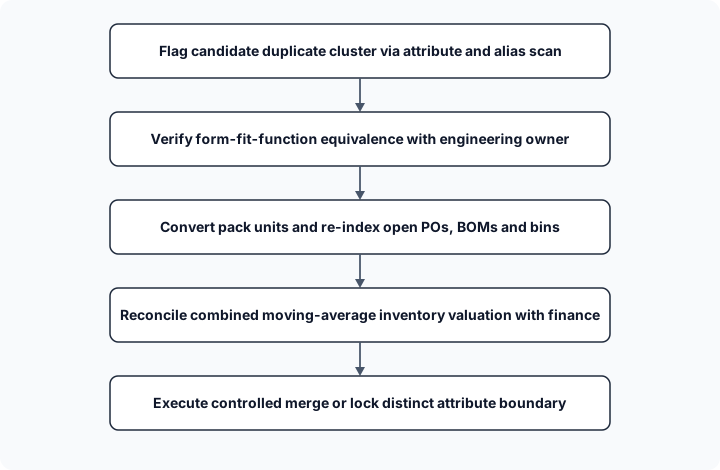
Govern item masters so duplicate parts do not break factory planning — reporting workflow
Follow the workflow below, or open its complete text version.
Read the complete workflow as text
- Flag candidate duplicate cluster via attribute and alias scan → Verify form-fit-function equivalence with engineering owner
- Verify form-fit-function equivalence with engineering owner → Convert pack units and re-index open POs, BOMs and bins
- Convert pack units and re-index open POs, BOMs and bins → Reconcile combined moving-average inventory valuation with finance
- Reconcile combined moving-average inventory valuation with finance → Execute controlled merge or lock distinct attribute boundary
Four-owner governance contract for manufacturing item masters
Consistent with the separation of technical, stockkeeping and accounting data taught in ETH Zurich's item master architecture and enterprise engineering-change controls (S03, S22), no single department should have unrestricted write access to create, merge or obsolete an active manufacturing part record. Enforce a four-stage ownership gate:
Scroll horizontally to see all columns.
| Governance domain | Accountable owner | Mandatory fields locked before activation or merge | Open-transaction check before merge | Boundary rule |
|---|---|---|---|---|
1. Technical identity & revision (Form-Fit-Function) |
Design / Manufacturing Engineering | Dimensional standard, material grade, internal-clearance class (CN/C0 vs C3), seal/shield configuration (2RS vs 2Z), approved datasheet reference, and released revision (S03, S22). |
Check all active eBOM / mBOM where-used lines and open shop-floor work orders (see reconciling BOM revision records across open factory work). |
AI/text tools may propose candidate clusters, but only qualified Engineering after manufacturer datasheet review can certify interchangeable equivalence or require a distinct item vs an alternate (see approving alternate components without changing the BOM by accident). |
| 2. Stockkeeping unit & physical custody | Stores & Inventory Control | Base stockkeeping UoM (EA, kg, m), storage bin location, shelf-life/lot tracking flag, and physical count verification. |
Count physical stock in both source and target bins; restate secondary pack quantities (BOX, SET) into the target base UoM (see keeping kilograms, metres and pieces consistent in metal inventory). |
Never merge two item codes with different base UoMs without executing a physical bin count and UoM conversion journal first. |
| 3. Commercial sourcing & pack aliases | Purchasing Lead | Approved manufacturer part numbers (MPN), supplier catalogue aliases, order UoM (1 BOX = 10 EA), and lead time. |
Re-point open purchase orders (PO) and cancel or adjust duplicate material requests (S05). |
Vendor catalogue numbers belong in the Approved Manufacturer List (AML) and supplier-item cross-reference table, never as separate internal item masters. |
| 4. Valuation layer & cost roll-up | Finance Controller / Costing | Inventory valuation method (moving-average or standard cost), HSN/tax code, and GL inventory account. | Recompute weighted moving-average unit cost or post an explicit standard-cost revaluation variance before retiring the duplicate code. | Combined inventory value after a merge must equal the exact sum of the pre-merge ledger balances to the rupee. |
As explained in the Microsoft Dynamics 365 engineering change management FAQ (S22), plants must decide when a change remains a tracked version of the same item versus when it requires a distinct item identifier. When two records are genuinely identical in form, fit and function, merging them requires migrating open material requests (S05), purchase orders and bin balances without losing audit traceability.
Worked example: resolving a 4-record 6205 bearing duplicate cluster (Batch IM-GOV-2026-10)
Scope note: All item IDs, fictional specification codes (
Spec A,Spec B), vendor catalogue aliases (VND-6205-2RS-BOX10), bin quantities, rupee valuations and order numbers below are purely synthetic illustrative records constructed to demonstrate manufacturing item-master governance. They are not bearing design or operating advice; in practice, bearing selection and interchangeability require qualified engineering review of manufacturer datasheets and application conditions (SKF rolling bearings and seals guide).
Consider synthetic industrial gearbox plant CHN-GBX-01, which is preparing its October MRP run for 600 gearboxes across two engineering-approved assembly BOMs that specify non-interchangeable 6205 bearing records after qualified engineering and manufacturer datasheet review:
- 400 Assembly Series A Gearboxes (
Model GBX-SER-A): Require2 bearings / gearbox=800 EAof fictional approvedSpec A(BRG-6205-2RS-C0,CN/C0normal radial internal clearance with2RScontact seals). - 200 Assembly Series B Gearboxes (
Model GBX-SER-B): Require2 bearings / gearbox=400 EAof fictional approvedSpec B(BRG-6205-2Z-C3,C3greater-than-normal radial internal clearance with2Znon-contact shields, designated by engineering as non-interchangeable withSpec A).
Ahead of the MRP run, an automated master-data similarity scan flags four active 6205 (25 mm × 52 mm × 15 mm) item records in Batch IM-GOV-2026-10:
Scroll horizontally to see all columns.
| Candidate record ID & description | Text similarity to ITM-10412 |
Engineering-reviewed spec (Clearance / Seal / Revision) |
Recorded UoM & physical stock on hand | Pre-governance inventory value (₹) |
Open supply (PO) & open demand (BOM / MR) |
Governance classification & authorised action |
|---|---|---|---|---|---|---|
ITM-10412 (BRG-6205-2RS-C0) |
Baseline (100%) | Approved Spec A: CN/C0 normal radial clearance; 2RS contact seal; current Rev B |
420 EA (Bin A-14-02 @ ₹180.00/EA) |
75,600 | Open PO-7810: 200 EA (₹36,000). Gross GBX-SER-A BOM demand: 800 EA. |
Retain as Master Record (Spec A): Absorb true pack-unit duplicate ITM-28904. |
ITM-28904 (VND-6205-2RS-BOX10) |
88% | Approved Spec A: CN/C0 normal radial clearance; 2RS contact seal (Identical FFF verified against datasheet) |
18 BOX (10 EA/BOX = 180 EA in Bin B-03-09 @ ₹1,850/BOX or ₹185.00/EA) |
33,300 | Unlinked to BOM; buyer raised duplicate MR-4402 for 20 BOX (200 EA, ₹37,000 planned exposure) due to apparent shortage on ITM-10412. |
True Duplicate — Merge into ITM-10412: Convert 18 BOX -> 180 EA; map VND-6205-2RS-BOX10 (1 BOX = 10 EA) in AML; cancel MR-4402. |
ITM-31108 (BRG-6205-2Z-C3) |
91% | Approved Spec B: C3 greater radial internal clearance; 2Z non-contact shield (Non-interchangeable per engineering review) |
150 EA (Bin C-01-04 @ ₹260.00/EA) |
39,000 | Open PO-7845: 100 EA (₹26,000). Gross GBX-SER-B BOM demand: 400 EA. |
False Duplicate — Reject Merge: Lock distinct C3 / 2Z attributes; release net MR-4419 for 150 EA (₹39,000). |
ITM-39055 (BRG-6205-2RS-REV-A) |
95% | Superseded Rev A record of Spec A created before controlled version tracking (S03, S22) |
0 EA on hand |
0 | 0 EA open PO; referenced on 2 legacy service BOMs (0 EA October MRP demand). |
Superseded Revision — Control via Effectivity (S03, S22): Keep historical audit record; update 2 legacy service BOMs under approved effectivity to ITM-10412 Rev B; block new purchasing on ITM-39055. |
| Pre-governance fragmented totals | — | 4 overlapping records | 570 EA + 18 BOX (750 physical bearings) |
1,47,900 | 300 EA on PO; 200 EA duplicate MR-4402 + 150 EA true shortage |
Requires cross-functional sign-off before MRP release |
Reconciling physical stock, moving-average valuation and MRP net requirements after governance
When Engineering, Stores, Purchasing and Finance execute the controlled decisions in Batch IM-GOV-2026-10, every physical bearing, rupee of inventory value and MRP shortage reconciles across the three distinct post-governance states (merged master, distinct specification, and superseded revision record):
Scroll horizontally to see all columns.
| Post-governance record & disposition status | Consolidated physical stock (EA) |
Reconciled unit valuation (₹ / EA) |
Reconciled inventory value (₹) |
Open confirmed PO supply (EA) |
Total available supply (EA) |
Gross gearbox BOM demand (EA) |
True net MRP shortage (EA & ₹) |
Governance & planning outcome |
|---|---|---|---|---|---|---|---|---|
ITM-10412 (BRG-6205-2RS-C0 — active Spec A master merged with ITM-28904) |
600 EA (420 EA + 180 EA from 18 BOX) |
₹181.50 / EA (₹1,08,900 ÷ 600 EA) |
1,08,900 (₹75,600 + ₹33,300) |
200 EA (PO-7810) |
800 EA | 800 EA (400 × GBX-SER-A) |
0 EA (₹0) |
Cancels duplicate MR-4402 (20 BOX = 200 EA), avoiding ₹37,000 in unnecessary planned purchase exposure. |
ITM-31108 (BRG-6205-2Z-C3 — active Spec B master kept distinct) |
150 EA (Bin C-01-04) |
₹260.00 / EA | 39,000 | 100 EA (PO-7845) |
250 EA | 400 EA (200 × GBX-SER-B) |
150 EA (₹39,000 on MR-4419) |
Prevents potential wrong-spec kitting between Spec A and Spec B; orders exact 150 EA net shortage. |
ITM-39055 (BRG-6205-2RS-REV-A — superseded under controlled effectivity, not merged) |
0 EA | — | 0 | 0 EA | 0 EA | 0 EA (2 legacy service BOMs updated under approved effectivity to ITM-10412 Rev B) |
0 EA (₹0) |
Preserves Rev A revision history (S03, S22) while blocking new PO/MR creation on the superseded code. |
| Reconciled governed total | 750 EA | 2 active cost layers | 1,47,900 | 300 EA | 1,050 EA | 1,200 EA | 150 EA (₹39,000 net request) |
Zero ledger write-off; ₹37,000 avoided duplicate purchase request; zero wrong-spec kitting. |
Notice why both under-merging and over-merging would have damaged planning and inventory integrity:
- Why leaving
ITM-28904unmerged distorted MRP: Because18 BOX(180 EA) sat under a separate vendor-catalogue code (VND-6205-2RS-BOX10),ITM-10412showed only420 EAon hand +200 EAonPO-7810=620 EAagainst800 EAdemand. That180 EAphantom deficit caused a planner to raiseMR-4402(S05) for20 BOX(200 EAat₹1,850/BOX = ₹37,000of planned purchase exposure). Normalising18 BOX × 10 EA/BOX = 180 EAintoITM-10412brings total available supply to800 EA, cancelling the unapproved purchase request before PO release and preserving exact general-ledger value (₹75,600 + ₹33,300 = ₹1,08,900, or₹181.50 / EA). - Why auto-merging
ITM-31108(91% text similarity) would have created potential wrong-spec kitting risk and costing distortion: BecauseC3is an internal-clearance class (Spec B, paired here with2Znon-contact shields) that engineering approved specifically forGBX-SER-Brather than an interchangeable substitute forSpec A(CN/C0,2RS), an automated script merging all6205records into a single pool (750 EAon hand +300 EAon PO =1,050 EAagainst1,200 EAcombined demand) would have blended the moving-average cost to₹1,47,900 ÷ 750 = ₹197.20 / EA(distorting product margins; see how we make the plant margin report show decisions rather than conflicting totals) and exposed assembly kitting to issuingSpec Astock againstSpec Bwork orders. - Why superseding
ITM-39055via controlled version effectivity differs from a duplicate merge: UnlikeITM-28904(which represented the exact sameSpec Arevision stored under a box UoM),ITM-39055was an earlierRev Aengineering definition. Rather than merging its identity away, engineering change controls (S03,S22) retainITM-39055in closed/superseded status for historical service traceability while updating active BOM effectivity dates—aligning system write boundaries as detailed in our guide to deciding which manufacturing decisions belong in ERP, MES, QMS and PLM and piloting ERP and shop-floor integration exceptions.
Run a 50-part duplicate triage pilot before freezing master-data rules
Before launching a plant-wide item-master cleansing programme, test this four-step governance loop on one high-value component family (such as bearings, fasteners, seals or electrical contactors):
- Extract candidate clusters with open balances: Group active items by geometry or supplier reference, together with current bin quantities, base UoMs, moving-average unit costs, open purchase orders and active BOM references.
- Require explicit engineering disposition (
Merge Duplicate,Keep Distinct Spec, orSupersede via ECN): Never permit a bulk spreadsheet upload to deactivate or merge parts without qualified engineering review of manufacturer datasheets confirming whether internal clearance, seal configuration, material grade or revision effectivity differ. - Execute UoM conversion and financial value reconciliation before closing a true duplicate code: Convert secondary pack quantities (
BOX,SET) into the master base UoM (EA) and verify that post-merge physical piece counts and ledger rupee totals match the pre-merge sum to the last unit and rupee. - Audit post-governance BOM effectivity, open purchase orders and MRP net requirements: Confirm that supplier pack aliases are mapped in the Approved Manufacturer List, superseded revision codes are blocked from new purchasing under controlled effectivity (
S03,S22), and the next MRP run generates shortage requests only for genuine net deficits.
Compare this workflow with your current setup
Share the step that takes the most manual work, the systems involved and the exceptions your team handles. That gives us a concrete starting point for comparing approaches.
Sources and further reading
Sources checked 15 October 2026. Worked examples and workflow diagrams are original illustrations, not reported client results.


