Keep kilograms, metres and pieces consistent in metal inventory
For stores, inventory control and production teams · Compare approaches
TL;DR — what you’ll learn
- Record both measured scale weight (kg) and physical count/length (bars or metres) at goods receipt instead of deriving length from a fixed nominal factor.
- Use physical length and piece count for saw-cutting and MRP availability while retaining scale weight for supplier invoice matching.
- Calculate a heat-lot-specific kg-per-metre factor when rolling tolerances create a gap between nominal and actual bundle weight.
- Isolate residual weight variances at bundle exhaustion so the system never leaves phantom negative kilograms on a physically empty rack.

Illustrative factory raw-material stores and receiving counter; not a client facility.
A factory buys 20 hot-rolled alloy steel round bars (6.00 metres each, 120.00 metres total physical length) priced by weight. The item master stores a nominal theoretical conversion of 10.00 kg per metre (1,200.00 kg expected). Because hot-rolled bar diameter sits near the upper rolling tolerance, the certified weighbridge and mill bundle tag record 1,236.00 kg (+3.0% over nominal). If receiving posts 1,236.00 kg and lets the ERP divide by the static 10.00 kg/m factor, the stock ledger invents 123.60 metres of bar—causing the planner to schedule 206 cut blanks of 0.60 m when only 200 blanks physically exist. Conversely, if production issues 20 bars (120.00 m) at the nominal 10.00 kg/m rate (1,200.00 kg), the rack is physically empty while the ledger still shows 36.00 kg (3.60 phantom metres) on hand.
This guide covers a dual-quantity transaction ledger that keeps commercial weight and physical length aligned per heat lot. Inventory valuation policy and write-off thresholds remain with finance and materials management.
Track physical length and measured weight together by lot
Consider an original illustrative ledger for heat bundle LOT-HR50-09 (20 bars × 6.00 m = 120.00 m physical; nominal factor: 10.00 kg/m; actual measured bundle weight: 1,236.00 kg; lot-specific factor: 10.30 kg/m).
Scroll horizontally to see all columns.
| Transaction step | Physical bars (count) | Physical length (m) | Nominal weight at 10.00 kg/m (kg) | Lot-measured weight at 10.30 kg/m (kg) | Static-factor ledger error if unadjusted |
|---|---|---|---|---|---|
1. Goods receipt (GRN-410, 20 bars × 6.00 m) |
+20 | +120.00 | +1,200.00 | +1,236.00 (scale & invoice basis) | Dividing 1,236 kg by 10.00 kg/m would overstate length by +3.60 m (6 blanks) |
2. Cut issue to WO-310 (12 bars = 120 blanks × 0.60 m incl. kerf) |
-12 | -72.00 | -720.00 | -741.60 | Issuing 72.00 m at nominal 10.00 kg/m leaves +21.60 kg unissued variance |
3. Cut issue to WO-315 (7 bars = 70 blanks × 0.60 m incl. kerf) |
-7 | -42.00 | -420.00 | -432.60 | Issuing 42.00 m at nominal 10.00 kg/m leaves +12.60 kg unissued variance |
4. Final bar cut to WO-319 (1 bar = 10 blanks × 0.60 m incl. kerf) |
-1 | -6.00 | -60.00 | -61.80 | Issuing 6.00 m at nominal 10.00 kg/m leaves +1.80 kg unissued variance |
| Ending bundle balance after 20 bars consumed | 0 bars | 0.00 m | 0.00 kg | 0.00 kg (1,236.00 - 1,236.00) | Without lot factor or zero-bar sweep, +36.00 kg (3.60 m) phantom stock remains |
The arithmetic reconciles every unit basis across the lifecycle of the bundle:
- Commercial invoice match: Accounts payable matches the supplier invoice against the 1,236.00 kg scale receipt on
GRN-410. - Shop-floor planning: Production planning sees exactly 20 bars / 120.00 metres (200 blanks at 0.60 m gross length per blank), preventing over-allocation.
- Lot depletion: Issuing 72.00 m + 42.00 m + 6.00 m = 120.00 m at the lot-specific rate of 10.30 kg/m deducts 741.60 + 432.60 + 61.80 = 1,236.00 kg, bringing bars (0), metres (0.00 m) and kilograms (0.00 kg) to zero simultaneously.
Reference documentation for the GS1 Global Traceability Standard and Microsoft AP invoice matching describes batch transformation events and invoice quantity tolerances.
Keep kilograms, metres and pieces consistent in metal inventory — reporting workflow
Follow the workflow below, or open its complete text version.
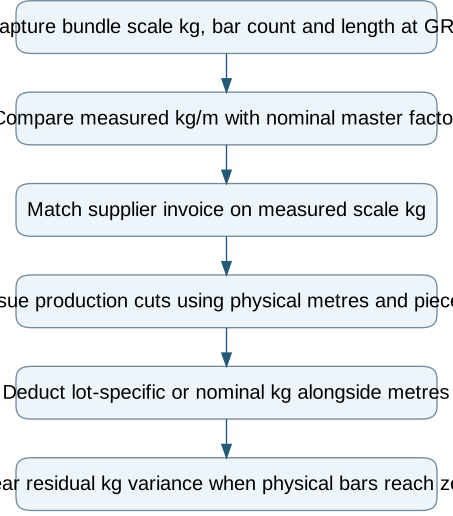
Read the complete workflow as text
- Capture bundle scale kg, bar count and length at GRN → Compare measured kg/m with nominal master factor
- Compare measured kg/m with nominal master factor → Match supplier invoice on measured scale kg
- Match supplier invoice on measured scale kg → Issue production cuts using physical metres and pieces
- Issue production cuts using physical metres and pieces → Deduct lot-specific or nominal kg alongside metres
- Deduct lot-specific or nominal kg alongside metres → Clear residual kg variance when physical bars reach zero
Trigger a zero-piece reconciliation when the last bar is cut
If your ERP cannot store a lot-specific conversion factor and instead issues metres at the nominal 10.00 kg/m rate, require a bundle-exhaustion check whenever physical bar count reaches zero. That check flags the residual 36.00 kg balance for an immediate inventory-variance posting rather than leaving phantom metres available to MRP.
Check five bar or sheet items with recurring stock write-offs
Sample five raw-metal items where cycle counts repeatedly find zero physical bars despite positive book kilograms. Compare the last three scale receipts against the master kg-per-metre factor to verify whether rolling-weight tolerance is creating phantom length at goods receipt.
Compare this workflow with your current setup
Share the step that takes the most manual work, the systems involved and the exceptions your team handles. That gives us a concrete starting point for comparing approaches.
Sources and further reading
Sources checked 15 October 2026. Worked examples and workflow diagrams are original illustrations, not reported client results.
