Reserve scarce components without promising the same stock twice
For stores, inventory control and production teams · Compare approaches
TL;DR — what you’ll learn
- Calculate allocatable stock from unrestricted, inspected inventory only—excluding quarantined receipts and stale reservations on held jobs.
- Maintain a single hard-allocation ledger so two supervisors cannot kit the same 50 bearings for two different work orders.
- Release stale reservations automatically when a downstream work order is placed on engineering or credit hold beyond an agreed window.
- Require a logged owner reason and impacted-order notice whenever an urgent order preempts stock already reserved for another job.

Illustrative factory raw-material stores and receiving counter; not a client facility.
A warehouse ledger shows 65 units of servo drive SD-750 in stock. Three open jobs need a combined 90 units this week (WO-401 needs 30, WO-402 needs 40, and urgent breakdown order WO-409 needs 20). Both assembly supervisors check the 65-unit total on the summary screen and promise full completion of their respective orders. When stores starts kitting, 15 of the 65 units are still sitting in incoming quality quarantine (QI-812), leaving only 50 unrestricted units. Worse, 20 of those 50 units are tied to an older work order (WO-388) that has been on customer drawing hold for three weeks.
This guide covers a single-balance reservation and preemption table that reconciles physical stock, quarantine holds, stale reservations and net shortage allocation. Order priority policy and customer delivery commitments remain with operations and sales leadership.
Reconcile physical stock to net allocatable balance before assigning jobs
Consider an original illustrative reservation ledger for servo drive SD-750 (physical warehouse count: 65 units; quarantined awaiting QC: 15 units; unrestricted usable stock: 50 units).
Scroll horizontally to see all columns.
| Order / bucket | Order status & start date | Gross requirement (units) | Prior reservation (units) | Reservation review action | Post-review hard allocation (units) | Uncovered shortage (units) | Allocation basis & owner note |
|---|---|---|---|---|---|---|---|
Quarantine bucket (QI-812) |
In incoming inspection | — | — | Excluded from allocatable pool (15 units) | 0 | — | Cannot kit until QC release |
WO-388 (Legacy order) |
On customer drawing hold (21 days) | 20 | 20 | Stale reservation released by materials planner | 0 (-20) | 20 (deferred) | Hold exceeds 7-day reservation expiry rule |
WO-409 (Spares breakdown) |
Released — starts Oct 16 | 20 | 0 | Allocated first under Tier-1 breakdown priority | 20 (+20) | 0 | Full kit confirmed for dispatch |
WO-401 (Firm customer order) |
Released — starts Oct 17 | 30 | 30 | Retains existing firm reservation | 30 (0) | 0 | Full kit confirmed for line start |
WO-402 (Stock replenishment) |
Released — starts Oct 18 | 40 | 0 | Receives remaining unrestricted stock (0 units left) | 0 | 40 | Rescheduled to next confirmed PO receipt (Oct 22) |
| Total across open work orders | — | 110 required | 50 prior reserved | 20 released from held job; 20 assigned to WO-409 |
50 allocated (matches 50 unrestricted) | 60 uncovered (20 held + 40 replanned) | Physical 65 = 50 allocated + 15 QC hold |
Every unit of SD-750 is accounted for without double-promising:
- Physical reconciliation: 65 physical units = 50 unrestricted allocatable units + 15 quarantined units (
QI-812). - Reservation transfer: Releasing the 20-unit stale reservation from held order
WO-388frees 20 unrestricted units to cover urgent breakdown orderWO-409(20 units), whileWO-401keeps its 30-unit reservation (20 + 30 = 50 units hard-allocated). - Explicit shortage visibility:
WO-402shows a 40-unit uncovered shortage immediately rather than discovering an empty bin after kitting starts, andWO-388shows a 20-unit deferred requirement awaiting drawing release.
Documentation for Microsoft finite capacity planning, ERPNext material requests and quality inspection explains how material availability, inspection holds and planning horizons are represented in standard software.
Reserve scarce components without promising the same stock twice — reporting workflow
Follow the workflow below, or open its complete text version.
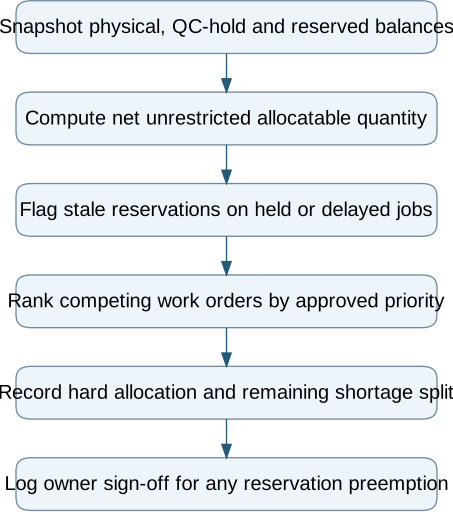
Read the complete workflow as text
- Snapshot physical, QC-hold and reserved balances → Compute net unrestricted allocatable quantity
- Compute net unrestricted allocatable quantity → Flag stale reservations on held or delayed jobs
- Flag stale reservations on held or delayed jobs → Rank competing work orders by approved priority
- Rank competing work orders by approved priority → Record hard allocation and remaining shortage split
- Record hard allocation and remaining shortage split → Log owner sign-off for any reservation preemption
Never allow silent preemption of an already kitted or reserved order
When an urgent spares order requires pulling components from a released job like WO-401, the reservation table must record both the approver's name and the new completion date for the preempted order. Unlogged bin borrowing fixes one customer complaint by creating an unannounced late delivery on another line.
Audit ten constrained components before automating reservation rules
Select ten shortage-prone components and compare their physical shelf count against quarantined lots and open work-order reservations. Verify how many units are locked to held orders older than seven days before configuring automated allocation rules.
Compare this workflow with your current setup
Share the step that takes the most manual work, the systems involved and the exceptions your team handles. That gives us a concrete starting point for comparing approaches.
Sources and further reading
Sources checked 15 October 2026. Worked examples and workflow diagrams are original illustrations, not reported client results.
