Decide which manufacturing decisions belong in ERP, MES, QMS and PLM
For operations leaders, IT teams and integration owners · Compare approaches
TL;DR — what you’ll learn
- Buying a new manufacturing application rarely fixes shop-floor discrepancies when two existing systems both claim write authority over the bill of materials (BOM), work-order progress or lot release status.
- In a proposed four-system reference architecture (recognising that commercial ERP, MES, QMS and PLM suites often overlap in capability), assign one authoritative system of record per decision boundary: PLM owns engineering design revisions (eBOM); ERP owns commercial demand, inventory valuation and purchasing (mBOM); MES owns operation-by-operation execution, serial genealogy and workstation WIP state; and QMS owns inspection specifications, nonconformance holds (NCR) and disposition sign-off.
- Require explicit unit-of-measure (UoM) and revision handshakes at every interface—such as converting PLM design lengths in millimetres and piece counts into ERP kitting metres and sets—and gate unrestricted release and customer dispatch (even where ERP design allows preliminary receipt into QC-hold or blocked stock) until MES serial completion and QMS disposition both pass.
- In a purely synthetic 24-panel switchgear record illustration (WO-MCC-415-08), enforcing write-ownership and mid-batch engineering-change (ECN-2026-114) rollback reverses a premature 24-panel ERP auto-backflush down to 20 unrestricted dispatchable panels (14 Rev B + 6 Rev C), isolates 4 panels in QMS quarantine (NCR-409), and reconciles 199.00 metres of issued copper busbar (197.00 m net embedded + 2.00 m retrofit scrap) alongside 984 terminal blocks (82.0 sets).

Illustrative electrical switchgear assembly and engineering-to-shopfloor boundary inspection; not a client facility.
Why overlapping system write permissions corrupt plant inventory and quality holds
When Indian discrete and batch manufacturers evaluate ERP vs MES—or debate adding standalone PLM and QMS modules—the root problem is often not missing software features. Commercial ERP platforms frequently include native quality inspection, BOM revision and capacity planning modules, while MES and QMS packages can overlap with ERP shop-floor and inventory transactions. Discrepancies arise when a plant leaves state transitions unowned across four overlapping copies of the same product and order record:
- Four conflicting BOMs and unit bases: Design engineers update a CAD assembly in PLM using geometric units (
8,500 mmof copper busbar and48 individual terminal blocks), while ERP purchasing and stores kit raw material in commercial bulk units (metresof busbar and12-piece boxes/sets). Meanwhile, the shop floor runs a locally edited spreadsheet or MES work-instruction copy, and quality inspectors check a PDF control plan tied to an older drawing revision. - Premature unrestricted release before MES and QMS verification: Some ERP designs post completed assemblies directly into unrestricted stock on work-order completion, whereas others receive assemblies into quality-inspection or blocked stock first. If the ERP auto-backflushes components and posts unrestricted, dispatchable finished goods as soon as a supervisor marks a work order header complete—without waiting for operation-level MES serial tracking or QMS disposition clearance—the financial and dispatch ledger shows available stock that is physically still in rework or quarantined.
- Silent overwrite during mid-batch engineering changes (
ECN): When an engineering change takes effect mid-order, overwriting the open ERP work order BOM in place destroys the as-built record for serial numbers already completed on the previous revision.
Vendor architecture discussions—such as IFS on ERP vs MES boundaries in complex manufacturing and VAI on ERP vs standalone MES production control—already explain the conceptual split and overlap between enterprise resource planning and shop-floor execution. To turn that conceptual split into an enforceable plant control, leadership should adopt a proposed record-ownership boundary that defines which system holds the single write lock for each operational event, how unit conversions are validated across handovers, and how exceptions roll back when a mid-batch change or quality hold occurs.
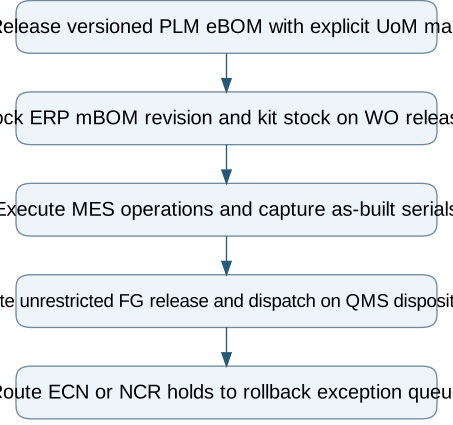
Decide which manufacturing decisions belong in ERP, MES, QMS and PLM — reporting workflow
Follow the workflow below, or open its complete text version.
Read the complete workflow as text
- Release versioned PLM eBOM with explicit UoM map → Lock ERP mBOM revision and kit stock on WO release
- Lock ERP mBOM revision and kit stock on WO release → Execute MES operations and capture as-built serials
- Execute MES operations and capture as-built serials → Gate unrestricted FG release and dispatch on QMS disposition
- Gate unrestricted FG release and dispatch on QMS disposition → Route ECN or NCR holds to rollback exception queue
Proposed boundary matrix: one write owner per manufacturing record
Because ERP, MES, QMS and PLM products overlap differently across vendors, the table below represents a proposed target architecture rather than universal software behaviour. Before funding a new licence or building point-to-point APIs, the CIO/CTO, plant head, engineering manager and quality head should adapt and sign off a record-ownership table for their specific landscape. Each row names the single system authorised to create or mutate the record, the downstream read-only consumers, the unit/revision handshake rule, and the rollback protocol when an exception occurs:
Scroll horizontally to see all columns.
| Decision / plant record | Proposed authoritative write owner | Read-only consumers | Handover & unit-conversion gate | Exception & rollback rule |
|---|---|---|---|---|
Product design, drawing revision & eBOM |
PLM (Engineering) | ERP, MES, QMS | Every component carries design UoM (mm, pcs) plus mapped stock/purchase UoM (m, sets) and effectivity date (S03). |
Unapproved draft revisions cannot be pulled into ERP planning or MES workstation screens. |
Manufacturing mBOM, MRP, POs & inventory ledger |
ERP (Planning & Finance) | MES, QMS | ERP locks the specific released mBOM revision on work-order release; plants using optional ERP finite capacity (S04) or external scheduling align order dates before release. |
Mid-batch ECN splits the work order or creates a controlled rework order; never overwrites completed serial history. |
| Workstation routing steps, operator start/stop & as-built serials | MES (Production) | ERP, QMS | MES consumes kitted lots against individual serials and posts operation completions using the locked ERP unit factor. | Out-of-sequence scans or connectivity dropouts buffer in a proposed idempotent integration queue; consistent with risk-based OT segmentation guidance (S19), enterprise integrations never edit PLC safety logic. |
Inspection plans, test results, NCR holds & lot disposition |
QMS (Quality) | ERP, MES | Even if ERP receives completed units into QC-hold or blocked stock, transfer to unrestricted finished goods and customer dispatch requires a passed QMS disposition reference (S07) matching the as-built revision. |
Failed or uninspected serials remain locked in blocked/quarantine stock in ERP and open a rework/scrap disposition route. |
Product documentation for Microsoft Dynamics 365 engineering change management (S03), finite capacity planning (S04, illustrating one optional ERP scheduling model) and ERPNext quality inspection (S07) shows how versioned BOMs, scheduling horizons and inspection gates can be configured in standard software. For shop-floor network boundaries, the NIST operational technology security publication list (S19) indexes OT security guidance—including NIST SP 800-82 Rev. 3 (final) and the initial public draft of Rev. 4—supporting risk-based OT network segmentation so enterprise systems do not directly alter machine safety controls. That NIST index provides security segmentation guidance rather than mandating a universal application write-lock architecture; single-writer record ownership, idempotent message buffering and deduplication keys are proposed application-layer design controls that the plant and integration team must engineer and test.
Worked example: reconciling a synthetic 24-panel batch (WO-MCC-415-08) across a mid-batch ECN and quality hold
Scope note: All panel counts, busbar lengths, terminal quantities and document IDs below are purely synthetic record data constructed to illustrate multi-system ledger reconciliation. They are not an electrical engineering design, safety specification or operating SOP.
Consider a synthetic record scenario for 24 low-voltage switchgear panels (Model MCC-415V-8F) under work order WO-MCC-415-08.
What happens when system boundaries are blurred
- Initial release (
Revision B): ERP releasesWO-MCC-415-08for24 panelsundermBOM Rev B. In this synthetic BOM, eachRev Bpanel requires8,000 mm(8.00 m) of copper busbar (24 × 8.00 m = 192.00 m) and36 control terminal blocksissued in12-piece sets(3.0 sets/panel × 24 = 72.0 sets, or864 pieces). - Mid-batch engineering change (
ECN-2026-114toRevision C): After18 panels(Serials MCC-01 to MCC-18) have completed initial busbar assembly, engineering releasesECN-2026-114(Revision C). In the syntheticRev CBOM, each panel requires8,500 mm(8.50 m) of copper busbar (+0.50 m/panel) and48 terminal blocks(4.0 sets/panel,+12 pieces/panel). - Disposition split across the 24 serials:
- Serials
MCC-01toMCC-14(14 panels): Built toRev B(8.00 mbusbar,36 pcs / 3.0 setsterminals per panel). Qualified engineering and quality authorities first verify and approve full technical conformity and safety disposition under applicable requirements (QI-MCC-88A) before recording commercial concessionCC-19for theRev Bconfiguration (customer commercial agreement alone can never waive safety or statutory requirements). - Serials
MCC-15toMCC-18(4 panels): Assigned to an order line that requiresRev C. QMS places all 4 serials on quarantine hold (NCR-409) for retrofit underRework Order RW-114. During retrofit, each panel receives+0.50 mof net additional busbar (8.50 mfinal embedded length) plus0.50 mof scrapped offcut removed during disassembly (9.00 mgross copper consumed per reworked panel, or36.00 mgross /34.00 mnet across the 4 panels) and+12 terminal blocks(+1.0 set/panel, bringing them to48 pcs / 4.0 setseach). Because final inspection re-testing is still pending at shift close, these 4 panels remain blocked in WIP or QC-hold stock and cannot be released to unrestricted dispatchable inventory. - Serials
MCC-19toMCC-24(6 panels): MES switches workstation instructions toRev Cbefore fabrication starts. Each panel consumes8.50 mof copper busbar (51.00 mtotal) and48 terminal blocks(4.0 sets/panel = 24.0 sets/288 pieces), and passes QMSRev Cinspection (QI-MCC-88B).
- Serials
Without boundary enforcement, an unguarded ERP auto-backflushes all 24 panels at the old Rev B rate (192.00 m copper, 72.0 sets terminals) directly into 24 unrestricted finished panels—understating copper usage by 7.00 metres, understating terminal blocks by 10.0 sets (120 pieces), and prematurely exposing 4 quarantined panels (MCC-15..18) as available for dispatch.
The table below shows the reconciled position when PLM, ERP, MES and QMS enforce the proposed write boundaries:
Scroll horizontally to see all columns.
Serial group (WO-MCC-415-08) |
Panel count | As-built PLM & MES rev | Net embedded copper busbar (mm & m) |
Retrofit scrap copper (m) |
Total physical copper issued (m) |
Terminal blocks (PLM pcs / ERP 12-pc sets) |
MES execution status | QMS inspection & hold status | ERP unrestricted dispatchable stock (panels) |
|---|---|---|---|---|---|---|---|---|---|
MCC-01 to MCC-14 |
14 | Rev B (Eng/QA approved + CC-19) |
112,000 mm (112.00 m) |
0.00 m | 112.00 m | 504 pcs (42.0 sets) |
Completed (Rev B) |
Passed (QI-MCC-88A + CC-19) |
14 |
MCC-15 to MCC-18 |
4 | Rev B -> Rev C (RW-114) |
34,000 mm (34.00 m) |
2.00 m | 36.00 m | 192 pcs (16.0 sets) |
In rework (RW-114 done; re-test pending) |
Quarantined (NCR-409) |
0 (4 held in WIP/QC-blocked) |
MCC-19 to MCC-24 |
6 | Rev C (ECN-2026-114) |
51,000 mm (51.00 m) |
0.00 m | 51.00 m | 288 pcs (24.0 sets) |
Completed (Rev C) |
Passed (QI-MCC-88B) |
6 |
| Reconciled 24-panel total | 24 | 14 Rev B; 4 Rework; 6 Rev C | 197,000 mm (197.00 m) |
2.00 m | 199.00 m | 984 pcs (82.0 sets) |
20 complete; 4 awaiting re-test | 20 released; 4 held on NCR-409 |
20 unrestricted (+4 blocked) |
| Uncontrolled ERP Rev B auto-backflush | 24 | Assumed 24 Rev B | 192,000 mm (192.00 m) |
0.00 m | 192.00 m | 864 pcs (72.0 sets) |
Marked 100% complete | Hold bypassed | 24 (overstated by +4 panels) |
| Boundary reconciliation delta | 0 | As-built split preserved | +5,000 mm (+5.00 m) |
+2.00 m | +7.00 m copper | +120 pcs (+10.0 sets) |
-4 panels held from unrestricted | 4 serials locked by NCR-409 |
-4 unrestricted panels |
Every unit of material and every serialised panel reconciles across all four systems:
- Copper busbar reconciliation: Unadjusted
Rev Bbackflushing booked24 × 8.00 m = 192.00 m. Actual physical consumption is112.00 m(14 × 8.00 m) +34.00 mnet embedded (4 × 8.50 m) +2.00 mretrofit scrap (4 × 0.50 m) +51.00 m(6 × 8.50 m) = 199.00 metres (+7.00 mvariance explained before month-end costing closes). - Terminal block UoM handshake (
pcsvssets): PLM design counts (504 + 192 + 288 = 984 pieces) divide cleanly by the locked ERP conversion factor (12 pieces/set) to equal 82.0 sets (42.0 + 16.0 + 24.0 sets), accounting for the+10.0 sets(120 pieces) required byECN-2026-114across the 10Rev Cpanels (4 reworked + 6 native). - Gating unrestricted release and dispatch: Whether the ERP holds completed units in WIP or receives them into a QC-inspection/blocked stock status, transfer into unrestricted dispatchable inventory is gated on both MES serial completion and QMS disposition sign-off. Only 20 panels (
14 + 6) become dispatchable, while the 4 panels onNCR-409(MCC-15..18) remain blocked until inspection re-testing passes in QMS.
Audit three high-friction handovers before buying another system
Before initiating an MES or QMS replacement tender, run a two-week boundary audit on one active production line:
- Trace one mid-batch engineering change (
ECN) end to end: Check whether ERP and MES preserve the split between serials built on the prior revision and serials built on the new revision, and verify whether unit conversions (mmtom,pcstosets) require manual spreadsheet edits. - Verify in an authorised non-production test environment that an open QMS nonconformance (
NCR) blocks unrestricted release and dispatch: Using a seeded test order in a sandbox or authorised test environment (never attempting live dispatch against actual quarantined goods), verify that ERP blocks transfer to unrestricted stock and blocks delivery-challan creation whenever a serial or lot is markedRejectedorPending Inspectionin QMS. - Eliminate dual-write fields: Where two systems currently edit the same status or quantity field, assign one authoritative write owner and convert the second system to a read-only subscriber with an owned exception queue.
Compare this workflow with your current setup
Share the step that takes the most manual work, the systems involved and the exceptions your team handles. That gives us a concrete starting point for comparing approaches.
Sources and further reading
Sources checked 15 October 2026. Worked examples and workflow diagrams are original illustrations, not reported client results.
