Reconcile foundry yield before blaming the melting process
For production managers, planners and plant leaders · Understand the problem
TL;DR — what you’ll learn
- Dividing finished casting weight by total furnace charge mixes reversible gating returns, fettling scrap, unweighed skull residue, and missing ERP return postings into a single misleading loss percentage.
- Separate every heat balance into four distinct physical buckets: accepted casting weight, clean remelt returns (runners, risers, sprues, and rejected castings), non-recoverable process loss (slag, dross, grinding dust, and oxidation), and unresolved cutoff variance.
- Value clean internal returns as circulating foundry metal rather than zero-value waste or newly purchased pig iron so remelt loops do not distort material cost variance.
- In an illustrative 1,000.0 kg ductile-iron induction heat (HEAT-DI-2026-114), separating a 250.0 kg unposted return tote (238.0 kg degated runners and risers plus 12.0 kg pigged ladle heel) and 30.0 kg of rejected castings from true oxidation, splatter, and grinding loss (40.0 kg, or 4.00% of furnace charge) prevents an unnecessary furnace lining or charge-chemistry intervention.

Illustrative manufacturing inspection room and machine shop floor; not a client facility.
When a foundry ERP report shows that a 1,000.0 kg furnace charge produced only 680.0 kg of accepted castings (a 68.00% charge-basis net good yield), plant leadership often assumes 320.0 kg of metal was lost in the furnace or poured into scrap. In practice, foundry yield is governed by distinct denominators: charge-basis net good yield (accepted dressed casting weight divided by total furnace metallic charge, 680.0 kg ÷ 1,000.0 kg = 68.00%), mould-poured casting yield (rough or accepted casting weight divided by liquid metal actually poured into moulds, 720.0 kg ÷ 960.0 kg = 75.00% gross box yield or 680.0 kg ÷ 960.0 kg = 70.83% net poured yield, excluding the 12.0 kg pigged ladle heel), and furnace metal recovery (total metallic weight recovered across castings, runners, risers, rejected castings, and pigged heel divided by total metallic charge, 960.0 kg ÷ 1,000.0 kg = 96.00%). Before adjusting induction furnace power profiles, slag coagulants, or charge chemistry, production and finance teams must close the physical heat balance across charge scales, pouring ladles, shakeout return totes, fettling cells, and period cutoff boundaries.
Why single-number yield reports misdirect foundry investigations
Foundries operate a closed-loop material cycle in which a substantial share of every furnace charge is intentionally solidified inside sprues, runners, gates, and feeder risers to ensure directional solidification and sound castings. Once shaken out and shot-blasted, those runners and risers return to the charge make-up bay as clean internal remelt stock.
When an ERP or shop-floor reporting configuration tracks only two transactions—raw charge issued to the melt and good castings received into finished or machined stock—three distinct operational realities collapse into one variance figure:
- Planned gating circulation and pigged ladle heels look like process waste: In our illustrative heat
HEAT-DI-2026-114, pouring960.0 kgof liquid metal into moulds at a75.00%gross cavity-to-poured box yield (720.0 kgrough casting weight and240.0 kgrunner-and-riser system) and pigging a12.0 kgladle heel yields238.0 kgof shot-blasted gating returns (after2.0 kgof pouring splatter) plus12.0 kgof pigged heel—250.0 kgof circulating inventory in Return ToteRT-09, not irreversible melt loss. Mixing charge-basis net good yield (680.0 kg ÷ 1,000.0 kg = 68.00%) with mould-poured yield (720.0 kg ÷ 960.0 kg = 75.00%gross box yield;680.0 kg ÷ 960.0 kg = 70.83%net good yield on poured weight) confuses pattern feeding geometry with furnace oxidation performance. - Unposted return-to-melt totes inflate apparent oxidation loss: When shakeout operators stage Return Tote
RT-09(250.0 kg) at the furnace bay at shift handover without scanning the return receipt before the daily ERP cutoff, the ledger treats the missing250.0 kgas vanished metal. - Remelt double-counting distorts purchased metal consumption: If the next shift charges that
250.0 kgtote back into a subsequent heat without recording it as internal return metal—or worse, issues it under a generic raw-material code—finance either double-counts material cost or loses visibility into how much virgin pig iron, steel scrap, and ferroalloy was actually consumed.
In transformation traceability models such as the GS1 Global Traceability Standard, a transformation event must account for all input lots and all resulting output classes—primary products, recyclable by-products or internal returns, and process losses—under consistent units of measure and time boundaries. Similarly, operational performance frameworks such as OEE.com's OEE calculation methodology emphasize that quality and yield denominators must be explicitly defined rather than blended across incompatible process boundaries.
Four-bucket mass balance for foundry heat reconciliation
To prevent false alarms between metallurgy, moulding, fettling, and cost accounting, the heat reconciliation workflow must partition every metallic charge into four mutually exclusive categories at shift or heat closure:
- Bucket 1 — Accepted good castings (
W_good): Net weight of castings passing visual, dimensional, and non-destructive inspection after degating and fettling, weighed on a calibrated dispatch or machining-intake scale. - Bucket 2 — Recoverable metallic returns (
W_return): Solid metallic material suitable for remelting in the same alloy grade, separated into:- Gating and feeder returns: sprues, runners, gates, risers, and pigged ladle heels recovered at pouring, shakeout, and degating.
- Internal casting scrap: short-poured moulds and metallurgical or dimensional rejects (
W_reject) returned to the charge yard with alloy heat identity intact.
- Bucket 3 — Measured and estimated non-recoverable process loss (
W_loss): Metal permanently removed from the metallic cycle through furnace slag skimming, melt oxidation/vaporisation, pouring splatter, shot-blast scale, and fettling/grinding swarf that cannot be remelted directly. - Bucket 4 — Unresolved cutoff or scale discrepancy (
W_unresolved): The residual differenceW_charge - (W_good + W_return + W_loss). Instead of forcingW_unresolvedinto furnace oxidation loss through an automatic plug formula, the ledger holdsW_unresolvedas an open investigation item until delayed return totes, pigged heel weights, or scale tares are verified.
Close the heat mass balance before escalating melt loss
Follow the workflow below, or open its complete text version.
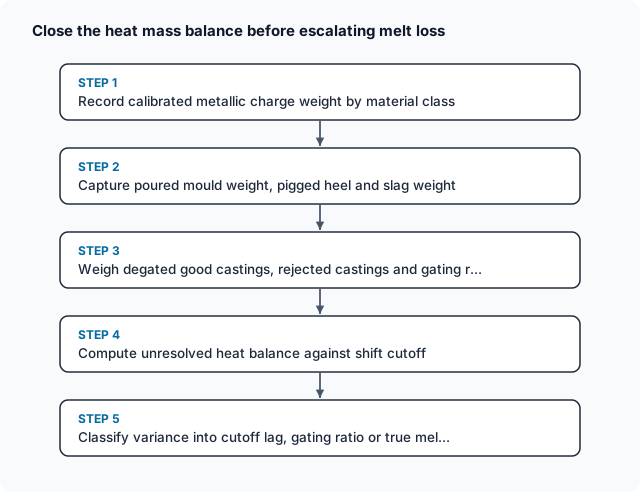
Read the complete workflow as text
- Record calibrated metallic charge weight by material class → Capture poured mould weight, pigged heel and slag weight
- Capture poured mould weight, pigged heel and slag weight → Weigh degated good castings, rejected castings and gating r...
- Weigh degated good castings, rejected castings and gating r... → Compute unresolved heat balance against shift cutoff
- Compute unresolved heat balance against shift cutoff → Classify variance into cutoff lag, gating ratio or true mel...
Worked example: 1,000 kg ductile-iron heat reconciliation (HEAT-DI-2026-114)
Consider an illustrative medium-frequency induction furnace heat (HEAT-DI-2026-114, alloy grade SG-500/7) at an industrial valve-body foundry. All weights, yield ratios, and rupee valuations below are synthetic operational figures constructed to demonstrate mass-balance reconciliation; they are not client performance records or universal metallurgical norms.
Reported morning flash exception
At the 07:00 morning production review, the ERP flash report flags HEAT-DI-2026-114 for severe yield collapse:
- Recorded furnace charge (
W_charge):1,000.0 kg(420.0 kgpig iron,310.0 kgsteel punchings,250.0 kgcertifiedSG-500/7internal foundry returns, and20.0 kgferroalloys/carburiser), valued at a blended metallic charge rate ofRs 84.00/kg(Rs 84,000.00 total metallic input). - Recorded finished casting receipt at 06:00 cutoff:
680.0 kgof accepted valve bodies (34 castings × 20.0 kgnet dressed weight, or68.00%charge-basis net good yield). - Unreconciled ERP variance:
1,000.0 kg − 680.0 kg = 320.0 kg(32.00%apparent loss on charge basis), prompting the plant manager to question whether excessive furnace superheat or wet charge scrap caused a32.00%melt loss.
Physical floor and scale reconciliation
Before altering furnace practice, the production controller and cost accountant pull the load-cell logs from the charge crane, ladle transfer scale, shakeout return bay, and fettling cell for HEAT-DI-2026-114:
- Furnace tap and melting loss (
972.0 kgtapped): Out of the1,000.0 kgsolid charge, furnace oxidation and skimmed slag removal accounted for28.0 kg(2.80%of charge) during melting and magnesium treatment (1,000.0 kg − 28.0 kg = 972.0 kgliquid metal tapped into pouring ladles). - Mould pouring vs pigged ladle heel (
960.0 kgpoured into moulds,12.0 kgpigged heel): Out of the972.0 kgtapped into the ladle,960.0 kgwas poured into36moulds (W_poured = 960.0 kg), consisting of720.0 kgsolidified in the casting cavities (75.00%gross cavity-to-poured box yield) and240.0 kgsolidified in the sprues, runners, and feeder risers (25.00%of poured weight). The remaining12.0 kgof cooling metal at the end of the ladle was not poured into a mould; it was pigged into a cast-iron chill mould (12.0 kgrecoverable ladle heel, kept outside the960.0 kgmould-pour denominator). During pouring and shakeout of the240.0 kggating system,2.0 kgwas lost as unrecoverable pouring splatter and sprue-cup oxidation scale, leaving238.0 kgof clean degated runners and risers. - Cutoff timing gap on Return Tote
RT-09(250.0 kg): Return ToteRT-09(238.0 kgshot-blasted runners and risers plus12.0 kgpigged ladle heel =250.0 kgcleanSG-500/7remelt stock) was weighed at06:14, fourteen minutes after the06:00automated ERP shift cutoff, so it remained inPending_Receiptstatus when the morning report ran. - Fettling grinding loss and casting rejects (
40.0 kgacross rough castings): Out of the720.0 kgrough casting weight across the36poured moulds,34sound castings yielded680.0 kgof accepted dressed valve bodies (34 × 20.0 kg) after removing10.0 kgof non-recoverable riser-neck and parting-line grinding swarf during fettling, while2castings totaling30.0 kg(1short-poured casting weighing10.0 kgrejected at shakeout plus1full20.0 kgcasting that failed ultrasonic inspection for shrinkage porosity) were routed to the quarantine cage (NCR-FDY-409) for disposition as internal remelt scrap (680.0 kg accepted + 30.0 kg rejected + 10.0 kg grinding swarf = 720.0 kgrough casting weight;250.0 kg tote + 30.0 kg rejected castings = 280.0 kgtotal recoverable metallic returns).
The table below reconciles the naive ERP flash report against the closed four-bucket physical mass balance:
Scroll horizontally to see all columns.
| Mass-balance category | Naive 06:00 ERP flash report (kg) | Reconciled heat balance (kg) | Share of 1,000.0 kg charge (%) | Recoverable metallic credit at Rs 84.00/kg (Rs) | Net non-recoverable metal cost impact (Rs) | Operational root cause and accounting treatment |
|---|---|---|---|---|---|---|
Furnace metallic charge (W_charge) |
1,000.0 | 1,000.0 | Full lot (all units) input basis | 84,000.00 | — | Verified crane load-cell log across 4 charge buckets |
Bucket 1: Accepted dressed castings (W_good) |
680.0 | 680.0 | 68.00% | 57,120.00 | 0.00 | 34 passed valve bodies (34 × 20.0 kg) transferred to machine shop |
Bucket 2a: Gating, risers & pigged heel (RT-09) |
0.0 (unposted at 06:00) | 250.0 | 25.00% | 21,000.00 | 0.00 | 238.0 kg runners/risers + 12.0 kg pigged heel weighed at 06:14; credited to SG-500/7 remelt stock |
Bucket 2b: Rejected castings (NCR-FDY-409) |
0.0 (in NDT hold cage) | 30.0 | 3.00% | 2,520.00 | 0.00 (metal) | 2 rejected castings (10.0 kg short pour + 20.0 kg shrink-porosity reject = 30.0 kg); metal recovered for remelt on NCR-FDY-409 |
| Bucket 3a: Furnace oxidation & slag loss | Bundled in 320.0 kg gap | 28.0 | 2.80% | 0.00 | 2,352.00 | Irreversible melt oxidation and skimmed furnace slag (28.0 kg × Rs 84.00/kg) |
| Bucket 3b: Pouring splatter & fettling dust | Bundled in 320.0 kg gap | 12.0 | 1.20% | 0.00 | 1,008.00 | 2.0 kg pouring splatter + 10.0 kg grinding swarf (12.0 kg × Rs 84.00/kg) |
Bucket 4: Unresolved cutoff variance (W_unresolved) |
320.0 (reported as loss) | 0.0 | 0.00% | 0.00 | 0.00 | Fully explained once RT-09 (250.0 kg) and NCR-FDY-409 (30.0 kg) are linked to HEAT-DI-2026-114 |
| Total accounted output & recovery | 680.0 kg (68.00%) | 960.0 kg metallic (96.00%) + 40.0 kg loss (4.00%) | 96.00% metallic recovery | Rs 80,640.00 | Rs 3,360.00 | True non-recoverable metal loss is 40.0 kg (Rs 3,360.00), not 320.0 kg (Rs 26,880.00) |
Arithmetic verification and operational decision impact
- Physical mass balance closure across stage boundaries:
- Furnace to ladle tap:
1,000.0 kg (charge) − 28.0 kg (furnace oxidation/slag) = 972.0 kg (tapped liquid metal). - Ladle tap to moulds and pigged heel:
972.0 kg (tapped) = 960.0 kg (poured into 36 moulds: 720.0 kg rough castings + 240.0 kg gating/risers) + 12.0 kg (pigged ladle heel). - Four-bucket heat closure:
680.0 kg (good castings) + 250.0 kg (runner/riser/heel tote RT-09: 238.0 kg gating + 12.0 kg pigged heel) + 30.0 kg (rejected castings on NCR-FDY-409) + 28.0 kg (melt oxidation/slag) + 12.0 kg (2.0 kg pouring splatter + 10.0 kg grinding dust) = 1,000.0 kg(0.0 kgunresolved residual).
- Furnace to ladle tap:
- Distinguishing furnace metallic recovery, mould-poured box yield, and charge-basis good yield:
- Total recoverable metallic weight (charge basis):
(680.0 kg + 250.0 kg + 30.0 kg) ÷ 1,000.0 kg = 960.0 kg ÷ 1,000.0 kg = 96.00%(note that960.0 kgtotal recovered metal equals960.0 kgpoured into moulds only because the12.0 kgpigged heel outside the moulds numerically offsets the12.0 kgcombined splatter and grinding loss inside the pouring/fettling loop). - True irreversible process loss (
W_loss, charge basis):(28.0 kg + 12.0 kg) ÷ 1,000.0 kg = 40.0 kg ÷ 1,000.0 kg = 4.00%, well within the foundry's illustrative configured engineering tolerance band of3.50%–4.50%for ductile iron. - Mould-poured yield (poured basis, excluding 12.0 kg pigged heel):
720.0 kg rough casting weight ÷ 960.0 kg poured into moulds = 75.00%gross box yield (240.0 kg ÷ 960.0 kg = 25.00%gating ratio), and680.0 kg accepted dressed castings ÷ 960.0 kg poured into moulds = 70.83%net good yield on poured weight. - Net good casting yield (charge basis):
680.0 kg accepted dressed castings ÷ 1,000.0 kg furnace charge = 68.00%(versus710.0 kg ÷ 1,000.0 kg = 71.00%dressed casting weight before the30.0 kgreject disposition).
- Total recoverable metallic weight (charge basis):
- Financial variance correction:
- Naive reporting overstated metallic loss at
320.0 kg × Rs 84.00/kg = Rs 26,880.00. - Reconciled reporting credits
280.0 kg × Rs 84.00/kg = Rs 23,520.00back to grade-segregatedSG-500/7remelt stock, isolating the true irreversible metal loss at40.0 kg × Rs 84.00/kg = Rs 3,360.00while flagging the2rejected castings (30.0 kg) for feeding-design and pouring-practice review by the methods engineer.
- Naive reporting overstated metallic loss at
Role authorities, exceptions, and accounting boundaries
A heat reconciliation workflow only stays trustworthy when operators and planners cannot plug missing weight into an arbitrary loss bucket to force a shift report to close.
Scroll horizontally to see all columns.
| Workflow step | Accountable owner | Required approval and evidence | Exception handling and system boundary |
|---|---|---|---|
| Charge make-up and scale capture | Melting supervisor | Calibrated crane/hopper load-cell log tied to Heat_ID and alloy grade |
Manual weight overrides require supervisor reason code and retain original scale reading |
| Shakeout and gating return receipt | Shakeout / degating lead | Weighed tote ticket (Tote_ID, Heat_ID, Alloy_Grade, gross/tare/net weight) |
Unweighed totes at shift end remain Pending_Return_Weighing; never auto-plugged to melt loss |
| Scrap casting disposition | Foundry quality engineer | Linked nonconformance record (NCR_ID) with defect code and net weight |
Rejected castings cannot return to the remelt bay until quality records the defect weight and releases the hold |
| Heat cutoff & valuation reconciliation | Production controller & cost accountant | Signed shift mass-balance sheet reconciling W_charge against all 4 buckets |
Any W_unresolved exceeding an illustrative configured threshold (such as 1.50% of heat charge, subject to plant policy) blocks automatic variance posting |
Scope and accounting guardrails
- No fabricated loss plugs: If a shift closes with an unexplained weight gap, the system must record the exact gap as
Unresolved_Heat_Variancerather than automatically adjusting oxidation percentage or raw-material inventory. - Preventing remelt double-counting: Internal returns (
Bucket 2) must be received into a dedicatedInternal_Foundry_Returnsstock valuation class by alloy grade and issued back to subsequent heats from that class, never booked as zero-cost unrecorded additions or new supplier purchases. - Process engineering authority: The reconciliation ledger identifies whether variance came from missing return tickets, casting rejects, or furnace loss; any change to furnace temperature, inoculant practice, or gating geometry remains the decision of qualified metallurgical and methods engineers.
Acceptance tests for foundry heat mass-balance controls
Before relying on ERP yield dashboards for operational or financial review, run these five observable acceptance checks in a sandbox environment using synthetic heat transactions:
Scroll horizontally to see all columns.
| Test ID | Scenario seeded in test environment | Expected system behavior | Pass/fail verification evidence |
|---|---|---|---|
ACT-M030-01 |
Close a 1,000.0 kg heat with 680.0 kg good castings and an unweighed return tote (RT-09) |
System holds 320.0 kg as Open_Cutoff_Reconciliation and blocks final melt-loss percentage sign-off |
Heat status shows Cutoff_Pending; oxidation loss is not auto-populated to 32.00% |
ACT-M030-02 |
Scan late return tote RT-09 (250.0 kg) 14 minutes after shift boundary referencing HEAT-DI-2026-114 |
Ledger links 250.0 kg to HEAT-DI-2026-114 Bucket 2a regardless of shift-clock rollover |
Heat balance updates W_return to 250.0 kg and reduces unresolved gap by 250.0 kg |
ACT-M030-03 |
Attempt to transfer 30.0 kg of rejected castings to the remelt bay without an approved NCR_ID |
System blocks inventory transfer to remelt stock until defect category and weight are logged | Transfer rejected with Missing_Quality_Disposition_Reference |
ACT-M030-04 |
Issue 250.0 kg of internal SG-500/7 returns to a new heat alongside 750.0 kg of purchased metal |
System tracks 1,000.0 kg total furnace charge while keeping internal circulate metal separate from new purchased consumption |
Cost ledger shows 750.0 kg net new metal consumed plus 250.0 kg internal circulation |
ACT-M030-05 |
Seed a heat where W_unresolved equals 22.0 kg (2.20% vs illustrative 1.50% review threshold) |
System flags the heat for joint production and finance review before posting cost variance | Exception queue entry created with full scale-reading audit trail |
Summary and next actions
Foundry yield improves only when the plant separates gating design ratio, casting scrap, cutoff timing gaps, and true furnace oxidation loss instead of reacting to a single aggregate percentage. Closing the four-bucket heat balance before closing the shift ensures metallurgists investigate real melt losses while planners fix delayed return-tote scans.
- Map every scale point between charge make-up, ladle pouring, shakeout return totes, fettling, and NDT quarantine so each heat links inputs and outputs by
Heat_IDand alloy grade. - Separate ERP heat reporting into four explicit buckets—accepted castings, recoverable internal returns, measured non-recoverable loss, and unresolved cutoff variance—and disable any formula that plugs residual gaps into furnace loss.
- Require shakeout return totes and rejected castings to be weighed and linked to the originating heat window before closing the daily production balance.
- Configure internal remelt stock by alloy family so circulating runners, risers, and scrap castings are neither lost from inventory nor double-counted as new purchases.
Recognise this problem in your operation?
Tell us where the records or handovers break down. We can discuss the process, data and software questions worth examining first.
Sources and further reading
Sources checked 15 October 2026. Worked examples and workflow diagrams are original illustrations, not reported client results.


