Keep PPAP evidence aligned with approved engineering changes
For production managers, planners and plant leaders · Compare approaches
TL;DR — what you’ll learn
- Updating a drawing revision or CNC work-centre routing in the ERP without re-evaluating the linked Production Part Approval Process (PPAP) package leaves the factory shipping modified parts under an obsolete customer warrant (PSW).
- Connect every engineering change notice (ECN) or process change request (PCR) to an explicit PPAP Evidence Impact Matrix that evaluates which core documents (Design Record, DFMEA/PFMEA, Process Flow, Control Plan, MSA, Dimensional Results, Capability Studies, PSW) and customer-specific notification gates apply before cut-over.
- Gate ERP production-order and dispatch release by Customer_ID + Part_Number + Revision_ID + PPAP_Approval_State so a part revision approved by one OEM customer cannot accidentally ship to a second OEM customer whose validation is still pending.
- In an illustrative Tier-1 aluminium steering-knuckle change (ECN-SK-2026-14, moving finish machining of Part Family SK-900 from Machine Cell MC-01 to new 5-axis Cell MC-04 and updating Rev B to Rev C), revision-and-customer gating allows 320 pcs (Rs 9,12,000.00) for OEM Customer Alpha (signed PSW-ALPHA-RevC) to ship on schedule while holding 180 pcs (Rs 5,13,000.00) for OEM Customer Beta on Interim_Hold until Beta's required run-at-rate witness sign-off completes.

Illustrative manufacturing inspection room and machine shop floor; not a client facility.
In automotive and precision industrial supply chains, initial Production Part Approval Process (PPAP) packages are carefully assembled before launch, stored in a folder, and quickly forgotten once serial production starts. Six months later, when engineering releases a drawing revision, transfers an operation to a new machining cell, or qualifies an alternate heat-treat sub-tier supplier, the ERP BOM and routing update immediately—while the quality file still points to the launch Process FMEA, Control Plan, and Part Submission Warrant (PSW). Shipping parts after an unnotified process or revision change exposes the supplier to immediate yard holds, controlled-shipping mandates, and chargebacks.
Why ERP engineering changes drift out of sync with PPAP evidence
Under automotive quality frameworks such as the AIAG Quality Core Tools (APQP, PPAP, FMEA, MSA, SPC) and ERP revision-control architectures such as Microsoft Dynamics 365 engineering change management, product approval is never a one-time blanket certificate for a part number. It is a binding link between a specific design revision, a specific manufacturing process and site/line, and a specific customer submission agreement.
Three structural gaps cause ERP changes and PPAP documentation to diverge:
- Treating process changes (
PCR) as internal-only routing edits: Planners often assume PPAP applies only when the customer changes a drawing dimension. In reality, moving a part to a different machine type, changing a tooling cavity, altering a process sequence, or switching a heat-treatment subcontractor requires updating theProcess Flow Diagram,PFMEA,Control Plan, and capability studies—and notifying the customer under their Customer-Specific Requirements (CSR) before shipping product from the new setup. - Document version fragmentation across FMEA, Control Plan, and shop-floor inspection: When
ECN-SK-2026-14adds a new critical datum flatness tolerance (0.03 mm), engineering updates the CAD drawing, but the shop-floor receiving/in-process inspection plan still referencesControl Plan v2instead ofControl Plan v3. - Assuming one universal submission level across multiple customers: Two customers buying variants of the same base part family (
SK-900) under different Customer-Specific Requirements may require completely different submission evidence for the same change (for example, Customer Alpha accepts aLevel 3submission with a 30-piece capability pack, while Customer Beta requires prior written notice plus a witnessed 300-piece run-at-rate beforePSWsign-off).
Building an ECN-to-PPAP impact and dispatch-gating workflow
This article outlines the document-control and ERP release-gating workflow for aligning engineering/process changes with PPAP evidence; it does not reproduce proprietary AIAG forms or prescribe a universal submission level, which always depends on the customer contract and applicable Customer-Specific Requirements (CSR).
1. Mandatory PPAP impact assessment on every ECN and PCR
Whenever an engineer creates an ECN (design change) or PCR (process/tooling/site/supplier change), the workflow requires a structured PPAP Impact Matrix before the change order can move to Approved_For_Cutover:
- Identify every affected
Part_Number,Revision_ID,Manufacturing_Line, andCustomer_ID. - Flag each affected core document (
Design Record,Engineering Change Document,DFMEA,Process Flow,PFMEA,Control Plan,MSA / Gauge R&R,Dimensional Results,Material/Performance Test Results,Initial Process Capability Study,Appearance Approval,Sample Production Parts,Master Sample,Checking Aids,Customer-Specific Requirements, andPart Submission Warrant / Interim Approval). - Record each customer's required notification and submission decision (
Customer_Notification_Required: Yes/No,Required_Submission_Path, andTarget_Effectivity_Date).
2. Synchronized revision lock across PLM, QMS, and ERP
The ERP item-revision effectivity gate prevents releasing a production order or customer delivery note for Revision C (or Process Routing R-04) unless:
- The linked
PFMEA,Control Plan, and shop-floorInspection Planmatch the active revision specified on the PPAP impact record, and - For the specific
Customer_IDon the sales order, the PPAP status for thatPart + Revision + Process_Routeis eitherFull_PSW_ApprovedorAuthorised_Interim_Waiver_Active(within its approved quantity or date ceiling).
Gate engineering and process change cut-over on customer-specific PPAP clearance
Follow the workflow below, or open its complete text version.
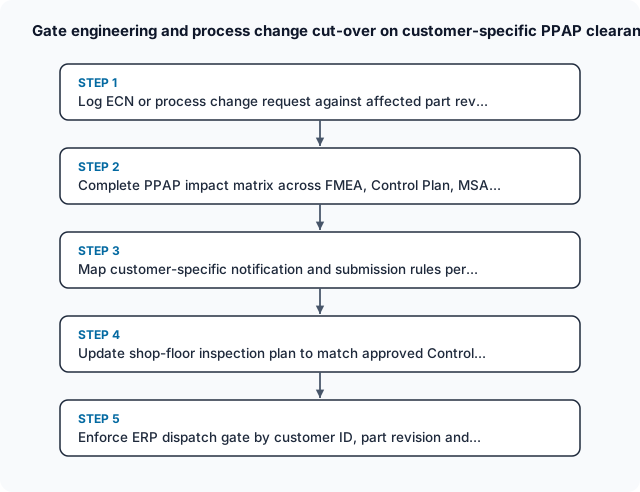
Read the complete workflow as text
- Log ECN or process change request against affected part rev... → Complete PPAP impact matrix across FMEA, Control Plan, MSA...
- Complete PPAP impact matrix across FMEA, Control Plan, MSA... → Map customer-specific notification and submission rules per...
- Map customer-specific notification and submission rules per... → Update shop-floor inspection plan to match approved Control...
- Update shop-floor inspection plan to match approved Control... → Enforce ERP dispatch gate by customer ID, part revision and...
Worked example: Steering knuckle cell transfer and revision change (ECN-SK-2026-14)
Consider an illustrative automotive Tier-1 precision machining supplier executing ECN-SK-2026-14 on a forged aluminium steering knuckle family (Base Family SK-900, unit price Rs 2,850.00/pc). All part numbers, capability indices, quantities, and rupee values below are synthetic operational data constructed to verify revision-to-PPAP reconciliation.
Scope of ECN-SK-2026-14
- Technical & process change: Tightens caliper-mount boss parallelism from
0.06 mmto0.03 mm(advancing drawing fromRev BtoRev C) and transfers finish machining (Op 20) from legacy 4-axis Horizontal CellMC-01(RoutingRT-SK-v2) to new 5-axis CellMC-04(RoutingRT-SK-v3). - Affected part variants and open weekly dispatch schedule (
500 pcstotal =Rs 14,25,000.00):SK-901-RevCfor OEM Customer Alpha (320 pcsscheduled,Rs 9,12,000.00): Under Alpha's CSR, the supplier submitted updatedPFMEA-v4,Control-Plan-v4,MSA-Gauge-RR-v3(7.8%R&R on new fixture),5-pieceCMM layout, and a30-piececapability study fromMC-04. Customer Alpha signed fullPSW-ALPHA-2026-88(Full_PSW_Approved) on2026-10-18.SK-902-RevCfor OEM Customer Beta (180 pcsscheduled,Rs 5,13,000.00): Under Beta's CSR, transferring a safety-critical steering knuckle to a new machining cell (MC-04) additionally requires an on-site or video-witnessed180-pieceproduction run-at-rate audit before Beta signs thePSW. As of2026-10-20, the180 pieceshave been machined and inspected (0defects), the internal documentation pack (PFMEA-v4,Control-Plan-v4,CMM-Layout,SPC-Pack) is complete, but Beta's supplier quality engineer (SQE) witness sign-off is scheduled for2026-10-22(PPAP_State = Pending_Customer_PSW_Signoff). Meanwhile, Beta still has an urgent requirement for60 piecesof legacySK-902-RevBmachined on approved CellMC-01(Rs 1,71,000.00) covered by Beta's active transition build-out authorization (Interim_Waiver_BETA-19, valid up to100 pcsofRevBthrough2026-10-25).
The table below reconciles the PPAP evidence matrix, ERP stock states, and dispatch eligibility across both customer accounts:
Scroll horizontally to see all columns.
| Part / Revision / Routing | Customer account & CSR rule | Core evidence status (PFMEA-v4 / CP-v4 / MSA-v3 / SPC) |
Customer PSW / waiver state on 2026-10-20 |
Completed stock on floor (pcs & Rs at Rs 2,850/pc) |
Dispatchable today (pcs & Rs) |
Held pending customer PSW (pcs & Rs) |
|---|---|---|---|---|---|---|
SK-901-RevC (RT-SK-v3 on MC-04) |
OEM Alpha (standard submission pack) | Complete (4/4 internal docs aligned to Rev C) |
Full_PSW_Approved (PSW-ALPHA-2026-88) |
320 pcs (Rs 9,12,000.00) | 320 pcs (Rs 9,12,000.00) | 0 pcs (Rs 0.00) |
SK-902-RevC (RT-SK-v3 on MC-04) |
OEM Beta (requires SQE run-at-rate witness) | Internal 4/4 complete; awaiting SQE witness (2026-10-22) |
Pending_Customer_PSW_Signoff (Dispatch blocked) |
180 pcs (Rs 5,13,000.00) | 0 pcs (Rs 0.00) | 180 pcs (Rs 5,13,000.00) |
SK-902-RevB (RT-SK-v2 on MC-01) |
OEM Beta (authorized bank build-out) | Complete under legacy PFMEA-v3 / CP-v3 |
Authorised_Transition_Waiver (BETA-19, cap 100 pcs) |
60 pcs (Rs 1,71,000.00) | 60 pcs (Rs 1,71,000.00) | 0 pcs (40 pcs waiver cap remaining) |
Total SK-900 family position |
2 OEM customers (Alpha, Beta) |
Synchronized by Part + Rev + Route |
Matrix-controlled per account | 560 pcs (Rs 15,96,000.00) | 380 pcs (Rs 10,83,000.00 / 67.86%) | 180 pcs (Rs 5,13,000.00 / 32.14%) |
Arithmetic and governance verification
- Total finished inventory across the
SK-900transition:320 pcs(SK-901-RevC) +180 pcs(SK-902-RevC) +60 pcs(SK-902-RevB) =560 piecestotal (560 × Rs 2,850.00 = Rs 15,96,000.00).
- Why customer-and-revision dispatch gating prevented an unauthorized shipment:
- Without customer-specific PPAP gating, releasing
ECN-SK-2026-14globally in the ERP after Alpha signedPSW-ALPHA-2026-88would have allowed shipping clerk dispatch of the180 pieces(Rs 5,13,000.00) ofSK-902-RevCto Customer Beta two days before Beta's SQE completed the mandatory run-at-rate approval—triggering a critical customer nonconformance for shipping unapproved process-change parts. - Instead, the ERP holds
180 pcs(Rs 5,13,000.00,32.14%of total stock) inPPAP_Hold_Pending_PSW, while allowing320 pcs(Rs 9,12,000.00) ofSK-901-RevCfor Alpha and60 pcs(Rs 1,71,000.00) of waiver-authorizedSK-902-RevBfor Beta (380 pieces = Rs 10,83,000.00, or67.86%of total stock) to ship cleanly.
- Without customer-specific PPAP gating, releasing
Roles, approval boundaries, and exception controls
Scroll horizontally to see all columns.
| Control point | Accountable owner | Required system record and evidence | Exception handling and boundary |
|---|---|---|---|
| ECN / PCR PPAP impact review | Automotive quality engineer & manufacturing engineer | Signed PPAP_Impact_Record mapping affected documents (DFMEA, PFMEA, Control Plan, MSA, SPC) and customer notification status |
No ECN or process routing transfer can activate in ERP without a completed PPAP impact record |
| Control Plan to shop-floor sync | Quality engineer | Active Inspection_Plan_ID version matched 1:1 to the approved Control_Plan_ID on the routing |
Production order cannot release if the shop-floor inspection template points to an older Control Plan version |
Customer PSW & interim waiver register |
Customer quality manager | Signed customer PSW_ID or time/quantity-bounded Interim_Waiver_ID per Customer + Part + Revision + Routing |
Interim waivers automatically expire when either Shipped_Qty == Waiver_Cap_Qty or Current_Date > Expiry_Date |
| Dispatch ASN / delivery note release | Logistics / shipping supervisor (system-enforced) | Automated validation of PPAP_Approval_State on every sales-order delivery line |
Shipping clerks cannot override a Pending_Customer_PSW block without quality manager and customer waiver upload |
Acceptance tests for PPAP change-evidence alignment
Scroll horizontally to see all columns.
| Test ID | Scenario seeded in test environment | Expected system behavior | Pass/fail verification evidence |
|---|---|---|---|
ACT-M039-01 |
Engineer attempts to set ECN-SK-2026-14 (Rev B → Rev C, Cell MC-01 → MC-04) to Active with an blank PPAP impact matrix |
System blocks ECN activation with Missing_PPAP_Impact_Assessment |
Change order remains in Engineering_Review until affected PPAP elements and customer rules are logged |
ACT-M039-02 |
Release trial production order for SK-902-RevC on MC-04 while shop-floor inspection plan still points to Control-Plan-v3 (Rev B) |
System blocks work-order release due to Control_Plan_Revision_Mismatch (v3 vs required v4) |
Ensures operators measure the new 0.03 mm parallelism limit under Control-Plan-v4 |
ACT-M039-03 |
Create delivery note for 320 pcs of SK-901-RevC for Customer Alpha (PSW-ALPHA-2026-88 active) and 180 pcs of SK-902-RevC for Customer Beta (PSW pending) |
System clears Alpha's 320 pcs (Rs 9,12,000.00) and blocks Beta's 180 pcs (Rs 5,13,000.00) |
Beta delivery line rejected with Customer_PSW_Approval_Pending |
ACT-M039-04 |
Ship 60 pcs of legacy SK-902-RevB against Beta's 100-piece transition waiver (BETA-19), then attempt a second shipment of 50 pcs (110 pcs cumulative) |
System allows the first 60 pcs (Rs 1,71,000.00) and blocks the second 50 pcs because 60 + 50 = 110 > 100 waiver ceiling |
Quantity-capped interim waiver enforced automatically |
ACT-M039-05 |
Upload Customer Beta's signed PSW-BETA-2026-31 after the 2026-10-22 SQE witness audit |
System transitions SK-902-RevC (RT-SK-v3) to Full_PSW_Approved and releases the 180 held pieces for dispatch |
Full traceability from ECN-SK-2026-14 to PSW-BETA-2026-31 recorded on shipment |
Summary and next actions
PPAP compliance breaks down after launch whenever engineering or process changes bypass quality document updates and customer notification gates. Binding every ECN and routing change to a customer-specific PPAP impact matrix—and gating ERP shipment release on active PSW or bounded waiver status—ensures modified parts never ship ahead of customer approval.
- Add a mandatory PPAP and Customer-Specific Requirement (
CSR) impact assessment step to your engineering change (ECN) and process change (PCR) approval workflows. - Link every ERP routing revision to the exact matching
PFMEA,Control Plan, and shop-floorInspection Planversion so operators never inspect a new revision against old limits. - Maintain PPAP approval status in the ERP at the
Customer_ID + Part_Number + Revision_ID + Routing_IDlevel rather than a single part-level checkbox. - Configure sales-order dispatch and ASN generation to block any shipment of a modified revision or process route until a signed customer
PSWor quantity/date-capped interim waiver is recorded.
Compare this workflow with your current setup
Share the step that takes the most manual work, the systems involved and the exceptions your team handles. That gives us a concrete starting point for comparing approaches.
Sources and further reading
Sources checked 15 October 2026. Worked examples and workflow diagrams are original illustrations, not reported client results.


