Plan apparel orders without losing the size and colour assortment
For production managers, planners and plant leaders · Compare approaches
TL;DR — what you’ll learn
- Tracking garment work orders only by aggregate style total allows cutting overruns in extreme sizes (such as XL) to mask mid-line shortages in core sizes (such as M and L) until pre-pack carton packing stalls.
- Fabric consumption and roll allocation must be governed per size-colour variant and dye shade lot so panels from different shade bands are never mixed inside the same garment bundle or solid-colour carton.
- Every department handover—cutting lay completion, bundle numbering, sewing line output, finishing QC and carton packing—should reconcile both variant piece balance and shade-lot identity against the customer assortment matrix.
- In a reconciled 600-piece woven shirt order (PO-APP-2026-600), aggregate finishing reaches 600 pieces (100.0% of total volume) but variant reconciliation exposes a 44-piece deficit in sizes M (-32) and L (-12) offset by a 44-piece excess in S (+2) and XL (+42), capping 1:2:2:1 pre-pack readiness at 84 of 100 cartons until a 72.40-metre shade-matched recut is released.

Illustrative garment size-and-colour assortment planning station; not a client facility.
Why aggregate piece tracking fails apparel assortment commitments
In discrete metal or plastics manufacturing, producing 600 units against a 600-unit sales order usually means the order is complete. In garment and textile manufacturing, a single style order is a two-dimensional matrix of colours (or wash finishes) and graded sizes—such as S, M, L, XL—often delivered in contractually fixed pre-pack carton ratios.
Many factories plan capacity and track daily sewing floor output using a single style-level total while managing size breakdowns on disconnected cutting-room spreadsheets. That split creates three recurring failures between cutting, sewing and dispatch:
- Over-cutting large or small sizes hides core-size deficits: When a fabric roll runs short on the final lay or a cutting table operator adds extra plies of
XLto use up a roll end, total cut pieces still exceed the order total, so the ERP header marks cutting100% completeeven though sizeLis already four pieces short. - Shade-lot mixing triggers mid-order quarantine: Woven shirting, denim and dyed knits exhibit roll-to-roll shade variation (
Shade Band AversusShade Band B). If cutting issues collars or cuffs fromLot SL-22Binto body bundles cut fromLot SL-22A, finishing quality control must reject the assembled garments—creating a sudden shortage in a single size hours before vessel cut-off. - Pre-pack carton ratios amplify single-size shortages: When a retail buyer orders
100 cartonspacked in a mandatory1 : 2 : 2 : 1ratio (1 S, 2 M, 2 L, 1 XL=6 pieces/carton), a32-pieceshortage in sizeMblocks 16 complete cartons (96 pieces of finished apparel) from shipping unless the planner triggers an immediate shade-matched recut or obtains written customer approval for single-size tail cartons.
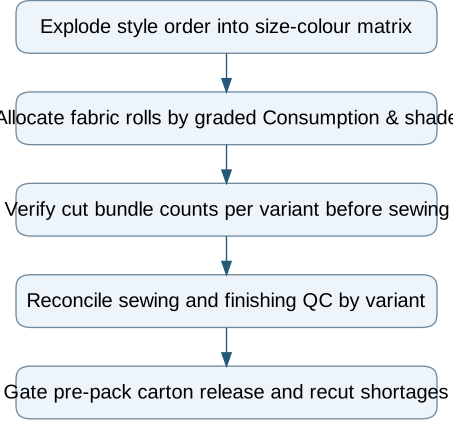
Plan apparel orders without losing the size and colour assortment — reporting workflow
Follow the workflow below, or open its complete text version.
Read the complete workflow as text
- Explode style order into size-colour matrix → Allocate fabric rolls by graded Consumption & shade
- Allocate fabric rolls by graded Consumption & shade → Verify cut bundle counts per variant before sewing
- Verify cut bundle counts per variant before sewing → Reconcile sewing and finishing QC by variant
- Reconcile sewing and finishing QC by variant → Gate pre-pack carton release and recut shortages
Four-stage variant and shade-lot control architecture
To prevent aggregate piece counts from masking variant deficits, production planning must enforce variant-level balances at four operational handovers:
1. Graded BOM consumption and shade-band roll reservation
Instead of applying a single average fabric consumption across the whole style, the bill of materials (BOM) records graded marker consumption by size—for example, 1.45 m/pc for S, 1.55 m/pc for M, 1.65 m/pc for L and 1.75 m/pc for XL. Before releasing a cutting ticket, the planner reserves inspected fabric rolls grouped by shade band so every ply in a bundle—and every garment packed into a solid-colour carton—shares a single verified shade lot.
2. Marker ratio lock and bundle-ticket validation
When the cutting room spreads fabric plies and cuts a multi-size marker, the system compares actual cut pieces per size against the authorised marker plan. Over-cuts in one size are never credited toward the completion percentage of another size. Each cut bundle receives a barcoded bundle ticket carrying Style + Colour + Size + Shade Lot + Ply Range.
3. Sewing line balancing and shade-segregated WIP transfer
Sewing lines receive complete component sets (fronts, backs, sleeves, collars, cuffs and size labels) matched by bundle ticket. If an in-line inspector rejects a damaged panel, the sewing supervisor logs the defect against the exact size-colour variant and requests a shade-matched replacement panel from the remnant roll buffer rather than cannibalising another bundle.
4. Finishing QC and pre-pack assortment reconciliation
At pressing, folding and carton packing, the system calculates two distinct metrics for the apparel planner:
- Capped variant fulfilment:
sum(min(Ordered_i, Passed_QC_i))across all variantsi, preventing surplus over-makes inSorXLfrom offsetting deficits inMorL. - Pre-pack carton ceiling:
min(floor(Passed_QC_i / Pack_Ratio_i)), identifying the exact limiting size that constrains complete ratio cartons.
Worked example: 600-piece Oxford shirt order (PO-APP-2026-600)
Consider an apparel manufacturer executing buyer order PO-APP-2026-600 for 600 pieces of Men's Long-Sleeve Oxford Shirt (Style ST-408, Colour Navy-04), contracted as 100 pre-pack cartons of 6 pieces each under a mandatory 1 S : 2 M : 2 L : 1 XL assortment ratio:
- Ordered variant quantities:
100 S,200 M,200 Land100 XL(600 pieces total). - Planned fabric requirement:
(100 × 1.45 m) + (200 × 1.55 m) + (200 × 1.65 m) + (100 × 1.75 m) = 145.0 + 310.0 + 330.0 + 175.0 = 960.0 metresofNavy-04shirting fabric. - What went wrong on the floor:
- During cutting of size
M, the operator cut170 piecesfrom primary Shade LotSL-22Aand completed the remaining32 piecesusing a roll from Shade LotSL-22Bwithout inserting a shade-separation sheet. During sewing, sleeves fromSL-22Bwere stitched onto bodies fromSL-22A, causing finishing QC to quarantine 32 pieces of sizeMfor visible shade mismatch (alongside 2 pieces rejected for stitch defects). - On size
L, a roll-end splice defect reduced the final lay by4 pieces(196 piecescut instead of200), and 8 pieces failed buttonhole and oil-stain inspection, leaving 188 good pieces. - On size
XL, the cutting supervisor added extra single-size markers onto remnant roll ends ofSL-22Ato boost daily cutting output, cutting 146 pieces and finishing 142 good pieces against a requirement of only 100 pieces.
- During cutting of size
The table below reconciles the style total against the true variant-by-variant and carton-pack position:
Scroll horizontally to see all columns.
Variant SKU (ST-408) |
Pack ratio (6-pc box) | Ordered qty (pcs) | Graded fabric (m/pc & plan m) | Actual cut qty (pcs) | Sewing & shade QC rejects (pcs) | Passed QC output (pcs) | Net variant balance vs PO (pcs) | Dispatchable against PO (pcs) | Max complete boxes by size |
|---|---|---|---|---|---|---|---|---|---|
ST-408-NVY-S (Size S) |
1 | 100 | 1.45 m (145.0 m) | 104 | 2 (stitch) | 102 | +2 surplus | 100 | 102 boxes |
ST-408-NVY-M (Size M) |
2 | 200 | 1.55 m (310.0 m) | 202 | 34 (2 stitch + 32 shade lot mix) | 168 | -32 shortage | 168 | 84 boxes (limiting) |
ST-408-NVY-L (Size L) |
2 | 200 | 1.65 m (330.0 m) | 196 | 8 (buttonhole / stain) | 188 | -12 shortage | 188 | 94 boxes |
ST-408-NVY-XL (Size XL) |
1 | 100 | 1.75 m (175.0 m) | 146 | 4 (stitch) | 142 | +42 surplus | 100 | 142 boxes |
| Total / assortment gate | 6 pcs/box | 600 | 1.60 m avg (960.0 m) | 648 | 48 total rejects | 600 (100.0% gross) | 0 net (-44 short / +44 over) | 556 (92.67% capped) | 84 boxes (504 pcs) |
Operational decisions from the reconciled assortment table
- Exposing the 600-piece aggregate illusion: A conventional production report shows 600 pieces ordered and 600 pieces passed QC (
0net variance), leading management to assume the shipment is ready. The variant ledger shows that only 556 pieces (92.67%) can be applied to the purchase order, while 44 pieces (2 S + 42 XL) are unrequested over-makes and 44 pieces (32 M + 12 L) are missing. - Quantifying pre-pack dispatch impact: Because size
Myields only168 ÷ 2 = 84 complete pre-pack cartons, the factory can pack only 504 pieces (84.0% of the order) into compliant1:2:2:1cartons—leaving18 S,20 Land58 XLfinished shirts stranded on the packing floor. - Executing a bounded recut before shipment cut-off: To close the 32-piece
Mand 12-pieceLdeficit without mixing shade bands, the apparel planner releases an emergency recut work order against reserved Shade LotSL-22Astock:Size M recut:32 pcs × 1.55 m/pc = 49.60 metresSize L recut:12 pcs × 1.65 m/pc = 19.80 metresEnd-loss and 3% defect buffer:3.00 metres- Total recut fabric issue: 72.40 metres of verified
SL-22Afabric, restoring all 100 cartons (600 assortment-compliant pieces) prior to container stuffing.
Implementation checklist for apparel production planners
- Cap order progress by variant: Calculate work-order completion as
sum(min(Ordered_i, Completed_i)) ÷ Total_Orderedat cutting, sewing and finishing so over-cuts in one size never mask shortages in another. - Enforce shade-lot separation on bundle tickets: Require every cut bundle and replacement panel request to carry the roll's
Shade_Band_ID, blocking mixed-shade assembly before sewing starts. - Gate over-cut marker additions: Require apparel planner sign-off before the cutting room adds unscheduled single-size plies to consume remnant roll ends.
Compare this workflow with your current setup
Share the step that takes the most manual work, the systems involved and the exceptions your team handles. That gives us a concrete starting point for comparing approaches.
Sources and further reading
Sources checked 15 October 2026. Worked examples and workflow diagrams are original illustrations, not reported client results.


