Choose downtime reasons operators can record and managers can act on
For production managers, planners and plant leaders · Compare approaches
TL;DR — what you’ll learn
- Presenting operators with 100+ engineering fault codes or forcing immediate root-cause selection on a stopped line produces high "Other" and "Material Waiting" entries that misdirect maintenance and planning teams.
- A governed downtime architecture separates automated machine-state capture (exact stop/start timestamps and PLC fault registers) from a concise 15-to-30 code operator list where every category maps to one accountable owner.
- Supervisor and maintenance reviews must record verified root-cause reclassifications in a separate audit column rather than overwriting the operator's original entry, keeping unverified stops honestly marked as pending until investigated.
- In a reconciled 15-shift review of CNC turning and cartoning cell CELL-CNC-04 (42 stops / 640.0 minutes across 7,200 planned minutes), audit recoding reduces unclassified stops from 23.44% (150.0 min) to 0.78% (5.0 min) and reveals that mechanical feeder faults—not material staging—drive 48.44% (310.0 min) of total downtime.

Illustrative shop-floor machine stoppage and maintenance audit review; not a client facility.
Why shop-floor downtime logs collapse into "Other" and misattributed waits
When a manufacturing plant installs operator touchscreens or an OEE monitoring terminal, engineering teams frequently load every possible failure mode from the maintenance system into the operator dropdown—creating 120 to 200 codes ranging from solenoid valve coil burnout to encoder cable shielding fault.
On an active machining cell or packaging line, that design fails for three practical reasons:
- Operators observe symptoms at stop time, not engineering root causes: When a bar feeder stops advancing stock into a CNC lathe, the operator sees an empty spindle collet and taps
Material Waitingso they can clear the jam—even when the actual fault is a worn pneumatic feed finger slipping on a full bundle of bars. - Long code lists trigger selection fatigue and "Other" dumping: Faced with seven screens of scrolling maintenance jargon while a line beacon flashes red, operators select the first visible button or dump the interval into
Other / Miscellaneous. - Silent overwrites destroy diagnostic feedback: If a maintenance technician later edits the database record in place to change
Material WaitingtoMechanical Feeder Fault, the plant loses the record of why operators misread the symptom—and conversely, if no one reviews the log, materials management gets blamed for a mechanical maintenance problem.
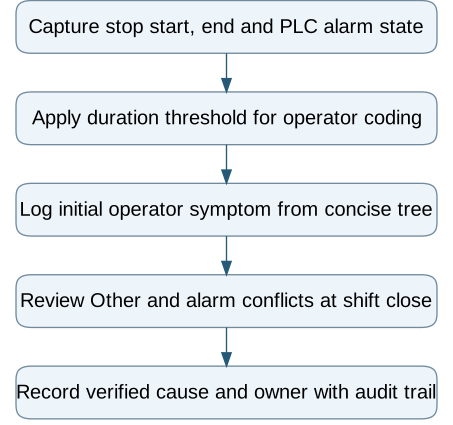
Choose downtime reasons operators can record and managers can act on — reporting workflow
Follow the workflow below, or open its complete text version.
Read the complete workflow as text
- Capture stop start, end and PLC alarm state → Apply duration threshold for operator coding
- Apply duration threshold for operator coding → Log initial operator symptom from concise tree
- Log initial operator symptom from concise tree → Review Other and alarm conflicts at shift close
- Review Other and alarm conflicts at shift close → Record verified cause and owner with audit trail
Four design rules for a governed downtime taxonomy
To produce Pareto tables that maintenance, engineering, quality and materials leads can act on every week, the stop-recording workflow should enforce four structural boundaries:
1. Separate machine state timestamps from human cause classification
Duration must never depend on when the operator walks over to the terminal. The machine controller (PLC) or cycle sensor records stop_start_ts, stop_end_ts, duration_min and any active hardware fault code (such as ALM-408 Collet Clamp Pressure Low). The human workflow only attaches a business cause classification to that immutable time interval.
2. Establish explicit duration thresholds (micro-stops vs reportable stops)
Requiring an operator to classify every 15-second photo-eye clear guarantees bad data. Define a clear boundary in the reporting specification:
- Micro-stops (under 2.0 minutes): Logged automatically by count and cumulative minutes under speed/minor-stop loss tied to the active PLC sensor register, without requiring manual text entry.
- Reportable stops (2.0 minutes or longer): Require an operator symptom selection from a two-tier list of 18 to 30 active codes grouped under 6 owner-aligned parent categories.
- Extended stops (15.0 minutes or longer): Require joint sign-off by the production supervisor and the responding maintenance or quality technician before shift close.
3. Map every parent category to one accountable functional owner
A reason code is only actionable if a named role owns its reduction:
EQP-MECH(Equipment mechanical, electrical or tooling breakdown) → Maintenance LeadSET-CHGO(Setup, die/collet changeover and first-off offset adjustment) → Manufacturing Engineering / Setter LeadMAT-WAIT(Raw material, component or packaging staging starvation) → Materials / Stores SupervisorQMS-HOLD(In-process quality hold, gauge verification or containment sort) → Quality Assurance LeadOPS-LABR(Operator relief, safety stand-down or cross-machine tending wait) → Production SupervisorOTH-UNCL(Unclassified / pending investigation) → Production Supervisor with Maintenance (governed by a5.0% maximumweekly ceiling and 24-hour review SLA; unknown causes remain explicitly marked as pending rather than guessed or AI-invented).
4. Preserve both initial_operator_code and verified_audit_code
When shift-close review or maintenance work-order closeout shows that an operator symptom entry differed from the technical root cause, the supervisor records verified_audit_code, recoded_by, recoded_at and evidence_ref (such as work order WO-8841 or PLC alarm ALM-408) without erasing initial_operator_code.
Worked example: 15-shift downtime audit on CELL-CNC-04
Consider a precision machining and automated cartoning cell (CELL-CNC-04) running 3 shifts per day across 5 days (7,200.0 planned production minutes). During the week, automated cycle monitoring captures 42 reportable stop events (2.0 minutes or longer) totaling 640.0 minutes of downtime (6,560.0 minutes run time, or 91.11% gross availability before speed and quality factors).
In the raw operator HMI summary pulled on Friday afternoon, MAT-WAIT (190.0 minutes, 29.69%) appears to be the #1 plant bottleneck, while OTH-UNCL sits at 150.0 minutes (23.44%)—more than four times the plant's 5.0% unclassified ceiling.
During the daily shift-close review, the production supervisor and maintenance lead cross-check the 42 stop intervals against PLC fault logs, maintenance work orders and setter sheets:
- 7 stops totaling 125.0 minutes originally coded by operators as
MAT-WAIToccurred while full bar bundles were loaded in the magazine, accompanied by PLC alarmALM-408 (Bar Feeder Pneumatic Pusher Slip). These 7 events (125.0 minutes) are reclassified toEQP-MECH. - 10 stops totaling 145.0 minutes originally dumped into
OTH-UNCLare resolved from technician and setter notes: 4 pneumatic pusher jams (70.0 minutes) move toEQP-MECH, 3 first-piece CMM offset waits (45.0 minutes) move toSET-CHGO, 2 thread-ring gauge verification holds (25.0 minutes) move toQMS-HOLD, and 1 shift-handover gauging pause (5.0 minutes) moves toOPS-LABR. - 1 transient spindle drive reset (5.0 minutes) has no conclusive fault trace yet and is retained honestly in
OTH-UNCLpending OEM drive-log inspection.
The table below reconciles the initial operator logs against the verified post-audit Pareto across all 42 events and 640.0 minutes:
Scroll horizontally to see all columns.
| Reason category & code | Accountable owner | Initial operator events | Initial logged minutes | Initial share (%) | Audit recoding delta (events / min) | Verified events | Verified minutes | Verified Pareto share (%) |
|---|---|---|---|---|---|---|---|---|
EQP-MECH Equipment & feeder fault |
Maintenance Lead | 6 | 115.0 | 17.97% | +11 events / +195.0 min | 17 | 310.0 | 48.44% |
SET-CHGO Setup & first-off offset |
Mfg Engineering / Setter | 8 | 140.0 | 21.88% | +3 events / +45.0 min | 11 | 185.0 | 28.91% |
MAT-WAIT Material staging starvation |
Materials / Stores | 13 | 190.0 | 29.69% | -7 events / -125.0 min | 6 | 65.0 | 10.16% |
QMS-HOLD Quality & gauge verification |
Quality Assurance | 3 | 35.0 | 5.47% | +2 events / +25.0 min | 5 | 60.0 | 9.38% |
OPS-LABR Operator relief & tending wait |
Production Supervisor | 1 | 10.0 | 1.56% | +1 event / +5.0 min | 2 | 15.0 | 2.34% |
OTH-UNCL Unclassified / pending review |
Supervisor + Maintenance | 11 | 150.0 | 23.44% | -10 events / -145.0 min | 1 | 5.0 | 0.78% |
Total cell downtime (CELL-CNC-04) |
All governed owners | 42 | 640.0 | 100.00% | 0 net events / 0.0 net min | 42 | 640.0 | 100.00% |
How the audit trail changes management action
- Reversing a false capital and inventory decision: Had management acted on the raw operator log, the plant would have expanded line-side bar-stock racks to fix an apparent 190.0-minute (29.69%) material starvation issue. The reconciled audit proves true material staging waits were only 65.0 minutes (10.16%), while 310.0 minutes (48.44%) stemmed from mechanical bar-feeder pusher wear and collet sensor trips (
EQP-MECH). - Improving the HMI taxonomy without blaming operators: Because the audit trail preserved
initial_operator_code = MAT-WAITalongsideverified_audit_code = EQP-MECH, engineering saw why operators misclassified the stop (the feeder stopped advancing bars) and added a clear symptom button labeledBar Feeder Jam / Stock Not Advancingmapped directly toEQP-MECH. - Enforcing the
5.0% maximumunclassified ceiling honestly: Shift-close review reducedOTH-UNCLfrom 23.44% (150.0 minutes) to 0.78% (5.0 minutes) while keeping the single unresolved 5.0-minute spindle drive reset visibly flagged as pending rather than fabricating a root cause.
Implementation checklist for shop-floor downtime governance
- Cap active operator codes at 18–30 symptom buttons: Use plain shop-floor symptom language on the HMI while mapping each button to its engineering parent category and functional owner in the reporting table.
- Flag PLC alarm vs manual reason mismatches automatically: Queue any stop interval where a machine fault register was active during an operator-selected
MAT-WAITorOPS-LABRcode for shift-close supervisor review. - Audit recoding volume monthly: Track which codes have the highest recoding delta so ambiguous buttons are relabeled and unused codes (zero occurrences in 90 days) are retired.
Compare this workflow with your current setup
Share the step that takes the most manual work, the systems involved and the exceptions your team handles. That gives us a concrete starting point for comparing approaches.
Sources and further reading
Sources checked 15 October 2026. Worked examples and workflow diagrams are original illustrations, not reported client results.

