Schedule moulding jobs around tool, material and colour changeovers
For production managers, planners and plant leaders · Compare approaches
TL;DR — what you’ll learn
- Standard ERP routing fields store a single static setup time per item, ignoring the reality that changing an injection moulding press from Natural to White takes 30 minutes of barrel purging, whereas changing from Carbon-Black to White requires a 3.5-hour screw pull and chemical purge.
- Practical moulding scheduling combines approved machine-tool eligibility with two sequence-dependent matrices: a mechanical tooling matrix (in-press cavity insert swap vs full bolster crane swap) and a barrel transition matrix (light-to-dark pigment progression and melt-temperature ramps).
- Planners compare due-date and setup-driven sequences within a due-date feasibility window so family mould runs and colour progressions never breach a customer delivery date or use an unapproved press combination.
- On a 350-ton press (IMM-350-04) running 6 weekly jobs (96.0 hours net moulding time), replacing naive Earliest-Due-Date sequencing with matrix-optimized sequencing (SCHED-IMM-04-W42) cuts changeover time from 21.5 hours to 8.0 hours (-62.79%) and reduces barrel purge consumption from 480 kg to 140 kg (saving ₹54,400/week) while meeting all 6 due dates.

Illustrative manufacturing inspection room and machine shop floor; not a client facility.
Why static ERP setup times fail moulding and stamping shops
In discrete machining or bench assembly, setup time depends mostly on the incoming part number. In polymer injection moulding, blow moulding and progressive-die stamping, setup time is asymmetric and sequence-dependent: the time and purge material required to set up Job B depend heavily on which Job A just finished running on the press.
Two physical mechanisms drive this asymmetry on an injection moulding machine:
- Mechanical master-bolster versus cavity-insert hierarchy: Swapping an entire
2.8-tonmould base via overhead crane, disconnecting cooling-water circuits, hydraulic core-pulls and hot-runner cables takes 120 minutes (2.0 hours). By contrast, swapping a quick-change cavity insert inside the same master mould frame (MB-A) while leaving the bolster clamped on the platen takes 30 minutes (0.5 hours)—or 0 minutes when two SKUs share the exact same mould geometry and differ only by masterbatch colour. - Polymer and pigment transition asymmetry: Moving up the pigment opacity scale (
Natural → White → Yellow → Red → Blue → Black) within the same polypropylene (PP) resin requires 30 minutes (0.5 hours) and 15–25 kg of purging compound. Reversing that order (Carbon-Black → WhiteorGlass-Filled Nylon PA66 at 285°C → Unfilled PP at 210°C) contaminates the melt stream with black specks or degraded polymer char, requiring a 180-to-210-minute (3.0–3.5 hour) barrel teardown, manual screw cleaning and 150+ kg of purging compound.
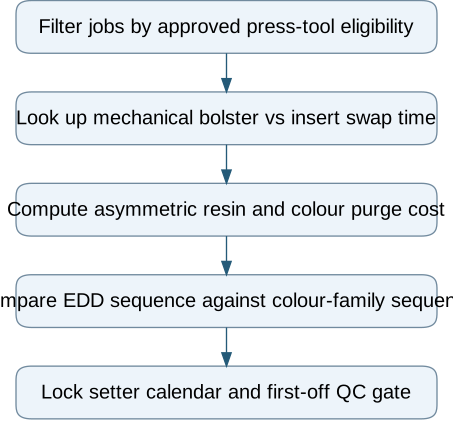
Schedule moulding jobs around tool, material and colour changeovers — reporting workflow
Follow the workflow below, or open its complete text version.
Read the complete workflow as text
- Filter jobs by approved press-tool eligibility → Look up mechanical bolster vs insert swap time
- Look up mechanical bolster vs insert swap time → Compute asymmetric resin and colour purge cost
- Compute asymmetric resin and colour purge cost → Compare EDD sequence against colour-family sequence
- Compare EDD sequence against colour-family sequence → Lock setter calendar and first-off QC gate
Designing a two-dimensional setup matrix in the planning sheet
To evaluate press sequences without relying on informal memory, production planning maintains approved press-mould compatibility rules alongside two lookup tables:
- Table A — Tooling transition matrix
T(from_tool, to_tool):- Same mould & same cavity insert:
0.0 hrs - Same master mould frame (
MB-A → MB-A), different quick-change insert:0.5 hrs(30 min) - Same manifold family (
MB-B1 → MB-B2), quick-clamp swap:1.5 hrs(90 min) - Full master mould base crane swap (
MB-A → MB-B):2.0 hrs(120 min)
- Same mould & same cavity insert:
- Table B — Barrel & colour purge matrix
P(from_resin_colour, to_resin_colour):- Same resin & same colour (
PP-BLK → PP-BLK):0.0 hrs/0 kgpurge - Same resin, light-to-dark step (
Nat → Wht → Red → Blk):0.5 hrs(30 min) /15–25 kgpurge - High-temperature / glass-fill ramp-up (
PP-BLK 210°C → PA66-GF30-BLK 285°C):1.0 hr(60 min) /55 kgpurge - Dark-to-light or glass-to-unfilled reversal (
BLK → WHTorPA66-GF → PP-NAT):3.5 hrs(210 min) /160 kgpurge (flagged for planner review).
- Same resin & same colour (
Because mechanical mould changeover, barrel purging and first-off quality inspection require coordinated setter and inspector availability, the schedule sums T + P for total changeover downtime while checking that every job finishes on or before its customer due hour.
Worked example: 350-ton press weekly schedule (SCHED-IMM-04-W42)
Consider illustrative injection moulding press IMM-350-04 operating 120.0 available hours in Week 42 across 6 approved work orders totaling 96.0 hours of net moulding run time. Purging compound costs ₹160.00/kg.
- Under a Naive Earliest-Due-Date Sequence (
Seq-A:JOB-101 → 102 → 103 → 104 → 105 → 106), the press alternates between Mould BasesMB-AandMB-Bthree times and incurs aPP-BLK → PP-WHTscrew pull beforeJOB-103, consuming 21.5 hours of setup/purge time (117.5 hours total clock) and 480 kg (₹76,800) of purging compound. - Under the Matrix-Optimized Sequence (
Seq-B:JOB-101 → 103 → 104 → 105 → 102 → 106), allMB-Ajobs run first in a strictNatural → White → Red → Blackprogression, followed by a single crane swap toMB-Bwhile keeping the barrel onPP-BLKforJOB-102, and ending withPA66-GF30-BLK(JOB-106) right before planned weekend barrel maintenance:
Scroll horizontally to see all columns.
| Sequence step & work order | Resin & colour grade | Mould base / insert ID | Tooling change (hrs) | Barrel purge (hrs) | Total setup (hrs) | Purge resin used (kg / ₹) | Net mould run (hrs) | Cum. press clock (hrs) | Customer due clock & SLA status |
|---|---|---|---|---|---|---|---|---|---|
STEP-01 JOB-101 |
PP-NAT (Natural) |
MB-A / Insert A1 |
0.5 | 0.5 | 1.0 | 15 kg (₹2,400) | 18.0 | 19.0 | Due 72.0h (Day 3) — 53.0h early |
STEP-02 JOB-103 |
PP-WHT (White) |
MB-A / Insert A2 |
0.5 | 0.5 | 1.0 | 20 kg (₹3,200) | 14.0 | 34.0 | Due 96.0h (Day 4) — 62.0h early |
STEP-03 JOB-104 |
PP-RED (Red) |
MB-A / Insert A2 (same) |
0.0 | 0.5 | 0.5 | 25 kg (₹4,000) | 15.0 | 49.5 | Due 120.0h (Day 5) — 70.5h early |
STEP-04 JOB-105 |
PP-BLK (Black) |
MB-A / Insert A3 |
0.5 | 0.5 | 1.0 | 25 kg (₹4,000) | 17.0 | 67.5 | Due 120.0h (Day 5) — 52.5h early |
STEP-05 JOB-102 |
PP-BLK (Black) (same) |
MB-B / Full Tool B1 |
2.0 | 0.0 | 2.0 | 0 kg (₹0) | 16.0 | 85.5 | Due 96.0h (Day 4) — 10.5h early |
STEP-06 JOB-106 |
PA66-GF30-BLK (285°C) |
MB-B / Full Tool B2 |
1.5 | 1.0 | 2.5 | 55 kg (₹8,800) | 16.0 | 104.0 | Due 144.0h (Day 6) — 40.0h early |
Total optimized (Seq-B) |
Light-to-dark + family | 1 crane bolster swap | 5.0 | 3.0 | 8.0 | 140 kg (₹22,400) | 96.0 | 104.0 | 6 / 6 jobs 100% on-time |
Baseline naive EDD (Seq-A) |
Unordered colour/tool | 3 crane swaps + screw pull | 11.5 | 10.0 | 21.5 | 480 kg (₹76,800) | 96.0 | 117.5 | Only 2.5h buffer remaining |
Net weekly gain (Seq-B vs Seq-A) |
Zero dark-to-light steps | -2 crane swaps | -6.5h | -7.0h | -13.5h (-62.79%) | -340 kg (-₹54,400) | 0.0h | +13.5h free | 16.0h total press capacity open |
Verifying the scheduling and financial arithmetic
- Setup time reconciliation: Tooling change hours (
0.5 + 0.5 + 0.0 + 0.5 + 2.0 + 1.5 = 5.0 hrs) plus barrel purge hours (0.5 + 0.5 + 0.5 + 0.5 + 0.0 + 1.0 = 3.0 hrs) equal 8.0 total setup hours, down from 21.5 hours inSeq-A—saving 13.5 hours (62.79%) of press time on a single machine in one week. - Purge resin savings: Purge consumption drops from 480 kg (
₹76,800) to 140 kg (15 + 20 + 25 + 25 + 0 + 55 = 140 kg, or₹22,400), saving 340 kg (₹54,400/week) of purging resin. - Zero due-date compromise: Even though
JOB-102(due at Hour 96.0, end of Day 4) moved from Step 2 to Step 5 so it could bridge thePP-BLKtransition betweenMB-AandMB-B, it still finishes at Hour 85.5—10.5 hours ahead of its customer delivery promise.
Implementation checklist for moulding & stamping schedulers
- Hard press-tool compatibility filter: Never allow the schedule to assign a mould to a press without an approved tie-bar spacing, tonnage and shot-weight eligibility record signed off by process engineering.
- Colour-index rank on item master: Assign each moulded SKU a numeric
pigment_sequence_rank(10 = Natural,20 = White,40 = Red,60 = Black) andmelt_temp_groupso the planning sheet flags dark-to-light reversals. - Setter and first-off QC reservation: Block simultaneous full-bolster crane swaps across adjacent presses when only one setter crew and one CMM first-off slot are available on the shift.
Compare this workflow with your current setup
Share the step that takes the most manual work, the systems involved and the exceptions your team handles. That gives us a concrete starting point for comparing approaches.
Sources and further reading
Sources checked 15 October 2026. Worked examples and workflow diagrams are original illustrations, not reported client results.

