Find task-coverage gaps in a manufacturing skills matrix
For people operations, production and planning teams · Compare approaches
TL;DR — what you’ll learn
- Use a task-specific key instead of a single “trained” flag.
- Read eligibility from the responsible source rather than deriving it from course attendance.
- Keep unknown, expired and explicitly ineligible records distinct.
- Treat a coverage matrix as a reporting view, not permission to assign work.
A factory matrix shows several people against a machine, yet the planner cannot tell which task each record covers. Operating, setting and inspection are different descriptions of work. Collapsing them into one green cell hides the question the planner needs to ask.
The data model here displays task eligibility supplied by the organization's existing process. It does not define competence, appoint assessors or grant operating or inspection authority. Use synthetic person IDs when demonstrating the report.
Separate evidence from the supplied decision
In this original illustration, the source provides the following records for machine C1 at a stated reference time:
Scroll horizontally to see all columns.
| Synthetic person | Operation task | Setup task | Training reference |
|---|---|---|---|
| Person A | Eligible in supplied record | Unknown: no task record | T-101 |
| Person B | Eligible in supplied record | Eligible in supplied record | T-205 |
| Person C | Expired source record | Unknown: no task record | T-309 |
The view contains two explicitly eligible operation records and one explicitly eligible setup record. It also contains two unknown setup entries and one expired operation record. Person C's training reference does not change the expired eligibility field.
Those counts describe the supplied records. They do not establish shift availability, current fitness for work or sufficient staffing. A one-person setup count is a prompt to examine the underlying plan, not a recommended staffing level.
HSE explains competence in relation to the task and circumstances, with training needs affected by changes in work. That supports keeping task context visible; this article does not translate UK guidance into a universal qualification rule. HSE training and competence guidance.
Find task-coverage gaps in a manufacturing skills matrix — reporting workflow
Follow the workflow below, or open its complete text version.
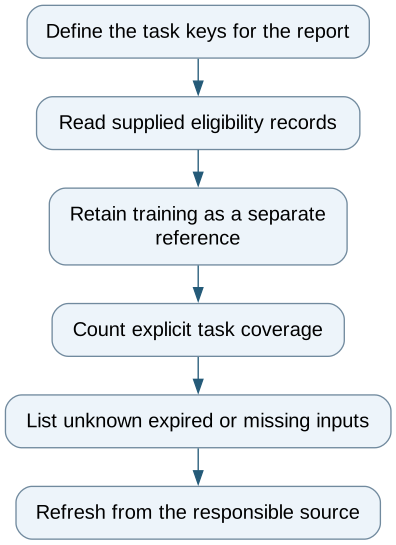
Read the complete workflow as text
- Define the task keys for the report → Read supplied eligibility records
- Read supplied eligibility records → Retain training as a separate reference
- Retain training as a separate reference → Count explicit task coverage
- Count explicit task coverage → List unknown expired or missing inputs
- List unknown expired or missing inputs → Refresh from the responsible source
Make the key specific enough to interpret
A useful reporting key can include machine or machine family, task, site and the source's effective period. Use the dimensions actually supplied by the responsible process. If the source only records a machine family, the report should not invent eligibility for an individual machine or operation.
Retain the source decision reference, version and timestamp. Keep training evidence separately linked so a reviewer can find it without mistaking it for the decision itself. Where records conflict, show the conflict rather than selecting whichever record produces a green cell.
The demonstration should use only fields needed for coverage, such as synthetic IDs and task status. A production rollout needs the organization's decisions on access and personnel-data handling; those are implementation inputs, not rules supplied by this example.
Test the distinctions before automating allocation
Test a completed course with no eligibility record, an expired record, a task change, a revoked source record and a stale feed. The matrix should preserve the difference between unknown and explicitly ineligible. A failed refresh should display its last successful timestamp.
A controlled worksheet can reveal whether the task keys are usable. An existing HR or manufacturing module may already hold the records. Integrate only when the same source decisions need to be retrieved reliably across planning screens.
The immediate deliverable is a coverage view whose cells can be explained from source records. Turning it into an allocation engine requires additional constraints; the linked shift-allocation example shows how to test supplied constraints without deciding eligibility itself.
Compare this workflow with your current setup
Share the step that takes the most manual work, the systems involved and the exceptions your team handles. That gives us a concrete starting point for comparing approaches.
Sources and further reading
Sources checked 15 October 2026. Worked examples and workflow diagrams are original illustrations, not reported client results.