Where food and beverage operations outgrow their software

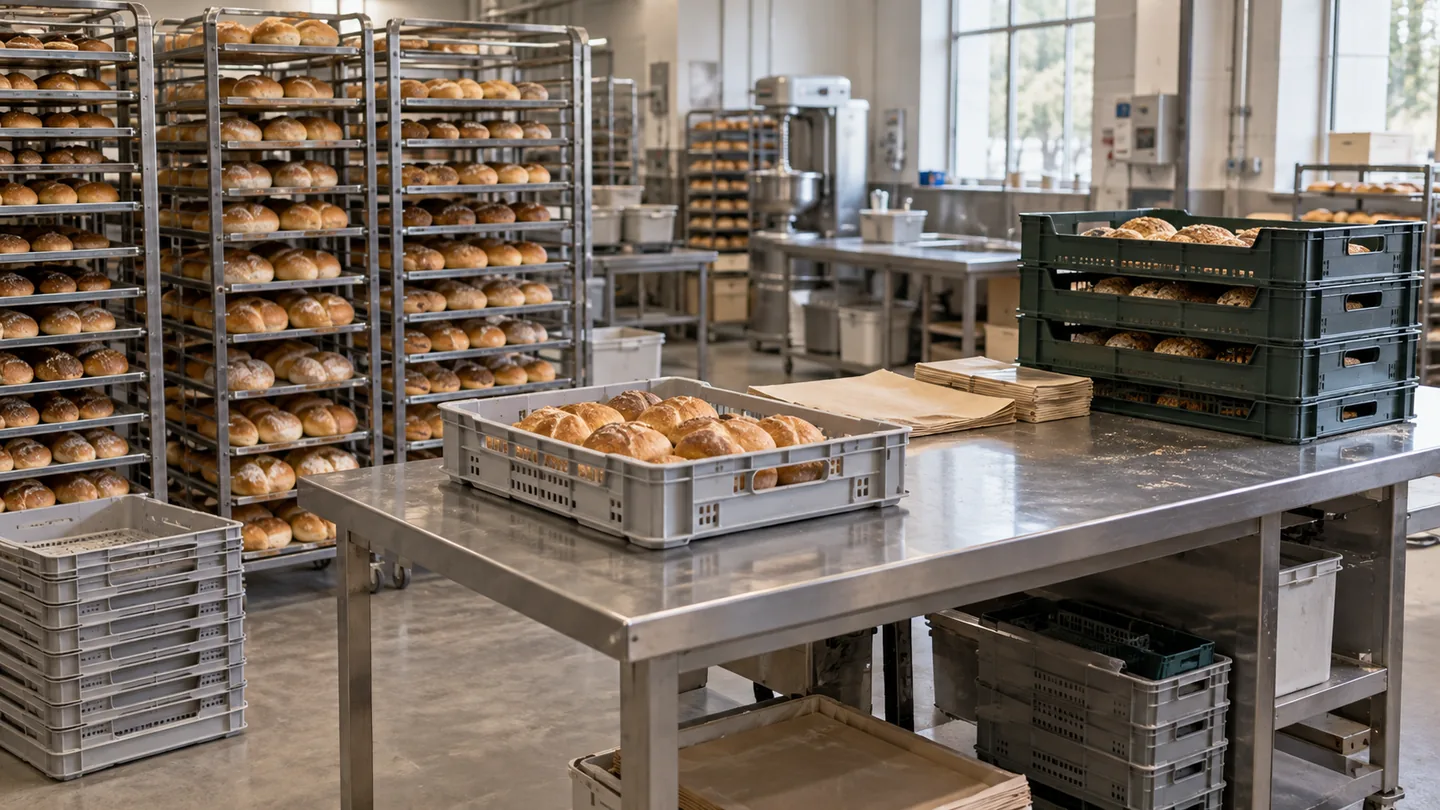
A bakery can run a factory, deliver to shops and serve customers at the counter. All three activities belong to the food and beverage industry, but they create different software requirements. A factory needs to account for what it made. A shop needs to know what it can sell. A delivery team needs to explain what arrived. Calling all of this ‘inventory’ makes the brief shorter and the implementation harder.
Follow one product through the business before deciding which system to replace. The gaps usually appear at the handovers.
- 01ReceiveSupplier, lot and quantity
- 02Make or prepareInputs, outputs and losses
- 03Hand overDispatch and receiving recordsDo the two records agree?YesReconcile the accountNoAssign the difference to an owner; correct the record with evidence before closing.
- 04ReconcileExplain differences and close the account
An example information flow across departments. Each food category needs its own operating controls. Diagram: NextEdge Labs.
Which operation are you actually trying to improve?
For technology planning, it helps to divide food businesses by the work they do. These are operating categories, not a regulatory classification. A company may belong to several, and its systems need to preserve those distinctions.
| Operation | What makes the work different | A useful transaction to inspect |
|---|---|---|
| Bakery and confectionery | Recipe changes, short selling windows and outlet returns | One production batch split between shops |
| Dairy processing | Combined inputs, intermediate storage and release decisions | An intake lot traced through filling and dispatch |
| Beverages | Formulation, pack formats and line changeovers | An order delayed by missing packaging |
| Packaged foods and snacks | Ingredient lots, substitutions and rework | A finished batch with more than one source lot |
| Restaurants and QSRs | Menu sales converted into ingredient usage | A stock variance after a busy service |
| Cloud and central kitchens | Shared preparation capacity and destination commitments | A cancellation after preparation has started |
| Fresh produce | Changing grade, condition and pack configuration | A receiving lot sorted into several outputs |
| Meat and seafood | Variable weights and cutting or processing yields | A container partly consumed in two runs |
| Cold-chain distribution | Product condition across storage and delivery | A shipment with a missing reading or partial rejection |
The handover is where two correct reports can disagree
Imagine a central kitchen dispatching 120 trays. The receiving outlet counts 116. The kitchen reports a completed dispatch, the outlet reports available stock, and finance has a transfer for 120. Each screen may accurately reflect its own record. The missing piece is an agreed way to resolve the four-tray difference.
That is the kind of problem a discovery exercise should expose. Record who creates the transaction, what the next team accepts and what happens when the quantities differ. Include units, timestamps and the original document reference. An integration that merely copies totals can carry the disagreement into a new application.
Also distinguish stock physically on site from stock available to promise. A held lot, a reserved pallet and an unrestricted pallet should not become one number simply because they share a location.
Decide whether the gap is in the process, the integration or the product
If staff use different names for the same ingredient, agree the master data before buying software. If two working applications cannot exchange a receipt reliably, investigate the interface. If an operator needs a workflow neither system supports, a focused application may be justified. These lead to different scopes and different costs.
Keep financial posting and approved master records with their agreed owners. For any new application, write down what it reads, what it may change and who handles a rejected transaction. Include export access and recovery from an outage in the buying discussion; these are difficult to negotiate once daily operations depend on the product.
The Ministry of Food Processing Industries identifies storage, transport, processing infrastructure and technology among its areas of work. Software sits within that broader investment picture. It cannot compensate for a missing cold room, inadequate production capacity or an unresolved operating policy.
Source: Ministry of Food Processing Industries · Goals and Roles: infrastructure and technology objectives. Reference details
Give the first release a decision it can improve
Choose a decision people currently make with incomplete information: how much to bake, which lot to allocate, or whether a transfer needs investigation. Follow the information needed for that decision through one complete operating cycle. The resulting scope is usually more useful than a list of dashboard widgets.
AI belongs in the brief when there is a specific interpretation problem, such as reading inconsistent supplier documents or estimating demand. Evaluate it against the existing method. A rule may be sufficient for an overdue receiving confirmation; a forecast may help with demand, provided stockouts and promotions are understood.
Before funding the next phase, ask the people doing the work to reconstruct a difficult transaction using the new system. Can they explain the quantity, the status and the person responsible for the next action? Their answer is a better starting point than the number of features delivered.
Sources and further reading
Sources checked 15 October 2026. The worked examples and software evaluation suggestions are NextEdge Labs’ editorial analysis.
- Goals and RolesMinistry of Food Processing Industries · Page last updated 25 September 2020
Background on processing, storage, transport and technology. The software recommendations in this article are NextEdge Labs’ analysis.
Visual credits
AI-generated illustration created for NextEdge Labs; it does not depict a client facility. Workflow diagram by NextEdge Labs. Icons from Lucide (ISC licence).