Non-Conformance Report (NCR) Workflow: ISO 9001 and IATF 16949 Containment, MRB Disposition, Cost of Poor Quality (COPQ) and ERP Quarantine Controls
For quality, engineering and records teams · Compare approaches
TL;DR — what you’ll learn
- Bind every Non-Conformance Report (NCR) opened under ISO 9001:2015 Clause 8.7 and IATF 16949 Clause 8.7.1 directly to an atomic ERP inventory state transition that moves the suspect lot or serial range out of nettable stock into a hard-locked MRB Quarantine Warehouse within seconds of defect detection.
- Separate immediate tactical containment and lot disposition (the NCR and Material Review Board [MRB] workflow: Use-As-Is under Concession, Rework, Regrade, Return-to-Vendor [RTV], or Scrap) from systemic root-cause elimination (the 8D and CAPA workflow under ISO 9001 Clause 10.2), triggering mandatory CAPA escalation through deterministic severity, safety, and repeat-occurrence rules.
- Enforce multi-disciplinary Material Review Board (MRB) digital signature gates: an engineering concession (Use-As-Is) requires Design Authority and Customer Waiver verification when form, fit, function, or safety characteristics are impacted, while Return-to-Vendor and Scrap dispositions automatically generate ERP Accounts Payable Debit Memos or Cost of Poor Quality (COPQ) variance postings.
- Reconcile physical quarantine cage counts against open ERP NCR lot balances weekly: any split lot (partial rework, partial scrap, partial RTV) must satisfy strict mass-balance conservation before the parent NCR is permitted to transition to CLOSED.

Illustrative manufacturing inspection room and machine shop floor; not a client facility.
A Non-Conformance Report (NCR)—often searched as nonconformance report or ncr in quality (1,000–10,000 monthly searches in India and globally)—is the formal quality record mandated by ISO 9001:2015 Clause 8.7 (Control of Nonconforming Outputs), IATF 16949:2016 Clause 8.7.1, and AS9100D Clause 8.7 to document, segregate, contain, evaluate, and disposition any raw material, sub-assembly, work-in-progress (WIP), or finished product that fails to meet specified engineering drawing tolerances, material specifications, or process control limits.
Despite being a foundational pillar of every Quality Management System (QMS), the NCR process fails in over 60% of discrete and batch manufacturing plants because the NCR document lives in a disconnected spreadsheet, paper red-tag book, or standalone QMS portal while physical inventory lives in the ERP (SAP S/4HANA QM/MM, Oracle Fusion Manufacturing, Microsoft Dynamics 365 Supply Chain, or ERPNext Quality & Stock). When a receiving inspector or CNC operator writes a paper NCR tag and attaches it to a pallet of 500 out-of-tolerance castings without simultaneously locking the lot in the ERP database, three expensive operational failures follow:
- MRP Netting Contamination: Because the ERP still sees the 500 defective castings as
AVAILABLE / UNRESTRICTEDstock, the overnight MaterialRequirements Planning (MRP) run fails to order replacement castings—guaranteeing an assembly line stop four days later. - Accidental Consumption of Quarantined Parts: A night-shift material handler pulls the pallet from the floor before the Material Review Board (
MRB) meets, building defective castings into finished transmissions that later trigger a field warranty recall. - Unrecovered Supplier Claims & Hidden Scrap: Quality dispositions 200 castings as Return-to-Vendor (
RTV) and 120 as In-House Rework, but Accounts Payable pays the supplier's invoice in full (3-way match leak) and Cost Accounting never captures the rework labor hours inside the Cost of Poor Quality (COPQ) ledger.
The architectural remedy is to engineer a closed-loop QMS-to-ERP Non-Conformance Report (NCR) and Material Review Board (MRB) State Machine (ERPNext Quality Inspection, Non-Conformance & Stock Quarantine Architecture). Distinct from M021 (which focuses specifically on supplier chargeback commercial recovery) and M041 (which governs scrap reason-code Pareto charts), this pillar guide (M130) establishes the end-to-end NCR data schema, NCR-versus-CAPA decision boundary, 5-path MRB disposition state machine, split-lot mass-balance math, COPQ financial journal automation, and IATF 16949 containment verification controls.
Scope and ISO 9001 Clause 8.7 / IATF 16949 boundary
This article defines the quality engineering rules, database state transitions, Material Review Board (MRB) authority matrices, and ERP inventory/financial postings required to govern non-conforming materials from initial detection through final disposition and systemic CAPA handoff:
- What this workflow governs: Detecting non-conformances across Incoming Goods Receipt (
IQC), In-Process Manufacturing (IPQC / WIP), Final Inspection (FQC), and Customer Returns (RMA); enforcing instant ERP lot/serial quarantine transfers; executing multi-signature MRB dispositions (Scrap,Rework,RTV,Regrade,Use-As-Is / Concession); reconciling split-lot quantities and costs; and escalating qualifying defects into formal 8D / CAPA (ISO 9001 Clause 10.2) investigations. - What this workflow does not replace: An NCR is a lot-specific containment and disposition instrument—it never replaces the formal engineering change process (
ECN / ECR) required to permanently modify a master drawing tolerance, nor does it replace statistical process control (SPC) charting used to detect process drift before a specification limit is breached.
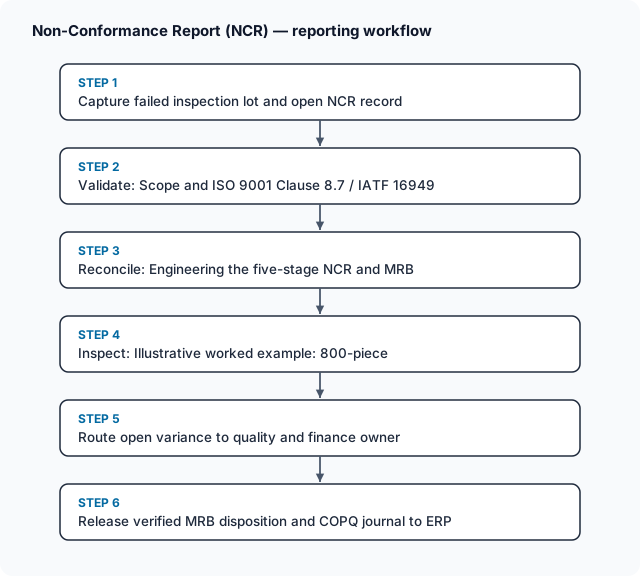
Non-Conformance Report (NCR) — reporting workflow
Follow the workflow below, or open its complete text version.
Read the complete workflow as text
- Capture failed inspection lot and open NCR record → Validate: Scope and ISO 9001 Clause 8.7 / IATF 16949
- Validate: Scope and ISO 9001 Clause 8.7 / IATF 16949 → Reconcile: Engineering the five-stage NCR and MRB
- Reconcile: Engineering the five-stage NCR and MRB → Inspect: Illustrative worked example: 800-piece
- Inspect: Illustrative worked example: 800-piece → Route open variance to quality and finance owner
- Route open variance to quality and finance owner → Release verified MRB disposition and COPQ journal to ERP
Engineering the five-stage NCR and MRB disposition architecture
1. NCR vs. CAPA vs. Deviation/Concession: Enforcing the Regulatory Distinction. Quality auditors under ISO 9001:2015 and IATF 16949 routinely issue major non-conformities when plants either (a) close NCRs with superficial "retrain operator" notes instead of investigating systemic repeats, or (b) open a heavyweight 8D CAPA for every minor isolated cosmetic scratch, burying the quality engineering team in paperwork. A disciplined QMS separates three distinct instruments:
Scroll horizontally to see all columns.
| Quality Instrument | ISO 9001 / IATF 16949 Clause | Primary Question Answered | Scope & Time Horizon | ERP System Action |
|---|---|---|---|---|
1. Non-Conformance Report (NCR) |
ISO 9001 Clause 8.7 (Control of Nonconforming Outputs) |
"What is wrong with this specific physical lot/serial right now, how do we contain it, and what should we do with the parts?" | Tactical & Lot-Specific (24 hours to 5 days): Bounds the suspect batch (LOT-2026-441) and executes MRB physical disposition |
Moves stock to WH-QUARANTINE-MRB (Non-Nettable); executes Scrap, Rework WO, RTV Delivery, or Release |
| 2. Production Deviation / Concession Permit | ISO 9001 Clause 8.7.1(b) & IATF 16949 Clause 8.7.1.1 | "May we legally accept and use a strictly bounded quantity or time window of non-conforming product without altering the master drawing?" | Temporary & Bounded (Specific Lot or ≤ N units): Requires Design Engineering + Customer written concession if contractual specs are affected |
Unlocks the specific NCR lot for consumption against a tagged CONCESSION_ID; does not alter BOM / Drawing Rev |
3. Corrective and Preventive Action (CAPA / 8D) |
ISO 9001 Clause 10.2 & IATF 16949 Clause 10.2.3 (Problem Solving) |
"Why did our manufacturing system allow this defect to occur and escape, and how do we permanently re-engineer the process (P-FMEA / Control Plan / Poka-Yoke) so it can never recur?" | Systemic & Process-Wide (14 to 60 days): Root-cause analysis (5-Why, Ishikawa, Fault Tree), poka-yoke deployment, and 30/60/90-day effectiveness verification |
Updates master Routing, P-FMEA RPN, Inspection Plan, and Operator Work Instructions |
2. The Deterministic NCR-to-CAPA Escalation Rule Engine. Instead of leaving CAPA initiation to subjective judgment, the ERP/QMS evaluates four deterministic rules whenever an NCR is logged:
- Rule 1 (
Critical / Safety / Regulatory Defect): Any defect affecting a Critical-to-Quality (CTQ) / Special Characteristic (CC / SCon drawing), safety compliance, or statutory requirement (100% automatic CAPA + 24-hour 8D D3 containment). - Rule 2 (
Repeat Occurrence Threshold): The sameItem_Family + Defect_Code + Work_Center/Suppliercombination triggers ≥ 3 NCRs within a rolling 60-day window (automated SQL window-function check at NCR creation). - Rule 3 (
Economic / COPQ Threshold): Total estimated Cost of Poor Quality (Scrap + Rework + Sorting + Line Downtime) on a single NCR exceeds the plant threshold (for example, ≥ $2,500 USD or ≥ ₹2,00,000 INR), or batch rejection rate exceeds ≥ 5.0% of lot size. - Rule 4 (
External Customer Escape): Any defect detected after shipment (Customer Complaint / RMA / 0-km Line Reject at OEM).
3. Mandatory Anatomy of an Audit-Ready Digital NCR Record (20 Core Data Fields).
To eliminate incomplete shop-floor tickets, the digital NCR schema enforces mandatory field validation across five sections:
- Section A — Identification & Origin Metadata:
ncr_id(immutable sequence, e.g.,NCR-2026-00842),origin_type(IQC_SUPPLIER,IPQC_WIP,FQC_FINISHED,CUSTOMER_RMA),detection_timestamp,detected_by_user_id,plant_site_code, andwork_center_or_vendor_id. - Section B — Traceability & Lot Bounding:
item_code,drawing_revision,bom_revision,lot_or_heat_number,serial_number_range[],reference_doc_id(PO / GRN / Work Order / Sales Shipment),lot_inspected_qty, andnon_conforming_qty. - Section C — Objective Metrology & Defect Classification:
inspection_characteristic_id(linked to Control Plan balloon number),nominal_target_spec,lower_spec_limit_lsl,upper_spec_limit_usl,actual_measured_min_max,calibrated_gauge_asset_id,defect_category_code(DIMENSIONAL,METALLURGICAL,SURFACE,FUNCTIONAL,MIXED_LOT),severity_class(CRITICAL_SAFETY,MAJOR_FUNCTIONAL,MINOR_COSMETIC), andannotated_photo_or_cmm_pdf_hash. - Section D — Immediate Containment (
D3 Bounding):quarantine_transfer_entry_id(proving physical and ERP movement toWH-MRB-HOLD),suspect_stock_sweep_completed(Checking upstream RM bins, parallel WIP jobs, and finished goods warehouse), andsorted_100pct_good_ vs_reject_tally. - Section E — MRB Disposition, Financial Costing & Closure:
mrb_disposition_code,split_lot_breakdown[],e_signatures[](Quality, Manufacturing, Design Engineering, Commercial/Customer),rework_work_order_id,rtv_debit_note_id,calculated_copq_amount, andlinked_capa_id.
4. The 5-Path Material Review Board (MRB) Disposition State Machine & ERP Transaction Mapping.
When an NCR enters STATUS = MRB_REVIEW, the Material Review Board can select one (or a split-lot combination) of five dispositions—each wired to a specific ERP inventory and general ledger transaction:
Scroll horizontally to see all columns.
| MRB Disposition Code | Engineering & Regulatory Prerequisite | Automated ERP Inventory Transaction | Automated ERP Financial / GL Posting |
|---|---|---|---|
1. SCRAP (Destroy / Render Unusable) |
Under IATF 16949 Clause 8.7.1.7, parts must be physically mutilated/crushed before entering scrap bins so they cannot re-enter the supply chain as counterfeit spares | Stock Entry: WH-MRB-HOLD → WH-SCRAP-WRITE-OFF (Zero nettable inventory; optional scrap metal weight credit in WH-METAL-SWARF) |
Dr COPQ — Internal/External Scrap Expense GL / Cr WIP or RM Inventory Valuation GL |
2. REWORK (Restore to Full Drawing Spec) |
Requires an approved Rework Routing & Standard Operating Procedure (SOP-RWK) plus 100% re-inspection to the original specification (IATF 16949 Clause 8.7.1.4) |
Issues a dedicated Rework Work Order (WO-RWK-xxxx) consuming the quarantined lot; holds output until re-inspection passes |
Dr COPQ — Rework Labor & Overhead Variance GL / Cr Shop-Floor Absorption GL (Part inventory value remains at standard cost!) |
3. REPAIR or USE-AS-IS (Concession) |
Part does not meet original drawing spec (Repair makes it usable but not identical to print; Use-As-Is accepts minor deviation). Requires Design Authority + Customer Written Waiver (IATF 8.7.1.1) |
Transfers lot from WH-MRB-HOLD → WH-CONCESSION-ALLOCATED locked strictly to the specific Work Order or Sales Order covered by the waiver |
Logs zero-value inventory move; posts any sorting/testing labor or customer commercial price discount to COPQ — Concession Cost GL |
4. REGRADE (Reclassify to Alternate Part/Grade) |
Approved specification match against a lower-grade SKU or secondary application (IATF 16949 Clause 8.7.1.2) |
Stock Reclassification Entry: Decrements ITEM-GRADE-A and increments ITEM-GRADE-B with new lot genealogy link |
Dr COPQ — Revaluation Loss GL for the unit cost difference (StdCost_A − StdCost_B) × Qty / Cr Inventory GL |
5. RTV (Return to Vendor / Supplier Chargeback) |
Supplier fault confirmed during Incoming Inspection (IQC) or during machining (latent casting porosity / raw material inclusion) |
Generates RTV Delivery Note (Movement Type 122 / Return to Supplier) from WH-MRB-HOLD and re-opens PO quantity if replacement is required |
Generates AP Debit Memo (Dr Vendor AP / Cr Inventory) for material cost + Sorting/Machining Recovery Claim |
5. Cost of Poor Quality (COPQ) Mathematical Formulation.
To prevent plants from under-reporting quality losses by looking only at raw material scrap, the ERP computes the Total NCR Cost of Poor Quality (COPQ_NCR) across four additive terms:
COPQ_NCR = (Q_scrap × C_unit_accumulated) + (H_rework × R_labor_mach + C_rework_matl) + (H_sorting × R_inspector) + C_downtime_and_concession − V_salvage_or_vendor_recovery
Where C_unit_accumulated includes raw material cost plus all upstream value-add machining/assembly conversion costs already absorbed prior to the operation where the defect was caught—demonstrating mathematically why catching a defect at Incoming Inspection ($14.00/unit raw casting) is exponentially cheaper than catching it at Final Test ($62.00/unit fully machined and assembled).
Illustrative worked example: 800-piece precision forged gear blank lot (NCR-2026-0412) with 3-way split MRB disposition
All figures below are illustrative and synthetic. An automotive transmission manufacturer receives and processes a batch of 800 alloy steel forged gear blanks (ITEM-GEAR-8620, Lot LOT-FRG-910, Standard Raw Material Cost = $15.00/blank, Total Lot RM Value = $12,000.00).
During Operation 20 (CNC Gear Hobbing, which adds $6.50/unit in standard machining conversion cost, bringing accumulated WIP unit value to $21.50/unit), the in-line CMM inspection flags an abnormal tooth lead error and subsurface forging inclusion after 250 pieces have already been machined (leaving 550 raw unmachined blanks still in the line-side input pallet):
Step 1: Instant containment, 100% sorting, and split-population bounding.
- Automated Quarantine Lock (
T + 3 minutes): OpeningNCR-2026-0412immediately moves all 550 unmachined blanks (valued at $15.00/unit = $8,250.00) and all 250 hobbed WIP gears (valued at $21.50/unit = $5,375.00)—totaling 800 units ($13,625.00total inventory value)—intoWH-QUARANTINE-MRB(Non-Nettable). - 100% Containment Sorting & Ultrasonic/CMM Screening (
12.0 inspector hoursat$35.00/hr = $420.00):- Out of the 550 unmachined blanks, ultrasonic testing proves 410 blanks are sound (
GOOD_RM) and 140 blanks contain supplier forging lap inclusions (DEFECT_SUPPLIER_INCLUSION). - Out of the 250 machined Op 20 gears, CMM inspection proves 165 gears meet print (
GOOD_WIP), 55 gears have oversize tooth thickness (+0.04 mmabove USL due to thermal hob offset, recoverable via a secondary skiving rework pass), 20 gears cracked during hobbing due to supplier forging inclusions (LATENT_SUPPLIER_SCRAP), and 10 gears are undersize below LSL due to operator offset error (INTERNAL_MACHINING_SCRAP).
- Out of the 550 unmachined blanks, ultrasonic testing proves 410 blanks are sound (
Step 2: Reconciling the 5-way split MRB disposition and COPQ ledger.
The Material Review Board (Quality Manager, Gear Manufacturing Engineer, Metallurgy Lead, and Supplier Quality Engineer) executes a split-lot disposition across the 800 units:
Scroll horizontally to see all columns.
Sub-Lot Segment (Parent Lot LOT-FRG-910) |
Quantity (Units) |
Stage & Unit Book Value | MRB Disposition Decision | Rework / Recovery Cost Adjustment | Net Internal COPQ Expense ($) |
Supplier Chargeback (AP Debit Memo $) |
|---|---|---|---|---|---|---|
| 1. Sound Unmachined Blanks | 410 pcs | RM ($15.00/pc = $6,150.00) |
RELEASE_TO_STOCK (Unrestricted RM) |
$0.00 |
$0.00 |
$0.00 |
| 2. Conformant Hobbed Gears | 165 pcs | Op 20 WIP ($21.50/pc = $3,547.50) |
RELEASE_TO_WIP (Proceed to Op 30) |
$0.00 |
$0.00 |
$0.00 |
| 3. Unmachined Forging Inclusions | 140 pcs | RM ($15.00/pc = $2,100.00) |
RTV (Return to Vendor) |
Full RM debit (140 × $15.00) |
$0.00 |
$2,100.00 |
| 4. Latent Forging Cracks at Op 20 | 20 pcs | Op 20 WIP ($21.50/pc = $430.00) |
SCRAP_VENDOR_FAULT |
RM ($300.00) + wasted Op 20 machining ($130.00) billed to vendor |
$0.00 |
$430.00 |
5. Oversize Tooth Thickness (+0.04 mm) |
55 pcs | Op 20 WIP ($21.50/pc = $1,182.50) |
REWORK (WO-RWK-0412) |
8.5 hrs CNC skiving + CMM re-test @ $60.00/hr = $510.00 |
$510.00 (Internal Rework) |
$0.00 |
6. Undersize Tooth (Below LSL) |
10 pcs | Op 20 WIP ($21.50/pc = $215.00) |
SCRAP_INTERNAL_FAULT |
Less steel swarf salvage credit (10 pcs × $1.20 = $12.00) |
$203.00 (Internal Scrap) |
$0.00 |
| 7. 100% Ultrasonic & CMM Sorting Labor | — | 12.0 hrs @ $35.00/hr ($420.00) |
Split 50% Vendor / 50% Internal |
$210.00 charged to Vendor; $210.00 internal sorting |
$210.00 (Sorting COPQ) |
$210.00 |
| Total Reconciled NCR Ledger | 800 pcs | $13,625.00 Initial Inventory |
100% Mass & Value Reconciled | Zero Orphaned Quarantine Stock | $923.00 Net Internal COPQ |
$2,740.00 Recovered from Vendor |
Independent arithmetic verification.
- Physical unit mass-balance conservation:
- Initial population: 550 unmachined RM blanks + 250 Op 20 WIP gears = 800 total units.
- Dispositioned population: 410 released RM + 165 released WIP + 140 RTV + 20 vendor-fault scrap + 55 reworked & released WIP + 10 internal scrap = 410 + 165 + 140 + 20 + 55 + 10 = 800 total units (
Ending Quarantine Balance = 0 units). - Total good units returning to production after rework completion: 410 RM + 165 WIP + 55 Reworked WIP = 630 usable units (
170 units permanently removed via RTV/Scrap: 140 + 20 + 10 = 170).
- Inventory valuation conservation:
- Initial quarantined inventory book value =
(550 × $15.00) + (250 × $21.50) = $8,250.00 + $5,375.00 = $13,625.00. - Released & retained good inventory value (at standard cost) =
(410 RM × $15.00) + ((165 + 55) WIP × $21.50) = $6,150.00 + (220 × $21.50) = $6,150.00 + $4,730.00 = $10,880.00. - Inventory removed from books (
RTV + Scrap) =140 RTV ($2,100.00) + 20 Vendor Scrap ($430.00) + 10 Internal Scrap ($215.00) = $2,745.00. - Check:
$10,880.00 retained + $2,745.00 removed = $13,625.00(Exact to $0.00).
- Initial quarantined inventory book value =
- COPQ & Supplier Recovery reconciliation:
- Supplier AP Debit Memo =
$2,100.00 (140 RTV blanks) + $430.00 (20 cracked gears @ Op 20 WIP value) + $210.00 (50% sorting fee) = $2,740.00. - Internal Net COPQ =
$510.00 (55-pc rework order) + ($215.00 − $12.00 salvage = $203.00 internal scrap) + $210.00 (50% sorting) = $923.00.
- Supplier AP Debit Memo =
Workflow, owner roles, exception handling and recovery controls
Scroll horizontally to see all columns.
| Workflow stage | Accountable owner | Required system evidence | Exception condition | System hold & recovery control |
|---|---|---|---|---|
| 1. Defect Detection & Instant Quarantine Lock | Inspector / Operator & QMS-ERP Trigger | Measured spec vs LSL/USL, photo/CMM attachment, lot/serial scan | Operator logs an NCR comment in QMS, but the ERP lot remains AVAILABLE in WH-MAIN |
Atomic database transaction forces immediate stock transfer to WH-QUARANTINE-MRB (Non-Nettable) upon NCR.save() |
2. Suspect Population Bounding (D3 Sweep) |
Quality Engineer & Warehouse Lead | Scanned inventory sweep of upstream RM, parallel WIP, and finished goods bins | Same heat/lot number is currently loaded on two adjacent CNC machines (WO-102, WO-103) |
ERP lot-where-used query automatically flags and places active Job Cards consuming that lot into CONTAINMENT_HOLD |
3. Material Review Board (MRB) Evaluation |
Cross-Functional MRB (QE, Mfg Eng, Design, Commercial) |
Split-lot quantities, disposition codes, engineering calculation or customer waiver | Manufacturing attempts to disposition an out-of-tolerance safety dimension as Use-As-Is without Design/Customer signoff |
Role-based state gate blocks USE_AS_IS transition unless Design_Authority_Signoff = TRUE and Customer_Waiver_PDF is attached |
| 4. Rework Execution & Re-Inspection Gate | Production Supervisor & QC Inspector | Rework Work Order WO-RWK, SOP revision, 100% re-inspection pass record |
Reworked parts are moved directly to assembly without passing re-inspection against original drawing specs | ERP locks WO-RWK completion receipt in WH-MRB-HOLD until a linked REINSPECTION_PASS record is signed by Quality |
| 5. Financial Settlement & CAPA Handoff | Cost Accountant, AP Buyer & Lead Auditor | Posted Scrap/Rework GL journals, Supplier Debit Memo, or linked CAPA_ID |
NCR meets repeat-defect (≥ 3 in 60 days) or COPQ (≥ $2,500) threshold, but owner tries to close NCR without a CAPA |
System blocks NCR_STATUS = CLOSED (ERR_MANDATORY_CAPA_LINK_MISSING) until a valid CAPA-8D record is spawned and linked |
Bounded pilot and implementation check
Pilot the integrated QMS-to-ERP NCR and MRB quarantine workflow across 1 Incoming Inspection bay and 1 Machining/Assembly value stream over 4 weeks:
- Pilot boundary: Configure the non-nettable
WH-QUARANTINE-MRBvirtual and physical cage, wire NCR creation to atomic ERP stock transfers, enforce split-lot mass-balance validation (Sum of dispositions == Quarantined Qty), and automate the 4-rule CAPA escalation trigger. - Acceptance tests:
ACT-M130-01(Zero-Latency MRP Quarantine Exclusion): Open an NCR against 200 units ofITEM-GEAR-8620inWH-MAINand immediately trigger an ERP MRP / Production Allocation run; verify that all 200 units are excluded from nettable available inventory within≤ 2 seconds.ACT-M130-02(Split-Lot Mass-Balance Conservation Lock): On an 800-unit NCR, enter split dispositions totaling795 units(410 Release + 165 WIP + 140 RTV + 80 Scrap) and attempt to close the MRB review; confirm the system rejects closure (ERR_SPLIT_QTY_MISMATCH: 5 units unaccounted).ACT-M130-03(Unauthorized Use-As-Is Concession Block): Classify an NCR defect asMAJOR_FUNCTIONALorCRITICAL_SAFETYand attempt to approveUSE_AS_ISusing only Production and Quality logins; verify the system blocks approval until Design Engineering and Customer Concession evidence are signed.ACT-M130-04(Automated Repeat-Defect CAPA Trigger): Log a 3rd NCR for the samePart + Defect_Code + Supplierwithin a 60-day window; confirm the system automatically setscapa_required = TRUEand prevents NCR closure until an 8D CAPA record is linked.
Next actions
- Bind NCR creation directly to an ERP inventory quarantine movement: Never allow a non-conformance record to exist in a QMS or spreadsheet while the physical lot remains nettable and allocatable in the ERP warehouse.
- Support multi-path split-lot MRB dispositions natively: Configure your NCR data table as a parent header with child disposition lines (
Release, Rework, RTV, Regrade, Scrap) so 100% sorted lots do not require artificial manual stock adjustments. - Cost scrap and rework at accumulated operation value (
RM + Prior Conversion), not raw material cost alone: Ensure Finance and Plant Operations see the true Cost of Poor Quality (COPQ) when parts fail at downstream machining or assembly stages. - Automate the bridge from tactical NCR to systemic 8D CAPA: Use deterministic database rules (
Safety/CTQ, ≥ 3 repeats in 60 days, COPQ ≥ threshold, or Customer RMA) so recurring process weaknesses always trigger root-cause engineering.
Frequently Asked Questions
How should manufacturing plants structure a Non-Conformance Report (NCR) and Material Review Board (MRB) workflow across QMS and ERP so defective incoming, WIP, and finished lots cannot bypass quarantine or distort inventory valuation?.
Teams should govern non conformance report workflows by binding the moment of defect detection to an atomic ERP inventory transfer that moves the suspect lot or serial range into a non-nettable MRB Quarantine Warehouse. Before the NCR can close, the Material Review Board must assign every unit across verified disposition paths—Release, Rework via a tracked Rework Work Order, Return-to-Vendor with an automated AP Debit Memo, Regrade, or Mutilated Scrap—while posting accumulated Cost of Poor Quality variances to the general ledger.
How does nonconformance report handle exceptions and mismatches?.
When an exception arises during nonconformance report processing—such as a split-lot quantity mismatch after 100% sorting, a request to accept out-of-tolerance parts under an engineering concession, or a repeat defect that breaches the 60-day recurrence threshold—the workflow holds the lot in quarantine and routes the record to designated engineering, quality, and finance owners. System gates block physical shipment, work-order consumption, or NCR closure until required customer waivers, re-inspection pass records, and 8D CAPA links are verified.
What should teams test before automating ncr in quality?.
Before scaling ncr in quality automation plant-wide, run a 4-week pilot across incoming inspection and one machining value stream using real supplier rejections, in-process rework orders, and split-lot MRB dispositions. Verify that quarantined stock is immediately excluded from MRP netting, rework orders cannot close without a 100% re-inspection pass gate, accumulated WIP conversion costs flow accurately into COPQ accounts, and repeat defects automatically spawn linked CAPA records.
Compare this workflow with your current setup
Share the step that takes the most manual work, the systems involved and the exceptions your team handles. That gives us a concrete starting point for comparing approaches.
Sources and further reading
Sources checked 15 October 2026. Worked examples and workflow diagrams are original illustrations, not reported client results.
- ISO 9001:2015 Quality Management Systems — Clause 8.7 (Control of Nonconforming Outputs) & Clause 10.2 (Nonconformity and Corrective Action)
- AIAG & IATF 16949:2016 Automotive Quality Management System — Clause 8.7.1.1 (Customer Authorization for Concession), 8.7.1.4 (Control of Reworked Product) & 8.7.1.7 (Nonconforming Product Disposition)
- ASQ (American Society for Quality): Cost of Quality (COQ) / Cost of Poor Quality (COPQ) & Material Review Board (MRB) Best Practices
- ERPNext Quality Management: Quality Inspection, Non-Conformance, and Stock Quarantine Workflows

