Set spare-parts stock by asset risk and replenishment reality
For production managers, planners and plant leaders · Compare approaches
TL;DR — what you’ll learn
- When a plant configures a single 12-month issue-history formula across its maintenance storeroom (as in the hypothetical plant configuration below, rather than a standard ERP default), slow-moving critical components with zero recent failures get set to zero target stock while high-turn consumables retain inflated buffers after one-off expediting events.
- Separate maintenance spares management into four governed policy classes (P1 dedicated critical insurance spare, P2 rotable/repairable pool spare, P3 lead-time-buffered preventive and wear consumable, and P4 non-stocked vendor call-off or decommissioned-asset part) using four explicit inputs: equipment consequence, part specificity and approved interchangeability, supplier or workshop repair lead time, and unit value.
- Keep technical, purchasing and finance controls explicit: scenario-specific Min/Max and rotable pool sizes depend on engineering and availability evidence, disabling auto-reorder requires removing configured reorder rules and governing open or manual requests rather than setting Min = 0 alone, and lowering a target stock level does not by itself authorize a ledger write-down.
- In a synthetic 120-SKU extrusion-line spares review (Batch MSP-CRIT-2026-10, pre-review illustrative target stock value Rs 49,00,000 at assumed unit costs), reclassifying parts by asset link and replenishment lead time proposes 4 missing single-point insurance spares (+Rs 7,20,000 subject to funding and purchasing approval, bringing P1 target coverage to 12 SKUs / Rs 21,60,000), pools 18 overhaulable subassemblies (Rs 13,20,000 vs Rs 19,80,000), aligns 55 routine wear items to PM-plus-lead-time buffers (Rs 7,40,000 vs Rs 9,90,000), and disables auto-reorder rules across 35 local-call-off or retired-asset SKUs (Rs 4,90,000 routed to controlled drawdown or obsolescence review), shifting governed illustrative target stock value to Rs 42,20,000 (-Rs 6,80,000 net target delta).

Illustrative maintenance spares review in a plant storeroom; not a client facility.
Why a uniform usage-history rule fails in a sparse-demand storeroom setup
When maintenance and inventory leads search for maintenance spares management or review critical spare parts inventory, established industry and academic references already lay out core concepts:
- IBM's overview of spare parts management already explains asset criticality, supplier lead times, inventory control levels, insurance spares and stock/no-stock decisions.
- Grainger's guide on how critical spare planning protects uptime outlines a practical review chart combining criticality, supplier lead time and maintainability (note that direct open-text extraction from that page was limited during review, so we cite its framework summary without claiming a complete page audit).
- In operations research, Janne Huiskonen's (2001) study on maintenance spare parts logistics characteristics in the International Journal of Production Economics (cited here from the primary research abstract) identifies criticality, specificity (standard versus user-specific parts), demand pattern (erratic/sparse versus predictable), and value as distinct control dimensions that a single inventory formula cannot collapse.
In practice, however, an individual plant team sometimes configures a single trailing-usage script (Reorder Point = 12-month average daily usage × supplier lead time) across every maintenance SKU during an initial setup. That configured rule is a local implementation choice—not a built-in default in ERPNext material request or auto-creation of material request (S05), where item-level reorder levels and quantities are configured per item and warehouse—and applying it uniformly produces three predictable distortions in the hypothetical plant examined below:
- Zero-usage penalty on single-point bottleneck parts: A custom
45 kWextruder drive module or main gearbox shaft that has run without failure for18 monthsshows0.00monthly consumption. In a storeroom governed by a trailing-usage script, its reorder level is calculated as zero, leaving the line exposed to a16-weekOEM import lead time. - Untracked rotable cores bought repeatedly as new consumables: Rotary cutter heads, servo motors and hydraulic proportional valves that can be overhauled by an approved workshop in
14 daysfor a fraction of replacement cost are issued as one-way consumables when the local setup does not track the worn core in aWORKSHOP_REPAIRbin. - Orphan spares retained on retired equipment: When a legacy mixer or packaging machine is decommissioned, its dedicated spares remain active in the item master with active auto-reorder rules if no equipment-to-part where-used link (
Asset BOM) is checked before running replenishment (S05).
Set spare-parts stock by asset risk and replenishment reality — reporting workflow
Follow the workflow below, or open its complete text version.
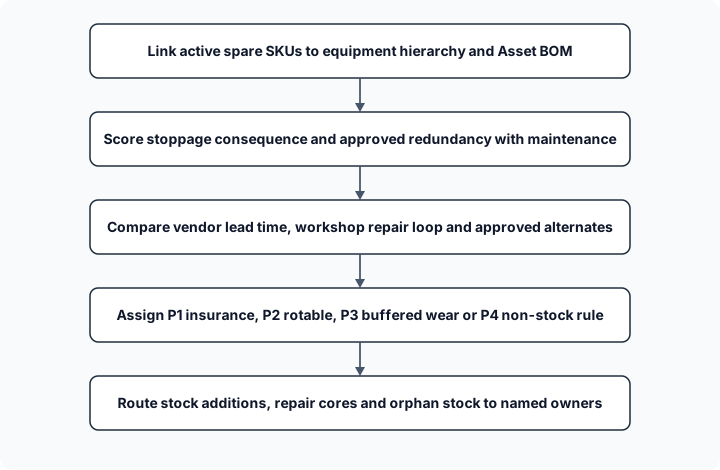
Read the complete workflow as text
- Link active spare SKUs to equipment hierarchy and Asset BOM → Score stoppage consequence and approved redundancy with maintenance
- Score stoppage consequence and approved redundancy with maintenance → Compare vendor lead time, workshop repair loop and approved alternates
- Compare vendor lead time, workshop repair loop and approved alternates → Assign P1 insurance, P2 rotable, P3 buffered wear or P4 non-stock rule
- Assign P1 insurance, P2 rotable, P3 buffered wear or P4 non-stock rule → Route stock additions, repair cores and orphan stock to named owners
Four-class stocking matrix and cross-functional ownership boundaries
Consistent with the four control characteristics highlighted in Huiskonen's (2001) spare-parts logistics framework and the planning principles in UK HSE maintenance guidance (S19—which provides general UK guidance on planned, competent maintenance rather than a universal statutory inventory mandate), maintenance stocking policies should separate sparse-demand risk protection from routine preventive consumption. In the matrix below, quantities such as Min 1 / Max 1 or specific rotable pool sizes are scenario-dependent parameter choices that must be set from site engineering, failure-mode and availability evidence rather than applied as universal constants:
Scroll horizontally to see all columns.
| Policy class & scenario parameter example | Qualifying asset & part characteristics | Primary replenishment mechanism (S05) |
Accountable approval owners | Mandatory governance boundary |
|---|---|---|---|---|
Class P1 — Dedicated Critical Insurance Spare (e.g., Min 1 / Max 1 where engineering confirms single-unit coverage) |
Single-point bottleneck equipment (no standby asset), sparse/erratic failure history (0–1/year), high specificity (no approved substitute), and supplier lead time exceeding tolerable line outage. |
Immediate replenishment material request (S05) triggered when the protected insurance unit is reserved or issued to a breakdown work order, sized to engineering-approved minimum coverage. |
Maintenance Engineering Lead + Plant Head / Finance Approver (joint sign-off for funding and purchasing approval). | Protect the engineering-approved Min level against automated usage-based reductions; inspect shelf preservation condition on a scheduled preventive calendar (see showing parts and access gaps before maintenance scheduling). |
Class P2 — Rotable / Repairable Pool Spare (e.g., Serviceable shelf target + tracked repair core pool) |
Overhaulable assemblies (cutter heads, pumps, spindles, drives) installed across 2+ identical machines where approved workshop repair turnaround is substantially shorter than new OEM lead time. |
Issue 1 serviceable unit from SERVICEABLE_STORE and receive 1 worn core into WORKSHOP_REPAIR against a refurbishment order; buy new on certified core condemnation or approved exceptions for repair delay, workshop capacity shortfall or emergency coverage. |
Maintenance Planner + Stores Controller (tracks serialised core return, overhaul certificate and turnaround exceptions). | Workshop repair returns require documented inspection acceptance before returning to SERVICEABLE_STORE; carrying values of repair cores and accounting treatment of refurbishment costs follow company finance policy. |
Class P3 — Lead-Time-Buffered Preventive & Wear Consumable (Min = PM + lead-time demand) |
Predictable wear parts (seals, filters, belts, heater bands, contactors) with regular consumption (12+ issues/year) and reliable domestic/contracted lead times (7–30 days). |
Configured ERP reorder-point material request (auto-creation of material request, S05) driven by scheduled PM work-order reservations plus verified vendor lead time. |
Inventory Planner + Procurement Buyer (reviews lead-time variance and supplier pack aliases). | Deduplicate vendor pack aliases first (see governing item masters so duplicate parts do not break factory planning) and only link substitutes approved by engineering (see approving alternate components without changing the BOM by accident). |
Class P4 — Non-Stocked Call-Off or Orphan / Retired-Asset Part (Target stock = 0; auto-reorder disabled) |
Either (a) non-safety, standard off-the-shelf hardware with short local delivery and negligible downtime impact, or (b) orphan parts whose only parent equipment has been retired or modified. | Explicitly remove or disable item auto-reorder rules (S05), review/close open MRs and POs, purchase standard call-off items only against approved work-order demand, and block purchasing on orphan codes. |
Maintenance Engineering + EHS (where applicable) (confirms non-safety status or zero active where-used) + Finance Controller (approves any obsolescence write-down). | In ERPNext (S05), projected quantity at or below a configured reorder level can still trigger an auto-request and manual MRs remain possible unless governed; disabling auto-reorder also does not write off on-hand stock (route orphan balances via deciding what to do with obsolete and excess factory inventory). |
Worked example: reclassifying 120 maintenance spares on an extrusion and packaging line (Batch MSP-CRIT-2026-10)
Scope note: All equipment IDs (
EXT-L04,RET-MIX-01), part numbers (SPR-4012toSPR-4210), fictional specification codes, lead times, issue counts, scenarioMin/Maxchoices and rupee figures below are hypothetical illustrative planning records at assumed unit costs. They do not represent statutory book values, universal stocking ratios, reliability predictions, or guaranteed working-capital savings; actual equipment criticality, safety-component classification, accounting treatment of repairable cores and capital/inventory additions, and safe return-to-service decisions remain with qualified site engineering, EHS and finance personnel.
Consider synthetic plastic film extrusion and converting plant PUNE-EXT-02, which reviews 120 active maintenance spare SKUs (Batch MSP-CRIT-2026-10) supporting 18 active machines on primary extrusion line EXT-L04 (plus one legacy mixer RET-MIX-01 that was decommissioned 18 months earlier). Prior to the review, the plant had configured a single custom reorder formula based on trailing 12-month issue history across all 120 SKUs, resulting in an illustrative pre-review stock value of Rs 49,00,000 at assumed unit costs while leaving four single-point bottleneck drives and shafts at zero stock.
Table 1: Portfolio reconciliation across 120 reviewed maintenance SKUs (Batch MSP-CRIT-2026-10)
Scroll horizontally to see all columns.
| Governed policy class & scenario rule | Reviewed SKU count (% of 120) |
Pre-review on-hand stock & illustrative value at assumed unit cost (₹) |
Post-review governed target stock & illustrative value at assumed unit cost (₹) |
Target valuation delta (₹) |
Operational & financial reconciliation rule |
|---|---|---|---|---|---|
Class P1 — Dedicated Critical Insurance Spares (scenario Min 1 / Max 1 per SKU) |
12 SKUs (10.0%) |
8 EA across 8 SKUs (4 SKUs at 0 EA under the prior 12m usage rule) = 14,40,000 |
12 EA (1 EA scenario target across all 12 single-point bottleneck SKUs) = 21,60,000 |
+7,20,000 | Identifies 4 unstocked critical gaps (+Rs 7,20,000 target stock addition requiring funding and purchasing approval; accounting classification as inventory or capital spare follows finance policy). |
Class P2 — Rotable / Repairable Pool Spares (Serviceable + Repair Core pool) |
18 SKUs (15.0%) |
54 EA held as new-buy stock across parallel machines = 19,80,000 |
36 pooled units (18 serviceable on shelf + 18 in WORKSHOP_REPAIR loop at assumed full unit cost) = 13,20,000 |
-6,60,000 | Tracks repairable cores across 14–21 day workshop overhaul cycles (book carrying value of cores and repair expenses depends on finance policy); 18 excess units (Rs 6,60,000) draw down via normal attrition unless repair-delay or emergency exceptions require earlier purchase. |
Class P3 — Lead-Time-Buffered PM & Wear Consumables |
55 SKUs (45.8%) |
Inflated ad-hoc buffers across 55 active wear SKUs = 9,90,000 | PM-calendar + verified vendor lead-time buffers = 7,40,000 | -2,50,000 | Aligns item-level reorder levels (S05) to scheduled PM reservations and 7–21 day contracted lead times (Rs 2,50,000 gradual drawdown as existing stock is consumed). |
Class P4 — Non-Stocked Call-Off (25 SKUs) & Orphan Retired-Asset Spares (10 SKUs) |
35 SKUs (29.2%) |
25 non-safety hardware SKUs (Rs 1,80,000) + 10 orphan RET-MIX-01 SKUs (Rs 3,10,000) = 4,90,000 |
0 (0 target stock; auto-reorder rules disabled and open MRs/POs governed for all 35 SKUs) |
-4,90,000 | Disables item auto-reorder rules (S05) and blocks orphan purchasing; Rs 1,80,000 active hardware depletes through controlled work-order use, while Rs 3,10,000 in orphan RET-MIX-01 stock routes to formal disposition review. |
| Total reviewed maintenance portfolio | 120 SKUs (100.0%) |
49,00,000 | 42,20,000 | -6,80,000 | +Rs 7,20,000 critical target coverage proposed; -Rs 14,00,000 gross target reduction (-Rs 6,80,000 net illustrative target stock shift). |
Table 2: Item-level decision trace for 5 representative SKUs from Batch MSP-CRIT-2026-10
To see how the four Huiskonen dimensions (criticality, specificity, demand pattern and value) interact with actual replenishment lead times and equipment links in this scenario, trace five individual part records from the 120-SKU batch:
Scroll horizontally to see all columns.
| Part ID & synthetic specification | Installed asset link & redundancy (Asset BOM) |
12-month issue history & demand pattern | Replenishment / repair reality & approved alternates | Assumed unit cost (₹) |
Pre-review stock (Qty & illustrative ₹) |
Post-review governed policy & scenario target (Qty & illustrative ₹) |
Target delta (₹) & required owner action |
|---|---|---|---|---|---|---|---|
SPR-4012 (Main Extruder Servo Drive 45 kW, DRV-EXT-45KW-A) |
1 unit on bottleneck extruder EXT-L04-DRV01; zero standby line |
0 EA in 12m (sparse/erratic) |
112 days OEM import lead time; non-repairable on site; 0 approved alternates |
1,80,000 | 0 EA (0) |
Class P1 (scenario Min 1 / Max 1 EA = 1,80,000) |
+1,80,000 — Submit MR-8801 (1 EA) for Maintenance, Plant Head and Finance funding/purchasing approval (1 of 4 unstocked P1 gaps). |
SPR-4048 (Rotary Pelletiser Cutter Head, CUT-HD-220-ROT) |
4 identical units on parallel pelletisers PEL-01..04 |
3 swaps in 12m (overhaulable wear) |
84 days new OEM lead time vs 14 days approved workshop grinding/bearing overhaul (Rs 18,500/turn repair fee) |
1,10,000 | 3 EA (3,30,000) |
Class P2 (scenario 1 serviceable + 1 repair core = 2 EA at assumed unit cost = 2,20,000) |
-1,10,000 — Register serialised cores in WORKSHOP_REPAIR; hold new POs until 3rd unit is consumed unless a repair delay, capacity shortfall or condemnation exception is approved. |
SPR-4105 (Melt Screen Changer Seal Kit, SEAL-KIT-EXT04) |
2 sets on EXT-L04 screen changer (15-day PM cycle) |
48 SET in 12m (4 SET/month regular PM) |
15 days (0.5m) domestic lead time; 2 engineering-approved alternate vendors |
4,500 | 24 SET (1,08,000) |
Class P3 (Min 4 / Max 8 SET, scenario target 6 SET = 27,000) |
-81,000 — Update ERP reorder level (S05) to 4 SET; allow 18 SET excess to draw down over 4.5 months. |
SPR-4189 (Tool-Cabinet Drawer Latch Set, HDW-LATCH-CAB8) |
6 workshop spare-storage cabinets (non-safety storage furniture; zero machine-guarding or line-stop role) |
2 SET in 12m (low-impact erratic) |
3 days local MRO distributor delivery; standard commercial cabinet hardware |
1,500 | 12 SET (18,000) |
Class P4 Call-Off (Target 0 SET = 0; auto-reorder disabled) |
-18,000 — Disable item auto-reorder rule (S05) and govern manual MRs; consume existing 12 SET on demand (note: machine perimeter-guarding latches require EHS/engineering safety review before any non-stock decision). |
SPR-4210 (Legacy Mixer Worm Shaft, SFT-WRM-MIX01) |
0 active assets (linked only to retired mixer RET-MIX-01) |
0 EA in 12m (obsolete orphan) |
60 days custom machining, but parent equipment decommissioned 18m ago |
62,000 | 1 EA (62,000) |
Class P4 Orphan (Target 0 EA = 0; auto-reorder disabled & POs blocked) |
-62,000 — Disable auto-reorder (S05), cancel any open MRs/POs and place purchasing block; route 1 EA (Rs 62,000) to formal engineering/finance obsolescence disposition. |
| 5-SKU sample subtotal | Across 4 policy classes | 0 to 48 issues/yr | 3-day call-off to 112-day OEM import | — | 5,18,000 | 4,27,000 | -91,000 (+Rs 1,80,000 proposed critical addition vs -Rs 2,71,000 illustrative target stock reductions). |
Three governance rules that keep this reclassification audit-safe
- Why illustrative target-stock changes (
-Rs 14,00,000gross /-Rs 6,80,000net) are not instant P&L savings or automatic book revaluations: All rupee amounts in Tables 1 and 2 represent illustrative target stock values at assumed unit costs. LoweringSPR-4105from24 SET(Rs 1,08,000) to a target of6 SET(Rs 27,000) or poolingSPR-4048from3 EA(Rs 3,30,000) to2 EA(Rs 2,20,000) reduces future replenishment orders (S05) as stock draws down; how repairable cores (SPR-4048) and workshop overhaul charges (Rs 18,500/turn) are carried on the books or expensed depends on company finance policy. Similarly, proposing4missingP1spares (+Rs 7,20,000, includingSPR-4012atRs 1,80,000) requires formal funding and purchasing approval, and does not trigger immediate cash outflow upon target reclassification or automatic fixed-asset capitalisation. For the35Class P4items (Rs 4,90,000), planners must explicitly disable item auto-reorder rules (auto-creation of material request,S05) and govern open or manual MRs/POs—because settingMin = 0alone does not prevent purchasing if projected quantity falls below a configured reorder level or if a user submits a manual request—and any write-down of the10orphanRET-MIX-01SKUs (Rs 3,10,000, includingSPR-4210atRs 62,000) requires the Finance Controller's approved valuation workflow (see deciding what to do with obsolete and excess factory inventory). - Why technical and safety classification cannot be inferred from an inventory rule: Scenario parameters such as
Min 1 / Max 1forP1or a2-unitrotable pool forP2must be validated by engineering for each asset duty, andP2procurement rules must allow approved exceptions when workshop repair turnaround slips, capacity is constrained, or an emergency breakdown occurs—not solely upon certified core condemnation. Likewise, non-stock (Class P4) treatment applies to non-safety items such as workshop storage-cabinet hardware (SPR-4189); components on machine perimeter guarding, interlocks or pressure/electrical boundaries require qualified EHS and engineering assessment (S19) and must never be downgraded to non-stock by a stores planner alone. Any alternate vendor part must also pass effective-dated engineering approval before use (see approving alternate components without changing the BOM by accident and governing item masters so duplicate parts do not break factory planning). - Why stocking readiness remains distinct from safe work execution: Having
1 EAofSPR-4012on the shelf closes the planning-data gap tracked in showing parts and access gaps before maintenance scheduling, but physical installation and return to service remain governed by competent maintenance execution (S19) and site EHS permit controls.
Run a 90-day spare-parts criticality review on one bottleneck line
Before changing reorder parameters across a plant storeroom, validate this four-class matrix on 100–150 spares tied to a single production line:
- Map every candidate spare to an active parent equipment ID (
Asset BOM) and disable orphan auto-reorders: Flag any spare with an active reorder rule that has no active equipment link or is tied only to retired machinery (Class P4orphan candidate); disable its auto-reorder rule (S05), review any open MRs/POs, and require EHS/engineering review before reclassifying any guarding or safety-related part. - Size
Class P1insurance coverage andClass P2rotable pools from engineering and turnaround evidence: Have Maintenance Engineering document asset redundancy, failure modes, OEM lead time and workshop repair turnaround before submitting funding and purchasing requests for missingP1spares or settingP2pool sizes. - Create a dedicated
WORKSHOP_REPAIRERP bin and exception gate forClass P2rotables: Enforce a1-for-1core return workflow when issuing a serviceable rotable assembly, agree core carrying-value rules with finance, and define the approval path for new purchases when cores are condemned or workshop repair turnaround is delayed. - Protect approved
Class P1reorder levels in ERP replenishment (S05): Restrict changes toClass P1reorder parameters so they require joint Maintenance Engineering, Plant Head and Finance sign-off following an equipment modification, reliability review or retirement.
Compare this workflow with your current setup
Share the step that takes the most manual work, the systems involved and the exceptions your team handles. That gives us a concrete starting point for comparing approaches.
Sources and further reading
Sources checked 15 October 2026. Worked examples and workflow diagrams are original illustrations, not reported client results.
- IBM: What is spare parts management?
- Grainger: How critical spare planning protects uptime (framework summary; open-text extraction limited)
- Huiskonen, J. (2001): Maintenance spare parts logistics: Special characteristics and strategic choices (International Journal of Production Economics abstract)
- ERPNext: Material request
- ERPNext: Auto creation of material request
- HSE: Maintenance of work equipment guidance


