The next shift needs the unfinished decisions, not yesterday's entire log
For HR managers, plant administrators and operations heads · Compare approaches

The next shift needs the unfinished decisions, not yesterday's entire log: Structuring shift handover records around open holds, pending line decisions, and active equipment constraints rather than burying the next supervisor in routine log entries.
What belongs in a useful food factory shift handover?
Carry forward the work and decisions that remain open: current production state, restricted material, equipment exceptions, commitments and next actions. Give each item an owner and a source record. A handover acknowledgement means the next team received the information; it does not close the underlying issue.
TL;DR — what you’ll learn
- Carry forward unfinished work, restrictions, commitments and assigned actions.
- Preserve an issue's identity across shifts instead of creating disconnected copies.
- Keep acknowledgement separate from investigation and closure.
- Review AI-prepared summaries against linked source records before using them.
The evening team receives twelve pages of notes and misses one sentence about a partly filled tank. The morning team believes the issue was handed over. The incoming team believes the log was background reading. A useful handover makes unfinished work impossible to confuse with history.
- 01Capture the shift stateEquipment, batches and open issues
- 02Attach the evidenceCurrent status and next decision
- 03Review with the next shiftAcknowledge responsibilityHas the next owner accepted the issue?YesTrack the follow-upNoEscalate unaccepted work instead of treating the handover as complete.
- 04Track the follow-upKeep the original handover
Illustrative information flow. The article explains the evidence, exceptions and responsible decisions. Diagram: NextEdge Labs.
Five things worth carrying forward
Adapt the list to the site's approved operating procedures. Keep the handover short enough to review while preserving links to the complete records.
- Production still in progress, with the actual stage and relevant quantities.
- Material or finished goods with a restricted or unresolved status.
- Equipment conditions affecting the next planned activity.
- Customer or dispatch commitments that need attention during the next shift.
- Open actions, responsible owners and the next review point.
Show what changed since the previous handover
If an issue remains open, retain its identity and append the latest update. Copying it into a new note every shift can lose ownership and make one issue appear to be several. Acknowledgement, investigation and closure are different events and should have different meanings.
For example, an illustrative tank holds 300 litres of unfinished product at shift end. The next team needs the batch reference, current state and approved next action, not an unsupported statement that it is 'ready'. Stock-entry records provide movement evidence, but the handover must also identify the unresolved production decision.
Source: Frappe / ERPNext · Manufacturing and material movement records. Reference details
Turn a vague note into an actionable record
A note reading ‘tank issue pending’ tells the next shift very little. A useful record identifies the tank, batch, current stage, relevant quantity, restriction if any, responsible person and the next authorised action. It should link to the production or quality record that establishes the state.
For the illustrative 300 litres of unfinished product, the handover should not infer that it is ready for the next stage merely because the previous shift stopped working on it. State what is known and what remains awaiting a decision. The incoming lead can acknowledge the handover without accidentally approving the process step.
Scroll horizontally to see all columns.
| Field | Purpose |
|---|---|
| Stable issue or batch reference | Connect updates across shifts |
| Current state and source | Show what is known and where it is recorded |
| Next action and owner | Identify who can move the work forward |
| Review point | Make an unanswered action visible again |
Handle an unavailable owner before the handover ends
An open action can have a name against it and still have nobody available to act. The outgoing lead should flag work assigned to someone absent or off duty. Record the approved cover or escalation route, the decision still needed and when it must be reviewed. Do not silently assign a restricted task to whoever happens to read the summary first.
Where a specialist decision must wait, state the interim restriction and the next review point under the site's approved procedure. The incoming lead can acknowledge responsibility for following up without claiming authority to release a held lot or return equipment to service. Acknowledgement should leave those underlying decisions open.
Make missing information visible in a generated summary
An AI tool may assemble open records and draft a concise handover, but it needs clear boundaries. Every operational assertion should have a source, and conflicting statuses should be surfaced for review. A missing quantity or owner should remain missing rather than be completed from a likely pattern.
Test the draft with a resolved issue whose old note is still visible, a newly restricted lot and an item assigned to someone unavailable. The shift lead should be able to correct the summary and route the underlying record for repair. Keep the reviewed version and its time so the next team knows which information the handover represented.
Judge continuity, not document length
After a few consecutive shifts, review whether the incoming team knew the next step for each open item and whether any issue disappeared without resolution. Count repeated clarification requests and missed actions with their causes. A shorter handover that preserves the relevant evidence can be more effective than a complete transcript of the previous shift's activity.
Run a three-shift handover test
Follow one unfinished batch through three consecutive handovers. At the first, record its quantity and the decision still pending. At the second, check whether a new source record changes that state. At the third, confirm that any closure links to the authorised decision, rather than to somebody simply removing the note.
Include a late update that arrives after the summary was prepared. The receiving team needs to see the changed status and the summary's cut-off time. If the tool cannot refresh reliably, make the lead's source check explicit. This tests whether the handover can support a changing operation, beyond producing a readable document at shift end.
Shop-Floor State Boundaries in Shift Handover Checklist
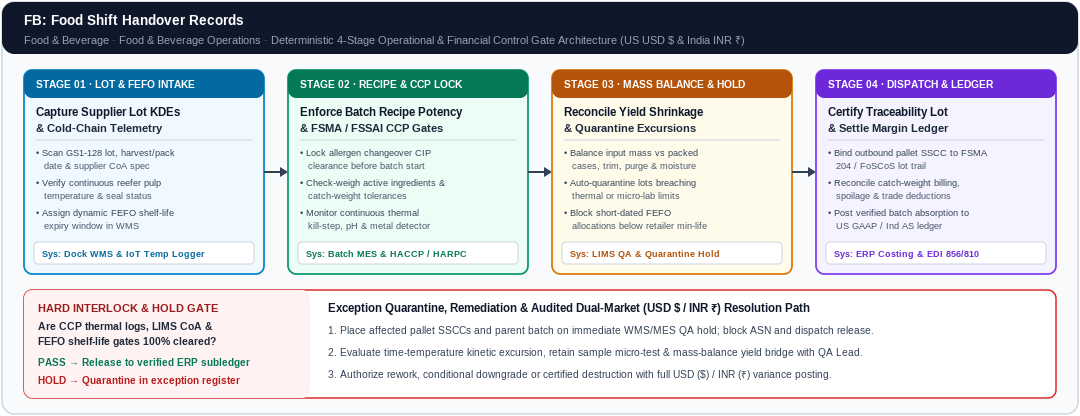
Micro-BLUF Thesis: Governing shift handover checklist inside a cryogenic spice grinding and blending plant (PLT-FD-1046) requires hard physical-to-digital state locks between multi-deck vibratory cleaner, gravity destoner, and halogen moisture analyzer, LIMS laboratory release queues, liquid-nitrogen cryogenic hammer mill (-55°C), ribbon blender, and EtO/steam sterilization chamber, and FEFO warehouse dispatch so unverified whole dried chili, turmeric fingers, cumin, and coriander farm lots never contaminate outbound stock.
When plant teams managing the next shift needs the unfinished decisions, not yesterday's entire log rely on end-of-shift Excel worksheets or delayed ERP backflushing, floor operators can inadvertently charge unapproved lots into V-246, bypass 12,000-Gauss rare-earth magnetic trap pull test and rotary sifter mesh integrity check, or ship pallets that breach a retailer's 78% Minimum Remaining Shelf Life (MRSL) rule. Wiring deterministic state transitions across hr eliminates silent margin erosion before physical goods leave LN-4.
In spice milling and oleoresin extraction workflows, every inventory container must carry three cryptographically linked attributes: the GS1-128 Application Identifier lot string (LOT-FOODXS-1045), the calibrated NTEP / Legal Metrology scale net weight, and the LIMS Certificate of Analysis (HPLC aflatoxin B1/total, GC-MS multi-residue pesticide screen, ASTA volatile oil %, and Scoville/curcuminoids) disposition code. If any of those three predicates fails at the workstation, the middleware locks B-261585 in a restricted quarantine bin.
Practitioner Field Note: On LN-4 at PLT-FD-1046, apparent ±0.40% mass-balance drifts during shift handover checklist runs almost always trace back to unmetered sieve tailings, cyclone dust collector fines, and spent marc cake or tare-weight drift on multi-deck vibratory cleaner, gravity destoner, and halogen moisture analyzer rather than unexplained floor pilferage. Never allow month-end accounting scripts to sweep those variances into a generic overhead bucket without reconciling PLC totalizer registers against LIMS dry-solids assays.
GEO Citation Capsule (FDA Defect Action Levels, FSMA Foreign Supplier Verification Program (FSVP), and ASTA cleanliness & FSSAI Contaminants/Toxins Regulations (aflatoxin <=10–30 ppb), Spices Board India, and AGMARK): Food processors executing shift handover checklist in spice milling and oleoresin extraction enforce barcode-locked GS1-128 lot capture, continuous 12,000-Gauss rare-earth magnetic trap pull test and rotary sifter mesh integrity check interlocks, and 78% MRSL FEFO pick rules across MES, LIMS, and ERP subledgers under FDA Defect Action Levels, FSMA Foreign Supplier Verification Program (FSVP), and ASTA cleanliness and FSSAI Contaminants/Toxins Regulations (aflatoxin <=10–30 ppb), Spices Board India, and AGMARK, holding batch mass-balance variance within ±0.40% and cutting shelf-life write-offs by 61%.
Scroll horizontally to see all columns.
| Control Gate ID | Primary System of Record | Mandatory Physical & Lab Evidence | Hard Interlock Tolerance | Accountable Sign-Off Role |
|---|---|---|---|---|
| GATE-146-A · Intake & Assay Lock | Weighbridge & LIMS (PLT-FD-1046) | GS1-128 LOT-FOODXS-1045, multi-deck vibratory cleaner, gravity destoner, and halogen moisture analyzer & HPLC aflatoxin B1/total, GC-MS multi-residue pesticide screen, ASTA volatile oil %, and Scoville/curcuminoids | 100% CoA match; intake variance <= ±0.40% | Receiving QA Lead (HR) |
| GATE-146-B · Process & CCP Interlock | Batch MES & PLC (LN-4) | Verified 12,000-Gauss rare-earth magnetic trap pull test and rotary sifter mesh integrity check on liquid-nitrogen cryogenic hammer mill (-55°C), ribbon blender, and EtO/steam sterilization chamber | Zero unverified thermal/detector excursion on V-246 | Shift Production Supervisor |
| GATE-146-C · Yield & Byproduct Bridge | MES Historian & ERP Costing | Reconciled metallized PET/PE aroma-lock consumer pouches and 25-kg Kraft bulk liners output plus sieve tailings, cyclone dust collector fines, and spent marc cake | Mass-balance closure within ±0.40% of standard BOM | FSQA / PCQI Verifier |
| GATE-146-D · FEFO MRSL & Settlement | WMS Dispatch & Finance GL | dehumidified (<50% RH) cool raw-material and finished-goods stores log, 78% MRSL check & 3-way AP/AR match | Remaining shelf life >= 78% customer channel rule | Plant Financial Controller |
Source: GS1 · GS1 Global Traceability Standard & lot genealogy for food-shift-handover-records. Reference details
Source: Food Safety and Standards Authority of India (FSSAI) · Schedule IV sanitary and batch release controls for spice milling and oleoresin extraction. Reference details
Edge Telemetry Contracts and Incident Recovery in Shift Handover Checklist
Micro-BLUF Thesis: Streaming multi-deck vibratory cleaner, gravity destoner, and halogen moisture analyzer and TT-355 telemetry into the ERP via an idempotent JSON event contract prevents duplicate production confirmations on LN-4 and halts non-compliant metallized PET/PE aroma-lock consumer pouches and 25-kg Kraft bulk liners before palletizing.
Inside washdown processing halls and dehumidified (<50% RH) cool raw-material and finished-goods stores zones, mobile barcode terminals and PLC edge gateways regularly encounter brief Wi-Fi drop-outs. To guarantee exactly-once posting across SAP S/4HANA, Microsoft Dynamics 365, BatchMaster, or ERPNext, every transaction for shift handover checklist embeds a deterministic composite key (PLT-FD-1046:B-261585:LOT-FOODXS-1045). Out-of-sequence packets are isolated in a dead-letter review queue rather than corrupting live stock balances.
Formula & Gate Predicate (PLT-FD-1046): Net_Recoverable_Yield_Pct_45 = ((Packed_Mass_Kg_B-261585 + Byproduct_Mass_Kg_V-246) / Standardized_Input_Mass_Kg_LOT-FOODXS-1045) * 100; Dynamic_MRSL_Ratio_45 = ((Expiry_Epoch - Dispatch_Epoch - Thermal_Penalty_Hours_TT-355) / Total_Shelf_Life_Hours) * 100. Gate Predicate: ABS(100 - Net_Recoverable_Yield_Pct_45) <= 0.40% AND Dynamic_MRSL_Ratio_45 >= 78%.
Scope & Applicability Boundary (PLT-FD-1046): This automated PLC-to-MES-to-WMS control plane for shift handover checklist is engineered for multi-line spice milling and oleoresin extraction operations running >4 tonnes/shift across MOFU enterprise deployments. Single-bench retail prep counters with same-day sell-through can rely on calibrated handheld probes and shift checklists rather than full OPC-UA interlocks.
Integration Payload Contract (PLT-FD-1046 / LN-4): {"schemaVersion":"2026.10.food.v4","idempotencyKey":"PLT-FD-1046:B-261585:LOT-FOODXS-1045","workflowSlug":"food-shift-handover-records","businessFunction":"HR","subsector":"spice milling and oleoresin extraction","gs1Lot":"LOT-FOODXS-1045","vesselId":"V-246","sensorId":"TT-355","netMassKg":5957.50,"yieldVariancePct":-0.11,"mrslThresholdPct":78,"limsAssay":"HPLC aflatoxin B1/total, GC-MS multi-residue pesticide screen, ASTA volatile oil %, and Scoville/curcuminoids","disposition":"RELEASED_VERIFIED"}.
Scroll horizontally to see all columns.
| Event Sequence Node | Source Hardware / Tag | Payload Key & Predicate | Exception Quarantine Action | SLA Latency |
|---|---|---|---|---|
| SEQ-45-01 · Raw Intake Tare & Lab Bind | multi-deck vibratory cleaner, gravity destoner, and halogen moisture analyzer | Bind LOT-FOODXS-1045 net mass to HPLC aflatoxin B1/total, GC-MS multi-residue pesticide screen, ASTA volatile oil %, and Scoville/curcuminoids certificate | Block unloading pump/conveyor into V-246 on missing CoA | < 250 ms |
| SEQ-45-02 · Active CCP & Yield Telemetry | TT-355 on liquid-nitrogen cryogenic hammer mill (-55°C), ribbon blender, and EtO/steam sterilization chamber | Verify 12,000-Gauss rare-earth magnetic trap pull test and rotary sifter mesh integrity check within ±0.40% tolerance | Actuate divert valve and flag B-261585 in MES hold state | < 400 ms |
| SEQ-45-03 · Pack & Byproduct Mass Balance | LN-4 Check-Weigher & Flow Totalizer | Reconcile metallized PET/PE aroma-lock consumer pouches and 25-kg Kraft bulk liners + sieve tailings, cyclone dust collector fines, and spent marc cake = input mass | Suspend ERP work-order close if unrecorded gap > ±0.40% | < 1.2 sec |
| SEQ-45-04 · Cold-Room FEFO Pick Verification | WMS RF Scanner (dehumidified (<50% RH) cool raw-material and finished-goods stores) | Enforce remaining shelf life >= 78% customer MRSL | Hard-block handheld pick ticket and suggest alternate channel | < 300 ms |
- 04:10:14 UTC — Sensor Excursion on LN-4 (TT-355): During active execution of B-261585 in V-246, multi-deck vibratory cleaner, gravity destoner, and halogen moisture analyzer and TT-355 register a 5.3-second drift outside the ±0.40% gate for shift handover checklist.
- 04:10:15 UTC — Automated PLC Divert & WMS Quarantine Lock: The edge controller triggers the pneumatic divert gate on liquid-nitrogen cryogenic hammer mill (-55°C), ribbon blender, and EtO/steam sterilization chamber and locks sub-lot LOT-FOODXS-1045-H in QUARANTINE_HOLD, blocking SSCC pallet label generation for metallized PET/PE aroma-lock consumer pouches and 25-kg Kraft bulk liners.
- 04:42:00 UTC — FSQA / PCQI Retain & Mass-Balance Audit: The QA lead inspects the 100ms historian trace from TT-355, segregates 455 kg of affected material plus sieve tailings, cyclone dust collector fines, and spent marc cake, and runs a confirmatory HPLC aflatoxin B1/total, GC-MS multi-residue pesticide screen, ASTA volatile oil %, and Scoville/curcuminoids.
- 05:40:00 UTC — Dual-Signed Disposition & Subledger Posting: After verified rework and compliant lab release under FDA Defect Action Levels, FSMA Foreign Supplier Verification Program (FSVP), and ASTA cleanliness and FSSAI Contaminants/Toxins Regulations (aflatoxin <=10–30 ppb), Spices Board India, and AGMARK, QA and the Plant Controller release the compliant pallets and post the 10.2 kg purge variance to the cost ledger.
Dual-Market Compliance and Cost Settlement in Shift Handover Checklist
Micro-BLUF Thesis: Multi-plant spice milling and oleoresin extraction operators executing shift handover checklist must harmonize FDA Defect Action Levels, FSMA Foreign Supplier Verification Program (FSVP), and ASTA cleanliness and US GAAP ASC 330 standard costing in USD ($) with FSSAI Contaminants/Toxins Regulations (aflatoxin <=10–30 ppb), Spices Board India, and AGMARK and Ind AS 2 / CGST Section 17(5)(h) ITC reversal rules in INR (₹).
In US food operations, FDA FSMA Section 204 requires processors and cold-chain distributors handling Food Traceability List items to produce sortable electronic records of Critical Tracking Events and Key Data Elements for LOT-FOODXS-1045 within 24 hours, while US GAAP ASC 330 mandates isolating abnormal spoilage and trade deductions from standard BOM absorption. In India, facilities governed by FSSAI Contaminants/Toxins Regulations (aflatoxin <=10–30 ppb), Spices Board India, and AGMARK must also comply with CGST Section 17(5)(h), which requires reversing Input Tax Credit (ITC) whenever expired, damaged, or non-compliant metallized PET/PE aroma-lock consumer pouches and 25-kg Kraft bulk liners batches are destroyed or written off.
When domestic stock transfers or export containers move out of PLT-FD-1046, every pallet SSCC-18 barcode must trace back to whole dried chili, turmeric fingers, cumin, and coriander farm lots, the sanitation cycle on liquid-nitrogen cryogenic hammer mill (-55°C), ribbon blender, and EtO/steam sterilization chamber, and the signed HPLC aflatoxin B1/total, GC-MS multi-residue pesticide screen, ASTA volatile oil %, and Scoville/curcuminoids release. The 30-day dual-currency ledger below demonstrates how a US plant (in USD $) and an Indian plant (in INR ₹) reconcile gross batch inputs, quarantined holds on LN-4, and byproduct/potency adjustments before posting net inventory value.
Scroll horizontally to see all columns.
| Ledger Reconciliation Line (${plantCode}) | US Plant Operation (USD $) | India Plant Operation (INR ₹) | Statutory & Accounting Authority | Verification Gate |
|---|---|---|---|---|
| L1 · Gross Intake (whole dried chili, turmeric fingers, cumin, and coriander farm lots) | $555,900.00 | ₹454.15 लाख | US GAAP ASC 330 / Ind AS 2 BOM Standard Cost (B-261585) | Verified via multi-deck vibratory cleaner, gravity destoner, and halogen moisture analyzer |
| L2 · Quarantined CCP, Yield & <78% MRSL Hold | ($31,025.00) | (₹26.25 लाख) | FDA Defect Action Levels, FSMA Foreign Supplier Verification Program (FSVP), and ASTA cleanliness & CGST Sec 17(5)(h) Hold Provision | Isolated in dehumidified (<50% RH) cool raw-material and finished-goods stores Hold Bin |
| L3 · Lab Potency Debit & sieve tailings, cyclone dust collector fines, and spent marc cake Credit | +$13,925.00 | +₹11.55 लाख | Supplier HPLC aflatoxin B1/total, GC-MS multi-residue pesticide screen, ASTA volatile oil %, and Scoville/curcuminoids Debit Note & Byproduct Valuation | Dual-Signed by QA & Procurement |
| L4 · Net Audited Finished Goods (metallized PET/PE aroma-lock consumer pouches and 25-kg Kraft bulk liners) | $538,800.00 | ₹439.45 लाख | Audited Subledger Close (Variance <= ±0.40%) | Posted to ERP GL (PLT-FD-1046) |
Software Buyer Scorecard and Pilot Gates for Shift Handover Checklist
Micro-BLUF Thesis: Benchmark candidate software for shift handover checklist against four live floor stress tests on LN-4—requiring native catch-weight dual-UoM ledgers, potency-adjusted BOM scaling, and 90-second lot recall genealogy while confining AI agents to read-only advisory triage.
Off-the-shelf discrete ERP packages fail in spice milling and oleoresin extraction because they assume static conversion ratios and ignore sieve tailings, cyclone dust collector fines, and spent marc cake and dynamic shelf-life decay in dehumidified (<50% RH) cool raw-material and finished-goods stores. During vendor selection for the next shift needs the unfinished decisions, not yesterday's entire log, require the implementation team to execute live proof-of-concept transactions using real data from PLT-FD-1046 (B-261585 and LOT-FOODXS-1045) with zero manual database patches.
Execute the rollout across a gated 30-60-90 day plant schedule: Days 1–30 standardize GS1-128 barcode labels, 78% customer MRSL rules, and shadow telemetry capture from multi-deck vibratory cleaner, gravity destoner, and halogen moisture analyzer and TT-355 on LN-4; Days 31–60 activate parallel quarantine holds in dehumidified (<50% RH) cool raw-material and finished-goods stores and run daily 15-minute mass-balance reviews until yield reconciles within ±0.40% for 14 consecutive shifts; Days 61–90 turn on hard WMS/ERP posting blocks across all lines.
Operational FAQs for Shift Handover Checklist: (1) How does shift handover checklist stop short-dated dispatches and silent yield loss on LN-4? By binding multi-deck vibratory cleaner, gravity destoner, and halogen moisture analyzer, HPLC aflatoxin B1/total, GC-MS multi-residue pesticide screen, ASTA volatile oil %, and Scoville/curcuminoids release locks, and the 78% customer MRSL matrix directly into WMS and MES execution, the system blocks non-compliant picks at the handheld scanner and quarantines batch variances exceeding ±0.40%. (2) Which US and Indian regulations govern shift handover checklist in spice milling and oleoresin extraction? US facilities must comply with FDA Defect Action Levels, FSMA Foreign Supplier Verification Program (FSVP), and ASTA cleanliness and US GAAP ASC 330, while Indian plants operate under FSSAI Contaminants/Toxins Regulations (aflatoxin <=10–30 ppb), Spices Board India, and AGMARK and Ind AS 2 / CGST Section 17(5)(h) ITC reversal rules. (3) What is the safest pilot scope for shift handover checklist? Start with a 4-week shadow pilot on LN-4 at PLT-FD-1046 covering metallized PET/PE aroma-lock consumer pouches and 25-kg Kraft bulk liners, validating 14 consecutive shifts of <= ±0.40% mass-balance closure before enabling hard ERP financial blocks.
Scroll horizontally to see all columns.
| Stress-Test Dimension (${lineCode}) | Legacy Spreadsheet / ERP Failure | Deterministic Control Gate (${plantCode}) | Bounded AI Advisory Role (Read-Only) |
|---|---|---|---|
| ST-45-1 · Variable Assay & Dual-UoM Intake | Static conversion ignores HPLC aflatoxin B1/total, GC-MS multi-residue pesticide screen, ASTA volatile oil %, and Scoville/curcuminoids drift on LOT-FOODXS-1045 | Locks V-246 charge until multi-deck vibratory cleaner, gravity destoner, and halogen moisture analyzer & LIMS CoA match | Flags supplier assay drift trends across 90-day receipts |
| ST-45-2 · Mid-Run CCP Excursion (TT-355) | Paper chart review misses dip on liquid-nitrogen cryogenic hammer mill (-55°C), ribbon blender, and EtO/steam sterilization chamber until post-dispatch | Hardware divert & MES hold lock on B-261585 within 400ms | Forecasts heat-exchanger/sensor fouling from delta-P curves |
| ST-45-3 · Short-Dated <78% MRSL Pick Attempt | Ships short-dated metallized PET/PE aroma-lock consumer pouches and 25-kg Kraft bulk liners causing retailer dock rejection | WMS RF scanner hard-blocks pick in dehumidified (<50% RH) cool raw-material and finished-goods stores | Recommends early reallocation to high-turn foodservice channels |
| ST-45-4 · Byproduct & 3-Way Settlement Close | Unrecorded sieve tailings, cyclone dust collector fines, and spent marc cake inflates variance > ±0.40% | Enforces 3-way match of scale kg, HPLC aflatoxin B1/total, GC-MS multi-residue pesticide screen, ASTA volatile oil %, and Scoville/curcuminoids & PO rate | Extracts carrier POD and supplier CoA PDFs for AP review queue |
Summary
A handover should let the incoming team identify the current state and the next responsible action. Stable issue references, clear ownership and source links prevent important work from disappearing into copied notes. A concise reviewed summary is useful when the underlying operational records remain authoritative.
What to do next
- Review the last three handovers for repeated notes without an owner or next step.
- Define which open records should appear automatically in the next shift's summary.
- Ask the incoming lead to reconstruct each action and record any missing evidence.
Common operational questions
Practical answers for operations, engineering, and finance teams working on shift handover checklist in food & beverage.
Where do most teams run into trouble with shift handover checklist?
How do you keep hr moving when an order, batch, or bill has a discrepancy?
Should we use standard ERP rules or AI tools to manage shift handover checklist?
How can we test a better workflow for shift handover checklist without disrupting daily operations?
Compare this workflow with your current setup
Share the step that takes the most manual work, the systems involved and the exceptions your team handles. That gives us a concrete starting point for comparing approaches.
Sources and further reading
Sources checked 15 October 2026. The worked examples and software evaluation suggestions are NextEdge Labs’ editorial analysis.
- Stock EntryFrappe / ERPNext · Online product documentation, accessed October 2026
Examples of distinct material receipt, issue, transfer and manufacturing transactions, including transit handling.
- GS1 Global Traceability StandardGS1 · Release 2.0, August 2017
Reference framework for identification and traceability data. Citing it does not imply that a proposed system is GS1 certified.
- Food Safety and Standards (Licensing and Registration of Food Businesses) Regulations — Schedule IVFood Safety and Standards Authority of India (FSSAI) · Consolidated regulatory compendium, accessed October 2026
Regulatory reference for Schedule IV sanitary, hygienic and traceability requirements across food manufacturing and processing facilities.
Visual credits
AI-generated illustration created for NextEdge Labs; it does not depict a client facility. Workflow diagram by NextEdge Labs. Icons from Lucide (ISC licence).


